Why Insect Farming Startups Failed, and What the Survivors Did Differently

In December 2025, a French commercial court placed Ÿnsect into judicial liquidation. The company had raised more than USD 600 million — by most counts over a quarter of every dollar ever publicly disclosed in insect agriculture. Robert Downey Jr.'s FootPrint Coalition had backed it. So had the French state. Four years earlier, Downey had promoted it on late-night television during Super Bowl weekend.
Six months later, in June 2026, Australia's Goterra entered voluntary administration after eleven years of building.
Between those two events, the Danish producer ENORM received a bankruptcy decree and Canada's Aspire Food Group went into receivership. Add Beta Hatch, which closed in late 2023 and auctioned its equipment, and AgriProtein, whose parent group entered administration back in February 2021, and you have six significant failures — four of them inside fourteen months.
The obvious conclusion is that insect farming does not work.
That conclusion is wrong, and the reason it is wrong matters commercially. Because at the same time these companies were collapsing, other insect producers were opening facilities, signing offtake agreements, raising capital and — in a few cases — reporting operating profitability. In August 2026, a Spanish startup raised money to build a plant on olive-industry byproducts. In June 2026, InnovaFeed closed a EUR 51 million round.
Something more specific than "insects" failed. This article is about what.
The full competitive assessment — global sizing, regional structure, pricing by product form and the company field — is in our black soldier fly study. Black Soldier Fly Market (2026–2036)
First, the scale of it
A few figures worth holding onto, because the sector's collapse is often described in language far larger than the money involved.
Roughly USD 2 billion has gone into insect agriculture over the past decade. AgFunder put the figure at USD 1.65 billion as of 2024, against USD 205 billion into agrifoodtech overall across the same period. Insect farming is, in venture terms, a rounding error.
Of the twenty or so largest insect farming startups, close to a quarter have now failed, and the companies that shut down account for almost half of all the money ever invested in the sector. That second figure sounds catastrophic until you remember that Ÿnsect alone attracted over a quarter of publicly disclosed funding. One failure skews the whole statistic.
Funding has contracted sharply but not vanished. AgFunder recorded roughly USD 152 million across insect ag in 2024 and USD 88 million in 2025 — down, but still a dozen or more disclosed rounds, and 2026 has continued to produce deals.
Goterra founder Olympia Yarger has made a pointed argument about how this gets narrated. She notes that criticising first-wave companies for the sums they raised does not legitimise the second wave; investors simply conclude that if USD 600 million could not do it, a much smaller raise certainly cannot. She calls the effect contagion, and argues the industry has damaged itself by participating in it. Whether or not you accept the framing, it is worth noticing that the sector's public story is now being written largely by people describing its worst outcomes.
Fig: The Insect Farming Shakeout
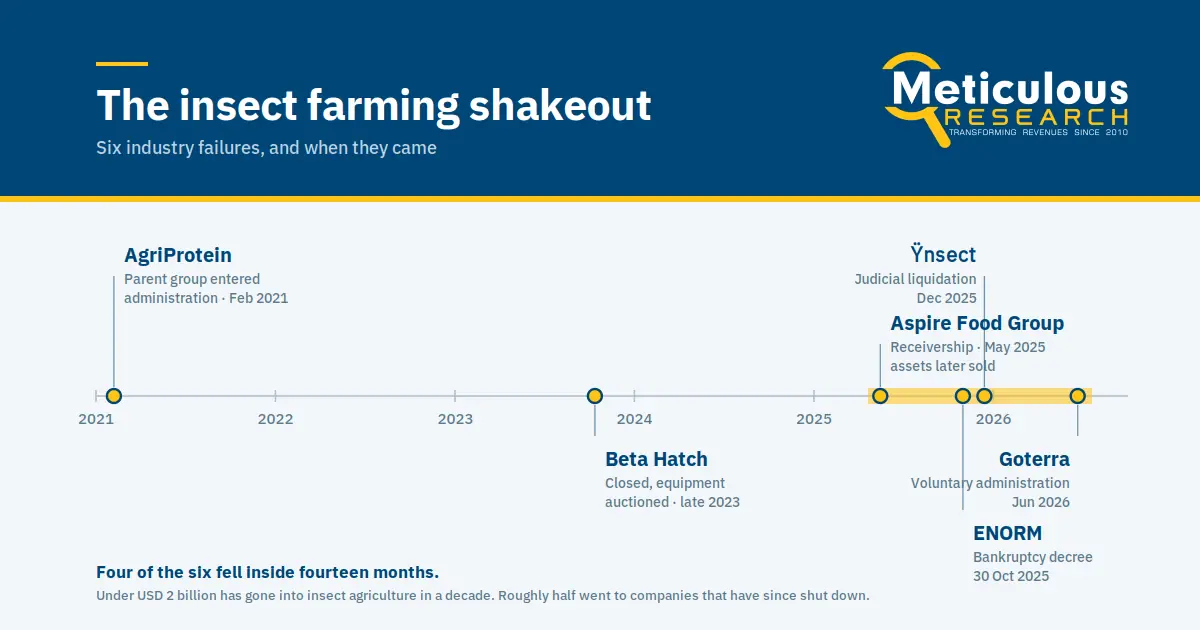
Source: Meticulous Research Analysis
Who failed, and when
|
Company |
Base |
Outcome |
When |
|
AgriProtein |
UK / South Africa |
Parent group Insect Technology Group entered administration |
February 2021 |
|
Beta Hatch |
Washington, USA |
Ceased operations, equipment and IP auctioned |
Late 2023 |
|
Inseco |
South Africa |
Ceased operations |
2025 |
|
Aspire Food Group |
Ontario, Canada |
Receivership; assets later sold to Halali Group Holdings |
May 2025 |
|
ENORM |
Jutland, Denmark |
Bankruptcy decree after failed reconstruction |
30 October 2025 |
|
Ÿnsect |
Amiens, France |
Judicial liquidation |
December 2025 |
|
Goterra |
Australia |
Voluntary administration; administrator seeking a buyer |
June 2026 |
And two major projects that stalled rather than failed, which is a different thing and should not be conflated:
- Tyson Foods and Protix's Nebraska facility — designed, engineered, and then placed on hold indefinitely. It would have raised roughly 70,000 tons of larvae a year on cattle paunch from Tyson's adjacent Dakota City operation.
- InnovaFeed's Decatur, Illinois pilot — suspended in autumn 2025 after expected grant funding fell through, about eighteen months after opening. The company maintains the larger project remains live, and secured an USD 11.8 million USDA fertiliser grant for the site in April 2026.
Why they failed
Five causes, and they compound. Almost every failure above involves at least three of them.
1. The price assumption was simply wrong
This is the big one, and everything else is downstream of it.
The founding thesis was that buyers would pay a premium for a sustainable protein. They did not. Animal feed is a commodity market, and commodity markets price on price.
FlyBox founder Larry Kotch has put numbers on the gap that are worth quoting precisely: commodity protein buyers want black soldier fly meal at under GBP 1.50 (about USD 2) per kilo, while most Western producers need GBP 3 (about USD 4) or more just to break even. That is not a gap you close with efficiency gains. It is a factor of two.
Set against conventional benchmarks the picture is worse still. Insect meal has run at roughly ten times the price of soybean meal and around three and a half times the price of fishmeal. Kotch's diagnosis of Ÿnsect, ENORM and Aspire is that they failed for different proximate reasons but shared one assumption — that the market would pay premium prices for insect protein meal — and that it did not.
Ÿnsect's own trajectory illustrates it. The company pivoted toward higher-value pet food in 2023, cutting staff as part of the shift. The strategy was right. The timing was not: by then it had already committed to a capital-intensive facility sized for a feed-commodity thesis. Its revenue from its main entity peaked around EUR 17.8 million in 2021, against a net loss of EUR 79.7 million by 2023.
2. Capital expenditure ran ahead of de-risked biology
Insect rearing is a biological process pretending to be a manufacturing process, and the pretence breaks at scale.
Protix cofounder Kees Aarts has been blunt that startups were pushed to move too quickly, and that you cannot bring a Silicon Valley playbook to a legacy industry and expect to outcompete it in three years. His framing — this is not a software business; it is about assets that must perform consistently for ten to twenty years — is the correct one, and it was not the prevailing one in 2019.
Better Origin's Miha Pipan describes the specific failure mode: companies made decisions about large facilities based on assumptions that held at small scale. At container scale, replacing a pump is trivial. At plant scale it can cost hundreds of thousands or millions.
Beta Hatch founder Virginia Emery has given the most granular account of why scale-up surprises you. The water content of a feedstock differs depending on whether it arrives by truckload or trainload. Mealworms generate metabolic heat as they digest, and if the climate system does not dissipate it, a feedback loop slows the whole colony. Her Cashmere, Washington site was deliberately sited in a dry climate so it could use evaporative cooling — an efficient choice that, as she has acknowledged, produced an air-handling design that would not transfer to a humid location.
That last point deserves emphasis, because it undermines the entire replication thesis on which several business plans rested. A working insect facility is not a template. It is a local solution.
3. Investors diligenced the wrong things
Emery's second observation is the sharpest thing anyone has said about how this capital was allocated: due diligence focused heavily on the commercial side rather than the operational side. Investors demanded offtake agreements before funding large facilities, but were less rigorous about assessing whether a company could actually run the plant.
She adds a detail that reframes Beta Hatch's failure entirely. The business was being underwritten at around USD 2,000 a ton, even though it held contracts at price points five to ten times higher. In other words, investors were valuing a mealworm business as a commodity fishmeal substitute while the company was actually selling into higher-value markets. Underwritten as a commodity, financed as a commodity, and starved accordingly.
4. Geography and feedstock rules were treated as details
They were not details. They were the business model.
The unit economics of insect farming hinge on getting substrate for nothing, or better, being paid to take it. EU rules block insect farms from using post-consumer food waste and most animal by-products. The consequence is that many European producers buy their feedstock — which inverts the core economic logic of bioconversion.
Layer on cost structure. Black soldier flies want to be kept around 28°C. That is free in Malaysia and expensive in the Netherlands, before you count labour, land, energy and construction. Protix has now concluded as much, repositioning its Dutch facility as a technology and development hub while pivoting production toward Southeast Asia and shelving a planned Polish plant.
Loopworm cofounder Ankit Alok Bagaria states the position most directly: in his view insect protein is fundamentally a tropical developing-country play rather than a temperate developed-country one, because the economics turn on climate, labour, land, utilities and feed. Western startups, he argues, were pushed into high automation, expensive climate control and high capex to compensate for geography.
The market data supports the geographic reading. Europe currently holds the largest share of the global black soldier fly market, built on the earliest regulatory authorisations and an established producer base, while Asia-Pacific is the fastest-growing region on the strength of vast aquaculture demand, lower production costs and acute waste-management need. The producers relocating east are following where the market is going, not retreating from it.
There is a counter-argument worth taking seriously. Agronutris general manager Cédric Auriol points out that Europe's restrictive rules also function as market protection: imports must meet the same standards, which limits cheap competition from less regulated jurisdictions. Both things can be true. Europe is a harder place to produce and a more defensible place to sell.
5. The capital structure never matched the asset
Insect farming is infrastructure. It was financed like software.
Goterra's Yarger makes this point with unusual precision. Her company spent AUS 25 million (about USD 17.5 million) building its technology, IP, regulatory approvals, manufacturing process and seven years of operating data — roughly what it costs to build a fairly standard composting facility. It then needed about the same again to scale, and could not raise it. Venture capital, she notes, has been designed since the late 1990s for explosive returns on minimal capital expenditure.
Goterra also found itself caught in a diligence trap that will be familiar to anyone building physical infrastructure on a venture cap table: some investors judged it too mature not to have Series B revenue, while others questioned whether it had ever raised enough to build an infrastructure business.
Aspire had understood the financing problem and tried to solve it. In 2024, before the receivership, cofounder Mohammed Ashour described a capital stack for the Ontario cricket plant of roughly 25% government grants, 30% debt and the balance equity, and argued that facilities of this kind need financing routes outside venture capital and private equity because the cost of capital has become too high. He was right about the diagnosis. It did not save the company.
The complication nobody should skip
Here is where most analyses of this sector become too neat.
The tidy conclusion is: protein-first models failed, waste-first models work. And there is real evidence for it. Kotch argues the economics only make sense when aligned with waste, and that FlyBox's entire current pipeline consists of waste management companies rather than feed businesses.
But Goterra was the waste-first model. It viewed black soldier flies primarily as a tool for organic waste management, not an alternative protein play. It was being paid around AUS 250 a ton to take food organics — enough, in Yarger's words, to cover the waste management side on its own. It ran a distributed, asset-light network, bought larvae from another supplier, used a third-party rendering facility, and worked with composters on frass. It had Woolworths as a client and AUS 8 million in contracted revenue for FY26/27.
It still ran out of money.
So the honest version is narrower: being paid for your feedstock is necessary but not sufficient. Goterra did not fail on unit economics. It failed on access to capital — a distinct failure mode, and one that says as much about how infrastructure gets financed as about insects.
Any operator reading a list of survival rules should hold that case in mind. Getting the model right does not protect you if the capital markets have stopped listening to your category.
What the survivors did differently
With that caveat in place, six patterns recur among the companies still standing.
Feedstock that costs less than nothing
Entosystem's president Cédric Provost frames this as the industry's central lesson: viable production must be built on residual streams that currently have little or no value, or that cost someone money to dispose of. The Quebec company runs on pre-consumer food waste destined for landfill, and reads the sector's troubles as problems of execution complexity, capital intensity and poorly chosen feedstock rather than weak fundamentals.
The newest entrants have internalised it from day one. InsectBiotech raised EUR 7.2 million in 2026 to build a plant in Andalusia converting olive oil industry byproducts and other agricultural side streams, targeting operation in Q3 2027. Cofounder Ben Brown's description of the winning model is as good a summary as the industry has produced: true agricultural waste as feedstock, low-operating-cost production close to the raw material, modular build-out, and hybrid technology balancing automation with skilled people — delivering products that compete on cost rather than on sustainability alone.
Geography chosen for the biology
Entobel has produced at commercial scale in Vietnam since 2019. After a difficult commissioning period at a new southern Vietnam factory in early 2024 — its founders have been unusually candid that they underestimated the difficulty of producing insects at scale — it now routinely produces 300 to 400 tons of insect meal a month alongside oil and frass, and reported hitting a production cost milestone in December 2025 that it says makes broader feed applications viable. The advantage it names is structural: rearing a tropical insect in the tropics, with technology designed around the local climate rather than fighting it, keeping both capex and energy use low.
Protenga, operating in Malaysia and Singapore, reports having reached operating profitability with cost-competitive production and stable offtake in aquaculture and fertiliser. Full Circle Biotechnology is building a 7,000-ton facility in Kanchanaburi, Thailand, with more than 80% of customers being shrimp farms. Loopworm is processing silkworm pupae — a byproduct of India's silk industry — into meal and oil at a Bangalore facility, and says that side of the business is already profitable.
Phased and modular capital deployment
The mega-facility built in one shot is the single most reliable predictor of failure on this list.
InnovaFeed's French site was built in phases from a 2017 pilot. Chapul Farms abandoned a large plant planned beside a North Dakota ethanol facility when it could not secure a lead equity partner, and redirected to a smaller commercial site in McMinnville, Oregon, built in stages so each can be financed and de-risked separately. Tebrio has publicly emphasised modular, phased development that reduces upfront investment and keeps expansion aligned with profitability.
FreezeM cofounder Yuval Gilad predicts the industry moves away from the capital-intensive vertically integrated mega-factory toward smaller, more modular, more commercially grounded facilities — enabled by a maturing ecosystem of equipment and technology suppliers that did not exist for the first generation.
Selling into value rather than volume
Entosystem's primary market is premium backyard chicken treats, where it has built a white-label offering gaining traction with large retail chains — not commodity aquafeed. Pet food and North American aquaculture are growing on top of that.
Oberland Agriscience founder Greg Wanger articulates the pivot in reasoning that the sector needed years ago. Competing with soy on price is very hard. But black soldier fly larvae confer anti-inflammatory and anti-microbial benefits and improved growth performance, and once you ask an aquaculture operator what reduced mortality or avoided antibiotics is worth, the conversation stops being about price per ton. The data to support that case is only now arriving. Oberland has started shipping commercial volumes of protein and frass from Halifax and appointed a food industry veteran as CEO.
Agronutris makes the same argument for Europe specifically: moving up the value chain, from commodity protein substitution toward functional benefits, is critical to sustainable profitability in a high-cost region.
Extracting more from the same larva
The first generation sold protein and treated everything else as residue. The survivors are monetising the whole animal.
Oil is now the fastest-growing product category in black soldier fly, ahead of protein meal, on demand for sustainable lipid alternatives. Frass carries a real fertiliser market. And chitin and chitosan — extracted from the exoskeleton — command substantially higher prices than any of the feed products, with applications in agriculture, water treatment, biomedicine, cosmetics and packaging. Singapore's Insectta built its business on melanin and chitosan rather than feed.
The strategic point is arithmetic. A producer selling one product from a larva needs that product to carry the entire cost of rearing it. A producer selling four spreads the same cost base across four markets with four different price ceilings, only one of which is a commodity. Several of the companies on the failure list were, structurally, single-product businesses.
Unbundling the value chain
First-generation companies did everything themselves — breeding, rearing, processing, sales — because there was no supply chain to buy from. There is now.
FreezeM sells black soldier fly neonates as a service, decoupling breeding from production, and reports around 40 customers at various stages. Its argument is that breeding and rearing require genuinely different skillsets, and that every other mature agricultural sector is segmented for exactly that reason. Entocycle supplies breeding technology and computer-vision counting equipment, and partnered with Bühler to handle installation and commissioning. Nasekomo has pursued a franchise model with Siemens. In the United States, EVO Conversion Systems — the Texas A&M spin-out — supplies eggs, neonates, equipment and process know-how to other producers.
A new entrant in 2026 can buy the parts of the problem that killed the pioneers.
A balance sheet that can wait
EnviroFlight is the clearest case. It operates the first purpose-built U.S. black soldier fly facility in Maysville, Kentucky, at up to 3,200 tons of dried larvae a year, inside Darling Ingredients — a company with USD 6.1 billion in fiscal 2025 revenue that has spent 140 years turning byproducts into ingredients. Insect protein is not a moonshot there. It is an adjacent product line with an existing route to feed and pet food buyers.
InnovaFeed's June 2026 raise of EUR 51 million, backed by existing shareholders including Creadev, QIA, Temasek, ABC Impact and ADM, takes its cumulative funding including grants past USD 500 million. It came alongside a consolidation of activities at the Nesle plant and a reduction of about 60 roles, mostly at its R&D and pilot site. That is what an industrialisation phase looks like: less research, more operations, patient strategic money rather than growth capital.
Where things actually stand
|
Company |
Base |
Current position |
|
EnviroFlight |
Kentucky, USA |
Operating; up to 3,200 t/yr dried larvae |
|
InnovaFeed |
France |
Raised EUR 51m in 2026; consolidating at Nesle; U.S. project active, pilot paused |
|
Protix (with Tyson) |
Netherlands |
Pivoting to Southeast Asia; Nebraska project on hold |
|
Entobel |
Vietnam |
300–400 t meal/month; targeting cost leadership |
|
Entosystem |
Canada |
Scaling Drummondville; evaluating a U.S. second site |
|
Oberland Agriscience |
Nova Scotia, |
Shipping commercial volumes of protein and frass |
|
Protenga |
Malaysia,Singapore |
Reports operating profitability; deploying partner farms |
|
Chapul Farms |
Oregon, USA |
Phased build in McMinnville after downsizing plans |
|
nextProtein |
France / Tunisia |
Raised EUR 18m in 2025; second site targeted Q4 2026 |
|
Volare |
Finland |
Building 5,000 t facility in Pori; offtake with Skretting |
|
InsectBiotech |
Spain |
Raised EUR 7.2m in 2026; plant targeted Q3 2027 |
|
FreezeM |
Israel |
Neonates-as-a-service; around 40 customers |
Frequently asked questions
Why did Ÿnsect fail? Ÿnsect raised more than USD 600 million but could not reach profitability. It built capital-intensive mealworm production for an animal feed market that prices on cost rather than sustainability, pivoted toward higher-value pet food only in 2023, and could not secure further financing. It entered safeguard proceedings in 2024, insolvency in early 2025, and judicial liquidation in December 2025. Its revenue peaked around EUR 17.8 million in 2021 against a EUR 79.7 million net loss by 2023.
How many insect farming companies have failed? Close to a quarter of the twenty or so largest insect farming startups have failed in recent years, and those companies account for almost half of all disclosed investment in the sector — a figure heavily skewed by Ÿnsect alone. Notable failures include AgriProtein (2021), Beta Hatch (2023), Inseco (2025), Aspire Food Group (2025), ENORM (2025), Ÿnsect (2025) and Goterra (2026).
Is insect protein economically viable? It is viable under specific conditions and not under others. The core constraint is that commodity buyers want black soldier fly meal at under about USD 2 per kilo while many Western producers need roughly USD 4 to break even. Producers reaching viability tend to combine feedstock that costs nothing or generates a gate fee, low-cost geographies, phased capital spending, and sales into higher-value applications rather than commodity feed.
What is the difference between the companies that failed and those that survived? Survivors generally secured feedstock at zero or negative cost, sited production where climate and operating costs favour the biology, built capacity in stages rather than in one large facility, sold into premium applications such as pet food and specialty treats, bought parts of the value chain rather than building everything, and had patient capital behind them. The exception worth noting is Goterra, which had most of these characteristics and still failed for lack of financing.
Did the Tyson and Protix insect farm get built? No. The companies completed design and technical work for a large facility near Tyson's Dakota City, Nebraska operation, but the project is on hold indefinitely. Protix has redirected its focus toward Southeast Asia.
Is investment in insect farming recovering? Disclosed funding fell from roughly USD 152 million in 2024 to about USD 88 million in 2025, and the character of investment has shifted toward smaller, more targeted rounds. Deals continued through 2026, including InnovaFeed's EUR 51 million round and InsectBiotech's EUR 7.2 million raise. The mega-round era appears to be over.
Does the shakeout mean black soldier fly is a bad business? Not necessarily, and species matters more than the headlines suggest. Ÿnsect farmed mealworms and Aspire farmed crickets — different organisms with different economics from black soldier fly. Protix leadership has argued that treating Ÿnsect's collapse as a systemic verdict on black soldier fly production is like concluding that a poultry bankruptcy dooms pig farming.
What to watch
Three developments would materially change the picture.
Cost parity. The moment feed-grade insect meal consistently lands near fishmeal pricing, the volume market opens. Entobel's December 2025 cost milestone is the first credible claim in that direction from a producer at scale.
High-value derivatives. If chitin and chitosan extraction matures at commercial scale, it changes producer economics more than any efficiency gain, because it adds a revenue line priced far above feed. Watch whether the companies now piloting it can do so without compromising the protein and frass streams.
Functional claims backed by data. If the anti-inflammatory, antimicrobial and performance benefits Oberland, Agronutris and others describe can be substantiated commercially, insect ingredients stop competing with soy and start competing with additives — a different price band entirely.
Capital that understands infrastructure. Yarger's point stands whatever you make of Goterra's fate: this is infrastructure financed by an asset class built for software. Whether the next wave gets funded by waste companies, feed corporates, project finance or agribusiness strategics will determine more about the sector's next decade than any technical improvement.
The insect industry's first generation was asked to invent the biology, build the plants, create the market and prove the economics simultaneously, largely with equity capital priced for three-year exits. It is not surprising that many failed. What is notable is how much of what they built — the science, the equipment ecosystem, the regulatory pathways, the trained people — has passed to a second generation that no longer has to start from nothing.
Our black soldier fly study covers the competitive field these companies operate in, and the economics that decided which of them survived:
- Competitive landscape, key growth strategies and the industrial-scale producer field
- Global market sizing to 2036, by product, application, end user and region
- Pricing analysis by product form: protein meal, whole dried larvae, larvae oil and frass
- Capital intensity, standardisation and cost-parity constraints
- Automation, AI, vertical integration and specialised strains
- The emerging chitin and chitosan opportunity
Access the full report: Black Soldier Fly Market (2026–2036)
Or download a sample: Download Free Sample
Species-level context on the companies discussed above: Mealworms Market — the segment Ÿnsect and Beta Hatch operated in · Crickets Market — Aspire Food Group's category · Edible Insects Market — the sector as a whole
Related topics: Insect Protein · Insect Farming · Black Soldier Fly · Alternative Protein · Ÿnsect · Agrifoodtech Investment · Sustainable Animal Feed · Circular Bioeconomy
Looking for full market sizing & granular dataset?
Access our comprehensive market forecast report SKU: MRFB - 104375.
Related Market Intelligence Briefings
Recommended reading from the same research domain

METICULOUS INSIGHT
Increasing Preference for Microalgae-sourced Products
Market trends and increasing consumer interest in natural and healthy products have driven researchers and the industry to develop innovativ...

METICULOUS INSIGHT
Increasing Awareness for Clean-Label Products Supports the Natural Food Colors Market Growth
Natural food colors typically are derived from fruits, vegetables, minerals, spices, animals, and microorganisms for coloring food and bever...
METICULOUS INSIGHT
Taste Modulators: The Magical Ingredients In Food Industry
Taste modulators are specialized compounds incorporated into food, beverages, and other applications to improve taste profiles. Their primar...