Resources
About Us

Crickets Market Size, Share, Forecast, & Trends Analysis by Product (Whole Cricket, Cricket Powder), Species (House Cricket), Application (Processed Whole Crickets, Animal Feed, Bakery Products), End Use, Distribution Channel – Global Forecast to 2036
Report ID: MRFB - 104560 Pages: 305 Mar-2026 Formats*: PDF Category: Food and Beverages Delivery: 24 to 48 Hours Download Free Sample Report
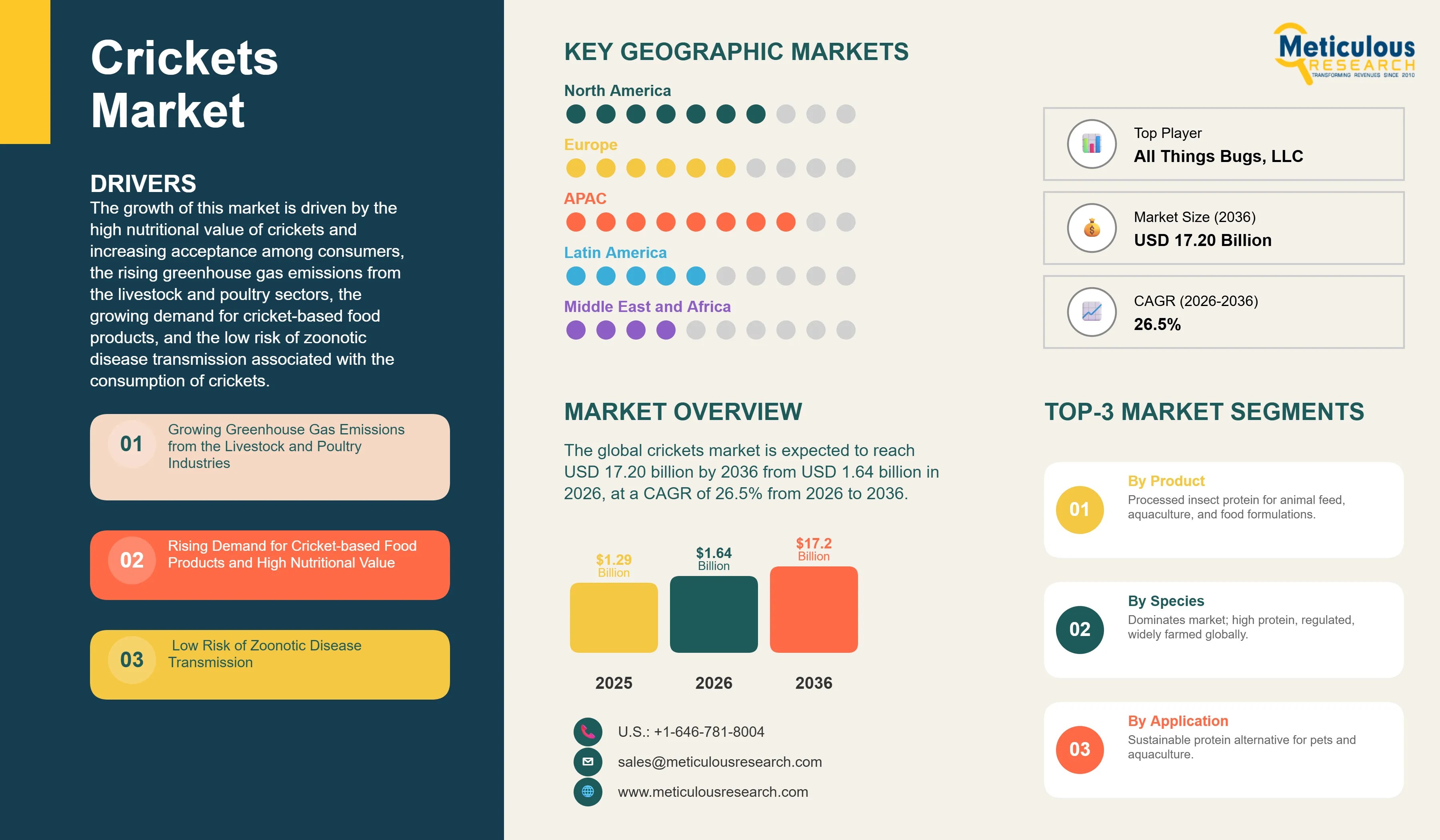
The global crickets market size was valued at USD 1.29 billion in 2025. This market is expected to reach USD 17.20 billion by 2036 from USD 1.64 billion in 2026, at a CAGR of 26.5% from 2026 to 2036.
The growth of this market is driven by the high nutritional value of crickets and increasing acceptance among consumers, the rising greenhouse gas emissions from the livestock and poultry sectors, the growing demand for cricket-based food products, and the low risk of zoonotic disease transmission associated with the consumption of crickets. FAO assessments indicate that edible insects such as crickets provide high-quality protein (60–70% by dry weight), essential amino acids, B vitamins, iron, and zinc, while requiring substantially less feed, land, and water per unit of protein compared to conventional livestock, with greenhouse gas emissions estimated at approximately 1% of those from beef production on a protein-equivalent basis . However, the lack of a standardized regulatory framework and psychological and ethical barriers to insect consumption are anticipated to restrain market growth. Emerging economies in Latin America, Asia, and the Middle East & Africa are expected to generate growth opportunities for the players operating in this market, particularly where traditional entomophagy practices intersect with modern food security strategies aligned with FAO guidance on sustainable protein diversification.
The crickets market has witnessed significant commercial and regulatory developments in recent years. In January 2023, the European Commission adopted Implementing Regulation (EU) 2023/5 authorizing partially defatted powder of Acheta domesticus (house cricket) as a novel food for human consumption, following positive scientific opinions from the European Food Safety Authority (EFSA) on its safety and nutritional adequacy. In the U.S., cricket-derived ingredients may be marketed under existing food regulations, including through Generally Recognized as Safe (GRAS) determinations submitted to the U.S. Food and Drug Administration (FDA), providing a regulatory pathway for product commercialization in one of the world’s largest consumer markets.
 Click here to: Get Free Sample Pages of this Report
Increasing Preference for Protein-rich, Sustainable Diets
The global shift toward high-protein, sustainable dietary patterns is the most powerful structural demand driver for the crickets market. Consumers are increasingly seeking nutrient-dense food sources with favorable environmental profiles, and crickets uniquely satisfy both criteria. Crickets contain approximately 60–70% complete protein on a dry weight basis — exceeding the protein content of beef (26%) or chicken (27%) per comparable dry weight — while also providing all essential amino acids, omega fatty acids, and micronutrients including iron, calcium, and vitamin B12. The environmental credentials of cricket farming are particularly compelling: crickets require 12 times less feed, 15 times less land, and approximately 2,000 times less water per kilogram of protein produced compared to cattle, while generating approximately 100 times fewer greenhouse gas emissions. As consumers adopt high-protein diets for fitness, weight management, muscle recovery, and general health optimization, demand for cricket-based products including protein bars, powders, and snacks continues to rise. Food manufacturers are increasingly incorporating cricket protein into products targeting athletes, gym-goers, and health enthusiasts seeking natural, nutrient-dense protein alternatives to synthetic supplements or conventional animal proteins.
Progressive Global Regulatory Approvals Unlocking New Market Access
The accumulation of formal government regulatory approvals for cricket-based ingredients in human food and animal feed across multiple major markets is the most important structural catalyst transforming the crickets market from a niche industry into a mainstream food ingredient sector. Between 2021 and 2023, the European Commission progressively authorized several insect species as novel foods under EU Novel Food Regulation (EU) 2015/2283, including the January 2023 authorization of frozen, dried, and powdered house cricket (Acheta domesticus) for human consumption and the February 2023 EFSA approval of dried partially defatted cricket powder. These EU authorizations provide the legal basis for European food manufacturers to commercially incorporate cricket-based ingredients into mainstream food products, enabling them to declare ingredients on labels in compliance with EU regulations — a prerequisite for mass-market retail distribution. The June 2023 U.S. FDA approval of cricket powder for human consumption similarly establishes the regulatory foundation for commercial cricket food ingredient use in the world’s largest consumer market. The April 2023 Singapore Food Agency (SFA) approval of 16 insect species including crickets extends regulatory approval into a key Asia-Pacific gateway market. These sequential approvals across three major regulatory jurisdictions — EU, U.S., and Singapore — are collectively expanding the total addressable regulated market for cricket-based food products substantially.
Integration of Automation and Vertical Farming Technology in Cricket Production
The integration of advanced automation, robotics, IoT-linked climate control systems, AI-driven production management, and vertical farming technology in commercial cricket production is progressively transforming the economics of cricket farming — reducing per-unit production costs, improving quality consistency, enabling year-round production independent of geographic and seasonal constraints, and enhancing biosecurity against contamination risks. Aspire Food Group’s 150,000 sq. ft. London, Ontario facility — completed in May 2022 and one of the world’s largest automated cricket production facilities — incorporates proprietary robotics and automation systems that dramatically reduce labor requirements per kilogram of cricket produced while improving production yield predictability. Protix B.V.’s May 2025 launch of an AI-integrated Black Soldier Fly production line enhancing protein yield by 18% and reducing energy consumption by 22% demonstrates the broader insect-protein industry’s trajectory toward AI-optimized, resource-efficient production, with similar automation principles applicable to cricket farming. The October 2023 Tyson Foods-Protix joint venture for a U.S. insect protein facility signals that mainstream protein industry investment is supporting the capital-intensive automation buildout that the cricket sector requires. These technological advances are expected to progressively reduce the cost premium of cricket protein versus conventional animal proteins, widening the addressable market and improving competitiveness in price-sensitive animal feed applications.
|
Report Coverage |
Details |
|
Market Size (Value) by 2036 |
USD 17.2 Billion |
|
Market Size (Value) in 2025 |
USD 1.29 Billion |
|
Market Size (Value) in 2026 |
USD 1.64 Billion |
|
Market Growth Rate (2026–2036) |
CAGR of 26.5% |
|
Base Year |
2025 |
|
Forecast Period |
2026 to 2036 |
|
Dominating Region |
Asia-Pacific |
|
Fastest Growing Region |
North America |
|
Dominating Product Segment |
Whole Cricket |
|
Fastest Growing Product Segment |
Cricket Powder |
|
Dominating Species Segment |
House Cricket (Acheta domesticus) |
|
Dominating Application Segment |
Processed Whole Crickets |
|
Fastest Growing Application Segment |
Cricket Protein Bars & Protein Shakes |
|
Dominating End Use Segment |
Human Consumption |
|
Dominating Distribution Channel |
Business-to-Business (B2B) |
|
Fastest Growing Distribution Channel |
Business-to-Consumer (B2C) |
|
Segments Covered |
By Product: Whole Cricket; Cricket Powder; Cricket Meal; Other Products By Species: House Cricket (Acheta domesticus); Other Species (Gryllus and Others) By Application: Processed Whole Crickets; Protein Supplement Powder; Animal Feed & Pet Food Products; Cricket Protein Bars & Protein Shakes; Bakery Products & Snacks; Beverages; Other Applications By End Use: Human Consumption; Animal Nutrition By Distribution Channel: Business-to-Business (B2B); Business-to-Consumer (B2C) (Store-based; Non-store-based) |
|
Countries Covered |
North America (U.S., Canada); Europe (Netherlands, Belgium, France, U.K., Denmark, Finland, Germany, Rest of Europe); Asia-Pacific (Thailand, China, South Korea, Vietnam, Japan, Australia, India, Rest of Asia-Pacific); Latin America (Brazil, Mexico, Argentina, Rest of Latin America); Middle East & Africa (South Africa, Saudi Arabia, Kenya, Uganda, Rest of Middle East & Africa) |
|
Key Companies |
Entomo Farms (Canada); Aspire Food Group (U.S.); All Things Bugs, LLC (U.S.); JR Unique Foods Ltd. (Thailand); Global Bugs Asia Co., Ltd. (Thailand); Chapul, LLC (U.S.); Bugsolutely Ltd. (Thailand); Eat Grub Ltd. (U.K.); Bitty Foods (U.S.); Six Foods Inc. (U.S.) |
Growing Greenhouse Gas Emissions from the Livestock and Poultry Industries
Growing environmental awareness of the unsustainable resource consumption and greenhouse gas emissions associated with conventional livestock protein production is one of the primary drivers of the crickets market. Around 77% of agricultural land is dedicated to raising livestock and producing animal feed, and the global livestock industry emits around 14.5% of human-caused greenhouse gases, comparable to all transportation sectors combined. This environmental toll is neither feasible nor sustainable to scale further, given that the global human population is expected to grow from 8.1 billion today to 9.8 billion by 2050, a 21% increase that will substantially boost global protein demand. Crickets present a compelling environmental alternative as they require up to 12 times less feed, 10 times less land, and approximately 1,000–2,000 times less water per kilogram of protein produced compared to cattle, while generating approximately 100 times fewer greenhouse gas emissions. Moreover, crickets can be fed on agricultural byproducts and food scraps, enabling cricket farms to simultaneously increase the world's protein supply while reducing and recycling organic waste streams. Cricket meal can also substitute for expensive conventional feed inputs such as soybeans and fishmeal in animal feed, potentially reducing livestock production costs and freeing feed crops for direct human consumption. Growing corporate sustainability commitments, investor ESG expectations, and government climate policy initiatives are increasingly incentivizing the food industry to transition toward lower-carbon protein sources, thereby driving the demand for cricket-based ingredients.
Rising Demand for Cricket-based Food Products and High Nutritional Value
The rising demand for cricket-based food products across both consumer and food-service channels is another key driver of market growth, reflecting the growing commercial viability and consumer acceptance of crickets as a functional food ingredient. Crickets are now considered a functional food ingredient and an integral part of food in major markets such as Thailand, Mexico, China, and the Netherlands, with rapidly growing consumer acceptance in North America and Europe. Crickets are a rich source of complete protein containing around 60-70% protein by dry weight, along with high levels of vitamins including B12, essential amino acids, iron at levels twice that of beef, zinc, calcium, and omega-3 and omega-6 fatty acids, making them nutritionally superior to many conventional protein sources. The high nutritional density of crickets makes them suitable for diverse food applications such as cricket pasta, burgers, cricket-infused candies and confections, beverages, cricket protein powder in bakery products, protein bars and shakes, and whole dried crickets as toppings or snacks. Food manufacturers are increasingly incorporating cricket protein into mainstream and functional food product portfolios targeting health-conscious consumers, athletes, and sustainable diet adopters. The rising availability of cricket-based consumer products in both specialist and mainstream retail channels, combined with growing media and social coverage of insect protein sustainability, is driving the consumption in Western markets.
Lack of Standardized Regulatory Framework Across Markets
The absence of a globally harmonized and comprehensive regulatory framework governing the production, processing, labeling, and commercial use of crickets and cricket-derived ingredients in food and feed is a significant restraint on the growth of the crickets market, particularly for companies seeking to supply products across multiple international markets. While the EU, U.S., Singapore, and several other markets have made progress in establishing novel food or food ingredient approvals for specific cricket-based products, the regulatory landscape remains fragmented, with significant jurisdictional differences in which cricket products are approved, for which applications, at what use levels, and with what labeling requirements. The post-Brexit lapsing of UK transitional rules in 2023 forced the withdrawal of several cricket-based food SKUs from the U.K. market, demonstrating how regulatory uncertainty can rapidly eliminate commercial shelf presence even in otherwise favorable markets. Regulatory approval processes are lengthy and costly, requiring substantial safety dossier preparation, toxicological testing, and regulatory affairs investment, creating barriers that are particularly challenging for smaller specialist cricket producers. The lack of harmonized international standards also complicates export logistics, ingredient labeling, and quality certification for cricket farmers and processors seeking to serve global markets.
Emerging Economies in Latin America, Asia, and the Middle East & Africa
Rapidly growing markets in Latin America, Southeast Asia, and the Middle East & Africa offer significant growth opportunities for the players in crickets market, driven by the combination of rapidly increasing protein demand from urbanizing populations, existing cultural acceptance of insect consumption in many of these regions, and growing investment in modern food processing and retail infrastructure. According to the OECD-FAO Agricultural Outlook 2025-2034, developing economies are projected to account for over 80% of global meat production growth through 2034, led by Asia, Brazil, and India. Meat producers in these regions are increasingly seeking cost-effective, high-quality protein feed sources to improve the nutritional value of livestock and aquaculture operations, making insect-derived feeds including cricket meal a commercially attractive input. The global demand for fish and shellfish, reaching 223 million tonnes of total aquatic production in 2022 per FAO's State of World Fisheries and Aquaculture, is creating severe pressure on fishmeal supplies, with aquaculture requiring 1-2 million tons of alternative raw materials annually for feed; cricket meal is one of the leading candidates. The rapid expansion of modern supermarket and hypermarket retail in China, India, and Southeast Asia is providing new distribution pathways for packaged cricket-based consumer products. The growth of e-commerce platforms in these regions is also enabling direct-to-consumer cricket product sales at scale, bypassing traditional retail entry barriers.
Growing Pet Food and Aquaculture Feed Applications
The rapidly growing global market for premium and sustainable pet food, combined with structural supply constraints in traditional marine ingredients for aquaculture feed, represents a significant high-growth commercial opportunity for cricket-based ingredients. Consumers worldwide are increasingly treating pets as family members and seeking premium, nutritionally optimized, and sustainable pet food formulations. Cricket protein in pet food offers high digestibility, with studies reporting total apparent digestibility exceeding 80% in canine trials, along with complete amino acid profiles and utility as a novel protein source for elimination diets in pets with sensitivities to conventional animal proteins. Aspire Food Group's July 2025 five-year North American pet food partnership signals growing commercial validation of insect protein in this channel, though the broader sector continues to navigate scaling and financial sustainability challenges.
In aquaculture, where fishmeal remains a critical but supply-constrained protein source, cricket meal provides a nutritionally compatible alternative with improved supply chain predictability and a significantly lower environmental footprint in life-cycle assessments. Global fishmeal production reached approximately 5.6 million tons in 2025, with demand pressures persisting as aquaculture output expands. The OECD-FAO Agricultural Outlook 2025–2034 projects continued intensification of animal production driving protein meal demand, alongside efforts to improve feed efficiency and diversify ingredient sourcing. While earlier industry analyses highlighted a potential 1.2 to 1.6 million ton annual gap for fishmeal alternatives by the mid-2020s, current FAO and IFFO assessments emphasize the importance of diversified protein portfolios, including insect meals, to support sustainable aquaculture growth.
As regulatory frameworks for insect-derived feed ingredients continue to mature across key markets, cricket-based formulations are positioned to address both nutritional performance and sustainability objectives in premium pet food and responsible aquaculture production.
Why Does the Whole Crickets Segment Dominate the Market?
Based on product, the whole crickets segment is expected to account for the largest share of the global crickets market in 2026. The dominant share of whole crickets reflects their role as the primary raw material form used in the production of value-added insect-based ingredients, including cricket powder, meal, and protein isolates. Whole crickets are the most widely available and cost-efficient farm-gate output and are therefore procured in bulk by ingredient processors and animal feed manufacturers for downstream processing.
In addition to their use as an input material for ingredient production, whole crickets are directly consumed in several Asia-Pacific markets where entomophagy practices are culturally established. Countries such as Thailand continue to export significant volumes of farmed whole crickets to international processing facilities for incorporation into food and feed applications, further driving the growth of this market.
The cricket powder segment is projected to grow at the fastest CAGR during the forecast period. Cricket powder is increasingly utilized in food product formulations across Western markets, where consumer acceptance of visible whole-insect formats remains limited. The powdered format enables incorporation into protein bars, baked goods, pasta, snack products, and nutritional beverages without affecting product appearance, thereby addressing consumer neophobia associated with insect-based foods. Its compatibility with conventional food manufacturing processes and its applicability across both human food and animal nutrition applications are expected to drive growth of this market over the forecast period.
Why Does Acheta domesticus Dominate the Commercial Crickets Market?
Based on species, the house cricket (Acheta domesticus) segment is expected to account for the largest share of the global crickets market in 2026 and is projected to register significant growth during the forecast period. The commercial dominance of Acheta domesticus is attributed to its favorable nutritional composition, established breeding cycles, high feed-conversion efficiency, and the availability of large-scale farming infrastructure in key producing countries such as Thailand and Vietnam.
Additionally, Acheta domesticus has received Novel Food authorization in the European Union for use in specific food formats, including frozen, dried, and powdered forms, enabling its incorporation into a range of food applications within regulated markets. These regulatory developments, combined with its suitability for use in aquaculture and livestock feed formulations due to its amino acid profile, are expected to support the continued expansion of this species in both food and feed applications.
Why Do Processed Whole Crickets Lead by Application Share?
Based on application, the processed whole crickets segment is expected to account for the largest share of the global crickets market in 2026. The large share of this segment is primarily attributable to the availability of farmed whole crickets from Asian production hubs and the growing consumption of roasted, dried, and seasoned cricket products in both traditional entomophagy markets and emerging Western markets.
Processed whole crickets are marketed as snack products for direct human consumption and are also utilized as an intermediate input for ingredient processing, including the production of cricket powder and meal.
The cricket-based functional food products segment, including protein bars and ready-to-drink nutritional beverages, is expected to register the fastest growth during the forecast period. The growth of this segment is driven by increasing consumer demand for high-protein, clean-label food products, expanding interest in alternative protein sources, and the growing adoption of sustainable nutrition solutions among health-conscious consumers. The complete amino acid profile and digestibility characteristics of cricket-derived protein support its application in premium sports nutrition and functional food product categories.
Why Does the Human Consumption Segment Dominate the Market?
Based on end use, the human consumption segment is expected to account for the largest share of the global crickets market in 2026 and is projected to register the fastest growth during the forecast period. This growth is driven by increasing consumer awareness regarding the nutritional benefits of insect-based proteins, rising demand for environmentally sustainable food sources, and expanding regulatory approvals for insect-derived ingredients in human food applications across developed markets.
Recent regulatory developments in regions such as the European Union and Singapore have enabled the commercialization of cricket-based food ingredients in regulated food product categories, encouraging food manufacturers to introduce insect-protein-based product offerings in the alternative protein space.
Why Does the B2B Segment Lead the Market?
Based on distribution channel, the business-to-business (B2B) segment is expected to account for the largest share of the global crickets market in 2026. The dominance of the B2B segment is due to the current commercial structure of the industry, wherein bulk volumes of whole crickets and cricket-derived ingredients are supplied by farming enterprises to processors, feed manufacturers, and food product companies for use in downstream applications.
The business-to-consumer (B2C) segment is projected to register faster growth during the forecast period, driven by the expansion of direct-to-consumer sales channels, including e-commerce platforms and specialty health food retailers. The increasing availability of cricket-based food products through online retail channels is enabling manufacturers to reach health-conscious consumers in emerging markets while overcoming the distribution constraints associated with traditional retail shelf space.
Geographic Analysis: Asia-Pacific Leads; North America Fastest Growing
Based on geography, Asia-Pacific is expected to dominate the global crickets market in 2026. This is mainly attributed to the well-established commercial cricket farming infrastructure, particularly in Thailand, which hosts tens of thousands of small- and medium-scale cricket farms and is among the largest commercial producers and exporters of farmed crickets globally. In addition, the availability of diverse cricket species, relatively high production volumes, and historically positive consumer attitudes toward insect consumption across Southeast Asia and parts of East and South Asia support regional leadership. The presence of key market players such as Global Bugs Asia Co., Ltd. and JR Unique Foods Ltd. (Thailand), along with emerging large-scale producers such as Cricket One (Vietnam), further strengthens Asia-Pacific’s production ecosystem. Moreover, the July 2023 approval by the Singapore Food Agency (SFA) permitting the sale of 16 insect species for human consumption has supported the commercialization of cricket-based food products across the region.
North America is expected to record the highest regional CAGR during the forecast period, driven by the growing demand for sustainable high-protein diets and increasing consumer acceptance of alternative protein sources. Expanding retail availability of insect-based food products, a rising number of cricket-based ingredient manufacturers and startups, and growing environmental concerns related to conventional livestock production are supporting regional market growth. Additionally, the availability of Generally Recognized as Safe (GRAS)-based regulatory pathways for cricket-derived ingredients in the U.S. is expected to facilitate commercialization. The presence of leading market players such as Entomo Farms, Aspire Food Group, All Things Bugs, and Chapul positions the region to benefit from increasing demand for cricket-based food and ingredient products.
The report provides a competitive analysis based on an extensive assessment of leading players’ product portfolios, geographic presence, and key growth strategies adopted over the past three to four years. Aspire Food Group (U.S.) has been among the most active companies in scaling automated commercial cricket production, including the development of its large-scale cricket production facility in London, Ontario, to support ingredient supply for food and pet food applications. Entomo Farms (Canada), one of North America’s largest commercial cricket producers, has continued to expand its processing capabilities to meet growing demand for cricket-based protein ingredients across human consumption and animal nutrition applications. In Asia-Pacific, companies such as Global Bugs Asia Co., Ltd. and JR Unique Foods Ltd. (Thailand) are strengthening regional supply through established farming and processing networks.
Key companies profiled in the global crickets market report include Entomo Farms (Canada), Aspire Food Group (U.S.), All Things Bugs, LLC (U.S.), Global Bugs Asia Co., Ltd. (Thailand), JR Unique Foods Ltd. (Thailand), Chapul, LLC (U.S.), Bugsolutely Ltd. (Thailand), Eat Grub Ltd. (U.K.), Bitty Foods (U.S.), and Six Foods Inc. (U.S.), among others.
Crickets Market Assessment—by Product
Crickets Market Assessment—by Species
Crickets Market Assessment—by Application
Crickets Market Assessment—by End Use
Crickets Market Assessment—by Distribution Channel
Crickets Market Assessment—by Geography
This report provides a comprehensive assessment of the global crickets market based on product, species, application, end use, distribution channel, and geography. It includes value and volume analysis of various market segments at the regional and country levels and covers commercial crickets used for both human consumption (direct food applications) and animal nutrition (feed and pet food) across multiple product formats.
The global crickets market is valued at USD 1.64 billion in 2026, growing to USD 17.2 billion by 2036, at a CAGR of 26.5% during the forecast period from 2026 to 2036.
The whole cricket segment is expected to account for the largest share of the crickets market in 2026 due to its relatively lower cost and widespread use by food and ingredient manufacturers for further processing into value-added products.
The business-to-consumer (B2C) segment is expected to register the highest growth during the forecast period due to increasing retail availability of cricket-based products, rising online sales channels, and growing consumer demand for sustainable alternative protein products.
Key growth drivers include the high nutritional value of crickets, increasing consumer acceptance of sustainable protein sources, rising greenhouse gas emissions from conventional livestock production, and growing demand for cricket-based food and pet food products. In addition, regulatory approvals in major markets, including the EU, the U.S., and Singapore, are expected to support commercialization and expand the addressable market.
Key companies operating in the global crickets market include Entomo Farms (Canada), Aspire Food Group (U.S.), All Things Bugs, LLC (U.S.), Global Bugs Asia Co., Ltd. (Thailand), JR Unique Foods Ltd. (Thailand), Chapul, LLC (U.S.), Bugsolutely Ltd. (Thailand), Eat Grub Ltd. (U.K.), Bitty Foods (U.S.), and Six Foods Inc. (U.S.), among others.
Asia-Pacific is expected to account for the largest share of the global crickets market, while North America is projected to register the highest CAGR during the forecast period. Countries across Latin America, the Middle East, and Africa are also expected to offer emerging growth opportunities due to increasing demand for sustainable protein sources and expanding aquaculture and pet food industries.




















Published Date: May-2025
Published Date: Sep-2026
Published Date: Jan-2025
Published Date: Jan-2025
Please enter your corporate email id here to view sample report.
Subscribe to get the latest industry updates


