Growing Need for Cybersecurity Services Among SME's

The digital transformation trend is not limited only to large enterprises, as small and medium-sized enterprises are also transitioning by incorporating digital technologies. The need to secure and manage real-time business applications has also increased with growing technological advancements, subsequently driving the adoption of cybersecurity services among SMEs. Cybersecurity services offer penetration testing services, managed detection & response services, threat hunting services, and compliance & vulnerability management services. Furthermore, these services offer various capabilities, such as stronger scalable security coverage, lower operating costs, and improved workforce productivity. Thus, the adoption of cybersecurity services is gaining prominence among SMEs.
Key global players are redefining their business strategies to improve productivity. For instance, in March 2022, Vodafone Group plc (U.K.) partnered with Accenture PLC (Ireland) to deliver managed security services to small & medium-sized enterprises and national corporate customers in Germany. In addition, government agencies are making significant efforts to promote cybersecurity among small & medium-sized enterprises. For instance, in August 2018, the U.S. Government passed the NIST Small Business Cybersecurity Act, a law intended to help small businesses with resources to fend off cyber threats. Thus, SMEs are adopting advanced cybersecurity services for protection against cyberattacks and improved cybersecurity. These factors are expected to create growth opportunities for companies operating in the cybersecurity services market.
INCREASING USE OF ARTIFICIAL INTELLIGENCE, MACHINE LEARNING, AND BLOCKCHAIN TECHNOLOGIES FOR CYBER DEFENSE
Technological advances, such as artificial intelligence (AI), machine learning (ML), and blockchain, are transforming industries. Due to the rapid pace of digital transformation, organizations face challenges in ensuring cybersecurity & data privacy, financial integrity, employee integrity, and enterprise longevity. The frequency and sophistication of cyberattacks are increasing significantly. Conventional security services are incapable of detecting ransomware, malware, and other sophisticated cyber threats. AI and ML-based cybersecurity services can analyze massive amounts of data to defend systems and identify new threats to protect enterprise networks from infiltration attempts. These services have become essential for enterprises as they identify advanced security threats and offer optimal protection against cyberattacks. Hence, cybersecurity services providers are leveraging AI and machine learning technologies to protect organizations from evolving cyber threats. Vendors are also leveraging blockchain technology to fortify their cybersecurity services, offering better protection to enterprises. Blockchain technology can be competently used to prevent DDoS attacks. Thus, AI, machine learning, and blockchain enhance cybersecurity by automating threat detection and response. As a result, the demand for AI, ML, and blockchain-based cybersecurity services is rising, creating growth opportunities for the players operating in this market.
Access Full Report Here:https://www.meticulousresearch.com/download-sample-report/cp_id=5455
Looking for full market sizing & granular dataset?
Access our comprehensive market forecast report SKU: MRICT - 104771.
Related Market Intelligence Briefings
Recommended reading from the same research domain
METICULOUS INSIGHT
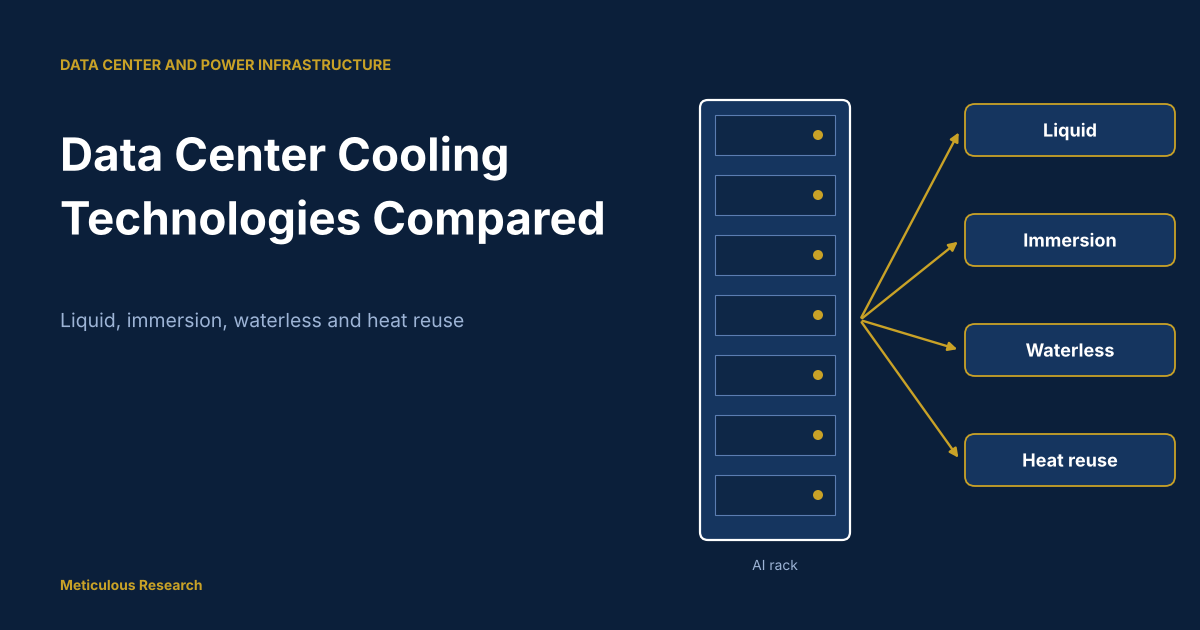
Data Center Cooling Technologies Compared: Liquid, Immersion, Waterless and Heat Reuse
Air is still the largest way to cool a data center, but every faster growing segment in our research points to liquid. Liquid, immersion, wa...
METICULOUS INSIGHT
Used and Refurbished Data Center GPU Market 2026: Demand Drivers, Challenges and Opportunities
When a new AI accelerator is hard to get and the wait is long, a GPU that has already done a few years of work in someone else rack starts t...
METICULOUS INSIGHT
AI Data Center Power Demand: Why Grid Delays Are Pushing Operators Toward Microgrids, Batteries and Fuel Cells
A data center can be built in about two years. Getting a grid connection for it can take longer than that, sometimes much longer. That gap b...