Resources
About Us
The U.S. home healthcare services industry is growing quickly as healthcare providers, payers, and patients see the benefits and savings of home care. With over 88 million Americans expected to be 65 or older by 2050, there is a rising need for skilled nursing, rehabilitation, and specialized home healthcare services. This demand is fueling significant market growth. Medicare and Medicaid are increasingly supporting home healthcare as a cheaper option than institutional care.
For example, in September 2024, the Centers for Medicare & Medicaid Services (CMS) announced new reimbursement rates for home healthcare services under the Patient-Driven Groupings Model (PDGM). They applied a 3.2% market basket inflation factor for 2025. This change is likely to lead to more use of home healthcare services in skilled nursing, therapy, and chronic care management.
The industry is also going through a major technological change with remote patient monitoring, AI-driven care coordination, and telehealth integration. Top home healthcare providers are investing in digital health platforms to improve patient outcomes, reduce readmission rates, and boost operational efficiency. These advancements are allowing providers to handle more complex patient needs while maintaining high care standards and improving financial results.
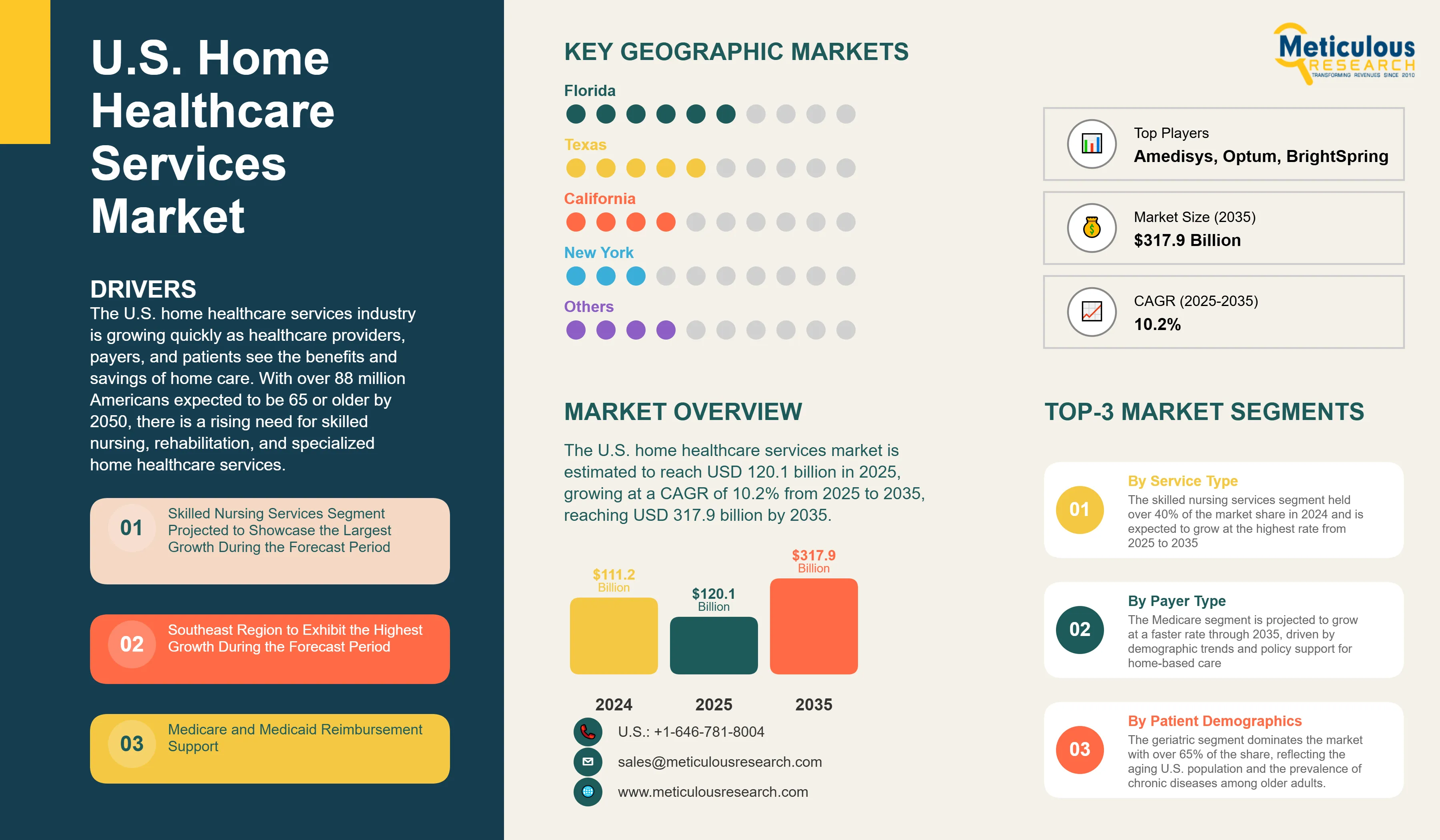
Skilled Nursing Services Segment Projected to Showcase the Largest Growth During the Forecast Period
Skilled nursing services are expected to grow significantly during the forecast period. They represent about 40% of the total home healthcare services market in the U.S. These services include wound care management, medication administration, chronic disease monitoring, and post-acute care after hospital discharge. The complexity of care in home settings is increasing as healthcare systems push for earlier hospital discharges. Value-based care models also focus on outcomes instead of volume.
The demand for skilled nursing services is linked to the rising number of chronic diseases. Over 190 million Americans live with at least one chronic condition. This group needs ongoing medical supervision and clinical intervention, which skilled nurses can effectively provide at home. Medicare data shows that beneficiaries who receive skilled home health services have much lower readmission rates than those without home healthcare support.
Major home healthcare providers like Amedisys, Optum Home Health, and BrightSpring Health Services are actively expanding and restructuring their services. They are doing this through mergers, acquisitions, and divestitures in 2024 and 2025 to meet the growing need for skilled nursing and home healthcare services. The integration of telehealth platforms and remote monitoring technologies allows skilled nurses to manage larger patient loads while keeping clinical quality and safety standards high.
Southeast Region to Exhibit the Highest Growth During the Forecast Period
The Southeast region is expected to see strong growth during the forecast period. This growth is fueled by a rapidly aging population, an increase in Medicare Advantage plans, and supportive government policies. States like Florida, Texas, and North Carolina are seeing a huge demand for home healthcare services as the retiree population rises and healthcare systems focus on community-based care.
Florida is at the forefront with around 4.6 million residents aged 65 and older, making up about 21% of the state's population in 2025. The state's home healthcare market mainly benefits from the growth of Medicare Advantage plans and state Medicaid waiver programs that focus on home and community-based services. Texas is also making strides, with important investments in rural home healthcare access and telehealth infrastructure.
U.S. Home Healthcare Services Market Analysis
The U.S. home healthcare services industry faces major workforce shortages, especially in nursing and therapy roles. Turnover rates average around 70% each year, which creates ongoing challenges for delivering care and maintaining access. Regulatory requirements from CMS quality reporting programs and state licensing differences add to operational complexity and raise administrative costs. Pressures on reimbursement rates from Medicare and Medicaid managed care organizations continue to affect provider margins. This situation requires improvements in operational efficiency and investments in technology.
Despite these challenges, the market presents significant growth opportunities through value-based care contracts, technology-driven service delivery, and expansion into underserved areas. The use of remote patient monitoring and artificial intelligence helps providers manage larger patient populations while enhancing clinical outcomes and lowering costs. Government initiatives that support aging-in-place policies and the growth of Medicare Advantage create stable reimbursement options for innovative service delivery models.
The home healthcare services market is divided by service type into skilled nursing services, rehabilitation services, home health aide services, medical social services, hospice and palliative care services, specialized services, and technology-enabled services. The skilled nursing services segment held over 40% of the market share in 2024 and is expected to grow at the highest rate from 2025 to 2035.
By payer type, the market is categorized into Medicare, Medicaid, commercial insurance, private pay, and other payers. The Medicare segment is projected to grow at a faster rate through 2035, driven by demographic trends and policy support for home-based care.
The market also serves different patient demographics, including geriatric patients (65+ years), adult patients (18-64 years), and pediatric patients (0-17 years). The geriatric segment dominates the market with over 65% of the share, reflecting the aging U.S. population and the prevalence of chronic diseases among older adults.
Regional Market Analysis
Florida leads the U.S. home healthcare market with strong Medicare Advantage enrollment and state support for aging-in-place programs. The regulations in the state promote home healthcare expansion. Easier licensing processes and telehealth-friendly policies encourage provider growth and innovation.
Texas is growing its home healthcare infrastructure to serve both urban and rural communities. The state's Medicaid managed care programs are increasingly focusing on home and community-based services. This trend creates opportunities for specialized providers who serve low-income individuals and those with disabilities.
California shows significant growth in technology-based home healthcare services. Companies in Silicon Valley are developing new care delivery platforms. The state's large Medicare Advantage population and progressive healthcare policies support new home healthcare models, including hospital-at-home programs and AI-driven care coordination.
New York is working to integrate home healthcare with managed long-term care programs and dual-eligible special needs plans. The state's focus on social determinants of health and health equity opens doors for home healthcare models that serve a variety of patients.
U.S. Home Healthcare Services Market Share
Major players like Amedisys, Optum (LHC Group), BrightSpring Health Services, BAYADA Home Healthcare, AccentCare Inc., and Enhabit Home Health & Hospice compete strongly in the U.S. home healthcare services industry. These companies focus on acquisitions, technology investments, and partnerships in value-based care to improve their market positions and expand services. As the demand for home healthcare grows among Medicare, Medicaid, and commercial populations, companies invest heavily in workforce development, clinical quality programs, and operational efficiency.
Leading providers are forming partnerships with health systems, Medicare Advantage plans, and technology companies to create integrated care delivery models. These collaborations enable better care coordination, improved patient outcomes, and sustainable financial performance under value-based payment arrangements. The market is also seeing more private equity investment in home healthcare platforms that can grow operations and integrate new technologies.
U.S. Home Healthcare Services Market Companies
Major players operating in the U.S. home healthcare services industry include:
U.S. Home Healthcare Services Industry Segmentation
The U.S. home healthcare services market consists of skilled nursing, rehabilitation therapy, personal care, medical social services, and specialized clinical services provided in patients' homes. It does not include institutional care settings and focuses only on home-based service delivery models.
The home healthcare services market is divided by service type, payer type, patient demographics, service model, and geography, which includes the Northeast, Southeast, Midwest, and West regions. By service type, the market features skilled nursing services, rehabilitation services, home health aide services, medical social services, hospice and palliative care services, specialized services, and technology-enabled services. By payer type, the market includes Medicare, Medicaid, commercial insurance, private pay, and other payers. The report offers a thorough market analysis and forecasts for each segment.
For each segment, market size is given in value (USD million) and includes growth projections through 2030.
|
Service Type |
Skilled Nursing Services |
|
Rehabilitation Services |
|
|
Home Health Aide Services |
|
|
Medical Social Services |
|
|
Hospice and Palliative Care Services |
|
|
Specialized Services |
|
|
Technology-Enabled Services |
|
|
Payer Type |
Medicare |
|
Medicaid |
|
|
Commercial Insurance |
|
|
Private Pay |
|
|
Other Payers |
|
|
Patient Demographics |
Geriatric Patients (65+ years) |
|
Adult Patients (18-64 years) |
|
|
Pediatric Patients (0-17 years) |
|
|
Geography |
Northeast Region |
|
Southeast Region |
|
|
Midwest Region |
|
|
West Region |
The U.S. home healthcare services market was valued at USD 111.2 billion in 2024 and is estimated to reach USD 120.1 billion in 2025, growing at a CAGR of 10.2% from 2025 to 2035, reaching USD 317.9 billion by 2035.
In 2025, the U.S. Home Healthcare Services Market size is expected to reach USD 120.1 billion.
Key players operating in the U.S. home healthcare services industry include Amedisys, Inc. (with over 519 care centers across 38 states and the District of Columbia), Optum (LHC Group), BrightSpring Health Services, Enhabit Home Health & Hospice, AccentCare, Inc., Addus HomeCare Corporation, Bayada Home Health Care, Elara Caring, and Gentiva, among others.
The Southeast region is estimated to grow at the highest CAGR over the forecast period (2025-2030).
In 2025, skilled nursing services account for the largest market share in the U.S. Home Healthcare Services Market.
In 2024, the U.S. Home Healthcare Services Market size was estimated at USD 111.2 billion. The report covers historical market size data and forecasts through 2035.
1. Market Definition & Scope
1.1. Market Definition
1.2. Market Ecosystem
1.3. Currency
1.4. Key Stakeholders
2. Research Methodology
2.1. Research Approach
2.2. Process of Data Collection and Validation
2.2.1. Secondary Research
2.2.2. Primary Research/Interviews with Key Opinion Leaders from the Industry
2.3. Market Sizing and Forecast
2.3.1. Market Size Estimation Approach
2.3.1.1. Bottom-up Approach
2.3.1.2. Top-down Approach
2.3.2. Growth Forecast Approach
2.3.3. Assumptions for the Study
3. Executive Summary
3.1. Overview
3.2. Segmental Analysis
3.2.1. Home Healthcare Services Market, by Service Type
3.2.2. Home Healthcare Services Market, by Payer Type
3.2.3. Home Healthcare Services Market, by Patient Demographics
3.2.4. Home Healthcare Services Market, by Service Model
3.2.5. Home Healthcare Services Market, by Geography
3.3. Competitive Landscape
4. Market Insights
4.1. Overview
4.2. Factors Affecting Market Growth
4.2.1. Drivers
4.2.1.1. Aging U.S. Population and Rising Chronic Disease Prevalence
4.2.1.2. Cost-Effectiveness Compared to Institutional Care
4.2.1.3. Medicare and Medicaid Reimbursement Support
4.2.1.4. Healthcare Consumerism and Patient Preference for Home-Based Care
4.2.2. Restraints
4.2.2.1. Workforce Shortages and High Turnover Rates
4.2.2.2. Regulatory Compliance and Quality Reporting Burden
4.2.2.3. Reimbursement Rate Pressures and Payment Delays
4.2.2.4. Limited Access to Specialized Care in Rural Areas
4.2.3. Opportunities
4.2.3.1. Technology Integration and Digital Health Solutions
4.2.3.2. Value-Based Care Models and Risk-Sharing Arrangements
4.2.3.3. Underserved Rural and Urban Markets
4.2.3.4. Specialized Service Line Expansion
4.2.4. Trends
4.2.4.1. Remote Patient Monitoring and Telehealth Integration
4.2.4.2. Artificial Intelligence in Care Coordination
4.2.4.3. Subscription-Based Care Models
4.2.4.4. Interdisciplinary Team-Based Care Approaches
4.2.5. Challenges
4.2.5.1. Quality Measurement and Outcome Reporting Requirements
4.2.5.2. Competition from Hospital-at-Home Programs
4.2.5.3. State-by-State Regulatory Variations
4.3. Porter's Five Forces Analysis
4.3.1. Bargaining Power of Suppliers
4.3.2. Bargaining Power of Buyers
4.3.3. Threat of Substitutes
4.3.4. Threat of New Entrants
4.3.5. Degree of Competition
4.4. Value-Based Care Impact on Home Healthcare Services Market
4.4.1. Quality and Outcome Measurement Factors
4.4.1.1. OASIS and HHCAHPS Integration
4.4.1.2. Star Ratings and Performance Benchmarks
4.4.2. Market Response to Value-Based Care Demands
4.4.2.1. Medicare Advantage Contract Negotiations
4.4.2.2. Risk-Sharing Partnership Models
4.4.3. Market Opportunities Created by Value-Based Care Focus
4.4.3.1. Challenges to Value-Based Implementation
4.4.3.2. Future Value-Based Care Trends
5. HOME HEALTHCARE SERVICES MARKET ASSESSMENT—BY SERVICE TYPE
5.1. Overview
5.2. Skilled Nursing Services
5.3. Rehabilitation Services
5.4. Home Health Aide Services
5.5. Medical Social Services
5.6. Hospice and Palliative Care Services
5.7. Specialized Services
5.8. Technology-Enabled Services
6. HOME HEALTHCARE SERVICES MARKET ASSESSMENT—BY PAYER TYPE
6.1. Overview
6.2. Medicare
6.3. Medicaid
6.4. Commercial Insurance
6.5. Private Pay
6.6. Other Payers
7. HOME HEALTHCARE SERVICES MARKET ASSESSMENT—BY PATIENT DEMOGRAPHICS
7.1. Overview
7.2. Geriatric Patients (65+ years)
7.3. Adult Patients (18-64 years)
7.4. Pediatric Patients (0-17 years)
8. HOME HEALTHCARE SERVICES MARKET ASSESSMENT—BY SERVICE MODEL
8.1. Overview
8.2. Episode-Based Care
8.3. Chronic Care Management
8.4. Transitional Care
8.5. Preventive Care Services
9. HOME HEALTHCARE SERVICES MARKET ASSESSMENT—BY GEOGRAPHY
9.1. Overview
9.2. Northeast Region
9.3. Southeast Region
9.4. Midwest Region
9.5. West Region
10. Competitive Landscape
10.1. Overview
10.2. Key Growth Strategies
10.3. Competitive Benchmarking
10.4. Competitive Dashboard
10.4.1. Industry Leaders
10.4.2. Market Differentiators
10.4.3. Vanguards
10.4.4. Contemporary Stalwarts
10.5. Market Share/Ranking Analysis, by the Key Players, 2024
11. Company Profiles (Business Overview, Financial Overview, Service Portfolio, Strategic Developments, and SWOT Analysis*)
11.1. Amedisys, Inc.
11.2. Optum (LHC Group)
11.3. BrightSpring Health Services
11.4. Enhabit Home Health & Hospice
11.5. AccentCare, Inc.
11.6. Addus HomeCare Corporation
11.7. Bayada Home Health Care
11.8. Elara Caring
11.9. Gentiva
11.10. VNA Health Group
11.11. Visiting Nurse Associations of America
11.12. Caring Brands International
11.13. Trinity Health At Home
11.14. Interim HealthCare Inc.
11.15. Comfort Keepers
11.16. Brookdale Senior Living
11.17. Home Instead
11.18. Maxim Healthcare Services
11.19. Aveanna Healthcare
11.20. Others
12. Appendix
12.1. Available Customization
12.2. Related Reports
LIST OF TABLES
Table 1. U.S. Home Healthcare Services Market, by Service Type, 2023–2035 (USD Million)
Table 2. U.S. Skilled Nursing Services Market, by Region, 2023–2035 (USD Million)
Table 3. U.S. Rehabilitation Services Market, by Region, 2023–2035 (USD Million)
Table 4. U.S. Home Health Aide Services Market, by Region, 2023–2035 (USD Million)
Table 5. U.S. Medical Social Services Market, by Region, 2023–2035 (USD Million)
Table 6. U.S. Hospice and Palliative Care Services Market, by Region, 2023–2035 (USD Million)
Table 7. U.S. Specialized Services Market, by Region, 2023–2035 (USD Million)
Table 8. U.S. Technology-Enabled Services Market, by Region, 2023–2035 (USD Million)
Table 9. U.S. Home Healthcare Services Market, by Payer Type, 2023–2035 (USD Million)
Table 10. U.S. Medicare Home Healthcare Services Market, by Region, 2023–2035 (USD Million)
Table 11. U.S. Medicaid Home Healthcare Services Market, by Region, 2023–2035 (USD Million)
Table 12. U.S. Commercial Insurance Home Healthcare Services Market, by Region, 2023–2035 (USD Million)
Table 13. U.S. Private Pay Home Healthcare Services Market, by Region, 2023–2035 (USD Million)
Table 14. U.S. Other Payers Home Healthcare Services Market, by Region, 2023–2035 (USD Million)
Table 15. U.S. Home Healthcare Services Market, by Patient Demographics, 2023–2035 (USD Million)
Table 16. U.S. Home Healthcare Services Market for Geriatric Patients (65+ years), by Region, 2023–2035 (USD Million)
Table 17. U.S. Home Healthcare Services Market for Adult Patients (18-64 years), by Region, 2023–2035 (USD Million)
Table 18. U.S. Home Healthcare Services Market for Pediatric Patients (0-17 years), by Region, 2023–2035 (USD Million)
Table 19. U.S. Home Healthcare Services Market, by Service Model, 2023–2035 (USD Million)
Table 20. U.S. Home Healthcare Services Market for Episode-Based Care, by Region, 2023–2035 (USD Million)
Table 21. U.S. Home Healthcare Services Market for Chronic Care Management, by Region, 2023–2035 (USD Million)
Table 22. U.S. Home Healthcare Services Market for Transitional Care, by Region, 2023–2035 (USD Million)
Table 23. U.S. Home Healthcare Services Market for Preventive Care, by Region, 2023–2035 (USD Million)
Table 24. Northeast Region: Home Healthcare Services Market, by Service Type, 2023–2035 (USD Million)
Table 25. Northeast Region: Home Healthcare Services Market, by Payer Type, 2023–2035 (USD Million)
Table 26. Northeast Region: Home Healthcare Services Market, by Patient Demographics, 2023–2035 (USD Million)
Table 27. Northeast Region: Home Healthcare Services Market, by Service Model, 2023–2035 (USD Million)
Table 28. Southeast Region: Home Healthcare Services Market, by Service Type, 2023–2035 (USD Million)
Table 29. Southeast Region: Home Healthcare Services Market, by Payer Type, 2023–2035 (USD Million)
Table 30. Southeast Region: Home Healthcare Services Market, by Patient Demographics, 2023–2035 (USD Million)
Table 31. Southeast Region: Home Healthcare Services Market, by Service Model, 2023–2035 (USD Million)
Table 32. Midwest Region: Home Healthcare Services Market, by Service Type, 2023–2035 (USD Million)
Table 33. Midwest Region: Home Healthcare Services Market, by Payer Type, 2023–2035 (USD Million)
Table 34. Midwest Region: Home Healthcare Services Market, by Patient Demographics, 2023–2035 (USD Million)
Table 35. Midwest Region: Home Healthcare Services Market, by Service Model, 2023–2035 (USD Million)
Table 36. West Region: Home Healthcare Services Market, by Service Type, 2023–2035 (USD Million)
Table 37. West Region: Home Healthcare Services Market, by Payer Type, 2023–2035 (USD Million)
Table 38. West Region: Home Healthcare Services Market, by Patient Demographics, 2023–2035 (USD Million)
Table 39. West Region: Home Healthcare Services Market, by Service Model, 2023–2035 (USD Million)
LIST OF FIGURES
Figure 1. Research Process
Figure 2. Secondary Components Referenced for This Study
Figure 3. Primary Research Techniques
Figure 4. Key Executives Interviewed
Figure 5. Breakdown of Primary Interviews (Supply Side & Demand Side)
Figure 6. Market Sizing and Growth Forecast Approach
Figure 7. In 2025, the Skilled Nursing Services Type to Account for the Largest Share
Figure 8. In 2025, the Medicare Payer Type to Account for the Largest Share
Figure 9. In 2025, the Geriatric Patients (65+ years) Demographics to Account for the Largest Share
Figure 10. In 2025, the Episode-Based Care Service Model to Account for the Largest Share
Figure 11. Southeast Region to be the Largest Regional Market
Figure 12. Impact Analysis of Market Dynamics
Figure 13. U.S. Home Healthcare Services Market: Porter's Five Forces Analysis
Figure 14. U.S. Home Healthcare Services Market, by Service Type, 2025 Vs. 2032 (USD Million)
Figure 15. U.S. Home Healthcare Services Market, by Payer Type, 2025 Vs. 2032 (USD Million)
Figure 16. U.S. Home Healthcare Services Market, by Patient Demographics, 2025 Vs. 2032 (USD Million)
Figure 17. U.S. Home Healthcare Services Market, by Service Model, 2025 Vs. 2032 (USD Million)
Figure 18. U.S. Home Healthcare Services Market, by Region, 2025 Vs. 2032 (USD Million)
Figure 19. Northeast Region: Home Healthcare Services Market Snapshot (2025)
Figure 20. Southeast Region: Home Healthcare Services Market Snapshot (2025)
Figure 21. Midwest Region: Home Healthcare Services Market Snapshot (2025)
Figure 22. West Region: Home Healthcare Services Market Snapshot (2025)
Figure 23. Key Growth Strategies Adopted by Leading Players (2022–2025)
Figure 24. U.S. Home Healthcare Services Market Competitive Benchmarking, by Service Type
Figure 25. Competitive Dashboard: U.S. Home Healthcare Services Market
Figure 26. U.S. Home Healthcare Services Market Share/Ranking, by Key Player, 2024 (%)
























Published Date: Jan-2025
Published Date: Jun-2023
Published Date: Feb-2023
Published Date: Jan-2023
Published Date: Sep-2013
Subscribe to get the latest industry updates