
Japan Cytogenetics Market (2025-2035)
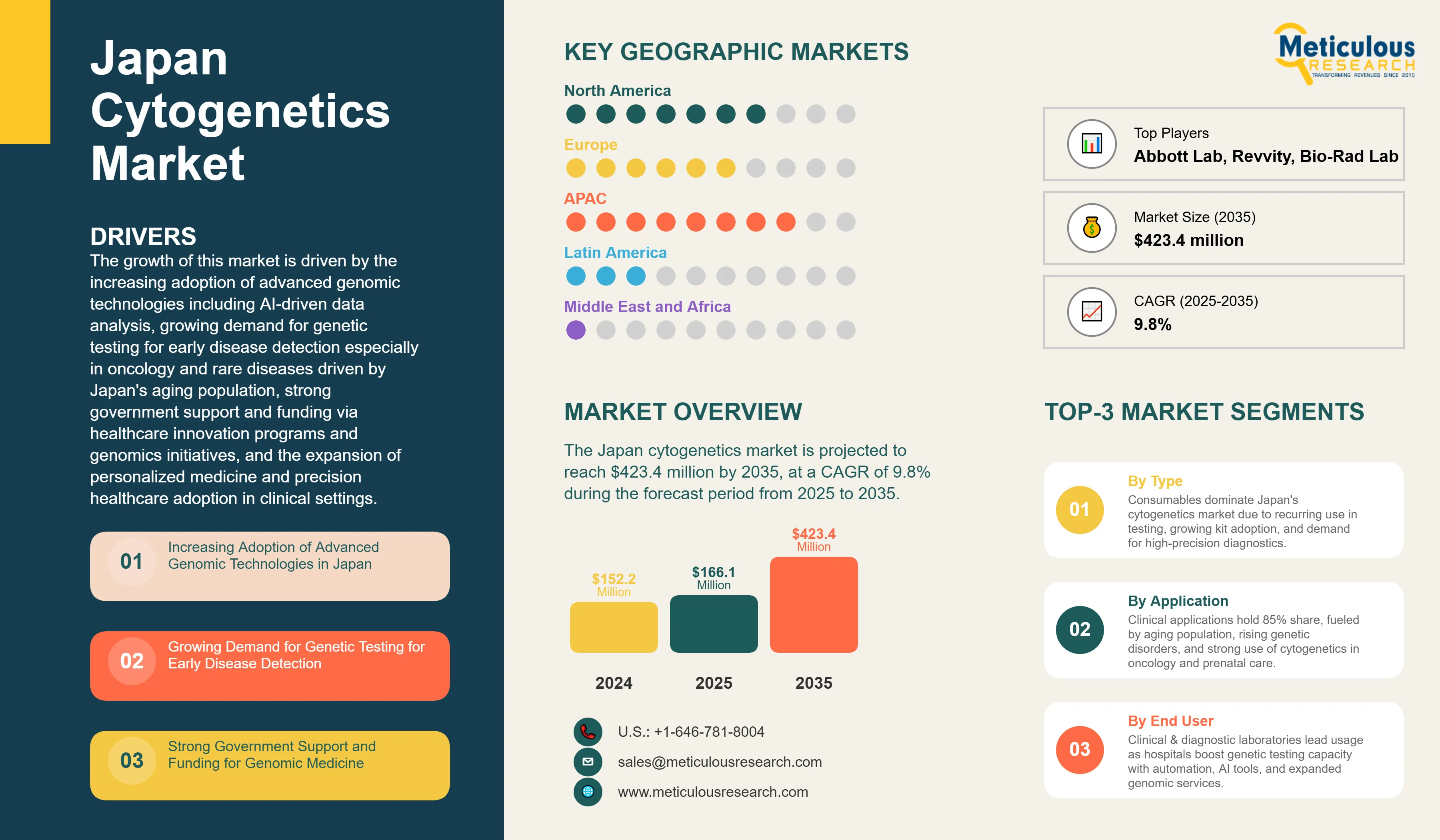
Japan Cytogenetics Market Size & Forecast The Japan cytogenetics market was valued at $152.2 million. This market is projected to reach $423.4 million by 2035 from an estimated $166.1 million in 2025, at a CAGR of 9.8% during the forecast period from 2025 to 2035. The growth of this market is driven
- Published
- Nov 2025
- Pages
- 137
- Format
- PDF + Excel
- Report ID
- MRHC - 1041626
- Base year
- 2025
- 2025 · ESTIMATED
- $166.1M
- 2035
- $423.4M
- CAGR 2025–2035
- 9.8%
2025–2035 forecast at 9.8% CAGR · hover a bar for the value
Key highlights
The Consumables Segment to Dominate the Japan Cytogenetics Market in 2025
The Comparative Genomic Hybridization Segment to Dominate the Technique Segment in 2025
The Clinical Applications Segment to Dominate the Japan Cytogenetics Market in 2025
The Clinical & Diagnostic Laboratories Segment to Account for Significant Share in 2025
Report summary
| Particulars | Details |
|---|---|
| Number of Pages | 137 |
| Format | |
| Forecast Period | 2025–2035 |
| Base Year | 2025 |
| CAGR | 9.8% |
| Market Size (Value), 2025 | USD 166.1 Million |
| Market Size (Value), 2035 | USD 423.4 Million |
| Segments Covered | By Offering: · - Consumables · - Instruments · - Software · - Services · By Technique: · - Fluorescence In Situ Hybridization (FISH) · - Comparative Genomic Hybridization · - Karyotyping · - Other Techniques · By Application: · - Clinical Applications · - Research Applications · By End User: · - Clinical & Diagnostic Laboratories · - Pharmaceutical & Biotechnology Companies · - Research & Academic Institutes · - Other End Users |
Report infographic
Market dynamics
4 factors across 1 forceIncreasing Adoption of Advanced Genomic Technologies
Japan is experiencing a significant transformation driven by the adoption of advanced genomic technologies in healthcare, particularly in cytogenetics. With its established infrastructure and focus on healthcare innovation, Japan has successfully integrated next-generation sequencing (NGS) and artificial intelligence (AI) into cytogenetics diagnostics. More than 700 hospitals nationwide utilize these technologies to enhance accuracy in diagnosing chromosomal abnormalities, cancers, and rare genetic diseases.
AI-powered cytogenetics software automates complex tasks such as karyotyping and anomaly detection, which traditionally require extensive manual expertise, thereby reducing diagnostic errors and labor costs. This acceleration in technology adoption aligns with Japan's national policies promoting precision medicine and personalized healthcare, facilitating faster and more accurate clinical decisions.
Furthermore, Japan's robust academic-industry-government collaborations contribute to continuous innovation, fueling research and development efforts to produce smarter diagnostic tools suited for Japan's unique healthcare landscape. The combination of technological sophistication, governmental support, and clinical demand is revolutionizing healthcare delivery, driving substantial growth in the Japanese cytogenetics market by enabling earlier disease detection, personalized treatment options, and improved patient outcomes.
Growing Demand for Genetic Testing for Early Disease Detection
The demand for genetic testing in Japan is increasing substantially due to the country's aging population and rising prevalence of oncological and rare genetic conditions. Japan's geriatric population aged 75 years and older increased by approximately 720,000 individuals from 2023 to 2024, reaching over 20 million people. This demographic shift results in higher hospital admissions and a greater need for advanced diagnostics and personalized treatments.
Studies such as the Japan Environment and Children's Study (JECS) reveal the critical role of genetic testing in early diagnosis and intervention for congenital anomalies and hereditary diseases. Chromosomal disorders like Down syndrome, trisomies, and various cancers are regularly screened in clinical settings using cytogenetic technologies such as fluorescence in situ hybridization (FISH) and array comparative genomic hybridization (array-CGH).
Genetic disorder awareness is increasing in Japan, where approximately 1 in 500 newborns suffers from hearing loss linked to genetic mutations. In 2025, Otsuka Pharmaceutical secured regulatory approval for HemeSight, a genomic profiling assay for hematologic cancers developed in partnership with the National Cancer Center, exemplifying Japan's advances in precision oncology diagnostics. Japan's healthcare system has embraced genetic testing as part of routine prenatal and oncological care, with public health insurance increasingly covering a range of genetic tests, making them more accessible across hospitals and specialized clinics.
Strong Government Support and Funding
Government initiatives play a pivotal role in accelerating the cytogenetics market in Japan. The Japanese Ministry of Health, Labour and Welfare (MHLW), alongside major public research institutions, has launched programs such as the Initiative on Rare and Undiagnosed Diseases (IRUD) and the national genomic medicine project to promote the use of genomic medicine. These programs provide extensive funding for research, development, and clinical deployment of cytogenetic technologies focused on early disease diagnosis and personalized treatment strategies.
The 2019 Bioeconomy Strategy allocates approximately USD 837 million to boost lifestyle-related healthcare and develop gene therapy, regenerative medicine, and biopharmaceutical production. Such initiatives underpin cytogenetics market expansion by fostering next-generation genomic technologies. Pharmaceutical R&D expenditure rose to about USD 10.9 billion in 2023, fostering innovation in cytogenetics.
The government's active role also encompasses policy-making and regulatory frameworks that facilitate faster clinical adoption and ensure patient safety. Moreover, subsidies and grants encourage hospitals and laboratories to invest in cutting-edge genomic equipment and train specialized personnel. This foundation of public support enhances market stability and growth prospects, making Japan one of the leaders in genomic medicine adoption globally.
Expansion of Personalized Medicine and Precision Healthcare
Personalized medicine is emerging as a transformative approach in Japan's healthcare system, significantly influencing the cytogenetics market. By leveraging detailed genetic and cytogenetic data, clinicians can tailor therapies to individual patients, optimizing effectiveness especially in oncology. Cytogenetics technologies help identify actionable mutations and chromosomal abnormalities that determine patient-specific responses to treatments, guiding drug selection and dosages.
Japan has witnessed active collaborations between biotechnology companies and hospitals aimed at developing precision medicine frameworks. Advances in electronic health records (EHR) integration with genomic data further strengthen personalized treatment planning by providing comprehensive patient profiles. This approach not only improves clinical outcomes but also reduces adverse effects and healthcare costs by avoiding ineffective treatments.
Notably, ADS Biotec Inc., a company with strong roots in Japan, received CE mark approval for its advanced cytogenetic automation instruments, signifying the integration of cutting-edge automation and AI technologies in clinical diagnostics. These instruments enhance chromosome preparation, staining, and analysis efficiency in clinical laboratories. As awareness and acceptance of personalized medicine grow among healthcare professionals and patients, investment in related cytogenetic tools rises accordingly.
Table of contents
11 chapters · 153 sections · 137 pages · click to expandSegmental analysis
| Segment | Largest share (2025) | Fastest growth (2025–2035) |
|---|---|---|
| By Offering | Consumables | — |
| By Technique | Comparative Genomic Hybridization | — |
| By Application | Clinical Applications | — |
| By End User | — | — |
By Offering
- The Consumables Segment to Dominate the Japan Cytogenetics Market in 2025
- The consumables segment is expected to account for the largest share of 68% of the Japan cytogenetics market.
- The large share of this segment is driven by the recurring nature of reagent and kit usage across multiple cytogenetic testing procedures in clinical diagnostics and research.
- The increasing development and adoption of user-friendly, pre-designed genetic testing panels and kits in research laboratories and clinical settings further propel the demand for consumables.
- Additionally, Japan's focus on enhancing diagnostic precision in oncology, prenatal testing, and rare genetic disease detection fuels frequent consumption of high-quality reagents and consumable kits.
- Moreover, advancements in automation and integration with AI-based analysis platforms intensify the need for consistent and reliable consumables to maintain testing accuracy, reproducibility, and scalability.
By Technique
- The comparative genomic hybridization segment is expected to account for the largest share of 61% of the Japan cytogenetics market.
- The large market share of the CGH segment is primarily attributed to its simplified workflow that enhances several cytogenetic procedures, including prenatal diagnostics, tumor research, hereditary disease identification, and population genetics studies.
- The technology's ability to standardize protocols, integrate automation systems, and boost clinical assessment accuracy makes it highly suitable for Japan's advanced healthcare infrastructure and growing demand for precise diagnostics.
- Additionally, Japan's aging population and increasing incidence of chronic and genetic diseases further propel CGH adoption, as it efficiently detects chromosomal abnormalities critical for early diagnosis and targeted treatment delivery.
By Application
- The clinical applications segment is expected to account for a share of 85% of the Japan cytogenetics market.
- The dominant share of clinical applications is mainly driven by the growing prevalence of genetic and age-related diseases within Japan's increasingly elderly population.
- The rising adoption of cytogenetic techniques for prenatal testing supports early identification of genetic mutations, which enables timely intervention and improved patient outcomes.
- Furthermore, diagnostic laboratories across Japan are escalating investments in automation and advanced cytogenetic platform integration, which enhances throughput and accuracy in clinical genetic testing.
- Hospitals and specialized diagnostic centers in Japan prioritize cytogenetic testing for oncology, prenatal, and hematological disorders, reinforcing the growth of this application segment.
- Supportive government policies promoting genomic medicine and increased awareness around early diagnosis further bolster adoption.
By End User
- The clinical & diagnostic laboratories segment is expected to account for a share of the Japan cytogenetics market.
- The large share of this segment is primarily attributed to the urgency in medical decision-making driven by Japan's aging population and the rising prevalence of genetic and chronic diseases requiring timely diagnosis.
- Increasing healthcare expenditure and continuous expansion of hospital infrastructure, particularly in urban and emerging areas, further fuel demand for sophisticated cytogenetic testing services.
- Many Japanese diagnostic laboratories are adopting advanced automation and AI-integrated cytogenetic platforms to enhance efficiency and accuracy, meeting the growing volume and complexity of genetic testing.
Geographic analysis
Asia-Pacific
The Japan cytogenetics market was valued at $152.2 million. This market is projected to reach $423.4 million by 2035 from an estimated $166.1 million in 2025, at a CAGR of 9.8% during the forecast period from 2025 to 2035. The growth of this market is driven by the increasing adoption of advanced genomic technologies including AI-driven data analysis, growing demand for genetic testing for early disease detection especially in oncology and rare diseases driven by Japan's aging population, strong government support and funding via healthcare innovation programs and genomics initiatives, and the expansion of personalized medicine and precision healthcare adoption in clinical settings. However, the high cost of molecular cytogenetic tests, shortage of skilled professionals and genetic counselors, stringent regulatory environment, and privacy and data security concerns restrain the growth of this market. The expansion of artificial intelligence (AI) in cytogenetic analysis, increasing penetration of genomic testing in clinical practice, government initiatives and funding for genomics research, and rising demand for personalized medicine and precision healthcare are expected to create market growth opportunities. However, managing high operational and technology costs in clinical laboratories, navigating the complex regulatory landscape and ensuring timely test approval, and maintaining data security and ethical use of sensitive genetic data are major challenges for the players operating in this market. Moreover, the integration of AI and machine learning-powered diagnostic tools and the expansion of non-invasive prenatal testing (NIPT) with expanding insurance coverage are prominent trends in the Japan cytogenetics market. AI is rapidly transforming the Japan cytogenetics market by enhancing diagnostic precision, efficiency, and scalability. AI algorithms facilitate automated image recognition, anomaly detection, and high-throughput genetic data analysis, which traditionally require intensive manual labor. This not only reduces human error and turnaround times but also enables laboratories and hospitals to process larger test volumes without compromising quality. Japan's government and private sectors are increasingly investing in AI-driven cytogenetics solutions as part of national strategies to promote precision medicine. The alignment of AI technologies with Japan's healthcare priorities—such as personalized treatment and early disease detection—creates promising opportunities for market leaders to develop innovative products and capture niche segments like rare genetic disorder diagnostics. Additionally, AI integration opens pathways for remote diagnostics and telemedicine, addressing healthcare accessibility challenges amid Japan's aging population and rural healthcare gaps. While regulatory bodies like the Pharmaceuticals and Medical Devices Agency (PMDA) impose stringent validation standards for medical AI applications, compliance with these principles inspires greater trust and wider clinical adoption. Overall, AI's integration into cytogenetic workflows presents a substantial growth avenue, fostering strategic partnerships and competitive differentiation in Japan's cytogenetics ecosystem. The report offers a competitive analysis based on an extensive assessment of the leading players' product portfolios, geographic presence, and key growth strategies adopted in the last three to four years. Some of the key players operating in the Japan cytogenetics market include major international and domestic manufacturers of cytogenetic instruments, consumables, and software solutions, as well as clinical laboratories and academic research institutions involved in cytogenetics testing and research. Japan Cytogenetics Market Size & Forecast Expansion of Artificial Intelligence (AI) in Cytogenetic Analysis Japan Cytogenetics Market Analysis: Key Findings Japan Cytogenetics Market: Key Companies
Competitive landscape
- August 2024
Sysmex Corporation (Japan) expanded its strategic alliance agreement with QIAGEN N.V. to deepen collaboration in genetic testing across R&D, production, clinical development, and commercialization, strengthening the availability of high-end molecular and cytogenetic assays for oncology and inherited disease testing in Japan.
- 2024
Otsuka Pharmaceutical Co., Ltd. obtained approval in Japan to manufacture and market HemeSight, a hematological malignancies gene panel test developed jointly with the National Cancer Center Japan and a multi‑institution research consortium. In March 2025, Otsuka Pharmaceutical secured regulatory approval for HemeSight, a genomic profiling assay for hematologic cancers developed in partnership with the National Cancer Center, exemplifying Japan's advances in precision oncology diagnostics.
- November 2023
South Korea–based CytoGen, Inc. signed a collaboration agreement with Japan’s National Cancer Center Hospital (NCCH) to develop circulating tumor cell (CTC)-based liquid biopsy methods, including a material transfer agreement for patient blood samples and plans to commercialize CTC cancer diagnostic services at NCCH and other large hospitals in Japan. As part of this collaboration, CytoGen announced plans to establish a local subsidiary in Tokyo and open an analysis center in early 2024 to provide CTC analysis and related cytogenetic testing services in the Japanese market.
Frequently asked questions
Cytogenetics is the study of chromosomes which involves testing chromosomes to check abnormalities such as broken, missing, rearranged, and extra chromosomes. These abnormalities can cause genetic diseases or some types of cancer. Cytogenetics is essential for sample testing such as blood, tissue, or bone marrow, genetic conditions, structural abnormalities, understanding cell behavior, and evolutionary studies.
The Japan cytogenetics market study provides valuable insights, market sizes, and forecasts in terms of value by offering, technique, application, and end user.
Cite this report
Meticulous Research. (2025). Japan Cytogenetics Market - Opportunity Analysis And Industry Forecast (2025-2035) (Report No. MRHC - 1041626). Meticulous Market Research Pvt. Ltd. https://www.meticulousresearch.com/product/japan-cytogenetics-market-6309