Resources
About Us
Transcriptome Sequencing Market by Product & Service (Consumables, Instruments, Software & Services), Technology (Bulk RNA-seq, Single-cell RNA-seq, Spatial Transcriptomics, Long-read RNA Sequencing), Application, and End User - Global Forecast to 2035
Report ID: MRHC - 1041675 Pages: 311 Jan-2026 Formats*: PDF Category: Healthcare Delivery: 2 to 4 Hours Download Free Sample Report
Transcriptome Sequencing Market Size & Forecast
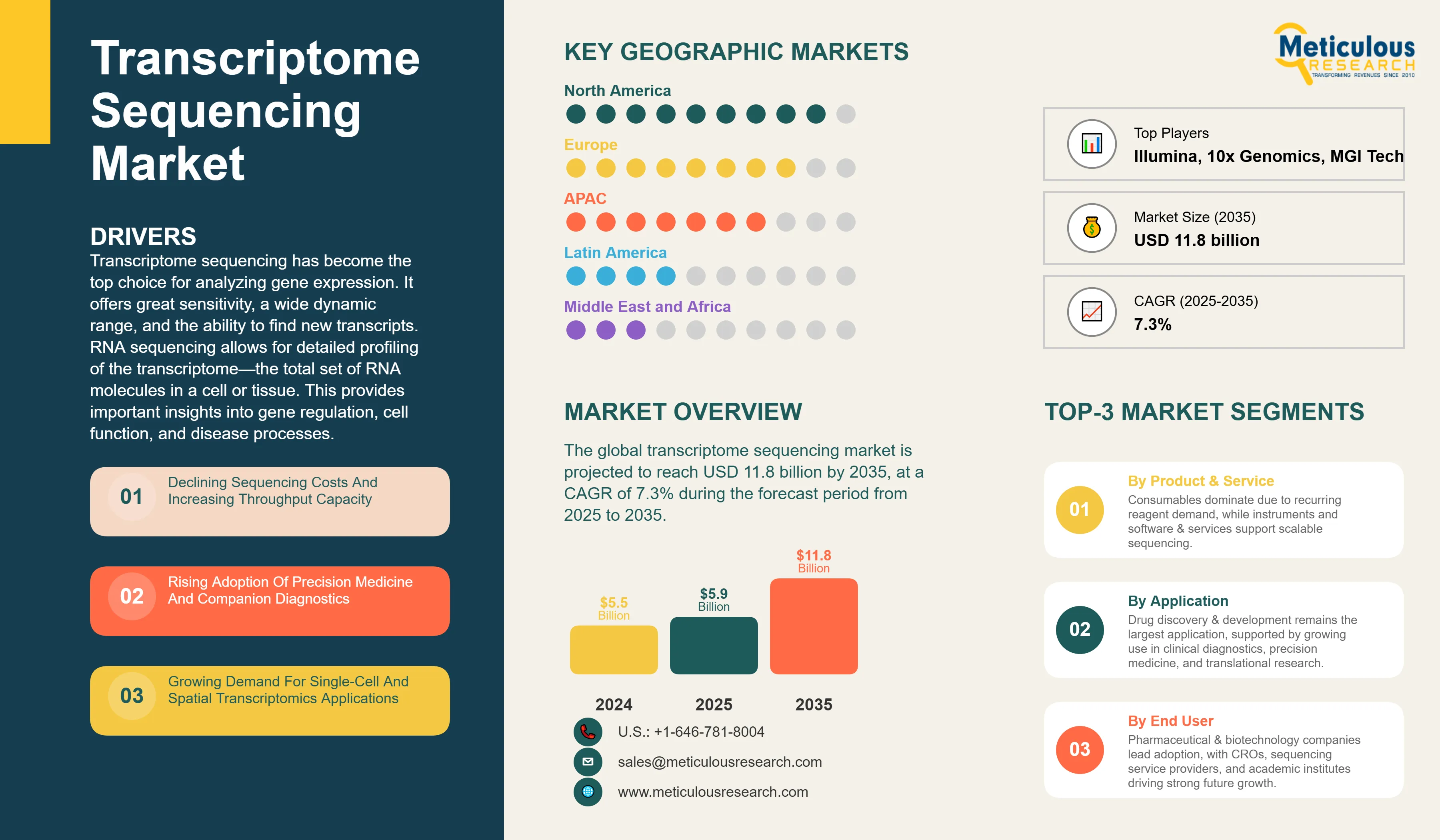
The global transcriptome sequencing market is projected to reach USD 11.8 billion by 2035 from an estimated USD 5.9 billion in 2025, at a CAGR of 7.3% during the forecast period from 2025 to 2035.
Transcriptome sequencing has become the top choice for analyzing gene expression. It offers great sensitivity, a wide dynamic range, and the ability to find new transcripts. RNA sequencing allows for detailed profiling of the transcriptome—the total set of RNA molecules in a cell or tissue. This provides important insights into gene regulation, cell function, and disease processes. Unlike older microarray technologies, modern transcriptome sequencing platforms provide whole-genome coverage, find splice variants and fusion genes, and uncover previously unknown transcripts. The technology includes various methods such as bulk RNA sequencing for looking at population-level gene expression, single-cell RNA sequencing for studying cell diversity, spatial transcriptomics for mapping gene expression in tissues, and long-read sequencing for characterizing full-length transcripts.
Key factors driving this market include falling sequencing costs and higher throughput capacity. There is a rising interest in precision medicine and companion diagnostics, along with growing demand for single-cell and spatial transcriptomics. Investment in drug discovery and biomarker development is also increasing. Sequencing costs have dropped significantly since 2008, far exceeding Moore's Law. Illumina's NovaSeq X Series targets a $200 genome, while Ultima Genomics' UG 100 Solaris, announced in February 2025, offers prices as low as $0.24 per million reads. Throughput has increased as well; Illumina reports up to 16 Tb per run on the NovaSeq X Plus and up to 26 billion single reads per flow cell. This allows for large population projects to be completed in shorter timeframes.
In August 2024, the FDA approved Illumina's TruSight Oncology Comprehensive (TSO) test. This test can profile over 500 genes, including RNA fusions like NTRK and RET. It serves as a companion diagnostic for targeted therapies, highlighting RNA sequencing's expanding role in clinical oncology. Large initiatives, like the NIH's All of Us Research Program, which has enrolled over 633,000 participants and sequenced more than 414,000 whole genomes, show how personalized medicine is progressing. In February 2025, the Chan Zuckerberg Initiative started the Billion Cells Project with 10x Genomics and Ultima Genomics. This project aims to analyze over one billion cells to develop advanced AI models for disease research.
With the rise of long-read sequencing technologies for full-length transcript analysis, the integration of AI and machine learning in transcriptome data analysis, and increasing use in clinical diagnostics and liquid biopsy, the transcriptome sequencing market is set to grow significantly. However, challenges remain. High capital investments are needed for sequencing infrastructure. The complexity of bioinformatics data analysis and interpretation, along with a shortage of skilled bioinformatics professionals and issues with standardization across sequencing platforms and workflows, could slow market growth.
Click here to: Get Free Sample Pages of this Report
Declining Sequencing Costs and Increasing Throughput Capacity
The sharp drop in sequencing costs is a major factor boosting the transcriptome sequencing market. Since 2008, sequencing costs have decreased much more quickly than Moore's Law predicted. NHGRI has tracked a steady reduction in the cost per genome across its funded centers. Illumina's NovaSeq X Series aims for a $200 genome at list price on its 25B flow cell and can process over 20,000 genomes per year on NovaSeq X Plus. Meanwhile, Ultima Genomics introduced UG 100 Solaris in February 2025. This platform offers 10 to 12 billion reads per wafer, with prices as low as $0.24 per million reads (about $80 per genome at 30×) and the capacity for over 30,000 genomes per year.
On the ultra-high-throughput side, Complete Genomics' DNBSEQ T20×2 claims it can process around 50,000 genomes per year and offers a path to reagent costs under $100 through dip immersion biochemistry and reagent reuse. Throughput has also increased, with Illumina reporting up to 16 Tb per run on NovaSeq X Plus (dual flow cell) and up to 26B single reads per flow cell. This allows for population-scale projects to be completed more quickly. Long-read platforms are also closing the price gap. PacBio Revio with SPRQ chemistry can report about 2,500 human genomes per year at just under $500 per genome. It also reduces DNA input to 500 ng while enhancing methylation calling for multiomic insights in every run. Together, these factors are speeding up transcriptome and genome programs from discovery to clinical application.
Rising Adoption of Precision Medicine and Companion Diagnostics
Precision medicine is quickly becoming essential in modern healthcare, with transcriptome sequencing playing a vital role in this change. By examining gene expression patterns, doctors can better understand disease mechanisms and choose treatments tailored to individual patients. Large initiatives such as the NIH's All of Us Research Program have already enrolled over 633,000 participants and sequenced more than 414,000 whole genomes, highlighting the rapid progress in personalized medicine.
Companion diagnostics are crucial to this shift. These tests help determine treatment options by matching patients with targeted therapies based on their molecular profiles. A significant milestone was reached in August 2024 when the FDA approved Illumina's TruSight Oncology Comprehensive (TSO) test. This panel can analyze over 500 genes, including RNA fusions like NTRK and RET, and acts as a companion diagnostic for treatments like VITRAKVI and RETEVMO. This illustrates the increasing importance of RNA sequencing in clinical oncology. Pharmaceutical companies are also incorporating companion diagnostics into their drug development processes. In 2024, QIAGEN expanded its partnership with AstraZeneca to create rapid diagnostic tools for chronic diseases using the QIAstat-Dx platform, which provides results during regular clinical visits.
Growing Demand for Single-Cell and Spatial Transcriptomics Applications
Single-cell RNA sequencing is transforming research by allowing scientists to study individual cells rather than averaging signals across thousands. This capability is critical for understanding cancer, immune disorders, and neurological diseases, where cell-to-cell differences drive treatment outcomes. In February 2025, the Chan Zuckerberg Initiative launched the Billion Cells Project with 10x Genomics and Ultima Genomics, aiming to analyze over one billion cells to build advanced AI models for disease research. New platforms like Parse Biosciences' GigaLab, which can process up to 10 million cells in a single run and scale to 2.5 billion cells annually, and CS Genetics' SimpleCell kit, enabling same-day analysis of 96 samples, are making single-cell studies faster and more accessible.
Spatial transcriptomics is gaining momentum as well. Unlike traditional sequencing, it preserves tissue architecture, showing not only which genes are active but where they are active. This is crucial for mapping tumor microenvironments, brain regions, and developmental processes. Leading platforms such as 10x Genomics' Visium HD, launched in 2024, deliver whole-transcriptome spatial analysis at near single-cell resolution, while Bruker's CosMx and GeoMx systems expanded in 2025 to include whole-transcriptome panels and 1,000-plex protein assays, pushing the boundaries of multi-modal tissue profiling.
Transcriptome Sequencing Market Opportunity
Integration of AI and Machine Learning in Transcriptome Data Analytics
Artificial intelligence is changing how we analyze transcriptome data. It makes the process faster and provides deeper insights. AI-driven tools now support every part of the workflow, from experimental design and automation to understanding complex sequencing data. Deep learning models help researchers tackle challenges in single-cell and spatial transcriptomics. They address issues like sparse data and batch effects by combining multiple data types for richer insights.
New developments are making analysis easier to access. In 2025, Nature Biotechnology featured CellWhisperer. This tool uses multimodal learning and natural language interfaces to allow scientists to query single-cell RNA sequencing data in a conversational way. This represents a significant step towards making data exploration more available to everyone. AI is also speeding up drug discovery by identifying biomarkers and predicting treatment responses. A notable example is the Illumina-NVIDIA partnership announced in May 2025. This collaboration combines Illumina's DRAGEN platform with NVIDIA's BioNeMo AI framework. It increases multiomics data processing speeds by 5 to 10 times, which greatly reduces time-to-insight for researchers and clinicians.
Transcriptome Sequencing Market Analysis: Top Market Opportunities
By Product & Service: The Consumables Segment Dominated the Transcriptome Sequencing Market in 2025
Based on product & service, the transcriptome sequencing market is segmented into consumables, instruments, and software & services. In 2025, the consumables segment accounted for the largest share of 51.4% of the transcriptome sequencing market with the fastest CAGR of 8.1% during the forecast period. The recurring nature of reagent and kit purchases required for ongoing sequencing operations, repeated usage of high-quality reagents in transcriptome studies, and expansion of sequencing applications across pharmaceutical, biotechnology, and academic research sectors contribute to the segment's large share. Key players are introducing advanced consumables to fulfill researchers' requirements. For instance, in May 2024, QIAGEN launched its QIAseq Multimodal DNA/RNA Library Kit, enabling researchers to prepare DNA and RNA libraries from a single sample.
However, the software & services segment is projected to register significant growth during the forecast period. The segment's growth is driven by increasing demand for bioinformatics expertise, AI-powered data analysis tools, and outsourced sequencing services that enable organizations without in-house capabilities to access advanced transcriptome analysis.
By Technology: The Bulk RNA-seq Segment Dominated the Transcriptome Sequencing Market in 2025
Based on technology, the transcriptome sequencing market is segmented into bulk RNA-seq, single-cell RNA-seq, spatial transcriptomics, long-read RNA sequencing, and small RNA sequencing. In 2025, the bulk RNA-seq segment accounted for the largest share of the transcriptome sequencing market. Bulk RNA-seq represents the most mature, standardized, and cost-effective transcriptomic technology available today. It has been widely adopted across academic research, pharmaceutical R&D, and clinical translational studies due to its robust workflows, reproducibility, and relatively straightforward data analysis. It enables high-throughput gene expression profiling across large sample cohorts, making it well suited for population-level studies, biomarker discovery, toxicology, and drug response analysis.
However, the spatial transcriptomics segment is the fastest-growing segment during the forecast period. The segment's fast growth is due to its ability to overcome the key limitation of traditional RNA-seq methods—loss of spatial context. Spatial transcriptomics enables researchers to measure gene expression while preserving the physical location of cells within tissues, providing critical insights into tissue heterogeneity, tumor microenvironments, neurobiology, and developmental biology.
By Application: The Drug Discovery & Development Segment Dominated the Transcriptome Sequencing Market in 2025
Based on application, the transcriptome sequencing market is segmented into drug discovery & development, clinical diagnostics, personalized medicine & companion diagnostics, basic & translational research, agricultural & veterinary research, and other applications. In 2025, the drug discovery & development segment accounted for the largest share of the transcriptome sequencing market. Pharmaceutical and biotechnology companies leverage RNA sequencing technologies extensively for target identification and validation, biomarker discovery, and toxicogenomics studies. The technology enables more precise gene expression profiling, facilitating the development of targeted therapies, particularly in oncology, neurology, and immunology.
However, the basic & translational research segment is projected to register the highest CAGR during the forecast period. This growth is driven by the rapid expansion of academic, government-funded, and collaborative research initiatives aimed at understanding disease biology at a molecular level.
By End User: The Pharmaceutical & Biotechnology Companies Segment Dominated the Transcriptome Sequencing Market in 2025
Based on end user, the transcriptome sequencing market is segmented into pharmaceutical & biotechnology companies, academic & research institutes, clinical diagnostic laboratories, contract research organizations (CROs) & sequencing service providers, and other end users. In 2025, the pharmaceutical & biotechnology companies segment accounted for the largest share of 34% of the transcriptome sequencing market. Transcriptomic data has become a strategic asset across the entire drug development lifecycle. These companies use RNA sequencing extensively for target discovery, biomarker identification, patient stratification, mechanism-of-action studies, toxicity profiling, and response monitoring.
However, the contract research organizations (CROs) & sequencing service providers segment is projected to register the highest CAGR of 8.9% during the forecast period due to the industry-wide shift toward outsourcing and flexible R&D models.
North America Dominated the Transcriptome Sequencing Market in 2025
Based on geography, the transcriptome sequencing market is segmented into North America, Europe, Asia-Pacific, Latin America, and the Middle East & Africa. In 2025, North America accounted for the largest share of 40% of the transcriptome sequencing market. North America's large share is attributed to its early adoption of advanced genomic technologies, strong life sciences ecosystem, and sustained investment in biomedical research. The region is home to a high concentration of pharmaceutical and biotechnology companies, leading academic institutions, and major sequencing technology providers, which collectively drive large-scale and continuous demand for transcriptome sequencing. Robust public and private research funding, particularly in the U.S., supports extensive use of RNA sequencing across drug discovery, clinical research, and translational studies.
However, the Asia-Pacific region is projected to register the highest CAGR during the forecast period. This growth is driven by rapid expansion of genomics infrastructure, research capacity, and healthcare investment across countries such as China, India, Japan, South Korea, and Australia. Governments in the region are increasingly funding national genomics initiatives, precision medicine programs, and population-scale research projects, which are significantly boosting adoption of transcriptome sequencing technologies.
Key Companies
Some of the prominent players operating in the transcriptome sequencing market are Illumina, Inc. (U.S.), Thermo Fisher Scientific Inc. (U.S.), Pacific Biosciences of California, Inc. (U.S.), Oxford Nanopore Technologies plc (U.K.), 10x Genomics, Inc. (U.S.), QIAGEN N.V. (Netherlands), Agilent Technologies, Inc. (U.S.), F. Hoffmann-La Roche Ltd (Switzerland), Bio-Rad Laboratories, Inc. (U.S.), Takara Bio Inc. (Japan), Becton, Dickinson and Company (U.S.), Standard BioTools Inc. (U.S.), Element Biosciences, Inc. (U.S.), MGI Tech Co., Ltd. (China), and Singular Genomics Systems, Inc. (U.S.).
|
Particulars |
Details |
|
Number of Pages |
311 |
|
Format |
|
|
Forecast Period |
2025–2035 |
|
Base Year |
2024 |
|
CAGR (Value) |
7.3% |
|
Market Size (Value) in 2025 |
USD 5.9 Billion |
|
Market Size (Value) in 2035 |
USD 11.8 Billion |
|
Segments Covered |
By Product & Service
By Technology
By Application
By End User
|
|
Countries Covered |
North America (U.S., Canada), Europe (Germany, France, U.K., Italy, Spain, and Rest of Europe), Asia-Pacific (China, India, Japan, South Korea, Australia, and Rest of Asia-Pacific), Latin America (Brazil, Mexico, and Rest of Latin America), and Middle East & Africa |
|
Key Companies |
Illumina, Inc. (U.S.), Thermo Fisher Scientific Inc. (U.S.), Pacific Biosciences of California, Inc. (U.S.), Oxford Nanopore Technologies plc (U.K.), 10x Genomics, Inc. (U.S.), QIAGEN N.V. (Netherlands), Agilent Technologies, Inc. (U.S.), F. Hoffmann-La Roche Ltd (Switzerland), Bio-Rad Laboratories, Inc. (U.S.), Takara Bio Inc. (Japan), Becton, Dickinson and Company (U.S.), Standard BioTools Inc. (U.S.), Element Biosciences, Inc. (U.S.), MGI Tech Co., Ltd. (China), and Singular Genomics Systems, Inc. (U.S.) |
The global transcriptome sequencing market size is projected to reach USD 5.9 billion in 2025.
The market is projected to grow from USD 5.9 billion in 2025 to USD 11.8 billion by 2035, at a CAGR of 7.3%.
The transcriptome sequencing market analysis indicates substantial growth, with projections indicating the market will reach USD 11.8 million by 2035, at a compound annual growth rate (CAGR) of 7.3% from 2025 to 2035.
The key companies operating in this market include Illumina, Inc. (U.S.), Thermo Fisher Scientific Inc. (U.S.), Pacific Biosciences of California, Inc. (U.S.), Oxford Nanopore Technologies plc (U.K.), 10x Genomics, Inc. (U.S.), QIAGEN N.V. (Netherlands), Agilent Technologies, Inc. (U.S.), and others.
Single-cell RNA sequencing revolutionizing cellular heterogeneity research, spatial transcriptomics enabling tissue-level gene expression mapping, and multi-omics integration combining transcriptomics with proteomics and metabolomics are prominent trends in the transcriptome sequencing market.
By product & service, the consumables segment is forecasted to hold the largest market share during 2025-2035; by technology, the bulk RNA-seq segment is expected to dominate; by application, the drug discovery & development segment is expected to hold the largest share; by end user, the pharmaceutical & biotechnology companies segment is expected to dominate; and by geography, North America is expected to hold the largest share of the market during 2025-2035.
By region, North America held the largest share of the transcriptome sequencing market in 2025. The large share is attributed to early adoption of advanced genomic technologies, strong life sciences ecosystem, and sustained investment in biomedical research. However, Asia-Pacific is expected to register the highest growth rate during the forecast period, driven by rapid expansion of genomics infrastructure and increasing government funding for precision medicine programs.
Key drivers include declining sequencing costs and increasing throughput capacity, rising adoption of precision medicine and companion diagnostics, growing demand for single-cell and spatial transcriptomics applications, and increasing investment in drug discovery and biomarker development programs. These factors are collectively driving the adoption of transcriptome sequencing across applications.















Published Date: Jun-2025
Published Date: Aug-2024
Please enter your corporate email id here to view sample report.
Subscribe to get the latest industry updates


