Resources
About Us
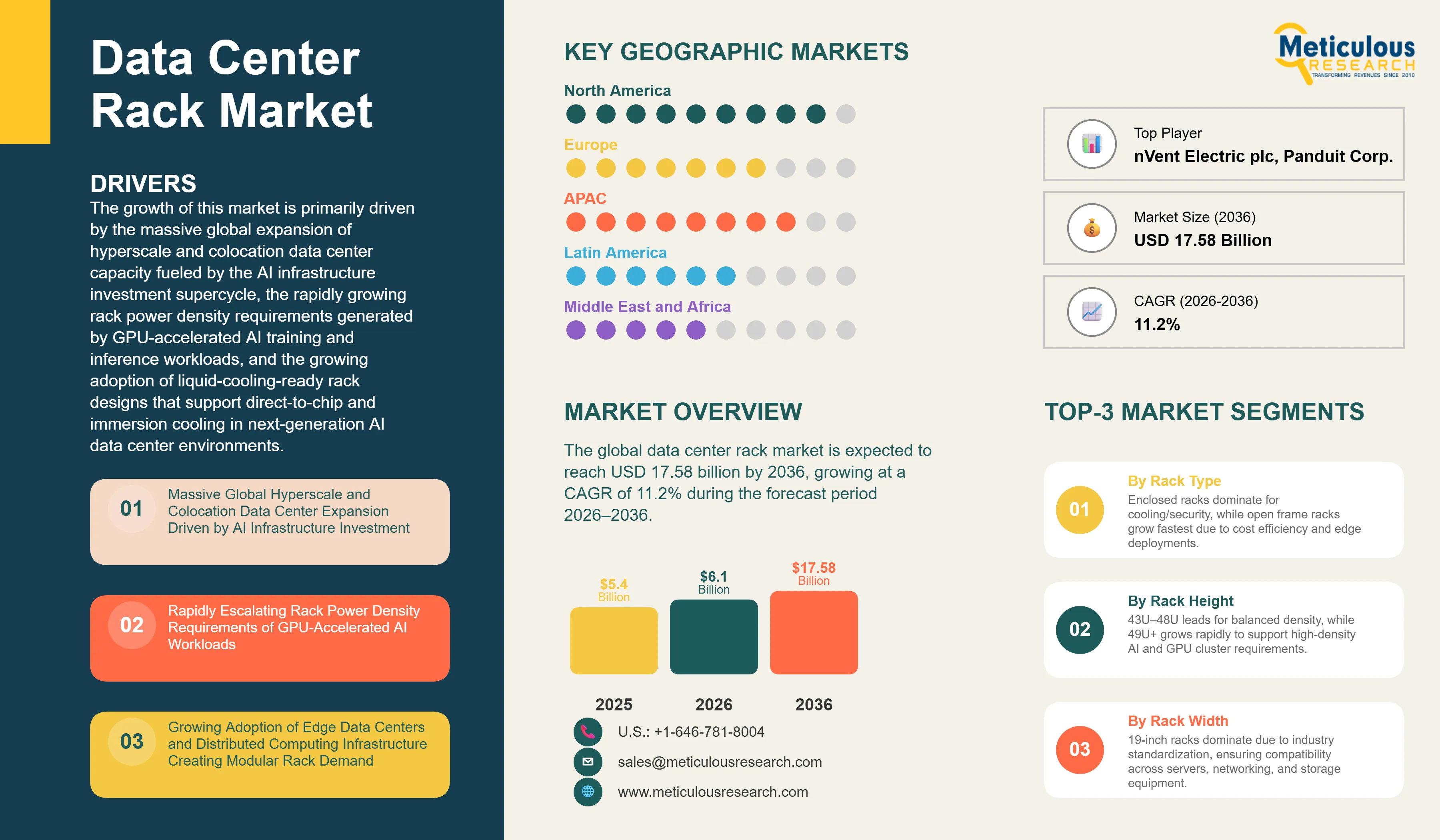
The global data center rack market was valued at USD 5.40 billion in 2025. This market is expected to reach USD 17.58 billion by 2036 from an estimated USD 6.10 billion in 2026, growing at a CAGR of 11.2% during the forecast period 2026–2036.
The growth of this market is primarily driven by the massive global expansion of hyperscale and colocation data center capacity fueled by the AI infrastructure investment supercycle, the rapidly growing rack power density requirements generated by GPU-accelerated AI training and inference workloads, and the growing adoption of liquid-cooling-ready rack designs that support direct-to-chip and immersion cooling in next-generation AI data center environments.
However, supply chain disruptions from tariffs on steel and aluminum components, integration complexity with legacy infrastructure during rack upgrades, and the high capital cost of premium AI-ready rack configurations restrain the growth of this market.
The growing transition from standard 42U rack heights to taller 48U and above configurations to accommodate AI GPU cluster deployments, the growing procurement of pre-integrated and prefabricated modular rack systems that reduce data center deployment timelines, and the rising adoption of intelligent smart rack monitoring platforms with IoT-based real-time power and thermal sensors offer significant market growth opportunities for stakeholders.
Furthermore, the proliferation of edge computing deployments requiring modular, rapidly deployable rack infrastructure in space-constrained environments is a major trend shaping this market.
 Click here to: Get Free Sample Pages of this Report
The global data center rack market covers standardized enclosures and mounting systems used to house, organize, and protect IT equipment in data centers. It includes enclosed cabinets, open frame racks, wall-mounted enclosures, and associated accessories such as cable management systems, blanking panels, rack power distribution units (PDUs), mounting hardware, and cooling components, forming the structural backbone of hyperscale, colocation, enterprise, and edge data center environments.
The data center rack market is at a structural inflection point, driven by the accelerating AI infrastructure investment cycle. According to JLL’s 2026 Global Data Center Outlook, the sector is projected to witness nearly USD 3 trillion in investments between 2026 and 2030, with close to 100 gigawatts of new capacity expected to come online, effectively doubling global capacity.
This significant expansion is creating a strong demand cycle for rack infrastructure, as every megawatt of deployed capacity requires standardized and high-performance rack systems. At the same time, the rapid emergence of AI GPU clusters is reshaping rack design requirements. While conventional racks were designed for power densities of 5–15 kW per rack, next-generation AI workloads demand significantly higher densities of 60–140+ kW per rack.
This shift is driving the adoption of purpose-built, high-density rack architectures featuring reinforced structural designs, integrated liquid-cooling compatibility, high-capacity power distribution systems, and advanced monitoring capabilities.
|
Parameters |
Details |
|
Market Size by 2036 |
USD 17.58 Billion |
|
Market Size in 2026 |
USD 6.10 Billion |
|
Market Size in 2025 |
USD 5.40 Billion |
|
Revenue Growth Rate (2026–2036) |
CAGR of 11.2% |
|
Dominating Rack Type |
Enclosed Racks/Cabinets |
|
Fastest Growing Rack Type |
Open Frame Racks |
|
Dominating Rack Height |
43U–48U |
|
Fastest Growing Rack Height |
49U & Above |
|
Dominating Rack Width |
19-Inch |
|
Dominating Application |
Servers |
|
Fastest Growing Application |
Networking Equipment |
|
Dominating End User |
Colocation Data Centers |
|
Fastest Growing End User |
Cloud Service Providers & Hyperscalers |
|
Dominating Geography |
North America |
|
Fastest Growing Geography |
Asia Pacific |
|
Base Year |
2025 |
|
Forecast Period |
2026 to 2036 |
AI-Ready Rack Designs Becoming a Distinct Premium Product Category
The development of rack enclosures specifically engineered for AI GPU cluster deployments is giving rise to a distinct and rapidly expanding premium segment within the data center rack market. These advanced racks incorporate reinforced structural frameworks capable of supporting loads exceeding 2,000 kg, compared to 600–1,200 kg for conventional racks, along with integrated direct-to-chip liquid-cooling compatibility, high-capacity power distribution architectures (including busway and 800V DC systems), and embedded thermal monitoring at the server inlet level.
This evolution indicates a broader shift toward high-density, AI-optimized infrastructure. Leading vendors such as Vertiv Holdings Co., Schneider Electric SE, and Rittal GmbH & Co. KG are actively introducing AI-ready rack solutions, commanding significantly higher average selling prices compared to standard configurations. As AI workloads scale, these premium, high-density racks are expected to account for a growing share of overall market revenue during the forecast period.
Pre-Integrated Modular Rack Systems Reducing Data Center Deployment Timelines
The increasing adoption of pre-integrated rack systems, where racks or aisle-level pods are delivered pre-configured with PDUs, cable management components, blanking panels, and, in some cases, pre-installed IT equipment, is emerging as a standard approach among hyperscale operators aiming to significantly reduce data center deployment timelines. This model enables compression of deployment cycles from several months to a few weeks, particularly for AI-driven infrastructure builds.
Leading vendors such as Schneider Electric SE (EcoStruxure prefabricated modules), Vertiv Holdings Co. (SmartAisle solutions), and Eaton Corporation plc (modular power enclosures, strengthened through the 2025 Fiberbond acquisition) are advancing factory-integrated rack solutions that are pre-assembled and tested prior to deployment, thereby reducing on-site labor requirements and commissioning time.
Strategic developments, such as the Eaton–Flexnode collaboration announced in 2026, aimed at accelerating deployment for AI, high-performance computing (HPC), and emerging workloads, further highlight the market’s transition toward modular, factory-built, and rapidly deployable rack infrastructure solutions.
Smart Rack Monitoring with IoT and AI-Driven Facility Management Integration
The integration of intelligent monitoring capabilities into rack enclosures is transforming data center racks from passive infrastructure into active, data-generating nodes within the broader digital ecosystem. Modern racks increasingly incorporate rack-level power monitoring (down to outlet or device level), inlet and exhaust temperature sensing, access control systems, vibration monitoring, and integrated environmental sensors, enabling real-time visibility into operational conditions.
These capabilities allow seamless integration with DCIM platforms, supporting predictive capacity planning, real-time energy optimization, and automated fault detection. Leading vendors such as Schneider Electric SE (EcoStruxure IT Expert), Vertiv Holdings Co. (Avocent and Geist ecosystems), and Panduit Corp. (SmartZone intelligent PDUs) are embedding advanced monitoring functionalities at the rack level to enhance operational intelligence.
In parallel, the adoption of digital twin technologies is further advancing rack-level intelligence. Initiatives such as the collaboration between Schneider Electric SE, ETAP, and NVIDIA Corporation in 2025 demonstrate the growing use of chip-level dynamic power modeling at rack densities exceeding 130 kW. This trend is driving demand for racks with native sensor integration capable of feeding high-resolution data into AI-driven facility management and optimization systems.
By Rack Type: In 2026, the Enclosed Racks/Cabinets Segment to Dominate the Global Data Center Rack Market
Based on rack type, the global data center rack market is segmented into enclosed racks/cabinets, open frame racks, and wall-mounted racks.
In 2026, the enclosed racks/cabinets segment is expected to account for the largest share of the global data center rack market. The large share of this segment is attributed to the superior thermal management capability of enclosed cabinet designs, which enable precise hot- and cold-aisle containment, compatibility with rear-door heat exchangers, and integration with liquid cooling manifold systems, that make them the preferred choice for high-density AI and HPC server deployments in hyperscale and colocation data center environments.
Cabinet enclosures also provide physical security, dust protection, structured cable management, and noise reduction that are mandatory requirements in multi-tenant colocation facilities.
However, the open frame racks segment is projected to register the highest CAGR during the forecast period. The high growth of this segment is driven by the increasing deployment of edge data centers, telecom central offices, and distributed computing nodes where open frame racks' lower cost, lighter weight, easy physical access for maintenance, and modular flexibility make them the preferred choice for high-volume, distributed deployment scenarios.
By Rack Height: In 2026, the 43U–48U Segment to Hold the Largest Share
Based on rack height, the global data center rack market is segmented into 42U and below, 43U–48U, and 49U and above.
In 2026, the 43U–48U segment is expected to account for the largest share of approximately 40–45% of the global data center rack market. This dominance is primarily attributed to the 48U format’s optimal balance between compute density and operational accessibility, offering additional vertical capacity over the traditional 42U standard without requiring significant facility-level modifications. Its widespread adoption across hyperscale, colocation, and enterprise data centers further supports its leading position, particularly in environments undergoing high-density server upgrades.
However, the 49U and above segment is projected to register the highest CAGR during the forecast period. This growth is driven by increasing demand for taller rack configurations in AI GPU cluster deployments, where additional vertical space is required to accommodate top-of-rack switches, liquid-cooling infrastructure, high-capacity power distribution systems, and advanced cable management. These requirements are often difficult to address within standard 42U or 48U configurations without limiting usable server capacity, thereby accelerating the shift toward taller rack formats.
By Application: In 2026, the Servers Segment to Account for the Largest Share
Based on application, the global data center rack market is segmented into servers, networking equipment, storage devices, and other applications including PDUs, patch panels, and KVM systems.
In 2026, the servers segment is expected to account for the largest share of the global data center rack market, driven by the high volume of server deployments across hyperscale, colocation, and enterprise data centers, as well as the premium pricing of AI-ready rack enclosures designed for GPU-intensive workloads. This segment includes both conventional CPU-based server racks and next-generation AI GPU rack systems, which command higher average selling prices due to enhanced structural strength, thermal management, and power distribution requirements.
However, the networking equipment segment is projected to register the highest CAGR during the forecast period. This growth is primarily driven by the rapid expansion of high-performance AI networking infrastructure, including 400G and 800G Ethernet-based spine-leaf architectures and InfiniBand switching systems. These deployments increasingly require dedicated rack configurations to isolate high-density networking equipment from server racks, enabling optimized cooling, power distribution, and operational efficiency.
By End User: In 2026, the Colocation Data Centers Segment to Hold the Largest Share
Based on end user, the global data center rack market is segmented into colocation data centers, cloud service providers and hyperscalers, enterprises, telecom operators, government and defense, and other end users.
In 2026, the colocation data centers segment is expected to account for the largest share of the global data center rack market. This dominance is driven by the large-scale rack deployments across global colocation facilities, which represent a significant portion of total data center capacity worldwide. Additionally, colocation providers are increasingly investing in AI-ready rack infrastructure to attract hyperscale tenants and enterprise customers upgrading their AI and cloud environments.
However, the cloud service providers and hyperscalers segment is projected to register the highest CAGR during the forecast period. This growth is primarily driven by large-scale AI-focused data center expansion programs undertaken by leading cloud companies such as Amazon.com, Inc., Microsoft Corporation, Alphabet Inc., Meta Platforms, Inc., and Oracle Corporation.
Rising hyperscale capital expenditure and the increasing adoption of high-density, AI-optimized rack configurations, characterized by higher power and cooling requirements, are contributing to significantly higher per-unit rack spending compared to traditional colocation and enterprise deployments.
Based on geography, the global data center rack market is segmented into North America, Europe, Asia Pacific, Latin America, and the Middle East and Africa.
In 2026, North America is expected to account for the largest share of the global data center rack market, driven by the highest global concentration of hyperscale data center deployments, strong U.S. hyperscale capital expenditure growth, and the leading role of North America‑headquartered cloud providers, including Amazon, Microsoft, Google, and Meta, as primary drivers of AI rack procurement. The strong presence of major rack manufacturers such as Schneider Electric, Vertiv, Eaton, and Legrand, with established North American supply chains, further drives its dominant position.
However, Asia Pacific is expected to register the highest growth rate over the forecast period, fueled by massive data center capacity expansion across China, India, Japan, Singapore, and Southeast Asia; aggressive government‑led digital‑infrastructure initiatives, including India’s IndiaAI‑oriented AI‑infrastructure push and Japan’s large‑scale digital and AI‑infrastructure strategy; and the surge in enterprise and cloud AI adoption, driving continuous rack‑procurement volumes. India’s data center capacity is projected to grow by several gigawatts between 2024 and 2030, indicating a substantial greenfield rack‑procurement opportunity. China’s domestic AI data center investment, driven by Huawei Ascend‑based cluster deployments and government‑backed AI‑infrastructure programs, is generating continuous high‑volume rack procurement despite export‑control restrictions on U.S. GPU hardware.
The global data center rack market is moderately consolidated, especially within the premium segment, where competition is focused on high-density load-bearing capability, liquid-cooling integration, intelligent monitoring features, global supply chain reach, and the ability to deliver pre-integrated, factory-assembled rack solutions that reduce deployment timelines.
Schneider Electric SE leads the market with its NetShelter portfolio and AI-ready rack solutions, driven by a strong global presence across hyperscale and colocation customers. Vertiv Holdings Co. competes with its VR series cabinets and SmartAisle solutions, leveraging tight integration with its power and cooling systems. Eaton Corporation plc is strengthening its position through modular and prefabricated infrastructure capabilities, driven by strategic developments such as the Fiberbond acquisition and Flexnode collaboration. Rittal GmbH & Co. KG maintains a strong presence in Europe and industrial-focused deployments with its TS IT platform.
The report provides a detailed competitive assessment based on product portfolios, geographic presence, and key strategic developments over the past few years. Key players operating in the global data center rack market include Schneider Electric SE (France), Vertiv Holdings Co. (U.S.), Eaton Corporation plc (Ireland), Legrand SA (France), Rittal GmbH & Co. KG (Germany), nVent Electric plc (U.K./U.S.), Panduit Corp. (U.S.), Chatsworth Products, Inc. (U.S.), Belden Inc. (U.S.), Hammond Manufacturing Ltd. (Canada), Great Lakes Case & Cabinet Co., Inc. (U.S.), Emerson Electric Co. (U.S.), Dell Technologies Inc. (U.S.), Hewlett Packard Enterprise Company (U.S.), and Tripp Lite (U.S.) among others.
The global data center rack market is expected to reach USD 17.58 billion by 2036 from an estimated USD 6.10 billion in 2026, at a CAGR of 11.2% during the forecast period 2026–2036.
In 2026, the enclosed racks/cabinets segment is expected to hold the largest share of the global data center rack market.
The open frame racks segment is expected to register the highest CAGR during the forecast period 2026–2036, driven by accelerating deployment of edge data centers and distributed computing infrastructure.
In 2026, the 43U–48U segment is expected to hold the largest share of the global data center rack market.
In 2026, the colocation data centers segment is expected to hold the largest share of the global data center rack market.
The growth of this market is primarily driven by the massive global expansion of hyperscale and colocation data center capacity fueled by the AI infrastructure investment supercycle, rapidly escalating rack power density requirements of GPU-accelerated AI workloads, and the growing adoption of liquid-cooling-ready rack designs.
Key players operating in the global data center rack market include Schneider Electric SE (France), Vertiv Holdings Co. (U.S.), Eaton Corporation plc (Ireland), Legrand SA (France), Rittal GmbH & Co. KG (Germany), nVent Electric plc (U.K./U.S.), Panduit Corp. (U.S.), Chatsworth Products, Inc. (U.S.), Belden Inc. (U.S.), Hammond Manufacturing Ltd. (Canada), Great Lakes Case & Cabinet Co., Inc. (U.S.), Emerson Electric Co. (U.S.), Dell Technologies Inc. (U.S.), Hewlett Packard Enterprise Company (U.S.), and Tripp Lite (U.S.).
Asia Pacific is expected to register the highest growth rate in the global data center rack market during the forecast period 2026–2036.
1. Introduction
1.1 Market Definition and Scope
1.2 Market Ecosystem
1.3 Currency and Limitations
1.3.1 Currency
1.3.2 Limitations
1.4 Key Stakeholders
2. Research Methodology
2.1 Research Approach
2.2 Data Collection & Validation Process
2.2.1 Secondary Research
2.2.2 Primary Research & Validation
2.2.2.1 Primary Interviews with Experts
2.2.2.2 Country-/Region-Level Analysis
2.3 Market Estimation
2.3.1 Bottom-Up Approach
2.3.2 Top-Down Approach
2.4 Data Triangulation
2.5 Assumptions for the Study
3. Executive Summary
3.1 Market Overview
3.2 Market Analysis by Rack Type
3.3 Market Analysis by Rack Height
3.4 Market Analysis by Rack Width
3.5 Market Analysis by Rack Depth
3.6 Market Analysis by Material
3.7 Market Analysis by Application
3.8 Market Analysis by End User
3.9 Market Analysis by Geography
4. Market Dynamics
4.1 Overview
4.2 Drivers
4.2.1 Massive Global Hyperscale and Colocation Data Center Expansion Driven by AI Infrastructure Investment
4.2.2 Rapidly Escalating Rack Power Density Requirements of GPU-Accelerated AI Workloads
4.2.3 Growing Adoption of Edge Data Centers and Distributed Computing Infrastructure Creating Modular Rack Demand
4.2.4 Rising Regulatory Requirements for Data Localization and Business Continuity Driving New Data Center Construction
4.3 Restraints
4.3.1 Supply Chain Disruptions from Tariffs on Steel, Aluminum, and Rack Components Increasing Landed Costs
4.3.2 Integration Complexity with Legacy Rack Infrastructure During High-Density Upgrade Programs
4.4 Opportunities
4.4.1 Rising Adoption of Pre-Integrated Modular Rack Systems Reducing Data Center Deployment Timelines
4.4.2 Smart Rack Integration with IoT Monitoring and AI-Driven Facility Management Platforms
4.4.3 Transition to Liquid-Cooling-Ready Rack Architectures for AI and HPC Deployments
4.5 Challenges
4.5.1 Physical and Structural Facility Constraints Limiting Adoption of Taller and Heavier AI Rack Configurations
4.5.2 Shortage of Skilled Technicians for High-Density Rack Integration and Liquid Cooling System Installation
4.6 Porter’s Five Forces Analysis
5. Data Center Rack Market, by Rack Type
5.1 Overview
5.2 Enclosed Racks/Cabinets
5.3 Open Frame Racks
5.4 Wall-Mounted Racks
6. Data Center Rack Market, by Rack Height
6.1 Overview
6.2 42U & Below
6.3 43U–48U
6.4 49U & Above
7. Data Center Rack Market, by Rack Width
7.1 Overview
7.2 19-Inch Racks
7.3 23-Inch Racks
7.4 Other Widths (Custom Sizes)
8. Data Center Rack Market, by Rack Depth
8.1 Overview
8.2 600 mm–1000 mm
8.3 1001 mm–1200 mm
8.4 Above 1200 mm
9. Data Center Rack Market, by Material
9.1 Overview
9.2 Steel
9.3 Aluminum
9.4 Composite and Other Alloys
10. Data Center Rack Market, by Application
10.1 Overview
10.2 Servers
10.3 Networking Equipment
10.4 Storage Devices
10.5 Other Applications (PDUs, Patch Panels, KVM Systems)
11. Data Center Rack Market, by End User
11.1 Overview
11.2 Colocation Data Centers
11.3 Cloud Service Providers & Hyperscalers
11.4 Enterprises
11.5 Telecom Operators
11.6 Government & Defense
11.7 Other End Users
12. Data Center Rack Market, by Geography
12.1 Overview
12.2 North America
12.2.1 U.S.
12.2.2 Canada
12.3 Europe
12.3.1 Germany
12.3.2 U.K.
12.3.3 France
12.3.4 Italy
12.3.5 Spain
12.3.6 Netherlands
12.3.7 Ireland
12.3.8 Rest of Europe
12.4 Asia Pacific
12.4.1 China
12.4.2 Japan
12.4.3 India
12.4.4 Singapore
12.4.5 South Korea
12.4.6 Australia
12.4.7 Rest of Asia Pacific
12.5 Latin America
12.5.1 Brazil
12.5.2 Mexico
12.5.3 Rest of Latin America
12.6 Middle East and Africa
12.6.1 UAE
12.6.2 Saudi Arabia
12.6.3 South Africa
12.6.4 Rest of MEA
13. Competitive Landscape
13.1 Overview
13.2 Key Growth Strategies
13.3 Competitive Benchmarking
13.4 Competitive Dashboard
13.4.1 Industry Leaders
13.4.2 Market Differentiators
13.4.3 Vanguards
13.4.4 Emerging Companies
13.5 Market Share Analysis (2025)
14. Company Profiles
14.1 Schneider Electric SE
14.2 Vertiv Holdings Co.
14.3 Eaton Corporation plc
14.4 Legrand SA
14.5 Rittal GmbH & Co. KG
14.6 nVent Electric plc
14.7 Panduit Corp.
14.8 Chatsworth Products, Inc.
14.9 Belden Inc.
14.10 Hammond Manufacturing Ltd.
14.11 Tripp Lite
14.12 Great Lakes Case & Cabinet Co., Inc.
14.13 Emerson Electric Co.
14.14 Dell Technologies Inc.
14.15 Hewlett Packard Enterprise Company
14.16 Others
15. Appendix
15.1 Questionnaire
15.2 Available Customization Options
15.3 Related Reports
























Published Date: Apr-2026
Published Date: Apr-2026
Published Date: Feb-2026
Published Date: Aug-2026
Subscribe to get the latest industry updates