Atmospheric Water Harvesting Systems Market (2026-2036)
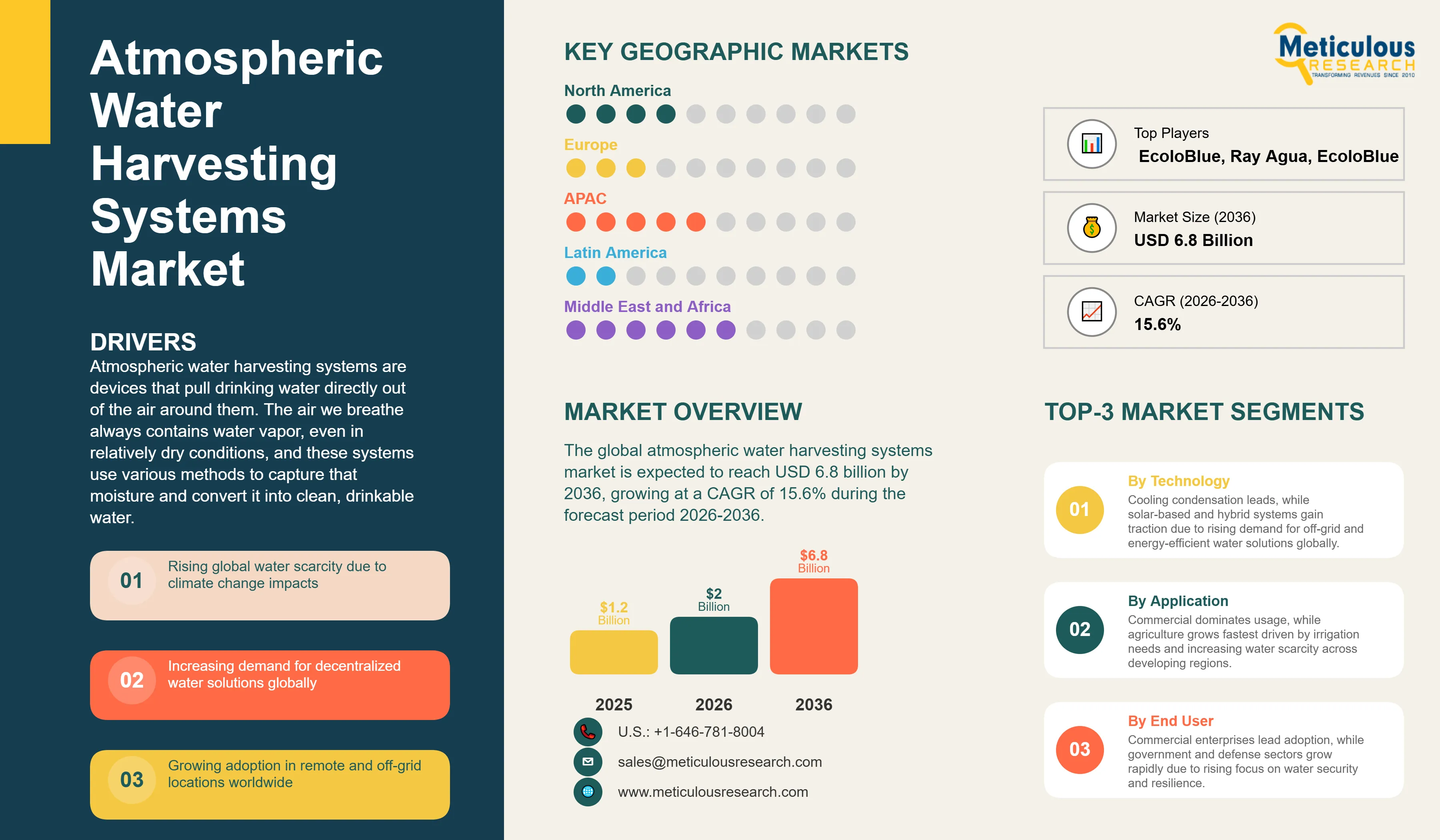
The global atmospheric water harvesting systems market was valued at USD 1.2 billion in 2025. This market is expected to reach USD 6.8 billion by 2036 from an estimated USD 1.6 billion in 2026, growing at a CAGR of 15.6% during the forecast period 2026-2036.
- Published
- Apr 2026
- Pages
- 275
- Format
- PDF + Excel
- Report ID
- MRSE - 1041935
- Base year
- 2025
- 2025 · BASELINE
- $1.20B
- 2036
- $6.80B
- CAGR 2026–2036
- 15.6%
2025 baseline · 2026–2036 forecast at 15.6% CAGR · hover a bar for the value
Key highlights
The global atmospheric water harvesting systems market is projected to reach USD 6.8 billion by 2036.
The market is expected to grow at a CAGR of 15.6% during the forecast period 2026-2036.
The global atmospheric water harvesting market was valued at USD 1.2 billion in 2025 and is estimated to reach USD 1.6 billion in 2026.
Middle East and Africa is expected to dominate the global atmospheric water harvesting market with the largest market share in 2026, while Asia-Pacific is projected to register the highest CAGR during the forecast period.
By technology type, the cooling condensation systems segment is expected to hold the largest share of the market in 2026, while the solar-based systems segment is projected to register the highest CAGR during the forecast period.
By system type, the standalone systems segment is expected to hold the largest share in 2026, while the integrated systems segment is projected to register the highest CAGR during the forecast period.
By application, the commercial applications segment is expected to hold the largest share in 2026, while the agricultural applications segment is projected to register the highest CAGR during the forecast period.
By end user, the commercial enterprises segment is expected to hold the largest share in 2026, while the government and defense segment is projected to register the highest CAGR during the forecast period.
By capacity, the medium capacity systems segment is expected to hold the largest share in 2026, while the large capacity systems segment is projected to register the highest CAGR during the forecast period.
By power source, the grid-powered systems segment is expected to hold the largest share in 2026, while the solar-powered systems segment is projected to register the highest CAGR during the forecast period.
Report summary
| Particulars | Details |
|---|---|
| Market Size by 2036 | USD 6.8 Billion |
| Market Size in 2026 | USD 1.6 Billion |
| Market Size in 2025 | USD 1.2 Billion |
| Revenue Growth Rate (2026-2036) | CAGR of 15.6% |
| Format | PDF, Excel & Cloud Portal · 275 pages |
| Dominating Technology Type | Cooling Condensation Systems |
| Fastest Growing Technology Type | Solar-Based Systems |
| Dominating System Type | Standalone Systems |
| Fastest Growing System Type | Integrated Systems (with HVAC/Building) |
| Dominating Application | Commercial Applications |
| Fastest Growing Application | Agricultural Applications |
| Dominating End User | Commercial Enterprises |
| Fastest Growing End User | Government and Defense |
| Dominating Capacity | Medium Capacity Systems (100-1,000 L/Day) |
| Fastest Growing Capacity | Large Capacity Systems (Above 1,000 L/Day) |
| Dominating Power Source | Grid-Powered Systems |
| Fastest Growing Power Source | Solar-Powered Systems |
| Dominating Geography | Middle East & Africa |
| Fastest Growing Geography | Asia-Pacific |
| Base Year | 2025 |
| Forecast Period | 2026 to 2036 |
Report overview
Segments covered: technology type, system type, application, end user.
Atmospheric water harvesting systems are devices that pull drinking water directly out of the air around them. The air we breathe always contains water vapor, even in relatively dry conditions, and these systems use various methods to capture that moisture and convert it into clean, drinkable water. The most common approach works the same way as a home dehumidifier: the system cools air below its dew point, causing the water vapor to condense into liquid water which is then filtered and purified to drinking water quality. More advanced systems use special chemical materials called desiccants that attract and absorb moisture from the air, which is then released as liquid water when the material is gently heated. The key practical advantage of atmospheric water harvesting is that it can produce clean drinking water anywhere there is air with humidity in it, without needing a well, a river, a pipeline, or a water treatment plant. For communities, military units, disaster response teams, or remote industrial facilities with no reliable water supply, this independence from traditional water infrastructure is extremely valuable.
The market is growing because water scarcity is worsening globally as a direct consequence of climate change, population growth, and the depletion of underground aquifers. The United Nations estimates that by 2030, global water demand will exceed reliable supply by 40%, and the regions most severely affected include many of the world's most populated areas in South Asia, the Middle East, Sub-Saharan Africa, and parts of Latin America and China. Traditional solutions to water scarcity such as building new dams, expanding desalination plants, or drilling deeper wells require very large infrastructure investments, take many years to build, and are not practical for isolated communities or rapidly changing water needs. Atmospheric water harvesting offers a faster and more flexible alternative that can be deployed almost anywhere within weeks, scaled up or down as needed, and operated with minimal connection to external infrastructure.
Two particularly significant opportunities are driving the next phase of market growth. The combination of solar panels with atmospheric water generators is creating water production systems that operate completely off-grid and produce both electricity and water from freely available natural resources. In sunny and humid regions including much of Southeast Asia, South Asia, the Middle East, and Sub-Saharan Africa, a solar-powered water harvesting system can provide a community's entire daily water needs without any fuel costs or grid connection, making clean water access affordable and sustainable even in very remote locations. In addition, the development of new advanced materials called metal-organic frameworks that are specifically engineered to absorb water from even very dry air, with water capture efficiencies far higher than current desiccant materials, promises to make atmospheric water harvesting viable in much drier climates than current technology can serve, significantly expanding the addressable market.
Report infographic
Market dynamics
7 factors across 3 forcesRising Global Water Scarcity and Climate Change Impact
The most powerful driver of the atmospheric water harvesting market is the worsening global water supply situation driven by climate change, population growth, and resource depletion. More than 2 billion people currently live in countries experiencing high water stress, and the number of people facing water scarcity is projected to grow substantially through 2036 as changing rainfall patterns reduce water availability in already dry regions, glaciers and snowpack that supply river systems in Asia and South America shrink, and groundwater aquifers that took thousands of years to fill are depleted by agricultural and urban pumping at rates far exceeding natural recharge. The cities and regions most severely affected include large population centers in India, Pakistan, China, the Middle East, North Africa, and sub-Saharan Africa, which collectively represent enormous potential markets for water harvesting technology. Climate change is not a distant threat in these regions but an immediate operational reality that is already driving governments, corporations, and communities to invest urgently in water supply alternatives that do not depend on rainfall, rivers, or groundwater.
Growing Adoption in Remote and Off-Grid Locations
The practical impossibility of extending conventional water supply infrastructure to every remote settlement, mining site, agricultural operation, military base, disaster-affected community, or tourism facility creates a large and commercially accessible addressable market for self-contained water generation technology. The cost of laying water pipelines across mountainous, desert, or jungle terrain is extremely high, the time required is measured in years, and the ongoing maintenance of long infrastructure networks in remote locations is a significant operational challenge. For a remote mine, a construction camp, an eco-resort, a military forward operating base, or a community of a few hundred people in a dry rural area, the economics of purchasing and operating an atmospheric water harvesting system that produces all needed water on-site often compare very favorably with the alternative of trucking in bottled water or building dedicated water infrastructure. This practical economic advantage in off-grid situations is generating growing commercial adoption across mining companies, defense establishments, resorts, and rural development programs globally, and the addressable market expands significantly as unit costs for atmospheric water generation continue to fall with technology improvements and production scale.
Table of contents
14 chapters · 177 sections · 275 pages · click to expandSegmental analysis
| Segment | Largest share (2026) | Fastest growth (2026–2036) |
|---|---|---|
| By Technology Type | Cooling Condensation Systems | Solar-based systems |
| By System Type | Standalone Systems | Integrated systems |
| By Application | Commercial | Agricultural applications |
| By End User | Commercial Enterprises | Government and defense |
By Technology Type
- Cooling Condensation Systems to Dominate
- The cooling condensation systems segment is expected to account for the largest share of the global atmospheric water harvesting systems market.
- Cooling condensation is the most commercially mature and most widely deployed technology in the market, using a refrigeration cycle similar to an air conditioner to cool incoming air below its dew point and cause water vapor to condense into liquid water that is collected, filtered, and purified.
- This technology is well understood, uses established components that are widely manufactured and serviced globally, and produces reliable results in humid environments.
- The majority of commercially available atmospheric water generators from companies including Watergen, EcoloBlue, and Drinkable Air use cooling condensation as their primary water capture mechanism.
- However, the solar-based systems segment is projected to register the highest CAGR during the forecast period.
- The rapid cost reduction of solar photovoltaic technology combined with growing demand for off-grid water solutions is driving strong adoption of solar-powered atmospheric water harvesting systems.
- These systems appeal to the large and fast-growing market of remote and off-grid customers for whom grid power is unavailable or unreliable, and the combination of zero fuel costs and zero water infrastructure requirements makes solar-based systems the most economically attractive option for many developing market and off-grid applications.
By System Type
- Standalone Systems to Hold the Largest Share
- The standalone systems segment is expected to account for the largest share of the global atmospheric water harvesting systems market.
- Standalone systems that operate independently as dedicated water generation units are the most commercially established product category, covering the widest range of applications from small household units to large industrial systems.
- Their ability to be deployed in any location without integration with existing building infrastructure makes them the most flexible and immediately deployable option for the diverse range of customers in the market.
- However, the integrated systems segment is projected to register the highest CAGR during the forecast period.
- The integration of atmospheric water harvesting capabilities with HVAC systems in commercial and institutional buildings, where the air handling infrastructure is already in place and the condensate from air conditioning units can be captured and purified for use rather than being drained away, represents a very efficient approach to water harvesting that is gaining traction in water-stressed urban commercial real estate markets.
- Large commercial buildings in cities like Singapore, Abu Dhabi, and Mumbai that operate extensive HVAC systems can capture significant volumes of water from their existing air conditioning infrastructure with relatively modest additional investment.
By Application
- Commercial Applications to Hold the Largest Share
- The commercial applications segment is expected to account for the largest share of the global atmospheric water harvesting systems market.
- Commercial customers including hotels, office buildings, restaurants, and retail facilities in water-stressed regions represent a well-funded and volume-significant customer category for atmospheric water harvesting systems.
- Hotels in the Middle East, island resorts in Southeast Asia, and commercial facilities in water-scarce cities across India and China are purchasing water generation systems both to reduce dependence on expensive trucked or bottled water supply and to communicate sustainability credentials to environmentally conscious customers and investors.
- However, the agricultural applications segment is projected to register the highest CAGR during the forecast period.
- Agriculture accounts for approximately 70% of global freshwater consumption, and the growing water stress in major agricultural regions including South and Southeast Asia, the Middle East, and Sub-Saharan Africa is creating strong demand for supplemental water supply technology for irrigation and livestock watering.
- Small and medium-scale agricultural operations in water-stressed regions that cannot access irrigation water during dry periods represent a large potential customer base for medium to large capacity atmospheric water systems, particularly solar-powered units that can provide water generation at zero ongoing energy cost.
By End User
- Commercial Enterprises to Hold the Largest Share
- The commercial enterprises segment is expected to account for the largest share of the global atmospheric water harvesting systems market.
- Commercial businesses, particularly in the hospitality, food service, and building management sectors in water-stressed regions, represent the largest current revenue-generating customer base for atmospheric water harvesting systems.
- These customers have the financial means to invest in water generation equipment, have clear operational need due to water supply unreliability or high water purchase costs, and value the marketing benefit of being able to communicate that they produce their own water sustainably.
- However, the government and defense segment is projected to register the highest CAGR during the forecast period.
- Government procurement of atmospheric water generation systems for military operations, disaster response stockpiling, rural community water supply programs, and critical infrastructure water security is growing rapidly as governments recognize the strategic importance of water supply resilience.
- Defense ministries investing in forward operating base water independence and civil emergency preparedness agencies building atmospheric water generation capacity into national disaster response plans represent high-value and high-volume government procurement programs that are expected to be among the fastest-growing end user categories through the forecast period.
Geographic analysis
Middle East & Africa
Largest shareIn 2026, the Middle East and Africa region is expected to account for the largest share of the global atmospheric water harvesting systems market. This region dominates the market because it is the world's most severely water-stressed region, with many countries in the Arabian Peninsula and North Africa having essentially no renewable freshwater resources and depending entirely on desalination, groundwater depletion, or water imports to meet their needs. Saudi Arabia, the UAE, and Israel are among the most water-scarce nations on Earth on a per-capita renewable water resource basis, and these wealthy Gulf states have both the financial resources to invest in advanced water technology and the urgent operational need to diversify their water supply sources. The UAE in particular has invested heavily in water technology innovation and has been an active adopter of atmospheric water generation systems in both government and commercial applications. Israel's technology sector, home to Watergen, has a natural domestic market for advanced water solutions and the country's sophisticated approach to water resource management has made it a global leader in water technology adoption. Sub-Saharan Africa represents the largest population-weighted demand for affordable atmospheric water generation, with hundreds of millions of people lacking access to safe drinking water, and the combination of NGO, government, and increasingly commercial investment in water access solutions is creating growing procurement activity for systems appropriate for community and humanitarian deployment.
Asia-Pacific
Fastest growthHowever, the Asia-Pacific atmospheric water harvesting market is expected to grow at the fastest CAGR during the forecast period. Asia-Pacific is home to the majority of the world's population and a very large fraction of the people living under water stress. India's groundwater crisis, with the Central Groundwater Board reporting that water tables in many agricultural states have fallen dramatically over recent decades, is creating acute water security challenges across the country's agricultural sector and increasingly in urban areas as well. The combination of India's very large rural population, extensive areas of water stress, growing government investment in rural water access programs, and a domestic manufacturing base including WaterMaker India and Akvo that can produce cost-competitive atmospheric water systems is making India one of the most important emerging markets for the technology. China's water stress in its northern and western regions, combined with the country's strong government investment in water security technology and its large manufacturing capability for the core components of atmospheric water systems, positions China as both a major market and a potential major production center for the global industry. Southeast Asian countries including Indonesia, Vietnam, and Thailand have high humidity that is favorable for cooling condensation systems and growing water security challenges in their agricultural and peri-urban regions.
North America
North America is a technologically advanced and growing market for atmospheric water harvesting systems, primarily in the United States where prolonged drought conditions in the southwestern states including California, Arizona, Nevada, and Texas are creating both institutional and commercial demand for supplemental and emergency water supply technology. The U.S. military's sustained interest in atmospheric water generation for forward operating base water independence is an important demand driver, and companies including Aqua Sciences have developed products specifically for the U.S. Defense Advanced Research Projects Agency requirements. California's ongoing water crisis is driving adoption of water harvesting technology in agricultural, residential, and commercial applications across the state.
Latin America
Latin America is an emerging market with strong potential in water-stressed Andean and coastal regions, and Chile's mining industry and Peru's agricultural sector both represent meaningful near-term market opportunities for medium and large capacity water generation systems.
Competitive landscape
- Watergen Ltd. · Israel
- Source Global/Zero Mass Water (U.S.)
- SkyWater Air Water Machines (U.S.)
- Akvo Atmospheric Water Systems Pvt. Ltd. · India
- EcoloBlue Inc. (U.S.)
- Atlantis Solar · Israel
- Dew Point Manufacturing (U.S.)
- Drinkable Air Technologies (U.S.)
- WaterMaker India Pvt. Ltd. · India
- Genaq Technologies S.L · Spain
- Hendrx Water (U.S.)
- PlanetsWater · Brazil
- Ray Agua · Spain
- Aqua Sciences (U.S.)
- Water Technologies International Inc. (U.S.)
Frequently asked questions
The global atmospheric water harvesting systems market is expected to reach USD 6.8 billion by 2036 from an estimated USD 1.6 billion in 2026, at a CAGR of 15.6% during the forecast period 2026-2036.
Cite this report
Meticulous Research. (2026). Atmospheric Water Harvesting Systems Market - Global Opportunity Analysis And Industry Forecasts (2026-2036) (Report No. MRSE - 1041935). Meticulous Market Research Pvt. Ltd. https://www.meticulousresearch.com/product/atmospheric-water-harvesting-systems-market-6618