Prefabricated Construction Market (2026-2036)
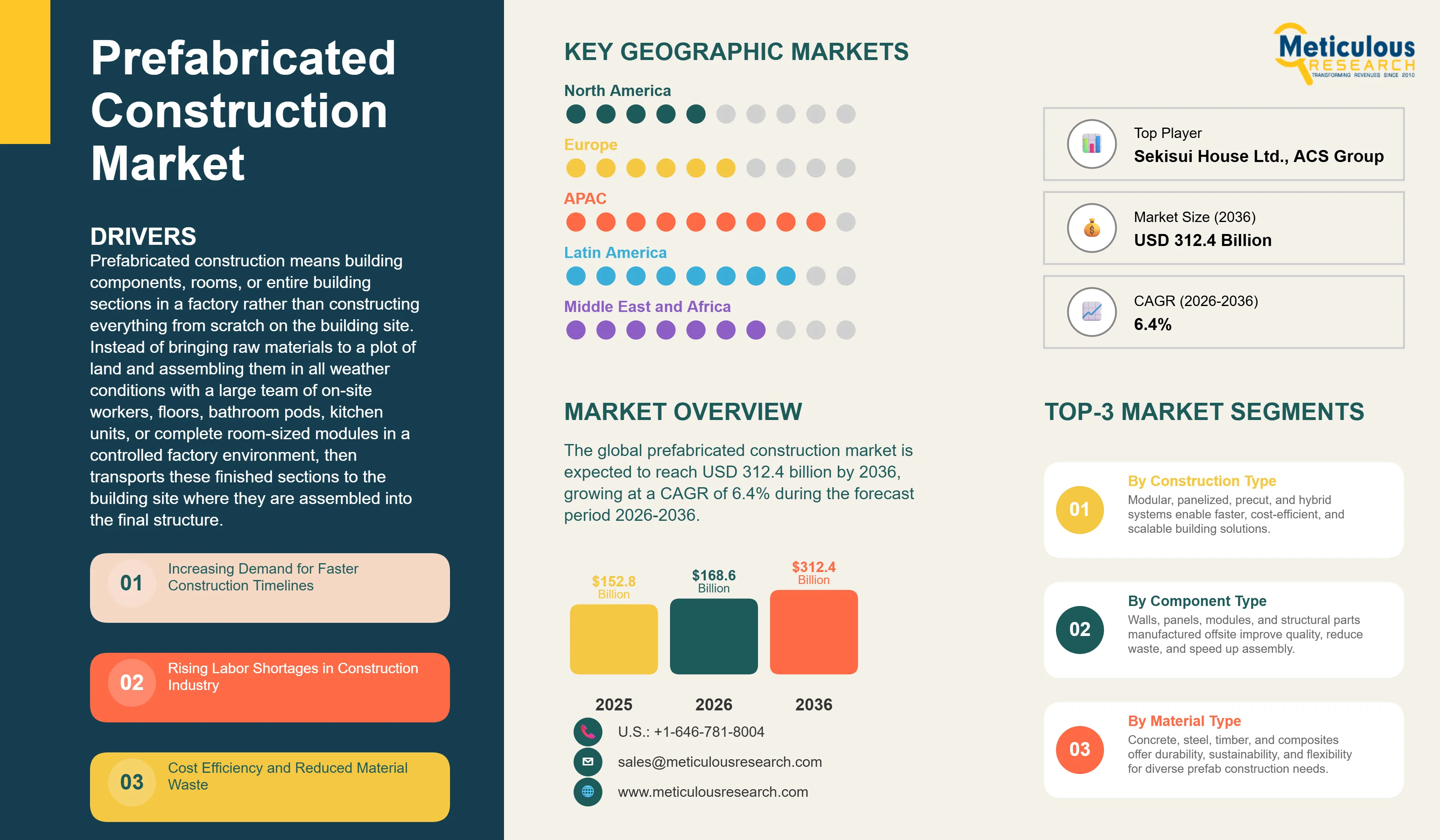
The global prefabricated construction market was valued at USD 152.8 billion in 2025. This market is expected to reach USD 312.4 billion by 2036 from an estimated USD 168.6 billion in 2026, growing at a CAGR of 6.4% during the forecast period 2026-2036.
- Published
- Apr 2026
- Pages
- 295
- Format
- PDF + Excel
- Report ID
- MRSE - 1041934
- Base year
- 2025
- 2025 · BASELINE
- $152.8B
- 2036
- $312.4B
- CAGR 2026–2036
- 6.4%
2025 baseline · 2026–2036 forecast at 6.4% CAGR · hover a bar for the value
Key highlights
The global prefabricated construction market is projected to reach USD 312.4 billion by 2036.
The market is expected to grow at a CAGR of 6.4% during the forecast period 2026-2036.
The global market was valued at USD 152.8 billion in 2025 and is estimated to reach USD 168.6 billion in 2026.
Asia-Pacific is expected to dominate the global prefabricated construction market with the largest market share in 2026, while the Middle East and Africa is projected to register the highest CAGR during the forecast period.
By construction type, the modular construction segment is expected to hold the largest share of the market in 2026, while the hybrid prefabrication systems segment is projected to register the highest CAGR during the forecast period.
By component type, the walls and panels segment is expected to hold the largest share in 2026, while the complete modules/units segment is projected to register the highest CAGR during the forecast period.
By material type, the concrete segment is expected to hold the largest share in 2026, while the wood (timber/CLT) segment is projected to register the highest CAGR during the forecast period.
By application, the residential construction segment is expected to hold the largest share in 2026, while the industrial construction segment is projected to register the highest CAGR during the forecast period.
By end user, the real estate developers segment is expected to hold the largest share in 2026, while the government and public sector segment is projected to register the highest CAGR during the forecast period.
By project type, the new construction segment is expected to hold the largest share in 2026, while the renovation and retrofit segment is projected to register the highest CAGR during the forecast period.
Report summary
| Particulars | Details |
|---|---|
| Market Size by 2036 | USD 312.4 Billion |
| Market Size in 2026 | USD 168.6 Billion |
| Market Size in 2025 | USD 152.8 Billion |
| Revenue Growth Rate (2026-2036) | CAGR of 6.4% |
| Format | PDF, Excel & Cloud Portal · 295 pages |
| Dominating Construction Type | Modular Construction |
| Fastest Growing Construction Type | Hybrid Prefabrication Systems |
| Dominating Component Type | Walls and Panels |
| Fastest Growing Component Type | Complete Modules/Units |
| Dominating Material Type | Concrete |
| Fastest Growing Material Type | Wood (Timber/CLT) |
| Dominating Application | Residential Construction |
| Fastest Growing Application | Industrial Construction |
| Dominating End User | Real Estate Developers |
| Fastest Growing End User | Government and Public Sector |
| Dominating Project Type | New Construction |
| Fastest Growing Project Type | Renovation and Retrofit |
| Dominating Geography | Asia-Pacific |
| Fastest Growing Geography | Middle East & Africa |
| Base Year | 2025 |
| Forecast Period | 2026 to 2036 |
Report overview
Segments covered: construction type, component type, material type, application, end user.
Prefabricated construction means building components, rooms, or entire building sections in a factory rather than constructing everything from scratch on the building site. Instead of bringing raw materials to a plot of land and assembling them in all weather conditions with a large team of on-site workers, a prefabricated construction company builds walls, floors, bathroom pods, kitchen units, or complete room-sized modules in a controlled factory environment, then transports these finished sections to the building site where they are assembled into the final structure. Think of it like manufacturing a car on an assembly line rather than building it in the customer's driveway. The factory setting allows for better quality control, less material waste, faster production through parallel working, and much reduced dependence on on-site labor. A building that would take 18 months to construct using traditional methods can often be assembled on site in a fraction of that time when the components arrive pre-finished from a factory.
The market is growing because the construction industry globally is facing a serious and worsening combination of challenges that traditional building methods are increasingly unable to address effectively. Construction labor shortages are severe in most developed markets as skilled tradespeople retire and younger workers choose other industries, driving up labor costs and causing project delays. The demand for new housing in cities around the world far outstrips current supply, creating housing affordability crises in major metropolitan areas that governments are under pressure to address quickly. Material costs are volatile and project cost overruns are common in traditional construction. Clients in healthcare, education, and data center construction need buildings delivered on tight schedules that conventional construction regularly misses. Prefabrication addresses all of these challenges simultaneously by moving most of the work off site into a controlled manufacturing environment where productivity is higher, quality is more consistent, schedules are more predictable, and labor requirements on site are dramatically reduced.
Two particularly significant opportunities are shaping the market's development. The integration of digital building information modeling technology with prefabricated construction is transforming how buildings are designed and coordinated, allowing architects and engineers to design in three-dimensional digital models that directly drive the manufacturing specifications for prefabricated components, reducing design errors, eliminating clashes between different building systems, and dramatically reducing the rework and waste that plague traditional construction projects. In addition, the rapid growth of cross-laminated timber and mass timber construction as a sustainable prefabricated building material is opening significant new market opportunities, particularly for mid-rise residential and commercial buildings where timber's sustainability credentials, its prefabrication compatibility, and its impressive structural performance relative to its weight are attracting developers seeking green building certifications and sustainable construction credentials.
Report infographic
Market dynamics
7 factors across 3 forcesIncreasing Demand for Faster Construction Timelines
The primary driver of the prefabricated construction market is the construction industry's growing inability to meet client schedule requirements and market delivery timelines using traditional on-site construction methods, creating structural demand for the 30 to 50% schedule reductions that prefabricated construction can deliver across most project types. Hospital construction projects that are needed urgently to address healthcare capacity shortages cannot wait the three to five years that traditional construction requires. Hotel developers need to open new properties during peak travel seasons and cannot afford schedule overruns that miss opening targets by months. Government infrastructure programs are held to delivery commitments by electoral timelines. Data center operators are competing to deliver capacity for cloud services customers who have signed capacity reservation agreements with specific operational dates. In all of these cases, the faster and more predictable construction schedule that prefabrication delivers through parallel factory manufacturing and simplified on-site assembly translates directly into measurable commercial or operational value that clients are willing to pay a premium for, creating durable demand for prefabricated construction solutions across multiple application sectors.
Rising Labor Shortages in Construction Industry
The construction industry is experiencing a severe and structural labor shortage in most developed markets, driven by the retirement of an aging skilled workforce without sufficient replacement from younger generations, the physical demands and outdoor working conditions of construction that reduce its attractiveness relative to other career options, and the cyclical nature of construction employment that discourages long-term workforce commitment. In the United States, the Associated Builders and Contractors estimated a shortage of over 500,000 construction workers in 2023. The UK construction industry faces critical skills shortages in trades including bricklaying, plastering, and roofing. Japan, Germany, and Australia all face similar skilled construction labor deficits. Prefabricated construction directly addresses this challenge by moving the majority of construction activity from site to factory, where work can be performed in a controlled environment by a more stable manufacturing workforce with less dependence on the specific skilled trades that are in shortest supply. A modular building factory can produce housing units with a much smaller and differently skilled workforce than would be required to build the same housing conventionally on site, allowing output to be maintained or expanded despite the tight labor market.
Table of contents
14 chapters · 180 sections · 295 pages · click to expandSegmental analysis
| Segment | Largest share (2026) | Fastest growth (2026–2036) |
|---|---|---|
| By Construction Type | Modular Construction | Hybrid prefabrication systems |
| By Material Type | Concrete | Wood (timber/CLT) |
| By Application | Residential Construction | Industrial construction |
| By End User | Real Estate Developers | Government and public sector |
By Construction Type
- Modular Construction to Dominate
- The modular construction segment is expected to account for the largest share of the global prefabricated construction market.
- Modular construction, which creates three-dimensional room-sized units in a factory and stacks or connects them on site to form the complete building, delivers the most complete level of prefabrication and therefore the largest schedule and labor savings of any construction type.
- The growing commercial application of modular construction to hotels, student accommodation, healthcare facilities, and multi-family residential buildings, where highly repetitive floor plans justify the upfront investment in module design and factory setup, has established modular construction as the dominant high-value segment within the prefabricated construction market.
- However, the hybrid prefabrication systems segment is projected to register the highest CAGR during the forecast period.
- Hybrid approaches that combine prefabricated elements such as structural panels, bathroom and kitchen pods, and pre-fitted service modules with traditional construction for other building elements are proving to be the most practically accessible entry point for contractors and developers who want to gain the schedule and labor benefits of prefabrication without committing to fully modular construction.
- As more construction companies develop experience with hybrid prefabrication and as the supply of prefabricated components expands, the market for partial prefabrication solutions is growing faster than fully modular approaches.
By Material Type
- Concrete to Hold the Largest Share
- The concrete segment is expected to account for the largest share of the overall market.
- Precast concrete elements including wall panels, floor planks, columns, beams, and stairs represent the largest and most globally widespread form of prefabricated construction component, used extensively in residential apartment construction, commercial buildings, infrastructure, and industrial facilities across all major markets.
- The combination of concrete's structural performance, fire resistance, acoustic properties, and cost-effectiveness with the productivity and quality benefits of factory precasting makes precast concrete the dominant prefabricated construction material by volume and value.
- However, the wood (timber/CLT) segment is projected to register the highest CAGR during the forecast period.
- The rapidly growing mass timber and CLT construction market, driven by sustainability credentials, design innovation, and regulatory changes enabling taller timber buildings, is making timber prefabricated construction one of the fastest-growing segments in the broader prefabricated market.
- Significant investment in CLT manufacturing capacity across Europe, North America, and Australia is expanding the supply of prefabricated timber components to meet rapidly growing demand.
By Application
- Residential Construction to Hold the Largest Share
- The residential construction segment is expected to account for the largest share of the overall market.
- Housing represents by far the largest single application for prefabricated construction globally by both unit volume and total value.
- Japan leads the world in prefabricated residential construction adoption with over 15% of new homes built using factory-based methods through companies including Sekisui House and Daiwa House.
- Scandinavia, Germany, and Australia have significant and growing prefabricated residential construction sectors.
- The acute housing supply crisis in the UK, Canada, and Australia is driving strong government policy support for factory-built homes that is expected to accelerate residential prefab adoption substantially through the forecast period.
- However, the industrial construction segment is projected to register the highest CAGR during the forecast period.
- The explosive growth of e-commerce distribution infrastructure, hyperscale data centers, and manufacturing facility construction globally is creating very large and fast-growing demand for prefabricated steel structural and panelized building systems in the industrial sector.
- The standardized, repetitive nature of most warehouse and data center building designs makes industrial construction particularly well-suited to prefabrication, and the industry's intense schedule sensitivity creates strong willingness to use prefabricated methods that can deliver on tighter timelines.
By End User
- Real Estate Developers to Hold the Largest Share
- The real estate developers segment is expected to account for the largest share of the global prefabricated construction market.
- Real estate developers are the primary procurers of new construction across residential, commercial, and mixed-use sectors, and their adoption of prefabricated construction methods for new developments is the dominant revenue driver in the market.
- Developers motivated by the competitive advantages of faster project delivery, more predictable construction costs, and lower on-site labor requirements are progressively shifting their project specifications toward prefabricated solutions.
- However, the government and public sector segment is projected to register the highest CAGR during the forecast period.
- Governments facing housing supply crises, healthcare infrastructure backlogs, and school building programs are increasingly mandating or strongly incentivizing prefabricated construction methods to accelerate delivery and improve cost predictability.
- Singapore's HDB public housing program, the UK's government-backed affordable housing programs, and Australia's defense and public infrastructure construction programs represent large government-led procurement pipelines that are growing rapidly.
Geographic analysis
Asia-Pacific
Largest shareIn 2026, Asia-Pacific is expected to account for the largest share of the global overall market. The region's dominance reflects both the extraordinary scale of construction activity in China and the highly advanced prefabricated construction industry of Japan. China is by far the world's largest construction market by volume and is undergoing a significant shift toward prefabricated construction driven by government policy mandates requiring prefab methods in public housing and large infrastructure projects in major cities, combined with severe urban construction site labor management challenges and a national policy push for construction industrialization. China's State Council has set explicit targets for the proportion of new construction using prefabricated methods, creating a policy-driven demand signal across the country's enormous construction industry. Japan's Sekisui House and Daiwa House are among the world's most technologically advanced and commercially successful prefabricated house builders, having delivered millions of factory-built homes over several decades. South Korea, Singapore, and Australia all have significant and growing prefabricated construction markets driven by housing supply pressures, government mandates, and advanced local manufacturing capabilities.
Middle East & Africa
Fastest growthHowever, the Middle East and Africa region is expected to grow at the fastest CAGR during the forecast period. The Middle East, particularly Saudi Arabia and the UAE, is experiencing an unprecedented wave of mega-project construction as part of Vision 2030 and similar national transformation programs that are building entirely new cities, tourism destinations, industrial zones, and infrastructure networks on an accelerated timeline that conventional construction methods cannot support alone. Saudi Arabia's NEOM project, The Line, Qiddiya, and numerous other giga-projects collectively represent hundreds of billions of dollars of construction that must be delivered on politically important timelines, making prefabricated construction methods for housing, hospitality, and support infrastructure practically necessary rather than optional. The UAE's continued commercial real estate and hospitality construction pipeline, including the rapid build-out of hotel and residential capacity associated with Dubai's continuing tourism growth, is creating large-scale demand for prefabricated construction systems. Red Sea Global, the Saudi developer of the Red Sea Project and Amaala tourism developments, has committed to using modular and prefabricated construction methods to meet its ambitious delivery schedules.
Europe
Europe is a technically sophisticated and environmentally progressive prefabricated construction market, with particularly strong positions in Scandinavia, Germany, the Netherlands, and the UK. Sweden and Norway have among the highest prefabricated housing adoption rates in Europe, with a long tradition of timber-frame factory-built homes. Germany has a well-developed precast concrete and modular construction industry serving both residential and commercial sectors. The UK's government-backed affordable housing modernization agenda and the strong corporate sustainability targets of UK commercial real estate developers are driving growing adoption of offsite construction methods.
North America
North America is a large and growing market with the U.S. modular construction industry serving healthcare, hospitality, and multifamily residential sectors, and Canada's growing adoption of prefabricated construction methods for housing programs in response to its severe housing affordability crisis.
Competitive landscape
- Laing O'Rourke (UK)
- Bouygues Construction · France
- Skanska AB · Sweden
- Daiwa House Industry Co. Ltd. · Japan
- Sekisui House Ltd. · Japan
- Red Sea Global · Saudi Arabia
- Lendlease Corporation · Australia
- Kiewit Corporation (U.S.)
- VINCI Construction · France
- Balfour Beatty plc (UK)
- ACS Group · Spain
- Larsen & Toubro Limited · India
- Tata Projects Limited · India
- Hickory Group · Australia
- Modscape Pty Ltd. · Australia
Frequently asked questions
The global prefabricated construction market is expected to reach USD 312.4 billion by 2036 from an estimated USD 168.6 billion in 2026, at a CAGR of 6.4% during the forecast period 2026-2036.
Cite this report
Meticulous Research. (2026). Prefabricated Construction Market - Global Opportunity Analysis And Industry Forecasts (2026-2036) (Report No. MRSE - 1041934). Meticulous Market Research Pvt. Ltd. https://www.meticulousresearch.com/product/prefabricated-construction-market-6617