Smart Grid Market (2026-2036)
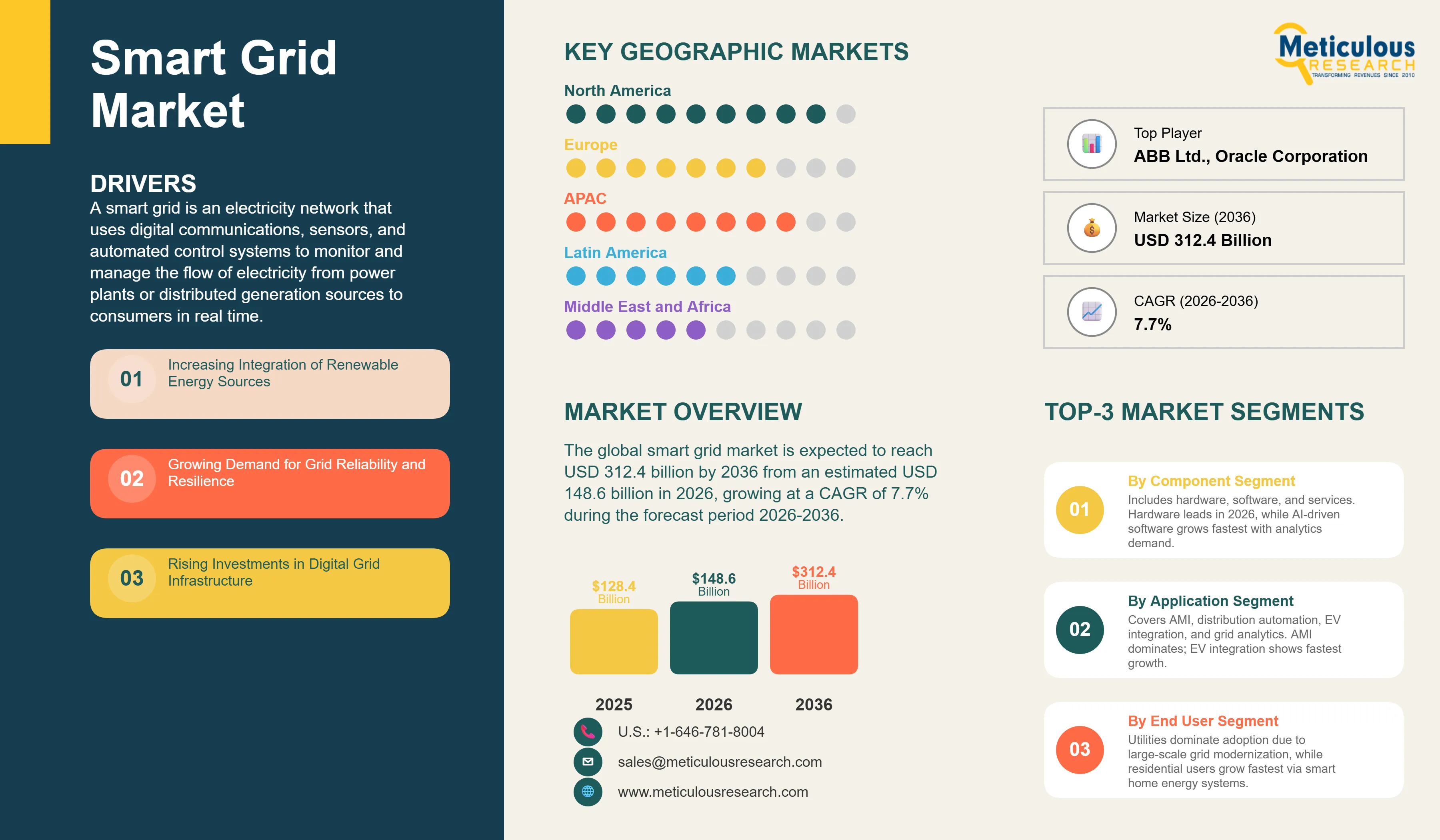
The global smart grid market was valued at USD 128.4 billion in 2025. This market is expected to reach USD 312.4 billion by 2036 from an estimated USD 148.6 billion in 2026, growing at a CAGR of 7.7% during the forecast period 2026-2036. According to the International Energy Agency’s World Energy Investment 2025 report, global investment in electricity grids reached approximately USD 400–420 billion in 2024, up from around USD 370–380 billion in 2023, reflecting continued record-level spending.
- Published
- Apr 2026
- Pages
- 280
- Format
- PDF + Excel
- Report ID
- MRSE - 1041937
- Base year
- 2025
- 2025 · BASELINE
- $128.4B
- 2036
- $312.4B
- CAGR 2026–2036
- 7.7%
2025 baseline · 2026–2036 forecast at 7.7% CAGR · hover a bar for the value
Key highlights
The global smart grid market is projected to reach USD 312.4 billion by 2036.
The market is expected to grow at a CAGR of 7.7% during the forecast period 2026-2036.
The global market for smart grid was valued at USD 128.4 billion in 2025 and is estimated to reach USD 148.6 billion in 2026.
North America is expected to dominate the global smart grid market with the largest market share in 2026, while Asia-Pacific is projected to register the highest CAGR during the forecast period.
By component, the hardware segment is expected to hold the largest share of the market in 2026, while the software (analytics and AI platforms) segment is projected to register the highest CAGR during the forecast period.
By grid layer, the distribution segment is expected to hold the largest share in 2026, while the consumption segment is projected to register the highest CAGR during the forecast period.
By application, the advanced metering infrastructure segment is expected to hold the largest share in 2026, while the EV integration segment is projected to register the highest CAGR during the forecast period.
By end user, the utilities segment is expected to hold the largest share in 2026, while the residential segment is projected to register the highest CAGR during the forecast period.
By communication technology, the wired segment is expected to hold the largest share in 2026, while the cellular (4G/5G) segment is projected to register the highest CAGR during the forecast period.
By voltage level, the medium voltage segment is expected to hold the largest share in 2026, while the low voltage segment is projected to register the highest CAGR during the forecast period.
Report summary
| Particulars | Details |
|---|---|
| Market Size by 2036 | USD 312.4 Billion |
| Market Size in 2026 | USD 148.6 Billion |
| Market Size in 2025 | USD 128.4 Billion |
| Revenue Growth Rate (2026-2036) | CAGR of 7.7% |
| Format | PDF, Excel & Cloud Portal · 280 pages |
| Dominating Component | Hardware |
| Fastest Growing Component | Software (Analytics & AI Platforms) |
| Dominating Grid Layer | Distribution |
| Fastest Growing Grid Layer | Consumption |
| Dominating Application | Advanced Metering Infrastructure (AMI) |
| Fastest Growing Application | EV Integration |
| Dominating End User | Utilities |
| Fastest Growing End User | Residential |
| Dominating Communication Technology | Wired (PLC, Fiber Optics) |
| Fastest Growing Communication Technology | Cellular (4G/5G) |
| Dominating Voltage Level | Medium Voltage |
| Fastest Growing Voltage Level | Low Voltage |
| Dominating Geography | North America |
| Fastest Growing Geography | Asia-Pacific |
| Base Year | 2025 |
| Forecast Period | 2026 to 2036 |
Report overview
Segments covered: component, grid layer, application, end user, communication technology, voltage level.
Grid investment has now become one of the fastest-growing segments of the energy sector, underscoring its critical role in enabling renewable energy integration, electrification, and energy security.
A smart grid is an electricity network that uses digital communications, sensors, and automated control systems to monitor and manage the flow of electricity from power plants or distributed generation sources to consumers in real time. Unlike a conventional grid, where electricity flows one-way from large centralized generators through transmission and distribution networks to passive consumers, a smart grid creates a two-way system where utilities can monitor consumption, detect faults, redirect power flows, and respond to demand changes automatically and instantly. Smart meters in homes and businesses communicate usage data back to utilities, distribution automation systems identify and isolate faults before they cascade into widespread outages, and demand response programs reduce load during peak periods by signaling connected devices and industrial systems to temporarily reduce consumption.
The market is growing at an accelerating pace because grid modernization is no longer optional: it has become operationally necessary. According to the IEA's World Energy Investment 2024, the world added a record 295 gigawatts of solar and wind capacity in 2023, and grids designed for centralized coal and gas generation are struggling to integrate this intermittent distributed capacity without smart monitoring and automated balancing systems. The U.S. Department of Energy's Grid Deployment Office has noted that the average age of large power transformers in the U.S. is over 40 years, and a significant portion of the transmission system was built in the 1950s and 1960s. Across Europe, the IEA estimates that EUR 600 billion in additional grid investment will be required by 2030 to meet the EU's clean energy targets. These infrastructure realities are generating substantial and urgent government-backed investment commitments globally.
Two specific opportunities stand out. The growth of distributed energy resources including rooftop solar, behind-the-meter battery storage, and small-scale wind is transforming millions of electricity consumers into prosumers who both consume and produce electricity. Managing this two-way flow requires distribution management systems, advanced inverter controls, and real-time monitoring that conventional grids cannot provide. Equally important is EV integration: according to the IEA's Global EV Outlook 2024, global EV sales reached 14 million in 2023, and managing the charging loads of tens of millions of EVs without causing local grid overloads requires smart charging management systems and ultimately vehicle-to-grid capabilities that are driving a major new smart grid investment cycle.
Report infographic
Market dynamics
7 factors across 3 forcesIncreasing Integration of Renewable Energy Sources
According to the IEA's Renewables 2024 report, the world added a record 295 GW of renewable energy capacity in 2023, and the IEA projects that renewable energy will account for over 40% of global electricity generation by 2030. Integrating this volume of variable generation into power systems designed for controllable thermal plants requires a fundamentally different approach to grid management. Solar and wind generate electricity based on weather conditions rather than demand, and their output can vary significantly within minutes. Managing this variability without causing frequency instability or voltage fluctuations requires smart grid systems including advanced SCADA, automated demand response, distributed energy resource management systems, and energy storage coordination that can balance supply and demand in real time. Every gigawatt of new renewable capacity added to the grid increases the need for smart grid investment to maintain system stability, creating a direct and growing linkage between the global renewable energy boom and smart grid market growth.
Electrification of Transportation (EV Integration)
The global EV fleet exceeded 40 million in 2023 and grew to 45+ million in 2024, according to the International Energy Agency, and BloombergNEF's Electric Vehicle Outlook 2024 projects that EVs will account for 75% of global passenger vehicle sales by 2040. Managing the charging loads of this growing EV fleet without causing grid congestion and local outages requires smart charging management systems, time-of-use tariff infrastructure, and ultimately vehicle-to-grid capabilities. The U.S. DOE's National Electric Vehicle Infrastructure program is installing charging infrastructure across the country, with federal requirements that new NEVI-funded chargers must include smart charging capabilities including demand response and grid communication. European utilities including E.ON and Enel have both launched large-scale smart EV charging infrastructure programs that integrate charging management with their smart grid platforms, creating direct demand for grid software and communication infrastructure upgrades.
Table of contents
14 chapters · 187 sections · 280 pages · click to expandSegmental analysis
| Segment | Largest share (2026) | Fastest growth (2026–2036) |
|---|---|---|
| By Component | Hardware | Software |
| By Application | Advanced Metering Infrastructure | EV integration |
| By End User | Utilities | Residential |
By Component
- Hardware to Hold the Largest Share
- The hardware segment is expected to account for the largest share of the global smart grid market.
- Smart meters, substation automation equipment, grid sensors, and communication infrastructure represent the largest procurement category by value in grid modernization programs globally.
- The scale of smart meter rollouts alone is very large: according to the IEA, over 1 billion smart meters were installed globally by end 2023, with hundreds of millions more planned across China, India, and emerging markets over the next five years.
- However, the software segment, particularly analytics and AI platforms, is projected to register the highest CAGR during the forecast period.
- As the hardware infrastructure of smart grids matures, utilities are increasingly investing in the software layers that extract operational value from the data generated by smart meters and grid sensors.
- AI-based grid analytics, digital twin platforms, and distribution management systems are growing faster than the hardware market and command improving margins, with subscription-based software pricing models generating recurring revenue streams for providers including Oracle, Schneider Electric, and Siemens.
By Application
- Advanced Metering Infrastructure to Hold the Largest Share
- The AMI segment is expected to account for the largest share of the global smart grid market.
- Smart metering programs represent the largest and most mature smart grid investment category globally, with mandatory smart meter rollouts mandated or in progress in the EU, the UK, the U.S., China, India, and many other markets.
- The EU's revised Energy Efficiency Directive requires member states to ensure that 80% of consumers have smart meters by 2024 where technically feasible and cost-justified.
- China's State Grid Corporation has deployed over 600 million smart meters making it the world's largest single smart metering program.
- These programs generate very large hardware procurement volumes and associated meter data management and analytics software investment.
- However, the EV integration segment is projected to register the highest CAGR during the forecast period.
- With global EV sales growing, the smart grid software and infrastructure required to manage EV charging loads at scale, including managed charging systems, demand response for EV chargers, and vehicle-to-grid platforms, is growing from an early-stage deployment base to commercial mainstream adoption across all major EV markets.
By End User
- Utilities to Hold the Largest Share
- The utilities segment is expected to account for the largest share of the global smart grid market.
- Electric utilities are the primary investors in smart grid infrastructure globally, deploying smart meters, distribution automation, SCADA upgrades, and grid analytics platforms as part of their asset management and network modernization programs.
- The scale of utility investment is very large: a single major national utility modernization program can represent billions of dollars of smart grid technology procurement over a multi-year deployment cycle.
- However, the residential segment is projected to register the highest CAGR during the forecast period.
- Smart home energy management systems, residential batteries, rooftop solar inverters with grid communication, smart EV chargers, and demand response-enabled appliances are creating a growing residential smart grid participation market.
- As time-of-use electricity tariffs become more widely available and as home energy management apps allow consumers to optimize their electricity costs by shifting flexible loads to low-price periods, residential engagement with smart grid programs is growing rapidly and creating a fast-growing market for consumer-facing smart grid technology.
Geographic analysis
North America
Largest shareIn 2026, North America is expected to account for the largest share of the global smart grid market. The United States has been investing in grid modernization longer than any other major market, and the Bipartisan Infrastructure Law's USD 65 billion grid allocation represents the largest single federal grid investment in U.S. history, supporting smart meter deployments, transmission upgrades, and distribution automation across the country's over 3,000 electric utilities. According to the Edison Electric Institute, U.S. electric utilities invested approximately USD 140 billion in infrastructure in 2023, with a growing share directed toward smart grid technology. The U.S. also has the world's largest advanced metering infrastructure deployment, with over 130 million smart meters installed according to the U.S. Energy Information Administration's 2024 data. Grid reliability challenges, including the increasing frequency of severe weather-related outages highlighted by events such as Winter Storm Uri in 2021, are driving continued utility investment in grid resilience technology including automated self-healing distribution systems and advanced monitoring. Canada's grid modernization programs, particularly in Ontario, British Columbia, and Alberta, add to the regional demand base.
Asia-Pacific
Fastest growthHowever, the Asia-Pacific smart grid market is expected to grow at the fastest CAGR during the forecast period. China is undertaking the world's most ambitious grid modernization program: State Grid Corporation of China, which operates the world's largest utility network, has committed to investing over CNY 6 trillion (approximately USD 840 billion) in grid infrastructure over the 2021 to 2025 period, with a major portion directed toward smart grid technology, ultra-high voltage transmission, and distribution automation. According to China's National Energy Administration, China had deployed over 600 million smart meters by 2024, making it the world's largest single smart metering deployment. India's Smart Grid Mission and the Revamped Distribution Sector Scheme are directing over USD 36 billion toward distribution network modernization across India's state distribution companies, addressing the country's very high distribution losses which the Ministry of Power reported at approximately 17% in 2024. Japan's grid is undergoing significant modernization driven by the integration of distributed rooftop solar, which has grown rapidly following post-Fukushima energy policy changes, and South Korea's Smart Grid Roadmap targets nationwide smart grid deployment supported by government investment programs.
Europe
Europe is a technically advanced smart grid market driven by the EU's ambitious clean energy targets and the world's most comprehensive smart metering mandates. Germany, the Netherlands, France, and the Nordic countries are among the most active European smart grid investment markets. The EU's revised Energy Efficiency Directive requires 80% smart meter penetration where cost-justified, and the Clean Energy for All Europeans package creates the regulatory framework for demand response, prosumer participation, and energy community models that require smart grid infrastructure to operate. Norway's very high EV penetration above 90% of new car sales in 2023 per the Norwegian Road Federation is creating immediate smart grid integration requirements that are making Norway an active early-adopter market for EV-integrated smart grid solutions.
Competitive landscape
- Siemens AG · Germany
- ABB Ltd. · Switzerland
- Schneider Electric SE · France
- General Electric Company/GE Vernova (U.S.)
- Hitachi Energy Ltd. · Switzerland
- Eaton Corporation plc · Ireland
- Itron Inc. (U.S.)
- Landis+Gyr Group AG · Switzerland
- Honeywell International Inc. (U.S.)
- Cisco Systems Inc. (U.S.)
- Oracle Corporation (U.S.)
- IBM Corporation (U.S.)
- Wipro Limited · India
- Infosys Limited · India
- Siemens Energy AG · Germany
Frequently asked questions
The global smart grid market is expected to reach USD 312.4 billion by 2036 from an estimated USD 148.6 billion in 2026, at a CAGR of 7.7% during the forecast period 2026-2036. According to the IEA's World Energy Investment 2024, global grid investment reached a record USD 375 billion in 2023, and the IEA projects annual grid investment must exceed USD 600 billion by 2030 to meet net-zero scenarios, indicating the market is well below the required investment level and has significant growth ahead.
Cite this report
Meticulous Research. (2026). Smart Grid Market - Global Opportunity Analysis And Industry Forecasts (2026-2036) (Report No. MRSE - 1041937). Meticulous Market Research Pvt. Ltd. https://www.meticulousresearch.com/product/smart-grid-market-6620