Battery Energy Storage (BESS) Market (2026-2036)
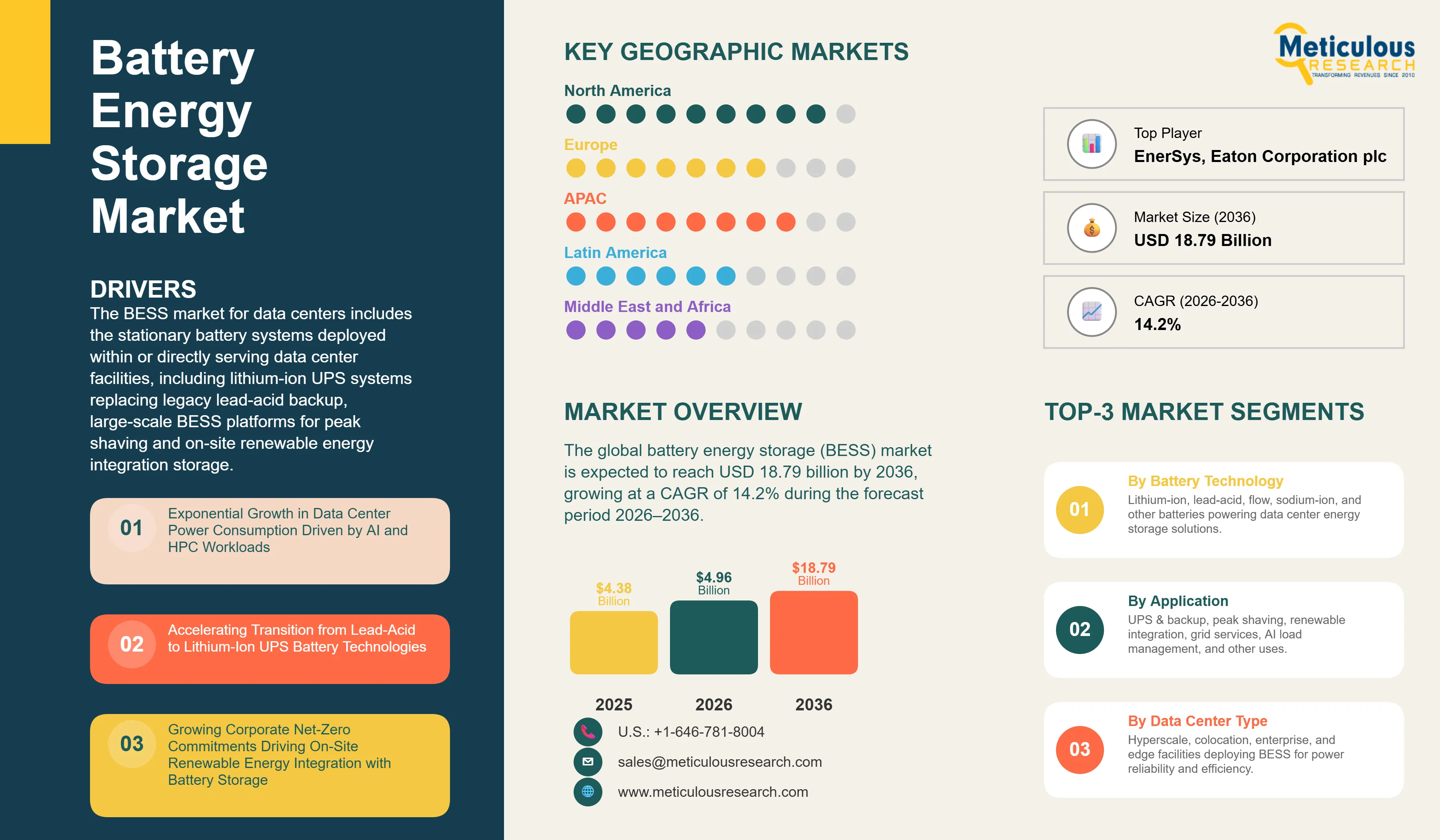
The global battery energy storage (BESS) market for data centers was valued at USD 4.38 billion in 2025. This market is expected to reach USD 18.79 billion by 2036 from an estimated USD 4.96 billion in 2026, growing at a CAGR of 14.2% during the forecast period 2026–2036.
- Published
- Apr 2026
- Pages
- 287
- Format
- PDF + Excel
- Report ID
- MR-1858
- Base year
- 2025
- 2025 · BASELINE
- $4.38B
- 2036
- $18.79B
- CAGR 2026–2036
- 14.2%
2025 baseline · 2026–2036 forecast at 14.2% CAGR · hover a bar for the value
Key highlights
The global battery energy storage market for data centers is projected to reach USD 18.79 billion by 2036.
The market is expected to grow at a CAGR of 14.2% during the forecast period 2026–2036.
The global BESS market for data centers was valued at USD 4.38 billion in 2025 and is estimated to reach USD 4.96 billion in 2026.
North America is expected to dominate the global battery energy storage market for data centers with the largest market share in 2026, driven by the highest concentration of hyperscale AI data center deployments, the strongest government policy support through the Inflation Reduction Act's investment tax credits for standalone battery storage, and the most advanced BESS deployment ecosystem.
Asia Pacific is projected to witness the fastest growth during the forecast period, driven by the explosive expansion of AI data center capacity across China, India, Japan, Singapore, and Southeast Asia, and the emergence of China as the world's most active AIDC energy storage market.
By battery technology, the lithium-ion segment is expected to account for the largest share of the global battery energy storage market for data centers in 2026.
By battery technology, the flow batteries segment is projected to register the highest CAGR during the forecast period, driven by growing requirements for long-duration energy storage in hyperscale campuses.
By application, the UPS and backup power segment is expected to account for the largest share of the market in 2026.
By application, the AI load management segment is projected to register the highest CAGR during the forecast period.
By data center type, the hyperscale segment is expected to account for the largest share in 2026, while the edge data center segment is projected to register the highest CAGR during the forecast period.
By capacity, the 1 MW–10 MW segment is expected to account for the largest share of the market in 2026, while the above 10 MW segment is projected to register the highest CAGR.
By geography, North America is expected to dominate the market in 2026, while Asia Pacific is expected to witness the fastest growth during the forecast period.
Report summary
| Particulars | Details |
|---|---|
| Market Size by 2036 | USD 18.79 Billion |
| Market Size in 2026 | USD 4.96 Billion |
| Market Size in 2025 | USD 4.38 Billion |
| Revenue Growth Rate (2026–2036) | CAGR of 14.2% |
| Format | PDF, Excel & Cloud Portal · 287 pages |
| Dominating Battery Technology | Lithium-Ion |
| Fastest Growing Battery Technology | Flow Batteries |
| Dominating Application | UPS & Backup Power |
| Fastest Growing Application | AI Load Management |
| Dominating Data Center Type | Hyperscale |
| Fastest Growing Data Center Type | Edge Data Centers |
| Dominating Capacity | 1 MW–10 MW |
| Fastest Growing Capacity | Above 10 MW |
| Dominating Geography | North America |
| Fastest Growing Geography | Asia Pacific |
| Base Year | 2025 |
| Forecast Period | 2026 to 2036 |
Report overview
Segments covered: battery technology, application, data center type, capacity.
The global BESS market for data centers includes the stationary battery systems deployed within or directly serving data center facilities, including lithium-ion UPS systems replacing legacy lead-acid backup, large-scale BESS platforms for peak shaving and demand response, on-site renewable energy integration storage, grid services and frequency regulation assets, and emerging purpose-built AI data center energy buffer systems across hyperscale, colocation, enterprise, and edge data center deployments worldwide.
The growth of this market is primarily driven by the increase in data center power consumption generated by AI and high-performance computing workloads accelerating the adoption of advanced BESS solutions for backup power, peak shaving, and renewable energy integration; the growing transition from legacy lead-acid UPS batteries to lithium-ion and next-generation battery technologies offering superior energy density, cycle life, and footprint efficiency; and the growing corporate sustainability commitments of hyperscale operators driving the integration of on-site renewable energy with battery storage to achieve net-zero carbon goals.
However, the high upfront capital cost of advanced BESS deployments, safety concerns associated with large-scale lithium-ion installations in occupied data center facilities, and the complexity of integrating BESS with existing power infrastructure and utility interconnection frameworks restrain the growth of this market.
The emergence of purpose-built AI data center energy storage solutions designed to manage the highly variable and instantaneous power demand spikes characteristic of GPU cluster workloads, the rising adoption of BESS-as-a-Service subscription models that remove upfront capital expenditure barriers, and the growing deployment of long-duration flow batteries for extended backup and renewable firming in hyperscale campuses offer significant market growth opportunities for stakeholders operating in this market.
Furthermore, the increasing regulatory transition away from diesel backup generators toward battery-based alternatives, driven by air quality regulations and sustainability mandates, is a major trend shaping this market.
LFP chemistry is gaining significant traction in data center applications due to its thermal stability, long cycle life exceeding 4,000 cycles, and declining cell costs that reached approximately USD 63/kWh in project tenders in China in 2025.
Report infographic
Market dynamics
3 factors across 1 forceAI Data Center Energy Buffer Storage Entering Commercial Deployment
The emergence of AI data center (AIDC)-specific energy buffer storage, distinct from conventional UPS systems, is a key trend driving the data center battery energy storage market. Unlike traditional UPS solutions, which function as passive backup systems activated only during grid outages, AIDC energy storage is designed as an active, integrated component of data center power architecture. These systems combine battery storage with intelligent energy management software, enabling bidirectional grid interaction and multi-hour discharge capabilities aligned with the dynamic power profiles of AI workloads.
AIDC energy storage systems actively manage real-time power delivery to high-density GPU clusters by mitigating sub-second load fluctuations. When thousands of GPUs ramp up simultaneously, these systems absorb sudden power spikes, and during ramp-down phases, they release stored energy to smooth demand curves and reduce peak electricity charges. This capability is becoming increasingly critical as AI workloads introduce unprecedented variability and intensity in power consumption patterns within hyperscale environments.
Early commercial deployments indicate this transition toward integrated energy storage architectures. Companies such as Microsoft Corporation and Equinix, Inc. are deploying large-scale battery energy storage systems alongside AI data center campuses to enhance energy efficiency, grid interaction, and operational resilience. This approach is expected to evolve into a standard design paradigm for hyperscale AI data centers by the latter part of the decade, particularly as power constraints and energy cost optimization become central to AI infrastructure planning.
Lithium Iron Phosphate Chemistry Displacing NMC as the Dominant Data Center Battery
Lithium iron phosphate (LFP) chemistry is rapidly displacing nickel manganese cobalt (NMC) as the preferred lithium‑ion chemistry for data center BESS applications, driven by LFP’s superior thermal stability, which significantly reduces fire risk in occupied data center facilities, its longer cycle life exceeding 3,000–4,000 charge‑discharge cycles compared to 1,500–2,500 cycles for NMC, and its dramatic cost decline to around USD 60–65/kWh for LFP‑based systems in Chinese project tenders in 2025.
Leading data center BESS integrators, such as Fluence Energy and Schneider Electric, have transitioned their primary stationary and data‑center BESS product lines toward LFP chemistry, and hyperscalers such as Microsoft are increasingly specifying LFP for new deployments based on lifecycle‑cost and safety considerations.
BESS-as-a-Service Models Expanding Addressable Market Beyond Hyperscale
The emergence of BESS‑as‑a‑Service (BESSaaS), in which battery storage system providers finance, install, own, and operate BESS within data center facilities under long‑term energy‑service‑type agreements, is expanding the commercial viability of data center battery storage beyond the large hyperscale operators who have historically dominated BESS procurement.
Under BESSaaS models, colocation and enterprise data center operators receive the operational benefits of battery storage—backup power, diesel‑generator reduction, peak shaving, and renewable‑firming—without the upfront capital expenditure or operational management burden, paying a monthly fee based on delivered energy services rather than on system purchase price.
This financing model is particularly relevant for mid‑market colocation and edge data center operators who require BESS for sustainability compliance and resilience but lack the scale and capital budgets of hyperscale customers, thereby enabling broader adoption of advanced energy‑storage solutions across the data‑center ecosystem.
Table of contents
12 chapters · 113 sections · 287 pages · click to expandSegmental analysis
| Segment | Largest share (2026) | Fastest growth (2026–2036) |
|---|---|---|
| By Battery Technology | Global battery energy storage market for data centers | Flow batteries |
| By Application | UPS and backup power | AI load management |
| Other segments | UPS and backup power | AI‑related load‑management |
| By Data Center Type | Hyperscale | Edge data center |
| By Capacity | 1 MW–10 MW | Above 10 MW |
By Battery Technology
- The global battery energy storage market for data centers is segmented into lithium-ion (LFP, NMC, NCA), lead-acid (VRLA, advanced lead-acid), flow batteries (vanadium redox flow, zinc-bromine, others), sodium-ion batteries, and other technologies.
- The lithium-ion segment is expected to account for the largest share of around 55–60% of the global battery energy storage market for data centers.
- The large share of this segment is attributed to its superior combination of energy density, cycle life, round-trip efficiency, and declining system cost that has made it the preferred replacement technology for both UPS backup and advanced BESS applications across all data center types globally.
- However, the flow batteries segment is projected to register the highest CAGR during the forecast period.
- The high growth of this segment is driven by the growing requirement for long-duration energy storage in hyperscale data center campuses seeking multi-hour backup capability, the suitability of flow batteries for renewable firming applications where several hours of discharge duration are required, and the modular scalability of flow battery architectures that enables capacity to be expanded independently of power rating.
By Application
- The global battery energy storage market for data centers is segmented into UPS and backup power, peak shaving and demand response, renewable energy integration, grid services and frequency regulation, AI‑related load‑management use cases, and other applications.
- The 1 MW–10 MW capacity segment is expected to account for the largest share of the global battery energy storage market for data centers.
- This capacity range corresponds to BESS deployments at mid‑size hyperscale facilities, large colocation data centers, and enterprise data centers, which together represent the largest proportion of operational data‑center floor space globally, and includes both UPS‑replacement systems and initial‑scale BESS for peak shaving and renewable integration.
Other segments
- The UPS and backup power segment is expected to account for around 40–45% of the global battery energy storage market for data centers, making it the largest application segment.
- This large share reflects the foundational requirement for reliable backup power in every operational data center, from the smallest enterprise server room to the largest hyperscale campus, and the active replacement cycle as operators retire legacy lead‑acid UPS batteries and upgrade to lithium‑ion systems.
- Tier 3 and Tier 4 data centers, which collectively represent the majority of commercial data‑center floor space, have contractual uptime commitments of 99.982% and above that make UPS‑battery investment non‑discretionary.
- However, the AI‑related load‑management segment is expected to grow at the highest CAGR during the forecast period.
- The high growth of this segment is driven by the emergence of AI‑data‑center‑specific energy‑buffer storage designed to manage the instantaneous and highly variable power‑demand spikes characteristic of GPU‑cluster workloads, a requirement that cannot be fully met by conventional UPS or passive BESS systems.
- This is creating a new application category with premium system‑pricing potential and high growth rates through 2036.
- The hyperscale segment is expected to account for the largest share of the global battery energy storage market for data centers.
- This is primarily attributed to the very large scale of BESS procurement by the world’s leading cloud providers, who are building AI‑optimized hyperscale campuses with integrated renewable‑energy targets that require large‑scale battery storage for firming, backup power, and managing the instantaneous power‑demand spikes of GPU‑cluster workloads.
- However, the edge data centers segment is poised to grow at the highest CAGR from 2026 to 2036.
- The high growth of this segment is driven by the proliferation of distributed edge data centers in locations with unreliable grid infrastructure, where BESS is essential for both backup power and power‑quality management, and by the growing adoption of renewable energy at edge sites, where battery storage is required to firm intermittent generation and improve system reliability.
- However, the above‑10 MW segment is projected to register the highest CAGR during the forecast period.
- The high growth of this segment is driven by the scale‑up of BESS deployments at gigawatt‑class AI data center campuses, where hyperscale operators are deploying 20–100 MW battery storage systems for comprehensive renewable‑firming, AI‑load management, and grid‑services applications—deployments that individually represent tens to hundreds of millions of dollars of battery‑system procurement.
By Data Center Type
- The global battery energy storage market for data centers is segmented into hyperscale, colocation, enterprise, and edge data centers.
By Capacity
- The global battery energy storage market for data centers is segmented into below 1 MW, 1 MW–10 MW, and above 10 MW.
Geographic analysis
North America
Largest shareIn 2026, North America is expected to account for the largest share of the global battery energy storage market for data centers. North America’s significant market share is attributed to the highest global concentration of hyperscale and AI‑optimized data center deployments, which generate the largest BESS procurement volumes, strong government policy support through mechanisms such as investment tax credits for standalone battery storage that improve project economics, and the most developed BESS system integration ecosystem, including leading providers such as Fluence Energy, Eaton, Schneider Electric, and Vertiv with established data‑center customer relationships.
Asia-Pacific
Fastest growthHowever, the Asia Pacific BESS market for data centers is expected to grow at the highest CAGR from 2026 to 2036. The rapid growth in this region is driven by the rapid expansion of AI data center capacity across China, which has invested billions of dollars in new data‑center capacity in the early 2020s and is rapidly adding server‑rack‑scale infrastructure, the emergence of China as one of the world’s most active BESS markets, where AI‑data‑center‑optimized energy‑storage solutions are entering commercialization, and the rapid expansion of data‑center infrastructure across India, Japan, Singapore, and Southeast Asia, which increasingly require both conventional UPS‑replacement systems and advanced BESS for renewable integration and AI‑load management. Projections indicate that by 2030 global shipments of lithium‑ion batteries for AI‑data‑center‑oriented BESS could exceed 300 GWh, with China expected to contribute a dominant share of this volume.
Competitive landscape
- CATL
- BYD
- LG Energy Solution
- Samsung SDI
- HiTHIUM
Frequently asked questions
The global battery energy storage market for data centers is expected to reach USD 18.79 billion by 2036 from an estimated USD 4.96 billion in 2026, at a CAGR of 14.2% during the forecast period 2026–2036.
Cite this report
Meticulous Research. (2026). Battery Energy Storage (BESS) Market for Data Centers - Global Opportunity Analysis and Industry Forecast (2026-2036) (Report No. MR-1858). Meticulous Market Research Pvt. Ltd. https://www.meticulousresearch.com/product/battery-energy-storage-market-for-data-centers-6541