Resources
About Us
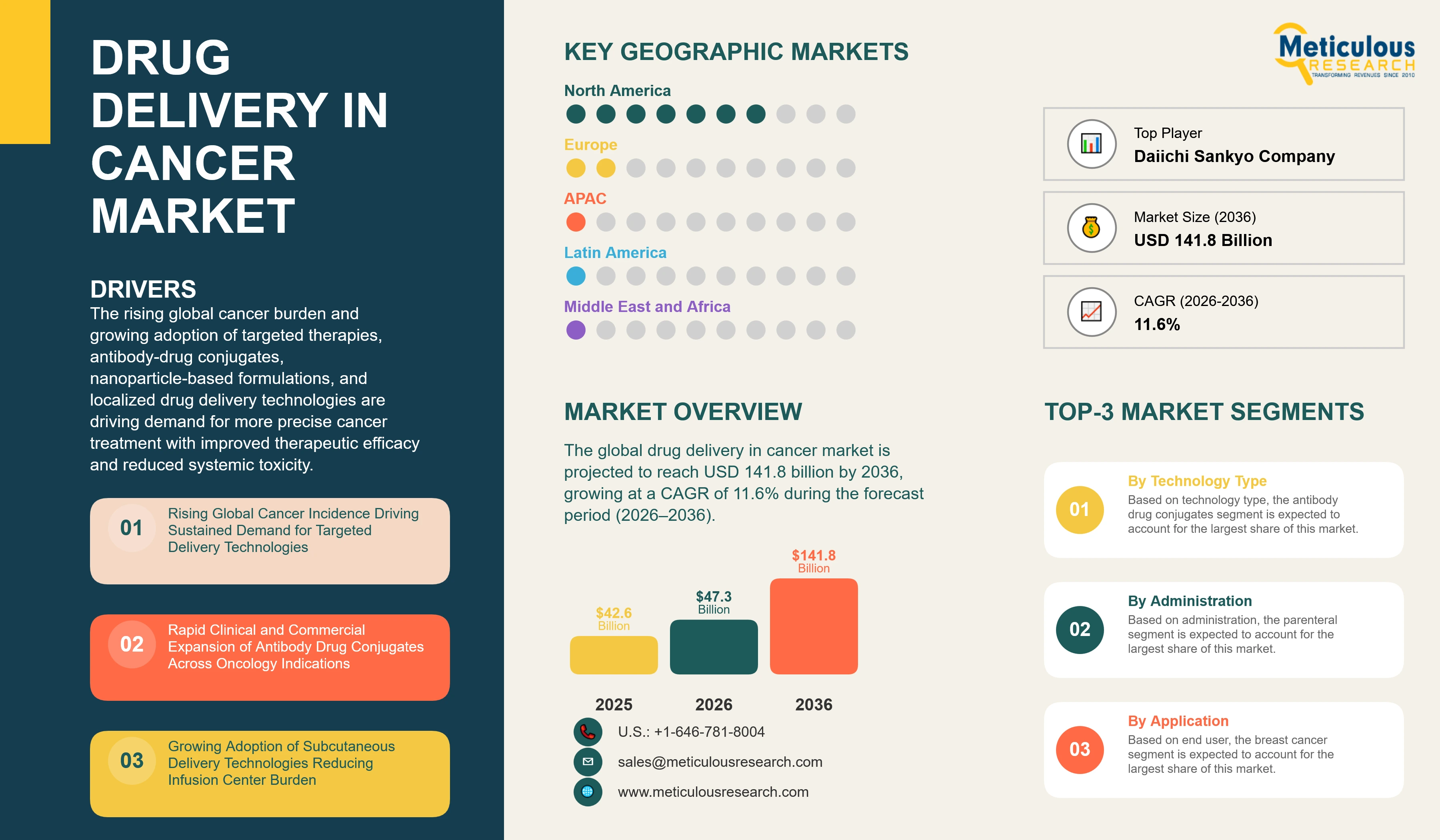
The global drug delivery in cancer market was valued at USD 42.6 billion in 2025. The market is projected to reach USD 141.8 billion by 2036, growing from USD 47.3 billion in 2026 at a CAGR of 11.6% during the forecast period (2026–2036).
Click here to: Get Free Sample Pages
The global drug delivery in cancer market encompasses technologies, devices, and formulation platforms designed to deliver therapeutic agents to tumors and cancer-affected tissues with greater precision, controlled release, and reduced systemic exposure. The market includes antibody-drug conjugates (ADCs), liposomal and lipid-based delivery systems, polymeric nanoparticles and micelles, drug-eluting embolic systems, infusion and injectable delivery systems, and implantable drug delivery systems across breast, lung, colorectal, liver, prostate, and hematological cancers.
Market growth is driven by the rising global cancer burden and increasing demand for treatments that improve therapeutic efficacy while limiting treatment-related toxicity. According to the International Agency for Research on Cancer (IARC), approximately 20 million new cancer cases and 9.7 million cancer-related deaths were estimated globally in 2022, with the burden expected to increase substantially as populations grow and age. This growing patient population is supporting demand for targeted and localized drug delivery technologies.
ADCs have become a major growth area by combining monoclonal antibodies with cytotoxic payloads to enable targeted drug delivery. Commercial successes such as Enhertu and Padcev have accelerated investment in the technology, including Pfizer's acquisition of Seagen and AbbVie's acquisition of ImmunoGen. Meanwhile, drug-eluting embolic systems enable localized delivery of chemotherapy to tumors, particularly in interventional oncology applications.
Advances in nanoparticle formulations, subcutaneous delivery technologies, and implantable systems are further expanding the market. However, complex manufacturing requirements, high development costs, specialized payload and linker production, regulatory requirements, and reimbursement challenges remain key constraints. Increasing oncology manufacturing capacity in Asia Pacific and the region's growing cancer burden are expected to create significant opportunities for advanced drug delivery platforms.
Antibody Drug Conjugates Redefining Targeted Payload Delivery Across Solid Tumors and Hematological Malignancies
The rapid commercial maturation of antibody drug conjugates represents the most significant technology shift currently reshaping the drug delivery in cancer market. By combining a monoclonal antibody's antigen specificity with a highly potent cytotoxic payload linked through an engineered chemical bridge, this modality allows oncologists to deliver cell killing agents that would be too toxic for systemic administration directly to antigen expressing tumor cells.
Products such as Daiichi Sankyo Company, Limited's Enhertu, co-developed and commercialized with AstraZeneca plc, and Pfizer Inc.'s Padcev have expanded conjugate use well beyond their original indications, with ongoing trials evaluating conjugate combinations with checkpoint inhibitors and other targeted agents across earlier lines of therapy. Genentech, Inc., a member of the Roche Group, and Gilead Sciences, Inc. continue to expand approved indications for Kadcyla, Polivy, and Trodelvy, while AbbVie Inc.'s Elahere has established a position in ovarian cancer treatment following the company's acquisition of ImmunoGen, Inc.
This growth is placing significant demand on specialized bioconjugation manufacturing capacity. Lonza Group AG has announced capacity expansion at its Singapore facility to address rising commercial and clinical demand for conjugate manufacturing, reflecting the broader capacity constraints facing the sector as more conjugates advance through clinical development and toward approval.
Locoregional and Embolic Delivery Technologies Establishing Standard of Care Positions in Liver Directed Cancer Therapy
Drug eluting embolic beads and microspheres have moved from a niche interventional technique to an established treatment pathway for hepatocellular carcinoma and liver metastases from colorectal cancer, where interventional radiologists deliver chemotherapeutic agents directly into the tumor's blood supply through catheter based access.
Boston Scientific Corporation's DC Bead and LC Bead platforms, Merit Medical Systems, Inc.'s HepaSphere microspheres, and Terumo Corporation's LifePearl beads each allow drug loading prior to embolization, with the bead subsequently eluting a controlled and sustained chemotherapy dose to the tumor while restricting blood flow to the malignant tissue. This dual mechanism, combining ischemic and chemotherapeutic tumor injury, has driven continued clinical adoption relative to conventional chemoembolization approaches.
Manufacturers in this segment continue to expand their interventional oncology portfolios through both internal development and acquisition, exemplified by Boston Scientific Corporation's acquisition of Obsidio, Inc. to add gel embolic material technology to its existing embolization offering, reinforcing the competitive importance of a broad locoregional delivery portfolio.
Subcutaneous Delivery Technologies and Nanoparticle Platforms Reducing Treatment Burden and Expanding Formulation Options
The migration of intravenous biologic oncology regimens toward subcutaneous administration is reshaping how cancer therapeutics reach patients, driven by enzymatic delivery technologies that temporarily modify the extracellular matrix under the skin to permit rapid absorption of large volume biologic doses that would otherwise require infusion. Halozyme Therapeutics, Inc.'s ENHANZE drug delivery technology has been licensed by multiple oncology drug developers to convert existing intravenous antibody therapies into subcutaneous formulations, reducing administration time from hours to minutes and easing capacity pressure on infusion centers.
In parallel, lipid based and polymeric nanoparticle platforms continue to expand the range of deliverable oncology payloads. Liposomal formulations such as Jazz Pharmaceuticals plc's Vyxeos and Ipsen S.A.'s Onivyde encapsulate cytotoxic agents within lipid vesicles engineered to accumulate preferentially in tumor tissue through the enhanced permeability of tumor vasculature, improving the therapeutic window relative to the free drug. Contract development and manufacturing organizations including Evonik Industries AG and Catalent, Inc., a Novo Holdings company, continue to expand polymer and lipid excipient manufacturing capacity to support this growing pipeline of nanoparticle formulated oncology therapeutics moving through clinical development.
By Technology: In 2026, the Antibody Drug Conjugates Segment to Dominate the Global Drug Delivery in Cancer Market
Based on technology, the drug delivery in cancer market is segmented into antibody drug conjugates, liposomal and lipid based delivery systems, polymeric nanoparticle and micellar systems, drug eluting embolic systems, infusion and injectable delivery systems, implantable drug delivery systems, and other technologies. In 2026, the antibody drug conjugates segment is expected to account for the largest share of this market. The leading position of this segment is attributed to the expanding number of approved conjugates across breast, lung, urothelial, and hematological cancer indications, continued label expansion of established products into earlier treatment lines, and sustained investment by large pharmaceutical companies seeking to secure conjugate platforms through acquisition and licensing.
However, the liposomal and lipid based delivery systems segment is projected to register the highest growth during the forecast period. The high growth of this segment is driven by an expanding clinical pipeline of lipid nanoparticle formulated oncology therapeutics, growing use of liposomal encapsulation to improve the therapeutic window of established cytotoxic agents, and continued manufacturing capacity investment by contract development organizations supporting this formulation class.
By Route of Administration: In 2026, the Parenteral Segment to Hold the Largest Share
Based on route of administration, the drug delivery in cancer market is segmented into parenteral, oral, topical, and other routes of administration, with the parenteral segment further divided into intravenous, subcutaneous, and intra-arterial or intratumoral delivery. In 2026, the parenteral segment is expected to account for the largest share of this market. The growth of this segment is driven by the continued dominance of intravenous administration for biologic and cytotoxic cancer therapeutics, where precise dose control and direct systemic access remain clinically necessary for a large share of approved oncology treatments.
However, the subcutaneous delivery segment is projected to register the highest growth during the forecast period. The high growth of this segment is driven by the ongoing conversion of established intravenous biologic regimens to subcutaneous formulations, growing adoption of enzymatic delivery technologies that enable large volume subcutaneous dosing, and the reduced treatment center burden and improved patient convenience associated with subcutaneous administration relative to lengthy infusion sessions.
By Application: In 2026, the Breast Cancer Segment to Hold the Largest Share
Based on application, the drug delivery in cancer market is segmented into breast cancer, lung cancer, colorectal cancer, liver cancer, blood cancer, prostate cancer, and other applications. In 2026, the breast cancer segment is expected to account for the largest share of this market, reflecting the high global incidence of the disease and the concentration of approved antibody drug conjugates and liposomal formulations developed specifically for HER2 positive and triple negative breast cancer treatment.
However, the blood cancer segment is projected to register the highest growth during the forecast period. The high growth of this segment is driven by the expanding use of antibody drug conjugates and cell based delivery approaches in leukemia, lymphoma, and multiple myeloma treatment, alongside a growing pipeline of targeted delivery candidates advancing through clinical development for hematological malignancies.
Based on geography, the overall drug delivery in cancer market is segmented into North America, Europe, Asia Pacific, Latin America, and the Middle East and Africa. In 2026, North America is expected to account for the largest share of the market. The region's leading position is supported by the strong concentration of oncology and biologics developers in the U.S., advanced cancer treatment infrastructure, extensive interventional oncology capabilities, and strong regulatory and clinical research ecosystems. The presence of major companies such as Boston Scientific Corporation, Merit Medical Systems, Gilead Sciences, Inc., and Pfizer Inc., together with substantial investment in oncology research and development, further strengthens the regional market.
Asia Pacific is expected to register the fastest growth from 2026 to 2036. Growth is supported by the region's large and increasing cancer burden, expanding healthcare expenditure, improving access to advanced cancer therapies, and growing pharmaceutical and biologics manufacturing capabilities across China, India, Japan, and South Korea. Government initiatives to expand cancer screening and treatment infrastructure are also supporting adoption of advanced drug delivery technologies.
Europe represents a mature market, supported by established oncology care infrastructure, strong pharmaceutical and biotechnology capabilities, clinical research activity, and supportive regulatory frameworks. Companies such as Lonza Group AG and Evonik Industries AG contribute to the region's drug-development, formulation, and manufacturing ecosystem.
The Middle East and Africa represent emerging markets, supported by increasing investment in specialized oncology infrastructure, particularly in Saudi Arabia and the UAE. Latin America is also expected to expand as cancer treatment access improves in Brazil, Mexico, and other major markets, alongside increasing adoption of advanced oncology and interventional treatment approaches.
The global drug delivery in cancer market is competitive, with a mix of large biopharmaceutical companies, specialized drug delivery technology providers, interventional oncology device manufacturers, and contract development and manufacturing organizations. Competition is primarily driven by technology platform breadth, manufacturing capabilities for complex biologic and nanoparticle formulations, clinical evidence supporting delivery precision and therapeutic outcomes, regulatory expertise, and commercialization capabilities across major markets. Key differentiators include proprietary conjugation, encapsulation, nanoparticle, subcutaneous, or embolic delivery technologies; specialized manufacturing capacity; intellectual property portfolios; and the strength of oncology-focused clinical development pipelines.
Large biopharmaceutical companies, including Daiichi Sankyo Company, Limited, AstraZeneca plc, Pfizer Inc., Gilead Sciences, Inc., and AbbVie Inc., compete through advanced oncology portfolios, ADC platforms, clinical development pipelines, and lifecycle expansion of marketed therapies. Daiichi Sankyo and AstraZeneca have particularly strong positions in ADCs through Enhertu and other DXd-based programs. Genentech, Inc. maintains capabilities in oncology biologics and ADC research, while Jazz Pharmaceuticals plc participates in liposomal oncology drug delivery through Vyxeos Liposomal.
Medical device companies such as Boston Scientific Corporation, Merit Medical Systems, Inc., and Terumo Corporation compete in interventional oncology and drug-eluting embolic technologies, while Baxter International Inc. participates in infusion and injectable delivery systems. Technology and manufacturing specialists, including Halozyme Therapeutics, Inc., Lonza Group AG, Evonik Industries AG, and Catalent, Inc., support the development, formulation, delivery, and commercial-scale manufacturing of advanced therapies.
The report provides a comprehensive competitive analysis based on key players' product portfolios, geographic presence, technology capabilities, and strategic initiatives undertaken in recent years.
Key players operating in the global drug delivery in cancer market include Daiichi Sankyo Company, Limited (Japan), AstraZeneca plc (U.K.), Roche Holding AG (Switzerland), Pfizer Inc. (U.S.), Merck & Co., Inc. (U.S.), Bristol Myers Squibb Company (U.S.), Johnson & Johnson (U.S.), Gilead Sciences, Inc. (U.S.), AbbVie Inc. (U.S.), Novartis AG (Switzerland), Ipsen S.A. (France), Halozyme Therapeutics, Inc. (U.S.), Boston Scientific Corporation (U.S.), Terumo Corporation (Japan), Merit Medical Systems, Inc. (U.S.), and Catalent, Inc. (U.S.), among others.
|
Parameters |
Details |
|
Market Size by 2036 |
USD 141.8 Billion |
|
Market Size in 2026 |
USD 47.3 Billion |
|
Market Size in 2025 |
USD 42.6 Billion |
|
Revenue Growth Rate (2026–2036) |
CAGR of 11.6% |
|
Dominating Technology |
Antibody Drug Conjugates |
|
Fastest Growing Technology |
Liposomal and Lipid Based Delivery Systems |
|
Dominating Route of Administration |
Parenteral |
|
Fastest Growing Route of Administration |
Subcutaneous |
|
Dominating Application |
Breast Cancer |
|
Fastest Growing Application |
Blood Cancer |
|
Dominating Geography |
North America |
|
Fastest Growing Geography |
Asia Pacific |
|
Base Year |
2025 |
|
Forecast Period |
2026 to 2036 |
The global drug delivery in cancer market is expected to reach USD 141.8 billion by 2036 from an estimated USD 47.3 billion in 2026, at a CAGR of 11.6% during the forecast period 2026–2036.
In 2026, the antibody drug conjugates segment is expected to hold the largest share of this market, driven by an expanding number of approved conjugates and their rapid clinical uptake across breast, lung, and blood cancer treatment protocols.
The liposomal and lipid based delivery systems segment is expected to register the highest CAGR during the forecast period 2026–2036, driven by an expanding pipeline of lipid nanoparticle formulated oncology therapeutics and growing manufacturing capacity investment supporting this formulation class.
In 2026, the parenteral segment is expected to hold the largest share of this market, reflecting the continued dominance of intravenous and subcutaneous administration for biologic and cytotoxic cancer therapeutics.
In 2026, the breast cancer segment is expected to hold the largest share of this market, reflecting the disease's high global incidence and the concentration of approved delivery technologies developed specifically for its treatment.
North America is expected to account for the largest share of the global drug delivery in cancer market in 2026, driven by the concentration of antibody drug conjugate developers headquartered in the region, a well-established interventional oncology treatment infrastructure, and the earliest regulatory access to newly approved delivery technologies.
The growth of this market is primarily driven by the rising global cancer burden, with the International Agency for Research on Cancer estimating approximately 21 million new cancer cases diagnosed worldwide in 2024; the continued clinical and commercial expansion of antibody drug conjugates; growing adoption of subcutaneous delivery technologies that reduce infusion center burden; established use of drug eluting embolic systems in liver directed cancer therapy; and sustained investment in nanoparticle and liposomal formulation manufacturing capacity.
Key players in the global drug delivery in cancer market include Daiichi Sankyo Company, Limited (Japan), AstraZeneca plc (U.K.), Pfizer Inc. (U.S.), Genentech, Inc. (U.S.), Gilead Sciences, Inc. (U.S.), AbbVie Inc. (U.S.), Jazz Pharmaceuticals plc (Ireland), Ipsen S.A. (France), Boston Scientific Corporation (U.S.), Merit Medical Systems, Inc. (U.S.), Terumo Corporation (Japan), Baxter International Inc. (U.S.), Halozyme Therapeutics, Inc. (U.S.), Lonza Group AG (Switzerland), Evonik Industries AG (Germany), and Catalent, Inc. (U.S.).
Asia Pacific is expected to register the highest growth rate in the global drug delivery in cancer market during the forecast period 2026–2036, driven by the region's large and expanding cancer patient population, growing domestic biologics manufacturing capacity, and expanding government led cancer care access programs across China, India, Japan, and South Korea.
1. Introduction
1.1 Market Definition and Scope
1.2 Market Ecosystem
1.3 Currency and Limitations
1.3.1 Currency
1.3.2 Limitations
1.4 Key Stakeholders
2. Research Methodology
2.1 Research Approach
2.2 Data Collection & Validation Process
2.2.1 Secondary Research
2.2.2 Primary Research & Validation
2.2.2.1 Primary Interviews with Experts
2.2.2.2 Country-/Region-Level Analysis
2.3 Market Estimation
2.3.1 Bottom-Up Approach
2.3.2 Top-Down Approach
2.4 Data Triangulation
2.5 Assumptions for the Study
3. Executive Summary
3.1 Market Overview
3.2 Market Analysis by Technology
3.3 Market Analysis by Route of Administration
3.4 Market Analysis by Application
3.5 Market Analysis by Geography
4. Market Dynamics
4.1 Overview
4.2 Drivers
4.2.1 Rising Global Cancer Incidence Driving Sustained Demand for Targeted Delivery Technologies
4.2.2 Rapid Clinical and Commercial Expansion of Antibody Drug Conjugates Across Oncology Indications
4.2.3 Growing Adoption of Subcutaneous Delivery Technologies Reducing Infusion Center Burden
4.2.4 Established Clinical Use of Drug Eluting Embolic Systems in Liver Directed Cancer Therapy
4.3 Restraints
4.3.1 Complex and Costly Manufacturing Requirements for Biologic Conjugates and Nanoparticle Formulations
4.3.2 Limited Specialized Manufacturing Capacity Constraining Payload and Linker Supply
4.4 Opportunities
4.4.1 Expanding Lipid Nanoparticle and Liposomal Pipeline Broadening Deliverable Payload Options
4.4.2 Growing Biologics Manufacturing Capacity in Asia Pacific Opening New Regional Demand
4.4.3 Continued Conversion of Intravenous Biologic Regimens to Subcutaneous Formulations
4.5 Challenges
4.5.1 High Cost of Advanced Delivery Platforms Influencing Reimbursement and Market Access Timelines
4.5.2 Regulatory Complexity in Characterizing Novel Conjugate and Nanoparticle Formulations
4.6 Porter's Five Forces Analysis
5. Drug Delivery in Cancer Market, by Technology
5.1 Overview
5.2 Antibody Drug Conjugates
5.3 Liposomal and Lipid Based Delivery Systems
5.4 Polymeric Nanoparticle and Micellar Systems
5.5 Drug Eluting Embolic Systems
5.5.1 Microspheres
5.5.2 Drug Eluting Beads
5.6 Infusion and Injectable Delivery Systems
5.7 Implantable Drug Delivery Systems
5.8 Other Technologies
6. Drug Delivery in Cancer Market, by Route of Administration
6.1 Overview
6.2 Parenteral
6.2.1 Intravenous
6.2.2 Subcutaneous
6.2.3 Intra-arterial and Intratumoral
6.3 Oral
6.4 Topical
6.5 Other Routes of Administration
7. Drug Delivery in Cancer Market, by Application
7.1 Overview
7.2 Breast Cancer
7.3 Lung Cancer
7.4 Colorectal Cancer
7.5 Liver Cancer
7.6 Blood Cancer
7.6.1 Leukemia
7.6.2 Lymphoma
7.6.3 Multiple Myeloma
7.7 Prostate Cancer
7.8 Other Applications
8. Drug Delivery in Cancer Market, by Geography
8.1 Overview
8.2 North America
8.2.1 U.S.
8.2.2 Canada
8.3 Europe
8.3.1 Germany
8.3.2 U.K.
8.3.3 France
8.3.4 Italy
8.3.5 Spain
8.3.6 Switzerland
8.3.7 Rest of Europe
8.4 Asia Pacific
8.4.1 China
8.4.2 Japan
8.4.3 India
8.4.4 South Korea
8.4.5 Australia
8.4.6 Rest of Asia Pacific
8.5 Latin America
8.5.1 Brazil
8.5.2 Mexico
8.5.3 Rest of Latin America
8.6 Middle East and Africa
8.6.1 Saudi Arabia
8.6.2 UAE
8.6.3 South Africa
8.6.4 Rest of Middle East and Africa
9. Competitive Landscape
9.1 Overview
9.2 Key Growth Strategies
9.3 Competitive Benchmarking
9.4 Competitive Dashboard
9.4.1 Industry Leaders
9.4.2 Market Differentiators
9.4.3 Vanguards
9.4.4 Emerging Companies
9.5 Market Share/Ranking Analysis (2025)
10. Company Profiles
10.1 Daiichi Sankyo Company, Limited
10.2 AstraZeneca plc
10.3 Roche Holding AG (Genentech, Inc.)
10.4 Pfizer Inc.
10.5 Merck & Co., Inc.
10.6 Bristol Myers Squibb Company
10.7 Johnson & Johnson
10.8 Gilead Sciences, Inc.
10.9 AbbVie Inc.
10.10 Novartis AG
10.11 Ipsen S.A.
10.12 Halozyme Therapeutics, Inc.
10.13 Boston Scientific Corporation
10.14 Terumo Corporation
10.15 Merit Medical Systems, Inc.
10.16 Catalent, Inc.
11. Appendix
11.1 Questionnaire
11.2 Available Customization Options
11.3 Related Reports
























Published Date: Jun-2026
Published Date: Jun-2026
Published Date: Feb-2026
Subscribe to get the latest industry updates