Ultrasound Wound Debridement Devices Market (2026-2036)
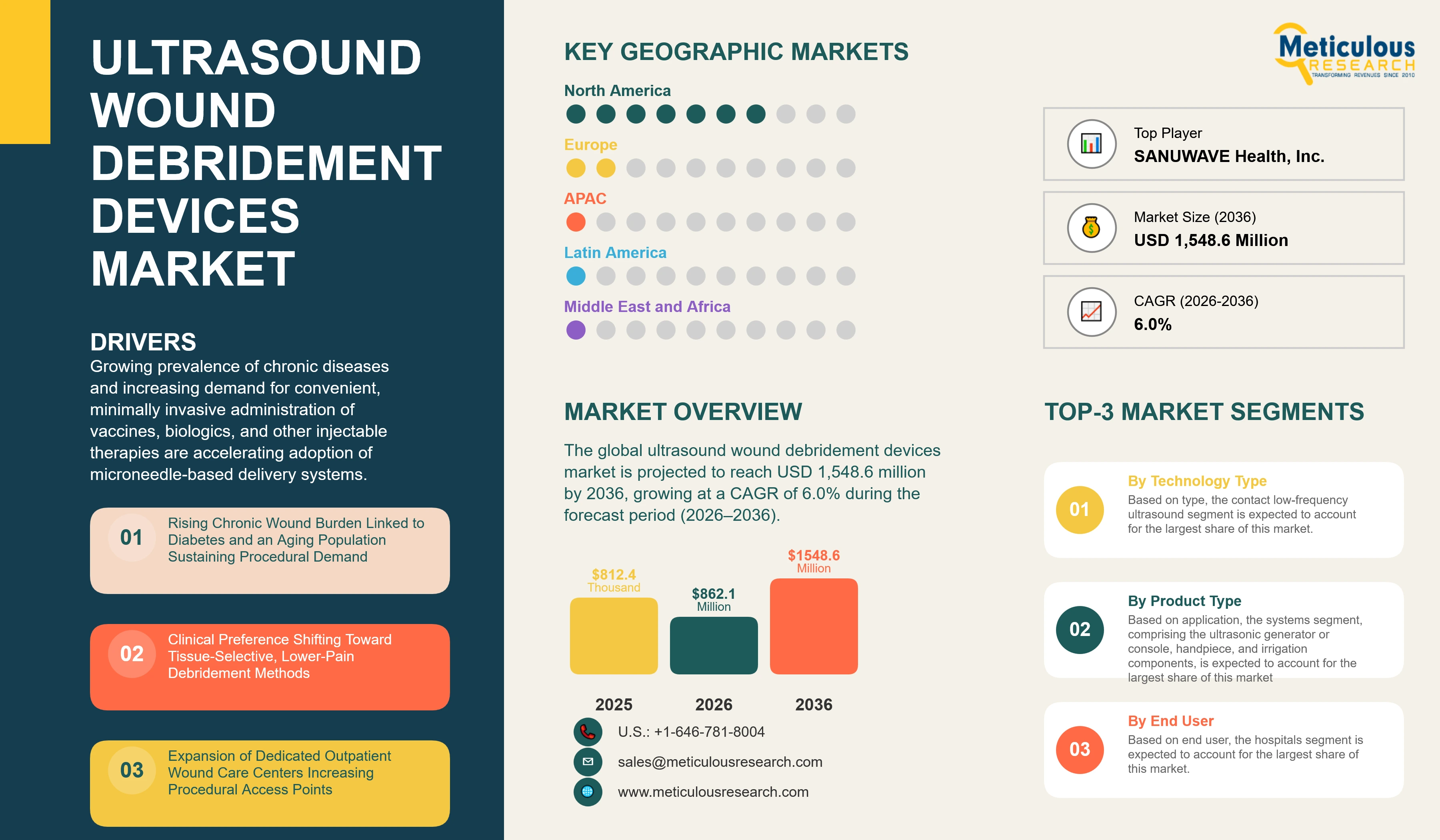
The global ultrasound wound debridement devices market was valued at USD 812.4 million in 2025. The market is projected to reach USD 1,548.6 million by 2036, growing from USD 862.1 million in 2026 at a CAGR of 6.0% during the forecast period (2026–2036).
- Published
- Aug 2026
- Pages
- 314
- Format
- PDF + Excel
- Report ID
- MR-2138
- Base year
- 2025
- 2025 · BASELINE
- $812.4M
- 2036
- $1.55B
- CAGR 2026–2036
- 6.0%
2025 baseline · 2026–2036 forecast at 6.0% CAGR · hover a bar for the value
Key highlights
The global ultrasound wound debridement devices market is projected to reach USD 1, 548.6 million by 2036.
The market is expected to grow at a CAGR of 6.0% during the forecast period 2026–2036.
The total market was valued at USD 812.4 million in 2025 and is estimated to reach USD 862.1 million in 2026.
North America is expected to dominate this market with the largest revenue share in 2026, driven by favorable hospital outpatient and physician office reimbursement coding for ultrasonic wound debridement procedures, a high concentration of specialty wound care centers, and the presence of leading device manufacturers headquartered in the region.
Asia Pacific is projected to witness the fastest revenue growth during the forecast period, driven by a rapidly expanding diabetic and geriatric population base, growing hospital infrastructure investment in China and India, and the entry of regional manufacturers offering lower-cost ultrasonic debridement platforms.
By technology type, the contact low-frequency ultrasound segment is expected to hold the largest share of the market in 2026, driven by its established use in operating room and bedside sharp debridement of deep, heavily necrotic wounds.
By technology type, the non-contact low-frequency ultrasound segment is projected to register steady growth, supported by its use in maintenance debridement of sensitive or painful wounds in outpatient and podiatry settings.
By product, the systems segment is expected to account for the largest share of the market in 2026, while the probes and accessories segment is projected to register the highest growth during the forecast period, reflecting the recurring, single-use nature of debridement tips and applicators.
By wound type, the diabetic foot ulcers segment is expected to account for the largest share in 2026, while the pressure ulcers segment is projected to register a strong CAGR through the forecast period.
By end use, hospitals are expected to account for the largest share in 2026, while wound care clinics and ambulatory surgical centers are projected to register the fastest growth.
By geography, North America is expected to dominate the market in 2026, while Asia Pacific is expected to witness the fastest growth during the forecast period.
Report summary
| Particulars | Details |
|---|---|
| Market Size by 2036 | USD 1,548.6 Million |
| Market Size in 2026 | USD 862.1 Million |
| Market Size in 2025 | USD 812.4 Million |
| Revenue Growth Rate (2026–2036) | CAGR of 6.0% |
| Format | PDF, Excel & Cloud Portal · 314 pages |
| Dominating Technology Type | Contact Low-Frequency Ultrasound |
| Fastest Growing Technology Type | Non-Contact Low-Frequency Ultrasound |
| Dominating Product | Systems |
| Fastest Growing Product | Probes and Accessories |
| Dominating Wound Type | Diabetic Foot Ulcers |
| Fastest Growing Wound Type | Pressure Ulcers |
| Dominating End Use | Hospitals |
| Fastest Growing End Use | Wound Care Clinics and Ambulatory Surgical Centers |
| Dominating Geography | North America |
| Fastest Growing Geography | Asia Pacific |
| Base Year | 2025 |
| Forecast Period | 2026 to 2036 |
Report overview
Segments covered: technology type, product, wound type, end use.
The global ultrasound wound debridement devices market comprises medical systems that use low-frequency ultrasonic energy to remove or disrupt necrotic tissue, fibrin, biofilm, and wound debris while supporting wound-bed preparation. The market includes contact ultrasonic systems, which use probes for targeted debridement, and non-contact low-frequency ultrasound systems, which deliver ultrasound through a saline mist for wound cleansing and maintenance debridement. These devices are used across hospitals, ambulatory surgical centers, wound care clinics, and long-term care settings to manage diabetic foot ulcers, pressure ulcers, venous and arterial ulcers, surgical and traumatic wounds, and burns.
Market growth is supported by the increasing burden of chronic and non-healing wounds, particularly those associated with diabetes. According to the U.S. Centers for Disease Control and Prevention, 40.1 million people in the U.S. had diagnosed or undiagnosed diabetes in 2023, equivalent to 12.0% of the population. Pressure injuries also represent a substantial healthcare burden, with AHRQ reporting that more than 2.5 million people in the U.S. develop pressure ulcers annually.
Ultrasonic debridement is gaining adoption because ultrasonic energy can facilitate selective removal of non-viable tissue and wound debris, while non-contact systems provide a less invasive approach to wound cleansing. FDA classifies low-energy ultrasound wound cleaners as Class II medical devices under 21 CFR 878.4410, with marketing applications generally submitted through the 510(k) pathway.
However, adoption can be constrained by equipment costs, clinician training requirements, reimbursement variability, and competition from conventional sharp, enzymatic, and mechanical debridement methods. Growth opportunities remain in non-contact ultrasound platforms, outpatient wound care, long-term care, and home healthcare, particularly as healthcare providers increasingly prioritize efficient wound management and reduced treatment burden.
Report infographic
Market dynamics
3 factors across 1 forceRising Chronic Wound Burden Linked to Diabetes and an Aging Population Sustaining Procedural Demand
The steadily increasing global prevalence of diabetes and its associated complications represents one of the most direct demand drivers for ultrasound wound debridement devices, since diabetic foot ulceration remains one of the leading indications for active wound debridement therapy. CDC data show an estimated 40.1 million people in the United States were living with diagnosed or undiagnosed diabetes in 2023, and a substantial share of this population will develop a foot ulcer at some point due to peripheral neuropathy and impaired circulation. Because diabetic foot ulcers are highly prone to biofilm formation and delayed healing, wound care specialists increasingly favor tissue-selective ultrasonic debridement over sharp debridement alone, both to reduce bacterial load and to prepare the wound bed for adjunct therapies such as skin substitutes and negative pressure wound therapy. Alongside diabetes, an aging population base across North America, Europe, and East Asia is expanding the pool of patients at risk for pressure ulcers and venous leg ulcers, both of which are commonly listed indications across major device manufacturers' labeling. This combination of a growing diabetic population and an aging demographic base is creating a durable, non-discretionary demand floor for debridement technologies across hospital, outpatient, and long-term care settings.
Clinical Preference Shifting Toward Tissue-Selective, Lower-Pain Debridement Methods
A structural shift in wound care practice, away from purely surgical sharp debridement and toward technologies that selectively remove necrotic tissue while sparing healthy granulation tissue, is reshaping procurement priorities among hospitals and wound centers. Contact low-frequency ultrasonic systems such as Bioventus Inc.'s SonicOne, Söring GmbH's SONOCA-based Ultrasonic-Assisted Wound (UAW) debridement instruments, and Arobella Medical, LLC's Qoustic Wound Therapy System use cavitation generated at ultrasonic frequencies, transmitted through sterile saline, to fragment and loosen non-viable tissue and biofilm with reported reductions in bleeding and procedural pain relative to sharp debridement. This tissue-preserving profile has supported adoption not only in operating rooms but increasingly at the bedside and in outpatient wound clinics, where minimizing patient discomfort during repeat debridement sessions is a clinical priority. In parallel, non-contact low-frequency ultrasound systems, most notably SANUWAVE Health, Inc.'s UltraMIST platform, deliver ultrasonic energy through a saline mist without direct probe contact with the wound bed, a design intended for gentler maintenance debridement of sensitive or painful wounds that may not tolerate contact-mode treatment. The continued clinical publication of comparative outcome data for both contact and non-contact modalities, including registered studies evaluating ultrasonic debridement against standard wound care in diabetic foot ulcers, is reinforcing physician confidence in ultrasonic technology as a standard-of-care adjunct rather than a niche intervention.
Regional Manufacturer Entry and Distribution Partnerships Expanding Market Access
The entry of a broader set of manufacturers beyond the historical base of European and North American device makers is expanding the geographic reach and price accessibility of ultrasonic wound debridement technology. In Japan, GUNZE LIMITED, through its subsidiary Medical U&A, launched the Ultra Curette ultrasonic debridement device as the first domestically developed product of its kind, with coverage under Japan's public health insurance system supporting adoption in hospital and home nursing care settings. In China, Bioevopeak Co., Ltd. has developed a portfolio of ultrasonic wound debridement systems positioned at more accessible price points for hospitals and clinics across Asia Pacific. In Italy, Esacrom S.r.l's Surgysonic Wound platform has extended contact ultrasonic debridement technology into European hospital and ward settings for indications spanning diabetic foot, osteomyelitis, burns, and pressure sores. Distribution partnerships are also playing a growing role in market access: in February 2026, wound care distributor New Horizon Medical Solutions announced a collaboration with Söring US, the American affiliate of Söring GmbH, to expand distribution of the Söring UAW debridement system across the United States, illustrating how established European manufacturers are using regional distribution partners to deepen penetration in the U.S. outpatient wound care market. Collectively, this broadening manufacturer base is making ultrasonic debridement technology accessible to a wider range of facility sizes and budgets than was the case when the market was concentrated among a small number of premium-priced platforms.
Table of contents
12 chapters · 104 sections · 314 pages · click to expandSegmental analysis
| Segment | Largest share (2026) | Fastest growth (2026–2036) |
|---|---|---|
| By Technology Type | Contact Low-Frequency Ultrasound | Non-contact low-frequency ultrasound |
| By Product | Systems | Probes and accessories |
| By Wound Type | Diabetic Foot Ulcers | — |
| By End Use | Hospitals | Wound care clinics and ambulatory surgical centers |
By Technology Type
- The contact low-frequency ultrasound segment is expected to account for the largest share of this market.
- The leading position of this segment is attributed to its established role in operating room and bedside sharp debridement of deep, heavily necrotic, or infected wounds, where direct probe contact allows clinicians to combine ultrasonic cavitation with mechanical fragmentation for faster, more thorough tissue removal.
- Platforms such as Bioventus Inc.'s SonicOne, Söring GmbH's SONOCA UAW instruments, and Arobella Medical, LLC's Qoustic Wound Therapy System operate in this mode, typically at frequencies in the 22 to 35 kHz range, and remain the default choice for surgeons and wound care specialists managing complex, deep, or heavily colonized wounds.
- However, the non-contact low-frequency ultrasound segment is projected to register the highest growth during the forecast period.
- The high growth of this segment is driven by its favorable pain and tissue-preservation profile in maintenance debridement of chronic wounds, its suitability for use on sensitive periwound skin and painful ulcers that may not tolerate contact-mode probes, and its growing adoption in outpatient wound centers and podiatry practices seeking a gentler option for repeat weekly treatment sessions.
- SANUWAVE Health, Inc.'s UltraMIST system, which delivers low-frequency ultrasound through a non-contact saline mist rather than a direct probe, exemplifies this segment's positioning as a complementary technology to contact-mode systems rather than a full substitute for deep surgical debridement.
By Product
- The Systems Segment to Hold the Largest Share
- The systems segment, comprising the ultrasonic generator or console, handpiece, and irrigation components, is expected to account for the largest share of this market, reflecting the significant upfront capital investment required by hospitals and wound centers to acquire a base platform.
- However, the probes and accessories segment is projected to register the highest growth during the forecast period.
- The high growth of this segment is driven by the recurring, largely single-use nature of debridement probes, sonotrodes, and disposable applicators, which must be replaced on a per-procedure or per-patient basis for infection control reasons once a facility has an installed base of systems.
- As the installed base of ultrasonic debridement consoles grows across hospitals and outpatient wound centers, the recurring consumables segment is expected to represent an increasing share of manufacturers' overall revenue relative to one-time system sales.
By Wound Type
- The diabetic foot ulcers segment is expected to account for the largest share of this market, reflecting the scale of the diabetic population base and the well-documented clinical need for aggressive, repeated debridement to control infection risk and support healing in this wound type.
- However, the pressure ulcers segment is projected to register a strong CAGR during the forecast period.
- The growth of this segment is driven by the significant volume of hospital-acquired and long-term-care-acquired pressure injuries recorded annually in the United States and other developed healthcare systems, and by growing institutional focus on reducing pressure injury rates as a quality and reimbursement metric, which is reinforcing procurement of effective, tissue-preserving debridement technologies in acute and long-term care settings.
By End Use
- The Hospitals Segment to Hold the Largest Share
- The hospitals segment is expected to account for the largest share of this market, supported by the concentration of complex, surgically managed wounds, the availability of capital budgets for higher-cost contact ultrasonic systems, and the presence of dedicated wound care teams within larger hospital systems.
- However, the wound care clinics and ambulatory surgical centers segment is projected to register the fastest growth during the forecast period, driven by the continued shift of chronic wound management toward dedicated outpatient wound centers, which offer lower-cost, more frequent access to debridement therapy than inpatient settings and are increasingly equipped with both contact and non-contact ultrasonic platforms to serve a broad range of wound severities.
Geographic analysis
North America
Largest shareIn 2026, North America is expected to account for the largest share of this market. This leadership position is supported by the scale of the U.S. diabetic and chronic wound patient population, a well-established network of specialty outpatient wound care centers, and the concentration of leading manufacturers, including Bioventus Inc. and SANUWAVE Health, Inc., headquartered in the region. Established coding and reimbursement pathways for ultrasonic wound debridement procedures under U.S. hospital outpatient and physician fee schedules further support consistent procedural volume across hospital and clinic settings.
Asia-Pacific
Fastest growthHowever, the Asia Pacific ultrasound wound debridement devices market is expected to grow at the fastest rate from 2026 to 2036. The rapid growth of this market is driven by the large and rising diabetic patient population across China and India, continued expansion of hospital infrastructure and specialty wound care capacity in these countries, and the emergence of regional manufacturers, including Bioevopeak Co., Ltd. in China and GUNZE LIMITED in Japan, offering ultrasonic debridement platforms suited to a broader range of hospital budgets than the premium-priced systems that have historically dominated the region.
Europe
Europe represents a well-established market for ultrasound wound debridement devices, anchored by Söring GmbH in Germany and Esacrom S.r.l in Italy, both of which maintain strong positions in their home markets and across the wider European hospital and wound clinic network. The region's adoption is further supported by the Medical Device Regulation (EU) 2017/745 framework, which sets a consistent bar for clinical evidence and quality system compliance across European Union member states, and by a deep base of published European clinical research on ultrasonic-assisted wound debridement outcomes in diabetic foot and post-surgical wound populations.
Middle East & Africa
The Middle East and Africa region represents a growing market for ultrasound wound debridement devices, supported by continued investment in tertiary hospital infrastructure across the Gulf Cooperation Council countries and rising diabetes prevalence in the region.
Latin America
The Latin America market is supported primarily by growing hospital and specialty wound clinic capacity in Brazil and Mexico, alongside increasing awareness of advanced wound care technologies among regional healthcare providers.
Competitive landscape
- Esacrom S.r.l in Italy
- Bioevopeak Co., Ltd. in China
- GUNZE LIMITED in Japan
Frequently asked questions
The global ultrasound wound debridement devices market is expected to reach USD 1,548.6 million by 2036 from an estimated USD 862.1 million in 2026, at a CAGR of 6.0% during the forecast period 2026–2036.
Cite this report
Meticulous Research. (2026). Ultrasound Wound Debridement Devices Market - Global Opportunity Analysis and Industry Forecast (2026-2036) (Report No. MR-2138). Meticulous Market Research Pvt. Ltd. https://www.meticulousresearch.com/product/ultrasound-wound-debridement-devices-market-6821