Drug Screening Market (2026-2036)
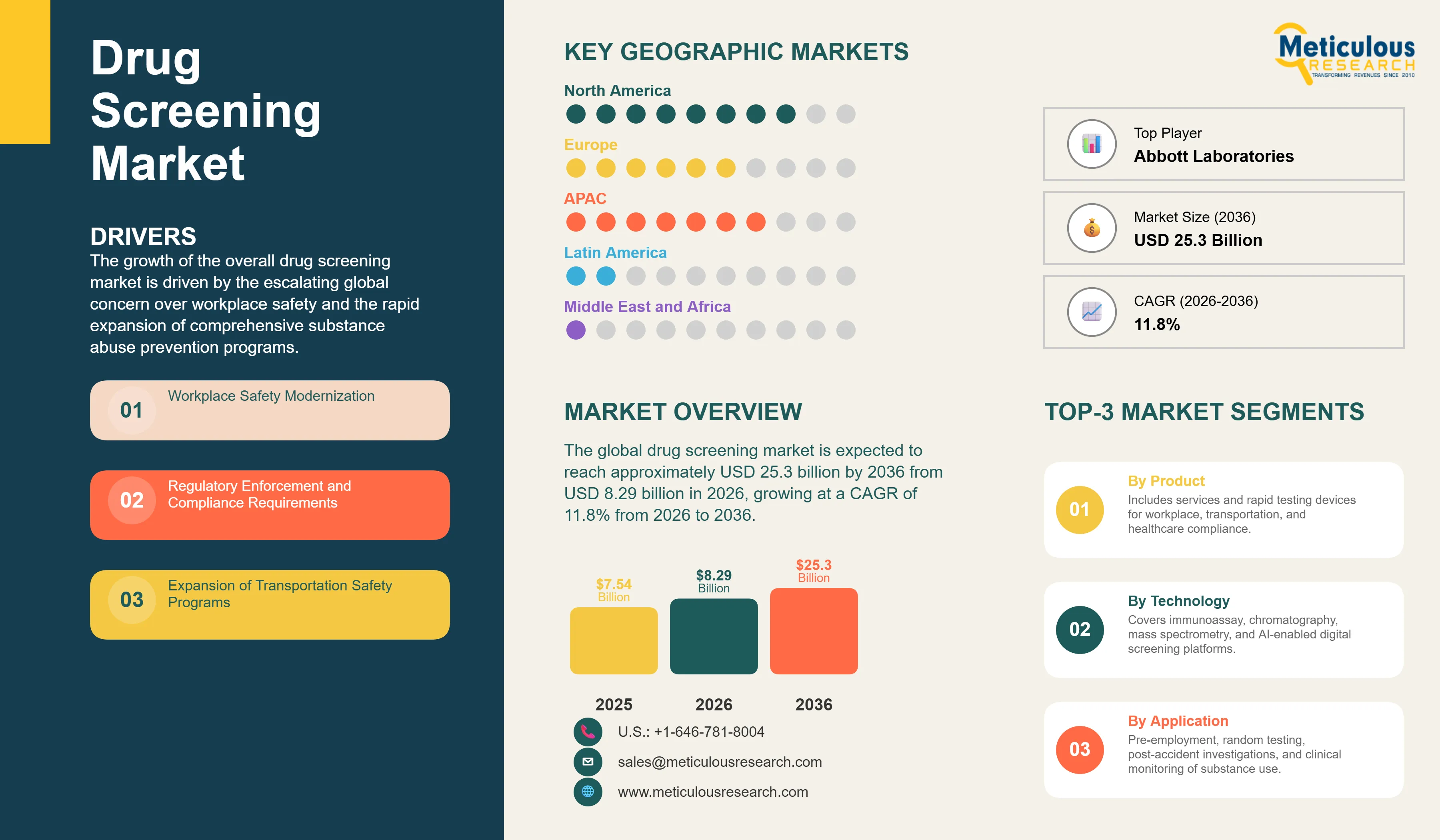
The global drug screening market was valued at USD 7.54 billion in 2025. The market is expected to reach approximately USD 25.3 billion by 2036 from USD 8.29 billion in 2026, growing at a CAGR of 11.8% from 2026 to 2036.
- Published
- Feb 2026
- Pages
- 284
- Format
- PDF + Excel
- Report ID
- MR-1763
- Base year
- 2025
- 2025 · BASELINE
- $7.54B
- 2036
- $25.30B
- CAGR 2026–2036
- 11.8%
2025 baseline · 2026–2036 forecast at 11.8% CAGR · hover a bar for the value
Key highlights
In terms of revenue, the global drug screening market is projected to reach USD 25.3 billion by 2036.
The market is expected to grow at a CAGR of 11.8% from 2026 to 2036.
North America dominates the global drug screening market with the largest market share in 2026, driven by stringent workplace regulations and the presence of comprehensive federal testing programs in the United States and Canada.
Asia-Pacific is expected to witness the fastest growth during the forecast period, supported by increasing awareness of substance abuse prevention and expanding workplace safety protocols in China, India, and Japan.
By product, the services segment holds the largest market share in 2026, particularly in supporting large-scale laboratory testing operations, comprehensive workplace programs, and superior analytical accuracy in forensic applications.
By sample type, the urine sample segment holds the largest market share in 2026, due to the widespread adoption of standardized testing protocols and established detection windows for diverse substance categories.
By end user, the workplace segment holds the largest share of the overall market in 2026.
Report summary
| Particulars | Details |
|---|---|
| Market Size by 2036 | USD 25.3 Billion |
| Market Size in 2026 | USD 8.29 Billion |
| Market Size in 2025 | USD 7.54 Billion |
| Market Growth Rate (2026-2036) | CAGR of 11.8% |
| Format | PDF, Excel & Cloud Portal · 284 pages |
| Dominating Region | North America |
| Fastest Growing Region | Asia-Pacific |
| Base Year | 2025 |
| Forecast Period | 2026 to 2036 |
| Segments Covered | Product, Sample Type, Technology, End User, Application, and Region |
| Regions Covered | North America, Europe, Asia-Pacific, Latin America, and Middle East & Africa |
Report overview
Segments covered: product, sample type, technology, end user.
The growth of the overall drug screening market is driven by the escalating global concern over workplace safety and the rapid expansion of comprehensive substance abuse prevention programs. As employers seek to integrate more stringent compliance measures into occupational health protocols and regulatory enforcement systems, drug screening solutions have become essential for maintaining high-performance workplace safety and operational reliability. The rapid expansion of point-of-care testing initiatives and the increasing need for high-reliability detection in transportation and healthcare complexes continue to fuel significant growth of this market across all major geographic regions.
Drug screening represents critical diagnostic testing technologies that leverage advanced analytical chemistry and immunoassay platforms to provide optimized substance detection and improved compliance monitoring through connected testing infrastructure. These solutions include integrated rapid testing devices, laboratory analyzers, and comprehensive services designed to automate sample processing and enhance detection precision across the testing lifecycle. The market is defined by high-efficiency technologies such as point-of-care devices and AI-driven result interpretation, which significantly enhance detection accuracy and resource utilization in high-pressure workplace environments. These solutions are indispensable for safety administrators seeking to optimize their compliance operations and meet aggressive regulatory and risk management targets.
The market includes a diverse range of solutions, ranging from simple rapid test kits for on-site screening to complex laboratory-based confirmatory platforms and AI-driven data management systems. These products are increasingly integrated with advanced components such as electronic chain-of-custody tracking and cloud-based reporting to provide services such as real-time compliance monitoring and remote result verification. The ability to provide accurate, legally defensible results while minimizing testing complexity has made drug screening technology the choice for organizations where regulatory compliance and operational safety are paramount.
The global workplace safety sector is pushing hard to modernize testing capabilities, aiming to meet zero-tolerance substance abuse policies and employee wellness goals. This drive has increased the adoption of high-performance analytical solutions, with advanced digital screening helping to maintain workplace safety standards for safety-sensitive occupations. At the same time, the rapid growth in the transportation and healthcare markets is increasing the need for high-reliability, secure testing solutions that can detect emerging synthetic substances and prescription drug misuse.
Report infographic
Market dynamics
4 factors across 3 forcesWorkplace Safety Modernization and Regulatory Enforcement
A key driver of the drug screening market is the rapid movement of the global occupational health industry toward comprehensive, high-performance safety models. Global demand for accurate substance detection, real-time compliance reporting, and data-driven risk management has created significant incentives for the adoption of drug screening infrastructure. The trend toward "prevention-first" approaches and the integration of testing systems into unified safety platforms drive organizations toward scalable solutions that drug screening can uniquely provide. It is estimated that as workplace substance abuse concerns rise and regulatory requirements become more stringent through 2036, the need for robust, comprehensive testing infrastructure increases significantly; therefore, high-performance laboratory services and rapid testing devices, with their ability to ensure accurate substance detection, are considered crucial enablers of modern workplace safety strategies.
Table of contents
12 chapters · 125 sections · 284 pages · click to expandSegmental analysis
| Segment | Largest share (2026) | Fastest growth (2026–2036) |
|---|---|---|
| By Product | Services | — |
| By Sample Type | Urine Sample | Oral fluid sample |
| By End User | Workplace | — |
By Product
- The services segment accounts for a significant portion of the overall drug screening market in 2026.
- This is mainly attributed to the comprehensive nature of laboratory-based testing in supporting workplace compliance programs, forensic investigations, and clinical monitoring requirements within modern occupational health environments.
- These services offer the most comprehensive way to ensure legal defensibility across diverse testing applications.
- The workplace and transportation sectors alone consume a large share of drug screening services, with major programs in North America and Europe demonstrating the capability to handle high-volume testing requirements with confirmatory analysis.
- However, the rapid testing devices segment is expected to grow at a notable CAGR during the forecast period, driven by the growing need for immediate results, point-of-care convenience, and technical support in complex workplace safety implementations.
By Sample Type
- The urine sample segment holds the largest share of the overall market in 2026.
- This is primarily due to the extensive regulatory acceptance and the comprehensive detection windows required for modern workplace testing programs.
- Current large-scale testing operations are increasingly specifying laboratory-based urine analysis platforms to ensure compliance with federal standards and employer expectations for reliable substance detection environments.
- The oral fluid sample segment is expected to witness the fastest growth during the forecast period.
- The shift toward non-invasive collection methods and the advantages of observed sample collection are pushing the requirement for advanced testing systems that can detect recent substance use and reduce sample tampering risks while ensuring absolute reliability for safety-critical workplace decisions.
By End User
- The workplace segment commands the largest share of the global drug screening market in 2026.
- This dominance stems from its superior ability to support pre-employment screening, random testing programs, and post-accident investigations, making it the end user of choice for comprehensive substance abuse prevention.
- Large-scale operations in transportation, manufacturing, and construction sectors drive demand, with advanced testing systems from providers like Quest Diagnostics and LabCorp enabling reliable performance in safety-sensitive environments.
- However, the drug testing laboratories segment is poised for steady growth through 2036, fueled by expanding requirements for confirmatory analysis and forensic investigations.
- Testing laboratories face mounting pressure to provide legally defensible results for diverse applications, where advanced chromatography-mass spectrometry platforms provide comprehensive analytical capabilities for complex substance identification.
Geographic analysis
North America
Largest shareNorth America holds the largest share of the global drug screening market in 2026. The largest share of this region is primarily attributed to the stringent workplace regulations and the presence of comprehensive federal testing programs, particularly in the United States. The United States alone accounts for a significant portion of global drug screening investment, with its position as a leading adopter of Department of Transportation mandates and Substance Abuse and Mental Health Services Administration guidelines driving sustained growth. The presence of leading service providers like Quest Diagnostics, LabCorp, and a well-developed testing infrastructure provides a robust market for both standard workplace screening and high-complexity laboratory solutions.
Asia-Pacific
Fastest growthAsia-Pacific is expected to witness the fastest growth during the forecast period. The growth of this market is mainly driven by the increasing awareness of workplace safety and the expansion of regulatory frameworks in the manufacturing and transportation sectors. The demand for drug screening in Asia-Pacific is mainly due to rapid industrialization, growing substance abuse concerns, and the presence of large manufacturing operations in China, India, and Southeast Asia.
Europe
In Europe, the focus on employee wellness and the push for comprehensive workplace safety programs are driving the adoption of advanced testing solutions. Countries like Germany, the United Kingdom, and France are at the forefront, with significant focus on integrating drug screening into occupational health workflows and transportation safety systems to ensure the highest levels of workplace protection and regulatory compliance.
Competitive landscape
- Quest Diagnostics Incorporated
- Laboratory Corporation of America Holdings (LabCorp)
- Abbott Laboratories
- Thermo Fisher Scientific Inc.
Frequently asked questions
The global drug screening market is expected to grow from USD 8.29 billion in 2026 to USD 25.3 billion by 2036.
Cite this report
Meticulous Research. (2026). Drug Screening Market - Global Opportunity Analysis and Industry Forecast (2026-2036) (Report No. MR-1763). Meticulous Market Research Pvt. Ltd. https://www.meticulousresearch.com/product/drug-screening-market-6446