Smart Wearable ECG Monitors Market (2026-2036)
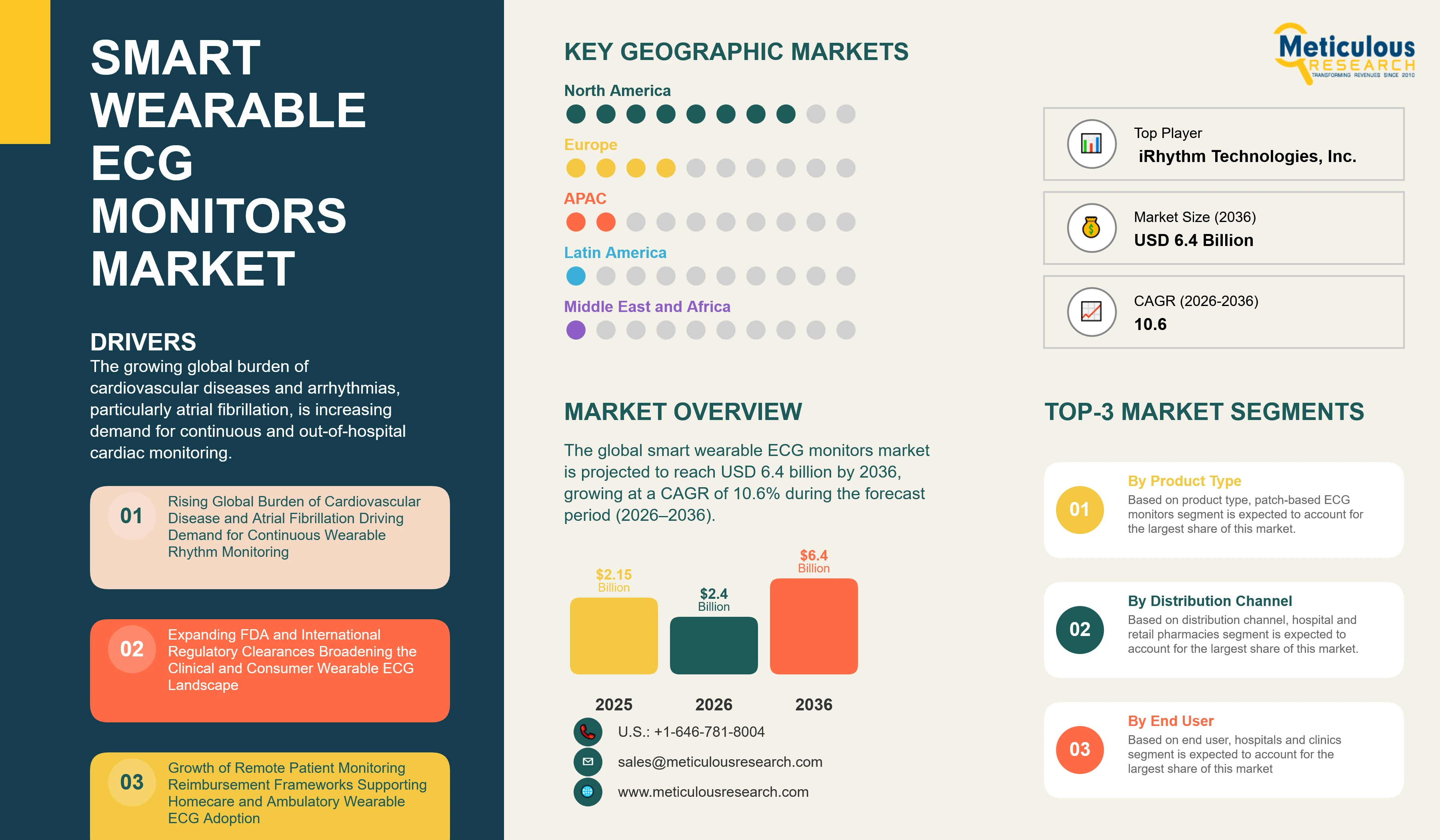
The global smart wearable ECG monitors market was valued at USD 2.15 billion in 2025. The market is projected to reach USD 6.4 billion by 2036, growing from USD 2.4 billion in 2026 at a CAGR of 10.6% during the forecast period (2026–2036).
- Published
- Aug 2026
- Pages
- 317
- Format
- PDF + Excel
- Report ID
- MR-2132
- Base year
- 2025
- 2025 · BASELINE
- $2.15B
- 2036
- $6.40B
- CAGR 2026–2036
- 10.6%
2025 baseline · 2026–2036 forecast at 10.6% CAGR · hover a bar for the value
Key highlights
The global smart wearable ECG monitors market is projected to reach USD 6.4 billion by 2036.
The market is expected to grow at a CAGR of 10.6% during the forecast period 2026–2036.
The total smart wearable ECG monitors market was valued at USD 2.15 billion in 2025 and is estimated to reach USD 2.4 billion in 2026.
North America is expected to dominate this market with the largest revenue share in 2026, supported by the widest availability of FDA-cleared consumer and clinical-grade ECG wearables, a well-established remote cardiac monitoring reimbursement structure under Medicare, and a large and rising base of diagnosed arrhythmia patients requiring ambulatory rhythm monitoring.
Asia Pacific is projected to witness the fastest revenue growth during the forecast period, driven by rising cardiovascular disease burden across China, India, Japan, and South Korea, expanding smartphone and smartwatch penetration, and growing government-backed digital health and telemedicine infrastructure across the region.
By product type, the patch-based ECG monitors segment is expected to hold the largest share of the market in 2026, driven by its established clinical use in extended ambulatory cardiac monitoring and its adoption by hospitals and diagnostic service providers as an alternative to traditional Holter monitoring.
By product type, the wrist-worn and smartwatch ECG monitors segment is projected to register the highest growth during the forecast period, driven by continued FDA clearances of consumer ECG features, expanding integration of multi-sensor cardiac and metabolic monitoring in mainstream smartwatches, and rising consumer demand for continuous, unobtrusive heart rhythm tracking.
By distribution channel, the hospital and retail pharmacies segment is expected to account for the largest share of the market in 2026, reflecting continued physician-directed prescription of clinical-grade ambulatory monitoring patches and devices.
By distribution channel, the online and direct-to-consumer channel is projected to register the highest growth during the forecast period, driven by the shift of consumer-grade smartwatch and handheld ECG device sales toward brand websites and e-commerce marketplaces.
By end use, the hospitals and clinics segment is expected to account for the largest share in 2026, while the homecare and ambulatory monitoring segment is projected to register the highest CAGR during the forecast period.
By geography, North America is expected to dominate the market in 2026, while Asia Pacific is expected to witness the fastest growth during the forecast period.
Report summary
| Particulars | Details |
|---|---|
| Market Size by 2036 | USD 6.4 Billion |
| Market Size in 2026 | USD 2.4 Billion |
| Market Size in 2025 | USD 2.15 Billion |
| Revenue Growth Rate (2026–2036) | CAGR of 10.6% |
| Format | PDF, Excel & Cloud Portal · 317 pages |
| Dominating Product Type | Patch-Based ECG Monitors |
| Fastest Growing Product Type | Wrist-Worn and Smartwatch ECG Monitors |
| Dominating Distribution Channel | Hospital and Retail Pharmacies |
| Fastest Growing Distribution Channel | Online and Direct-to-Consumer |
| Dominating End Use | Hospitals and Clinics |
| Fastest Growing End Use | Homecare and Ambulatory Monitoring |
| Dominating Geography | North America |
| Fastest Growing Geography | Asia Pacific |
| Base Year | 2025 |
| Forecast Period | 2026 to 2036 |
Report overview
Segments covered: product type, distribution channel, end use.
The global smart wearable ECG monitors market comprises ECG-enabled wearable and portable devices that capture, record, and transmit cardiac electrical activity outside traditional clinical settings. The market includes patch-based biosensors, wrist-worn smartwatches, handheld single- and multi-lead ECG devices, and chest strap or vest-type monitors used across hospitals, ambulatory care, homecare, and consumer fitness and wellness settings. These devices support detection and documentation of arrhythmias, including atrial fibrillation, bradycardia, and tachycardia, while enabling longer-duration and patient-friendly cardiac monitoring.
Market growth is driven by the rising burden of cardiovascular disease and the shift toward out-of-hospital rhythm monitoring. Cardiovascular disease remains the leading global cause of death, while atrial fibrillation represents a growing monitoring need. The U.S. CDC estimates that 12.1 million people will have atrial fibrillation by 2050; in 2021, AF was mentioned on 232,030 U.S. death certificates and was the underlying cause in 28,037 deaths. These trends are increasing demand for wearable systems capable of capturing intermittent and asymptomatic arrhythmic episodes.
Regulatory clearances, technological miniaturization, and integration of AI-based ECG analysis are further supporting adoption. AI-enabled platforms can automate rhythm classification and reduce physician review workloads. Industry consolidation is also strengthening the competitive landscape. Boston Scientific completed its acquisition of Preventice Solutions in 2021, adding the BodyGuardian family of remote wearable cardiac monitors and cloud-based cardiac monitoring capabilities to its portfolio.
Despite strong growth prospects, adoption remains constrained by variable reimbursement, signal-quality differences between consumer and clinical-grade devices, false-positive alerts, and limited validation of some consumer ECG features in broad populations.
Report infographic
Market dynamics
3 factors across 1 forceExpanding FDA and Global Regulatory Clearances Broadening the Clinical and Consumer Wearable ECG Landscape
The steady expansion of regulatory clearances for wearable ECG devices represents one of the most structurally significant demand drivers in the global smart wearable ECG monitors market, extending both the range of approved use cases and the pool of manufacturers able to market clinically validated products. Over the past two years, the FDA has cleared a diverse set of wearable ECG products, including Cardiosense's CardioTag for noninvasive ECG, seismocardiogram, and photoplethysmogram-based cardiac timing monitoring, and VitalConnect's VitalRhythm biosensor for continuous ECG, heart rate, and respiratory monitoring. Consumer wearable makers have also expanded into medically regulated territory, with WHOOP obtaining FDA clearance for an ECG feature in April 2025 and Hexoskin's smart shirt, developed by Carré Technologies, receiving FDA 510(k) clearance for long-term ECG and respiratory monitoring. This broadening clearance activity is lowering the barrier for both established medical device companies and consumer electronics manufacturers to enter the wearable ECG category with clinically defensible products, while also reshaping FDA's own regulatory approach: updated FDA guidance issued in January 2026 clarified that whether a non-invasive wearable qualifies as a general wellness product depends on how the manufacturer promotes it, rather than solely on the physiological parameter being measured, a shift that is expected to influence how future wearable ECG and blood pressure features are positioned and marketed.
Consolidation Among Ambulatory Cardiac Monitoring Specialists Reshaping the Competitive Landscape
Consolidation activity among established wearable and ambulatory cardiac monitoring providers is reshaping competitive dynamics in the global smart wearable ECG monitors market, as larger diagnostics and medical device companies acquire specialist wearable biosensor makers to build integrated, end-to-end cardiac monitoring platforms. In August 2026, iRhythm Technologies agreed to acquire VitalConnect for approximately USD 287.5 million, adding VitalConnect's seven-day wearable VitalPatch biosensor, which monitors 21 cardiac arrhythmias alongside several vital signs, to iRhythm's mobile cardiac telemetry portfolio. This follows a broader pattern established by Boston Scientific's 2021 acquisition of Preventice Solutions, which brought the BodyGuardian family of wearable cardiac monitors and its cloud-based PatientCare monitoring platform into a larger rhythm management and electrophysiology business. These transactions reflect the growing strategic value of proprietary wearable sensor technology, cloud-based monitoring infrastructure, and established physician relationships in ambulatory cardiac diagnostics, and are expected to continue driving portfolio consolidation among mid-size wearable ECG specialists over the forecast period.
Artificial Intelligence Integration Improving Arrhythmia Detection Accuracy and Reducing Clinical Review Burden
The incorporation of artificial intelligence and machine learning algorithms into wearable ECG interpretation is transforming both the clinical utility and commercial positioning of wearable ECG products, improving detection accuracy for atrial fibrillation and other arrhythmias while reducing the physician and technician workload associated with reviewing continuous rhythm data. Clinical evidence continues to build around consumer-grade wearable accuracy: a systematic review and meta-analysis published in JACC: Advances found that Apple Watch ECG showed pooled sensitivity of 94.8 percent and specificity of 95 percent for identifying atrial fibrillation across eleven studies covering 4,241 participants, although the American College of Cardiology and European Society of Cardiology guidelines advise caution around using such devices for diagnosis in broader, undiagnosed populations given the limited extent of large-scale clinical validation. Manufacturers are responding by pairing AI-based interpretation with cloud-based clinician review services, exemplified by Boston Scientific's BeatLogic deep learning algorithms embedded in the Preventice BodyGuardian platform, and by newer entrants such as HeartBeam, which received FDA clearance for a cable-free device that synthesizes ECG signals collected from three non-coplanar directions into a 12-lead ECG for at-home arrhythmia assessment. This convergence of AI-based signal interpretation with cloud connectivity is expanding the diagnostic reach of wearable ECG devices while supporting the shift of rhythm monitoring workflows from episodic clinic visits toward continuous, remotely supervised care.
Table of contents
11 chapters · 115 sections · 317 pages · click to expandSegmental analysis
| Segment | Largest share (2026) | Fastest growth (2026–2036) |
|---|---|---|
| By Product Type | Patch-Based ECG Monitors | Wrist-worn and smartwatch ECG monitors |
| By Distribution Channel | Hospital and Retail Pharmacies | Online and direct-to-consumer |
| By End Use | Hospitals and Clinics | Diabetes and biologic self-administration |
By Product Type
- The patch-based ECG monitors segment is expected to account for the largest share of this market.
- The leading position of this segment is attributed to its established role in extended ambulatory cardiac monitoring, where adhesive, single-use biosensors such as VitalConnect's VitalPatch and Preventice's BodyGuardian family allow patients to be monitored continuously for seven to thirty days without the cabling and electrode maintenance associated with traditional Holter monitors, improving patient compliance and diagnostic yield for intermittent arrhythmias.
- However, the wrist-worn and smartwatch ECG monitors segment is projected to register the highest growth during the forecast period.
- The high growth of this segment is driven by the continued expansion of FDA-cleared ECG features across mainstream consumer smartwatches, growing integration of ECG alongside photoplethysmography-based heart rhythm screening and other health sensors in a single device, and rising consumer willingness to use everyday wearables for ongoing cardiac health tracking rather than relying solely on physician-prescribed monitoring.
By Distribution Channel
- The hospital and retail pharmacies segment is expected to account for the largest share of this market.
- The growth of this segment is driven by the continued role of physicians and cardiac diagnostic service providers in prescribing and dispensing clinical-grade patch and handheld ECG monitors, particularly for patients referred for ambulatory arrhythmia workups where device selection and monitoring duration are determined by clinical protocol rather than consumer preference.
- However, the online and direct-to-consumer segment is projected to register the highest growth during the forecast period.
- The high growth of this segment is driven by the growing share of consumer-grade smartwatch, ring, and handheld ECG device sales occurring directly through manufacturer websites and major e-commerce platforms, supported by expanding consumer awareness of preventive cardiac health and the ability of brands such as AliveCor and Withings to market FDA-cleared consumer ECG accessories without requiring a physician visit.
By End Use
- The Hospitals and Clinics Segment to Hold the Largest Share
- The vaccination and immunization segment is expected to account for the largest share of this market, reflecting sustained public health sector investment in patch-based vaccine delivery as a tool to close persistent global immunization coverage gaps.
- With global first-dose measles coverage remaining at 83 percent and over 22 million children missing a first vaccine dose annually, national immunization programs and multilateral health organizations continue to prioritize microarray patch development as a means of simplifying vaccine logistics and improving reach in underserved populations.
- However, the diabetes and biologic self-administration segment is projected to register the highest growth during the forecast period.
- The high growth of this segment is driven by the large and growing population managing chronic disease through recurring injectable therapy, with an estimated 40.1 million people living with diabetes in the United States alone as of 2023, alongside rising patient and payer interest in painless, at-home biologic administration formats that reduce clinical burden and improve treatment adherence.
Geographic analysis
North America
Largest shareIn 2026, North America is expected to account for the largest market share, supported by broad availability of FDA-cleared wearable ECG products across clinical and consumer channels, established remote patient and remote physiologic monitoring reimbursement mechanisms, high healthcare expenditure, and a large population requiring arrhythmia monitoring. The presence of leading companies such as iRhythm Technologies, AliveCor, Apple, and Boston Scientific, including its Preventice portfolio, together with mature digital-health infrastructure and direct-to-consumer distribution, strengthens regional adoption.
Asia-Pacific
Fastest growthAsia Pacific is expected to register the fastest growth during 2026–2036. Growth is supported by the expanding cardiovascular disease burden, aging populations, increasing smartphone and smartwatch penetration, rising healthcare digitization, and growing investment in telemedicine and connected-health infrastructure. China, Japan, South Korea, and India represent major growth markets, supported by large patient populations and expanding adoption of consumer and clinical wearable technologies. China's established electronics and wearable-device manufacturing ecosystem further supports product availability and cost competitiveness, while India's expanding private healthcare sector and digital-health infrastructure are creating additional opportunities for remote cardiac monitoring.
Europe
Europe represents a mature market, supported by established cardiology infrastructure, high healthcare expenditure, strong adoption of connected medical devices, and regulatory requirements under the EU Medical Device Regulation for applicable medical devices. However, reimbursement and market access conditions vary considerably across individual European countries.
Latin America
Latin America and the Middle East and Africa represent emerging markets, supported by increasing cardiovascular disease awareness, expanding private healthcare infrastructure, rising smartphone and wearable penetration, and gradual adoption of telemedicine and remote patient monitoring. Brazil, Mexico, Saudi Arabia, the UAE, and South Africa are among the more attractive markets for future adoption.
Competitive landscape
- Apple Inc. (U.S.)
- AliveCor, Inc. (U.S.)
- iRhythm Technologies, Inc. (U.S.)
- Royal Philips · Netherlands
- Medtronic plc (Ireland/U.S.)
- Boston Scientific Corporation (U.S.)
- GE HealthCare Technologies Inc. (U.S.)
- SmartCardia (U.S.)
- VivaLNK, Inc. (U.S.)
- VitalConnect (U.S.)
- Withings SA · France
- Samsung Electronics Co., Ltd. · South Korea
- Bittium Corporation · Finland
- Biotricity Inc. (U.S.)
- Qardio, Inc. (U.S.)
- Garmin Ltd. · Switzerland
Frequently asked questions
The global smart wearable ECG monitors market is expected to reach USD 6.4 billion by 2036 from an estimated USD 2.4 billion in 2026, at a CAGR of 10.6% during the forecast period 2026–2036.
Cite this report
Meticulous Research. (2026). Smart Wearable ECG Monitors Market - Global Opportunity Analysis and Industry Forecast (2026-2036) (Report No. MR-2132). Meticulous Market Research Pvt. Ltd. https://www.meticulousresearch.com/product/smart-wearable-ecg-monitors-market-6815