Resources
About Us
Drug Diversion Monitoring Market Size, Share & Trends Analysis by Type, Deployment Mode, Component, End User, and Geography - Global Opportunity Analysis and Industry Forecast (2026-2036)
Report ID: MRHC - 1042037 Pages: 277 Jun-2026 Formats*: PDF Category: Healthcare Delivery: 24 to 72 Hours Download Free Sample Report
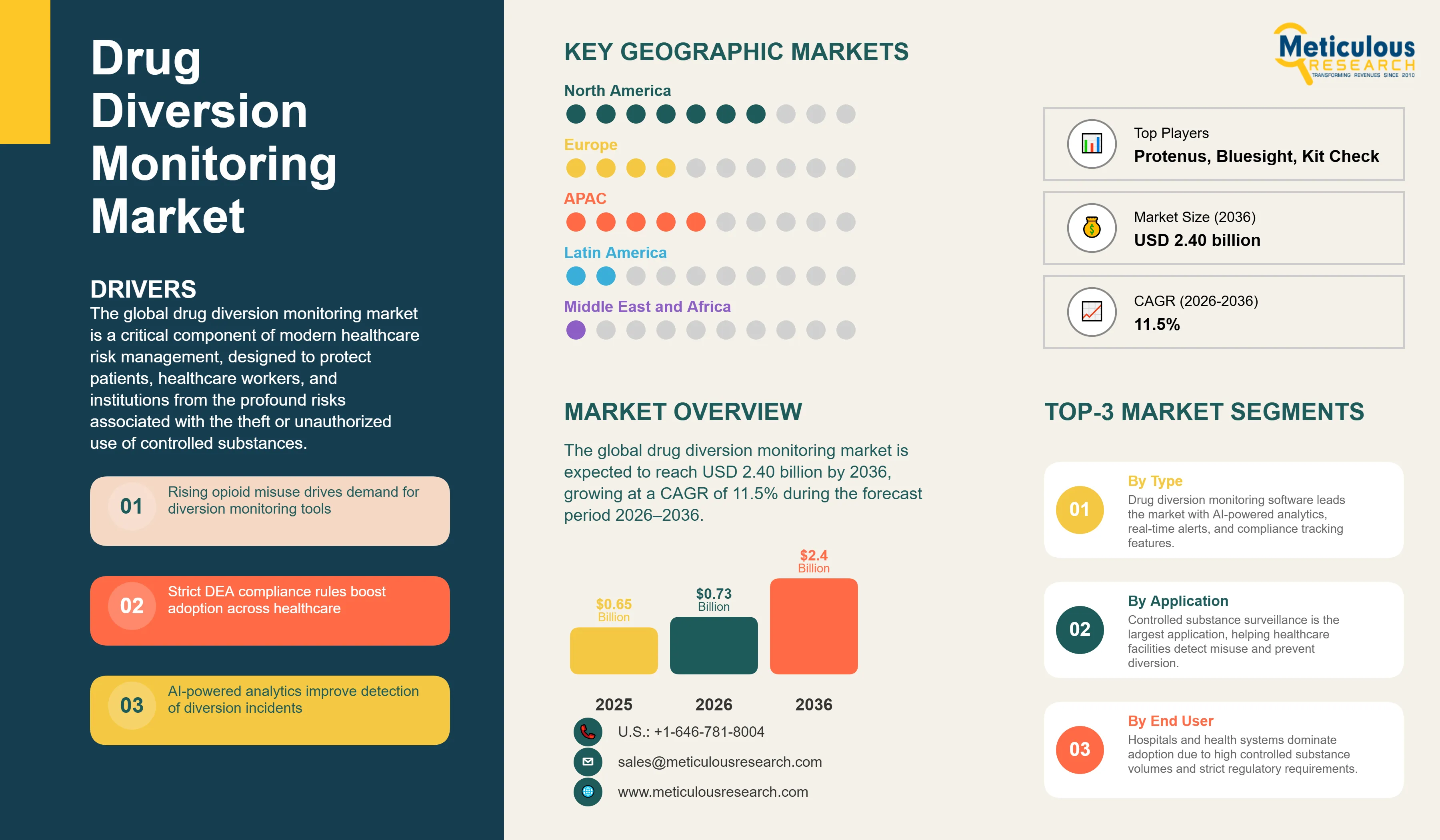
The global drug diversion monitoring market was valued at USD 0.73 billion in 2026. This market is expected to reach USD 2.40 billion by 2036, growing at a CAGR of 11.5% during the forecast period 2026–2036.
Click here to: Get Free Sample Pages of this Report
The global drug diversion monitoring market is a critical component of modern healthcare risk management, designed to protect patients, healthcare workers, and institutions from the profound risks associated with the theft or unauthorized use of controlled substances. These systems leverage sophisticated behavioral analytics, machine learning, and integration with automated dispensing cabinets (ADCs) and electronic health records (EHRs) to identify anomalies in drug handling patterns. According to the Drug Enforcement Administration (DEA), drug diversion within healthcare facilities remains a persistent challenge, with significant implications for patient safety, clinical outcomes, and institutional liability. As of 2026, the transition from reactive, manual auditing to proactive, AI-driven surveillance is a fundamental shift in the industry.
The imperative for robust drug diversion monitoring is intensified by the global opioid crisis and the increasing regulatory scrutiny on controlled substance management. In the United States alone, the cost of drug diversion to the healthcare industry is estimated in the billions of dollars annually, encompassing legal fees, regulatory fines, and the loss of clinical productivity. Beyond financial impact, diversion poses severe risks to patient safety, including the administration of tampered or diluted medications and the potential for healthcare worker impairment. Modern drug diversion monitoring software provides health systems with the tools necessary to perform comprehensive audits, identify high-risk individuals, and maintain a secure and compliant environment for medication management.
Drivers: Mitigating the Opioid Crisis and Enhancing Institutional Safety
The primary driver for the drug diversion monitoring market is the urgent need to combat the opioid epidemic and strengthen medication security across healthcare settings. According to the Centers for Disease Control and Prevention, more than 80,000 opioid-related overdose deaths were reported annually in the United States in recent years, highlighting the continuing public health impact of controlled substance misuse. In response, regulatory agencies such as the U.S. Drug Enforcement Administration have implemented stringent requirements for the tracking, storage, and reporting of controlled substances, increasing pressure on healthcare organizations to strengthen diversion prevention programs. Furthermore, studies suggest that 10–15% of healthcare professionals may misuse drugs at some point during their careers, creating substantial risks for patient safety and regulatory compliance.
Furthermore, the integration of AI and machine learning into monitoring platforms has significantly improved the accuracy of anomaly detection, reducing false positives and allowing pharmacy departments to focus their investigative resources on the highest-risk cases. According to a 2025 industry report, hospitals utilizing AI-driven diversion monitoring saw a 40% increase in the detection of potential diversion events compared to traditional manual methods.
Restraints: High Implementation Costs and Integration Challenges
Market growth is restrained by the high cost of implementing comprehensive drug diversion monitoring systems and the technical complexities of integrating these platforms with disparate legacy IT systems. For many mid-sized and community hospitals, the initial capital investment and ongoing maintenance costs can be a significant barrier. Additionally, the effectiveness of monitoring systems is highly dependent on the quality and completeness of data from EHRs and ADCs. Inconsistent data entry and lack of interoperability between systems can lead to gaps in surveillance, making it difficult to achieve a truly enterprise-wide view of medication management. Organizational resistance to new surveillance workflows and the need for specialized staff training also present significant hurdles to successful implementation.
Opportunities: Advancing Predictive Analytics and Cloud-Native Platforms
The expansion of predictive analytics and the shift toward cloud-native (SaaS) monitoring platforms offer substantial growth opportunities. Cloud-based solutions enable health systems to aggregate data across multiple facilities, providing a more comprehensive view of drug handling patterns and facilitating the identification of diversion that may occur across different sites. By 2026, predictive models are being developed to identify potential diverters before an incident occurs, based on subtle changes in behavioral and clinical documentation patterns. Furthermore, the integration of drug diversion monitoring with broader institutional risk management and employee wellness programs presents an opportunity to address the root causes of diversion, such as healthcare worker burnout and substance use disorders, in a more holistic manner.
Integration of Behavioral Biometrics and Advanced Video Analytics
A prominent trend in 2026 is the integration of behavioral biometrics and AI-enabled video analytics into drug diversion surveillance. These technologies allow for the monitoring of physical drug handling at the point of care and within pharmacy storage areas, providing an additional layer of security beyond data-driven audits. Video analytics can automatically flag suspicious behaviors, such as unauthorized access to medication bins or improper drug disposal, providing investigators with visual evidence of potential diversion. This convergence of digital and physical surveillance is becoming a standard feature in high-security healthcare environments.
Focus on Holistic Healthcare Worker Wellness and Early Intervention
There is a growing trend toward using drug diversion monitoring as a tool for early intervention and healthcare worker support. Instead of focusing solely on punitive measures, health systems are increasingly using monitoring data to identify staff who may be struggling with impairment or burnout. This shift reflects a more compassionate and proactive approach to institutional safety, where the goal is to provide necessary resources and support to employees before a diversion incident occurs. This trend is supported by the development of 'peer-to-peer' support models and integrated wellness dashboards that prioritize employee health as a key component of patient safety.
Analysis by Type
Based on type, the drug diversion monitoring software segment is expected to hold the largest share in 2026. This dominance is driven by the critical role of software in aggregating and analyzing vast amounts of data from various hospital systems. The increasing adoption of AI-driven platforms that provide real-time alerts and comprehensive audit trails is a key factor in this segment's growth. The hardware segment, including specialized cameras and biometric access controls, remains an important secondary market, providing the physical infrastructure for secure medication management.
Analysis by Deployment Mode
Based on deployment mode, the cloud-based segment is expected to account for the largest share in 2026. The advantages of cloud deployment, such as scalability, cross-facility data integration, and lower upfront costs, make it highly attractive to health systems. Cloud-native platforms also facilitate more frequent updates to detection algorithms, ensuring that hospitals have access to the latest surveillance capabilities. The on-premises segment continues to serve organizations with specific data sovereignty requirements or those with significant existing IT infrastructure.
North America is expected to dominate the global drug diversion monitoring market in 2026, accounting for an estimated 42.5% of total revenue. The region's leadership is driven by the severe impact of the opioid crisis and the presence of a robust regulatory framework that mandates strict controlled substance management. High adoption of advanced healthcare IT and the presence of leading market players further solidify North America's position. In the U.S., the AHA and DEA continue to play a pivotal role in shaping the standards for institutional drug diversion programs.
The Asia Pacific region is projected to witness the fastest growth during the forecast period. This growth is fueled by the modernization of healthcare infrastructure and the increasing adoption of digital health solutions across China, India, and Southeast Asian nations. As these countries expand their hospital networks and implement more sophisticated pharmacy management systems, the demand for drug diversion monitoring solutions is expected to rise significantly. Government initiatives aimed at improving medication safety and reducing healthcare fraud are also contributing to market expansion in the region.
The competitive landscape of the global drug diversion monitoring market is characterized by intense innovation and strategic partnerships. Leading players are focusing on the development of integrated platforms that provide end-to-end visibility into the medication lifecycle. Strategic acquisitions of niche AI and behavioral analytics companies are a common trend as vendors seek to enhance their detection capabilities. The market is also seeing increased collaboration between software vendors and automated dispensing cabinet manufacturers to ensure seamless data integration and more effective surveillance.
Key players operating in the global drug diversion monitoring market include Becton, Dickinson and Company (BD) (U.S.), Omnicell, Inc. (U.S.), Drägerwerk AG & Co. KGaA (Germany), Invistics Corporation (Curebase) (U.S.), Protenus (U.S.), Bluesight (U.S.), LogicStream Health (U.S.), Imprivata, Inc. (U.S.), Kit Check (U.S.), and various emerging technology providers specializing in AI-driven healthcare risk management.
The market is projected to reach USD 2.40 billion by 2036, growing at a CAGR of 11.5% from 2026 to 2036.
Hospitals report a significant increase in the detection of diversion events and a reduction in the time required for audits and investigations.
The drug diversion monitoring software segment is expected to grow the fastest as AI-driven anomaly detection becomes the industry standard.
Approximately 70% of new deployments are cloud-native, enabling cross-facility data aggregation and rapid scalability.
North America holds the largest share, estimated at 40-42% in 2026, driven by regulatory mandates and the impact of the opioid crisis.
AI enables the identification of subtle patterns in drug handling and clinical documentation that may indicate diversion, significantly improving detection accuracy.
Diversion poses severe risks, including medication tampering, diluted doses, and the potential for care delivered by impaired healthcare workers.
Hospitals and large health systems are the primary adopters, managing the highest volumes of controlled substances.
These systems provide comprehensive audit trails and automated reporting tools necessary to meet DEA and other regulatory requirements.
The top 5 players are Becton, Dickinson and Company (BD), Omnicell, Inc., Drägerwerk AG & Co. KGaA, Invistics Corporation, and Protenus.





















Published Date: Aug-2026
Published Date: Jun-2026
Published Date: Feb-2026
Published Date: Jan-2025
Please enter your corporate email id here to view sample report.
Subscribe to get the latest industry updates


