Resources
About Us
AI in Social Media Market is set to Flourish as the Integration of AI Increases Significantly
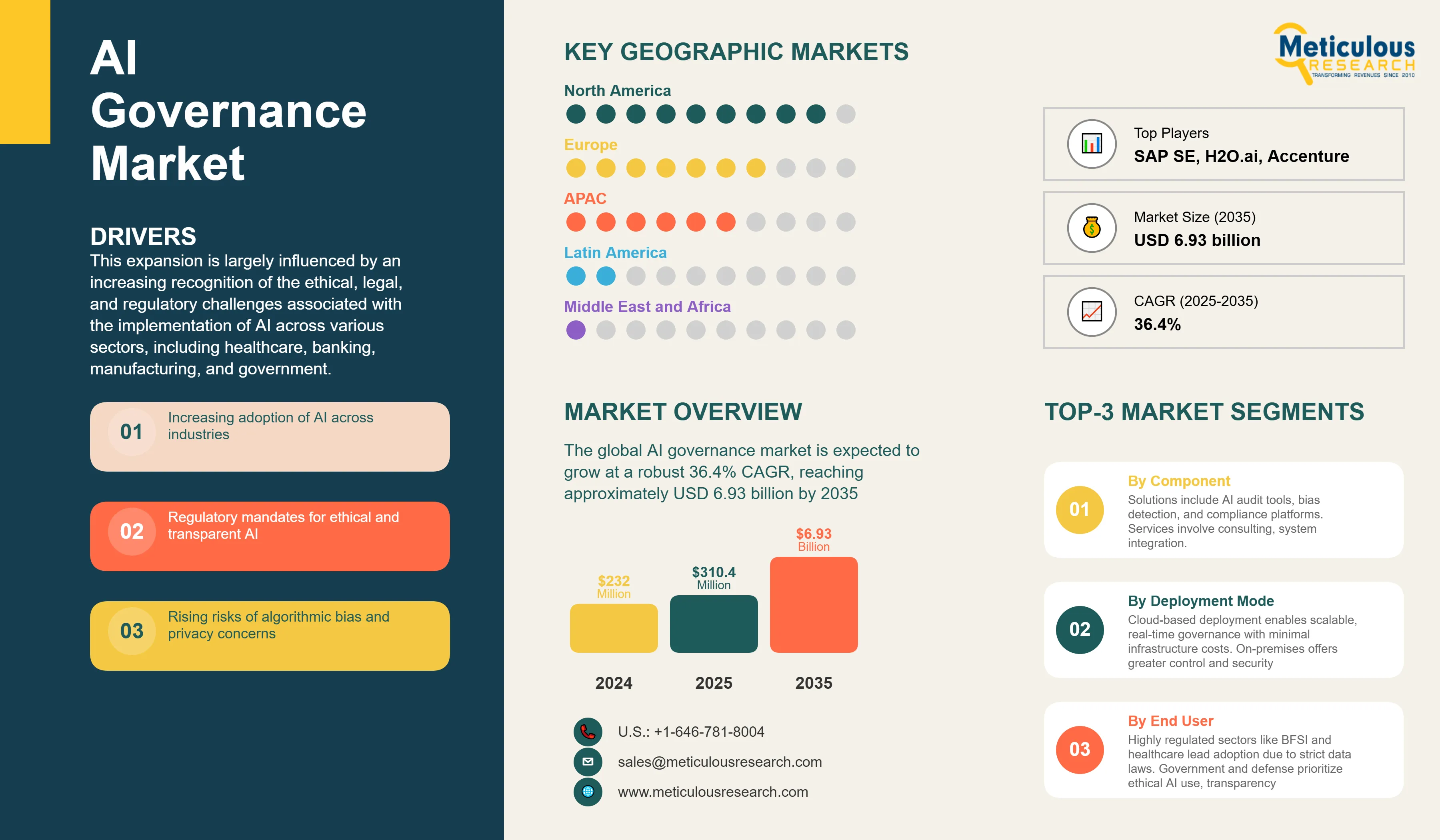
The global AI governance market was valued at USD 232 million in 2024. This market is expected to grow at a robust 36.4% CAGR, reaching approximately USD 6.93 billion by 2035 from USD 310.4 million in 2025.
This expansion is largely influenced by an increasing recognition of the ethical, legal, and regulatory challenges associated with the implementation of AI across various sectors, including healthcare, banking, manufacturing, and government. The rise in legal requirements, including frameworks like GDPR in Europe and forthcoming AI-specific regulations, has prompted businesses and governments to establish thorough AI governance frameworks. These frameworks emphasise transparency, fairness, accountability, and the implementation of risk mitigation measures to address issues such as bias and data misuse. The market is advancing due to increasing investments in AI audit, risk management, and compliance solutions. North America and Europe are at the forefront of adoption, driven by stringent data protection regulations. Meanwhile, emerging economies in the Asia-Pacific region are making significant investments to enhance their AI governance capabilities in response to the increasing adoption of AI technologies.
Click here to: Get Free Sample Pages of this Report
The AI governance sector is highly competitive, featuring both well-established technology leaders and new specialists offering a variety of governance, audit, and compliance solutions. IBM, Microsoft, SAP, Infosys, ABB, and DXC Technology are recognised as prominent organisations, focussing on sector-specific challenges and adherence to regulatory standards. Vendors set themselves apart by focussing on AI explainability, conducting thorough risk assessments, and integrating ethical AI tools. Partnerships between technology firms and consulting agencies are increasing to develop tailored solutions for regulated sectors like financial services and healthcare, focussing on real-time policy enforcement and audit preparedness.
Recent Developments
IBM Launches Advanced AI Governance Suite
Microsoft Enhances Responsible AI Frameworks
Key Market Drivers
Key Market Restraints
Base CAGR: 36.4%
|
Category |
Key Factor |
Short-Term Impact (2025–2028) |
Long-Term Impact (2029–2035) |
Estimated CAGR Impact |
|
Drivers |
1. Regulatory Push for Ethical and Transparent AI |
Accelerated policy adoptions |
Global governance standards |
▲ +6.0% |
|
2. Ethical Concerns |
Heightened auditing requirements |
Embedded ethics-by-design |
▲ +5.5% |
|
|
3. Increasing AI Adoption in Regulated Industries |
Rapid tool integration |
Mature compliance ecosystems |
▲ +5.2% |
|
|
Restraints |
1. Disparate Regulatory Frameworks Across Regions |
Fragmented compliance efforts |
Harmonization slow |
▼ −2.3% |
|
2. Integration Challenges Within AI Ecosystems |
Complex system interoperability |
Unified platform standards |
▼ −2.0% |
|
|
Opportunities |
1. Rapid growth of explainable AI solutions and audit tools |
Improved transparency offerings |
Standardized explainability |
▲ +4.8% |
|
2. Expanding demand from regulated industries |
New compliance tool deployments |
Industry-wide AI governance norms |
▲ +4.4% |
|
|
Trends |
1. Rise of automated AI model monitoring and compliance systems |
Real-time risk alerts |
Fully automated governance flows |
▲ +3.7% |
|
Challenges |
1. Managing governance for large-scale, dynamic AI deployments |
Strain on oversight frameworks |
Scalable governance architectures |
▼ −1.8% |
North America: Compliance and Advancement Leadership in Artificial Intelligence Governance
North America represents approximately 35-40% of the global AI governance market, driven by robust regulatory frameworks like the effects of GDPR on US multinationals and the expected introduction of the AI Bill of Rights by the US government. Leading companies such as IBM and Microsoft are significantly focused on developing governance tools tailored for highly regulated industries, including healthcare, financial services, and government agencies. Growing legislative frameworks necessitate transparency and strength in AI deployment, driving the adoption of governance platforms.
Asia-Pacific: Accelerated Development with Emphasis on Compliance and Ethical Standards
The Asia-Pacific AI governance market is experiencing significant growth and is expected to grow at a CAGR of 41.2% through 2035, driven by nations such as China, India, and South Korea. The necessity of governance frameworks to mitigate the risks associated with AI deployment is being acknowledged by governments and businesses in the region, particularly in sectors such as finance and healthcare. Although formal AI governance policies are still in the early stages of development in certain countries, there is a growing trend toward the establishment of regulatory frameworks. South Korea is experiencing consistent growth through heightened Investments are being made in AI ethics and governance tools to meet the objective of fulfilling both local and international regulatory standards. South Korea’s AI Basic Act, effective of January 2026, expands transparency compliances, whereas India’s state initiatives add funding for responsible-AI sandboxes. Companies in the Asia Pacific region are also investing in AI auditing, bias detection, and compliance tools to ensure the responsible use of AI technologies.
United States: Early Mover in AI Governance with Robust Regulatory Initiatives
The U.S. recorded a market value of USD 61.6 million in 2024, with forecasts anticipating an increase to USD 1.78 billion by 2035, driven by a CAGR of 29.8%. The early legislation in the country, such as the AI Bill of Rights initiative and stringent privacy laws, promotes the swift adoption of AI governance, particularly within highly regulated sectors like finance and healthcare. Leading companies like Microsoft, IBM, and SAP offer extensive governance solutions that assist organisations in reducing bias, improving auditability, and adhering to new standards.
China: Dominant Growth with Stringent Compliance Frameworks
China's AI governance market is rapidly expanding, establishing itself as the leader in the APAC region, with projections indicating a market share of 50-60% by 2035. Governments are taking proactive steps to advance AI ethics and ensure responsible usage by implementing regulations that require transparency and fairness. Organisations in various sectors, particularly in manufacturing, finance, and public safety, are rapidly adopting AI governance tools designed to address these needs. Collaborations between local technology companies and international vendors enhance the scope and capabilities of solutions.
Germany: Emphasis on Data Privacy and Ethical AI Compliance
Germany leads the Europe AI Governance market accounting for leading share of 25-30% in 2025. The AI governance market in Germany demonstrates the European Union's rigorous approach to privacy, encompassing the General Data Protection Regulation and the forthcoming AI Act frameworks. German companies are making significant investments in explainable AI systems and bias mitigation protocols, emphasising their commitment to ethical AI adoption. Cooperation among industry leaders, government entities, and academic institutions fosters the advancement and execution of AI governance standards, especially within the automotive, industrial, and healthcare sectors.
Cloud-First AI Governance Platforms Scale Rapidly on Embedded Compliance and SME Adoption
In 2024, cloud implementations accounted for 70-75% share of the AI Governance market and are expected to grow at a CAGR of 38% through 2035. The platform services are directly embedded with governance hooks by providers, who provide automatic upgrades that monitor the changing rules. A single console can inspect prompts, training runs, and inference logs across multi-region data centers, thereby reducing compliance overhead. These pay-as-you-go options are preferred by SMEs due to the minimal upfront capital requirements.
Government and Defense Accelerate AI Governance Investments on Security and Ethical Mandates
The government and defense segment is set to expand at substantial pace owing to increasing emphasis on national security, data privacy, and strict regulatory compliance. To mitigate risks associated with AI use and manage sensitive information, these sectors necessitate AI governance frameworks that are both highly secure and controlled. Governance is a critical component of the AI strategy of government agencies, as they frequently emphasize transparency, accountability, and the ethical use of AI. Additionally, defense organizations employ sophisticated AI systems for mission-critical operations, necessitating robust governance solutions to guarantee responsible deployment.
|
Report Attribute |
Details |
|
Market size (2025) |
USD 310.4 million |
|
Revenue forecast in 2035 |
USD 6.93 billion |
|
CAGR (2025-2035) |
36.5% |
|
Base Year |
2024 |
|
Forecast period |
2025 – 2035 |
|
Report coverage |
Market size and forecast, competitive landscape and benchmarking, country/regional level analysis, key trends, growth drivers and restraints |
|
Segments covered |
Component Type (Solution, Services), Deployment Mode (On-Premises, Cloud), Organization Size, End-use Vertical (BFSI, Government & Defense, Healthcare and Life Sciences), Geography |
|
Regional scope |
North America, Europe, Asia-Pacific, Latin America, and Middle East & Africa |
|
Key companies profiled |
International Business Machines Corporation (IBM); Alphabet Inc. (Google LLC); Microsoft Corporation; SAP SE; SAS Institute Inc.; Dataiku Inc.; Atos SE; Fair Isaac Corporation (FICO); H2O.ai, Inc.; Informatica Inc.; Salesforce, Inc.; Oracle Corporation; Amazon Web Services, Inc.; Accenture plc; NTT DATA Corporation (Nippon Telegraph and Telephone Corporation); Deloitte Touche Tohmatsu Limited; PwC (PricewaterhouseCoopers International Limited); IBM Watson OpenScale. |
|
Customization |
Comprehensive report customization with purchase. Addition or modification to country, regional & segment scope available |
|
Pricing Details |
Access customized purchase options to meet your specific research requirements. Explore flexible pricing models |
The AI governance market size is estimated to be USD 310.4 million in 2025 and grow at a CAGR of 36.4% to reach USD 6.93 billion by 2035.
In 2024, the AI governance market size was estimated at USD 232 million, with projections to reach USD 310.4 billion in 2025.
International Business Machines Corporation (IBM), Alphabet Inc. (Google LLC), Microsoft Corporation, SAP SE, SAS Institute Inc., Dataiku Inc., Atos SE, Fair Isaac Corporation (FICO), H2O.ai, Inc., Informatica Inc., Salesforce, Inc., Oracle Corporation, Amazon Web Services, Inc., and Accenture plc among others are the major companies operating in the AI in Social Media Market.
The Asia-Pacific region is projected to grow at the highest CAGR over the forecast period (2025-2035).
In 2024, cloud implementations accounted for 70-75% share of the overall AI Governance market and are expected to grow at a rate of 30% annually.
1. Market Definition & Scope
1.1. Market Definition
1.2. Market Ecosystem
1.3. Currency
1.4. Key Stakeholders
2. Research Methodology
2.1. Research Approach
2.2. Process of Data Collection and Validation
2.2.1. Secondary Research
2.2.2. Primary Research/Interviews with Key Opinion Leaders from the Industry
2.3. Market Sizing and Forecast
2.3.1. Market Size Estimation Approach
2.3.1.1. Bottom-up Approach
2.3.1.2. Top-down Approach
2.3.2. Growth Forecast Approach
2.3.3. Assumptions for the Study
3. Executive Summary
3.1. Overview
3.2. Segmental Analysis
3.2.1. AI Governance Market, by Component
3.2.2. AI Governance Market, by Deployment Type
3.2.3. AI Governance Market, by Organization Size
3.2.4. AI Governance Market, by End-Use Vertical
3.2.5. AI Governance Market, by Region
3.3. Competitive Landscape
3.4. Strategic Recommendations
4. Market Insights
4.1. Overview
4.2. Factors Affecting Market Growth
4.2.1. Drivers
4.2.1.1. Increasing adoption of AI across industries
4.2.1.2. Regulatory mandates for ethical and transparent AI
4.2.1.3. Rising risks of algorithmic bias and privacy concerns
4.2.2. Restraints
4.2.2.1. Lack of standardization in AI governance frameworks
4.2.2.2. High implementation complexity and costs
4.2.3. Opportunities
4.2.3.1. Rapid growth of explainable AI solutions and audit tools
4.2.3.2. Expanding demand from regulated industries
4.2.4. Trends
4.2.4.1. Rise of automated AI model monitoring and compliance systems
4.2.5. Challenges
4.2.5.1. Managing governance for large-scale, dynamic AI deployments
4.3. Porter's Five Forces Analysis
4.3.1. Bargaining Power of Suppliers
4.3.2. Bargaining Power of Buyers
4.3.3. Threat of Substitutes
4.3.4. Threat of New Entrants
4.3.5. Degree of Competition
4.4. Technology Impact on AI Governance Market
4.4.1. Explainability and Transparency Platforms
4.4.1.1. Bias and fairness assessment frameworks
4.4.1.2. Audit trail generation and traceability tools
4.4.2. Data Privacy, Security, and Compliance
4.4.2.1. Secure multi-party computation and federated learning
4.4.2.2. Automated regulatory compliance monitoring
4.4.3. Automated Model Monitoring and Lifecycle Management
4.4.3.1. Continuous performance dashboarding
4.4.3.2. Alert systems for model drift or outlier detection
4.4.3.3. Self-healing and retraining mechanisms
5. Impact of Sustainability on AI Governance Market
5.1. Supporting ethical and responsible AI innovation
5.2. Reducing algorithmic discrimination and social bias
5.3. Enabling low-carbon, energy-efficient AI pipelines
5.4. Broadening access to explainable AI in the public sector
5.5. Vendor initiatives for open, trustworthy, and inclusive AI
5.6. Advancing global standards and cross-sector ESG reporting
6. Competitive Landscape
6.1. Overview
6.2. Key Growth Strategies
6.3. Competitive Benchmarking
6.4. Competitive Dashboard
6.4.1. Industry Leaders
6.4.2. Market Differentiators
6.4.3. Vanguards
6.4.4. Contemporary Stalwarts
6.5. Market Share/Ranking Analysis, by Key Players, 2024
7. AI Governance Market Assessment—By Component Type
7.1. Overview
7.2. Solutions
7.3. Services
8. AI Governance Market Assessment—By Deployment Mode
8.1. Overview
8.2. Cloud-based
8.3. On-Premises
9. AI Governance Market Assessment—By Organization Size
9.1. Overview
9.2. Large Enterprise
9.3. SMEs
10. AI Governance Market Assessment—By End-Use Vertical
10.1. Overview
10.2. BFSI
10.3. Government and Defense
10.4. Healthcare and Life Sciences
10.5. Media and Entertainment
10.6. Retail
10.7. IT and Telecommunication
10.8. Automotive
10.9. Others
11. AI Governance Market Assessment—By Geography
11.1. Overview
11.2. North America
11.2.1. U.S.
11.2.2. Canada
11.3. Europe
11.3.1. Germany
11.3.2. U.K.
11.3.3. France
11.3.4. Netherlands
11.3.5. Switzerland
11.3.6. Rest of Europe
11.4. Asia-Pacific
11.4.1. China
11.4.2. Japan
11.4.3. South Korea
11.4.4. Taiwan
11.4.5. India
11.4.6. Singapore
11.4.7. Australia
11.4.8. Rest of Asia-Pacific
11.5. Latin America
11.5.1. Brazil
11.5.2. Mexico
11.5.3. Argentina
11.5.4. Rest of Latin America
11.6. Middle East & Africa
11.6.1. UAE
11.6.2. Saudi Arabia
11.6.3. Israel
11.6.4. South Africa
11.6.5. Rest of Middle East & Africa
12. Company Profiles (Business Overview, Financial Overview, Product Portfolio, Strategic Developments, and SWOT Analysis)
12.1. International Business Machines Corporation (IBM)
12.2. Alphabet Inc. (Google LLC)
12.3. Microsoft Corporation
12.4. SAP SE
12.5. SAS Institute Inc.
12.6. Dataiku Inc.
12.7. Atos SE
12.8. Fair Isaac Corporation (FICO)
12.9. H2O.ai, Inc.
12.10. Informatica Inc.
12.11. Salesforce, Inc.
12.12. Oracle Corporation
12.13. Amazon Web Services, Inc.
12.14. Accenture plc
12.15. NTT DATA Corporation (Nippon Telegraph and Telephone Corporation)
12.16. Deloitte Touche Tohmatsu Limited
12.17. PwC (PricewaterhouseCoopers International Limited)
12.18. IBM Watson OpenScale
12.19. SAS Model Risk Management
12.20. ArthurAI Inc.
12.21. Truera, Inc.
12.22. Others
13. Appendix
13.1. Available Customization
13.2. Related Reports
























Published Date: Aug-2025
Published Date: Jul-2025
Published Date: Oct-2024
Published Date: Sep-2024
Subscribe to get the latest industry updates