Quantum Computing Market (2026-2036)
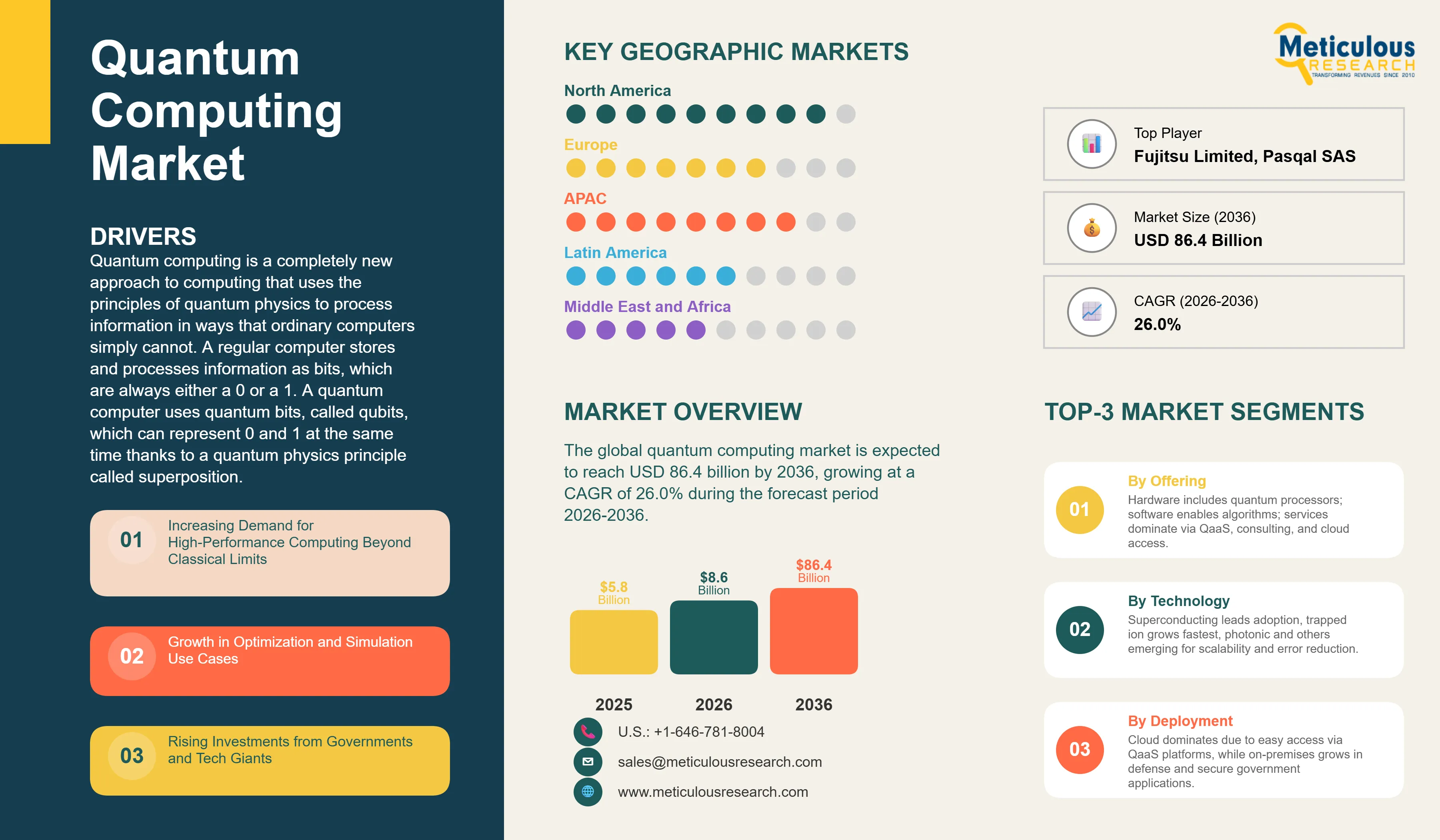
The global quantum computing market was valued at USD 5.8 billion in 2025. This market is expected to reach USD 86.4 billion by 2036 from an estimated USD 8.6 billion in 2026, growing at a CAGR of 26.0% during the forecast period 2026-2036.
- Published
- Apr 2026
- Pages
- 280
- Format
- PDF + Excel
- Report ID
- MR-1922
- Base year
- 2025
- 2025 · BASELINE
- $5.80B
- 2036
- $86.40B
- CAGR 2026–2036
- 26.0%
2025 baseline · 2026–2036 forecast at 26.0% CAGR · hover a bar for the value
Key highlights
The global quantum computing market is projected to reach USD 86.4 billion by 2036.
The market is expected to grow at a CAGR of 26.0% during the forecast period 2026-2036.
The global quantum computing market was valued at USD 5.8 billion in 2025 and is estimated to reach USD 8.6 billion in 2026.
North America is expected to dominate the global quantum computing market with the largest market share in 2026, while Asia-Pacific is projected to register the highest CAGR during the forecast period.
By offering, the services segment is expected to hold the largest share of the market in 2026, while the hardware segment is projected to register the highest CAGR during the forecast period.
By technology type, the superconducting qubits segment is expected to hold the largest share in 2026, while the trapped ion segment is projected to register the highest CAGR during the forecast period.
By deployment model, the cloud-based quantum computing segment is expected to hold the largest share in 2026, while the on-premises quantum systems segment is projected to register the highest CAGR during the forecast period.
By application, the simulation and modeling segment is expected to hold the largest share in 2026, while the machine learning and AI segment is projected to register the highest CAGR during the forecast period.
By end user, the BFSI segment is expected to hold the largest share in 2026, while the healthcare and pharmaceuticals segment is projected to register the highest CAGR during the forecast period.
By enterprise size, the large enterprises segment is expected to hold the largest share in 2026, while the SMEs segment is projected to register the highest CAGR during the forecast period.
Report summary
| Particulars | Details |
|---|---|
| Market Size by 2036 | USD 86.4 Billion |
| Market Size in 2026 | USD 8.6 Billion |
| Market Size in 2025 | USD 5.8 Billion |
| Revenue Growth Rate (2026-2036) | CAGR of 26.0% |
| Format | PDF, Excel & Cloud Portal · 280 pages |
| Dominating Offering | Services (QaaS) |
| Fastest Growing Offering | Hardware |
| Dominating Technology Type | Superconducting Qubits |
| Fastest Growing Technology Type | Trapped Ion |
| Dominating Deployment Model | Cloud-Based Quantum Computing |
| Fastest Growing Deployment Model | On-Premises Quantum Systems |
| Dominating Application | Simulation and Modeling |
| Fastest Growing Application | Machine Learning and AI |
| Dominating End User | BFSI |
| Fastest Growing End User | Healthcare & Pharmaceuticals |
| Dominating Enterprise Size | Large Enterprises |
| Fastest Growing Enterprise Size | SMEs |
| Dominating Geography | North America |
| Fastest Growing Geography | Asia-Pacific |
| Base Year | 2025 |
| Forecast Period | 2026 to 2036 |
Report overview
Segments covered: offering, technology type, deployment model, application, end user, enterprise size.
Quantum computing is a completely new approach to computing that uses the principles of quantum physics to process information in ways that ordinary computers simply cannot. A regular computer stores and processes information as bits, which are always either a 0 or a 1. A quantum computer uses quantum bits, called qubits, which can represent 0 and 1 at the same time thanks to a quantum physics principle called superposition. This means a quantum computer can explore many possible solutions to a problem simultaneously, rather than testing each possibility one at a time the way a conventional computer does. For certain specific types of problems, particularly those involving finding the best answer among an enormous number of options or simulating how molecules and chemicals interact, this approach can solve problems that would take today's most powerful conventional computers millions of years to work through.
The market is growing because organizations in industries like banking, pharmaceutical research, logistics, and cybersecurity are starting to recognize that quantum computing could give them a significant competitive advantage for specific high-value problems they currently cannot solve efficiently. Banks want to use quantum computers to optimize their investment portfolios and detect fraud in ways that account for many more variables simultaneously than current systems can handle. Drug companies want to use quantum simulation to design new medicines by modeling how drug molecules interact with the human body at the atomic level, which is too complex for conventional computers. Logistics companies want to use quantum optimization to find the ideal delivery routes and supply chain configurations across networks so large and complex that current software cannot find truly optimal solutions.
Two significant opportunities are shaping the near-term commercial development of the market. Cloud-based quantum computing services, often called Quantum-as-a-Service, allow businesses to access quantum computing power over the internet from platforms operated by IBM, Google, Amazon, and Microsoft without needing to buy or operate expensive quantum hardware themselves. This dramatically lowers the barrier to experimenting with quantum computing and is the primary commercial revenue generator in the current market. The growing integration of quantum computing with conventional artificial intelligence systems is also a significant opportunity, as hybrid quantum-classical computing approaches that use quantum processing for the most computationally demanding parts of an AI workload and conventional computing for the rest are already showing practical performance advantages for certain types of machine learning problems.
Report infographic
Market dynamics
7 factors across 3 forcesIncreasing Demand for High-Performance Computing Beyond Classical Limits
The fundamental driver of the quantum computing market is the existence of important and commercially valuable problems that conventional computers simply cannot solve efficiently, no matter how powerful they become. These include simulating the quantum mechanical behavior of molecules for drug discovery and materials science, optimizing extremely complex logistics and financial systems across thousands of variables simultaneously, breaking and creating cryptographic codes, and training very large machine learning models. For these specific problem types, quantum computers offer the potential to find solutions in hours or days that would take conventional supercomputers thousands to millions of years to compute. The pharmaceutical industry alone spends over USD 180 billion annually on drug research and development, and being able to accurately simulate how drug candidates interact with disease proteins before costly physical experiments could dramatically reduce the time and cost of bringing new medicines to market. Similarly, the financial services industry manages portfolios worth hundreds of trillions of dollars and faces optimization and risk management problems so complex that truly optimal solutions currently require approximations. The commercial value available to early users of quantum computing for these specific high-value applications is creating strong and sustained demand for quantum computing investment and development.
Rising Investments from Governments and Tech Giants
The combination of very large government funding commitments and the significant quantum computing investment programs of technology giants including IBM, Google, Microsoft, Amazon, and Intel is providing the sustained capital base that quantum computing development requires to progress from research to commercial product. IBM has invested billions of dollars in its quantum computing program over more than a decade and has the most commercially deployed quantum computing infrastructure in the world through its IBM Quantum Network. Google's quantum computing investment through its Google Quantum AI division has produced some of the most technically significant quantum computing milestones, including the Sycamore supremacy demonstration and the Willow chip error reduction breakthrough. Microsoft is pursuing a fundamentally different approach through topological qubits and has committed to making quantum computing available through Azure with its own hardware development program. Amazon's AWS Braket and its investment in IonQ, a trapped ion quantum computing company, reflect its strategy of providing quantum access across multiple hardware technologies. These very large and sustained investments from well-funded institutions are accelerating the timeline to commercially useful quantum computing and creating a growing industry ecosystem of quantum hardware manufacturers, software developers, and application specialists.
Table of contents
14 chapters · 191 sections · 280 pages · click to expandSegmental analysis
| Segment | Largest share (2026) | Fastest growth (2026–2036) |
|---|---|---|
| By Offering | Services | Hardware |
| By Technology Type | Superconducting Qubits | Trapped ion |
| By Deployment Model | Cloud-Based | On-premises |
| By Application | Simulation and Modeling | Machine learning and AI |
| By End User | BFSI | Healthcare and pharmaceuticals |
| By Enterprise Size | Large Enterprises | SMEs |
By Offering
- Services to Dominate
- The services segment is expected to account for the largest share of the global quantum computing market.
- The services segment encompasses cloud-based Quantum-as-a-Service access fees, consulting and integration services that help organizations understand and apply quantum computing to their business problems, and training services for quantum computing skills development.
- QaaS is currently the primary commercial revenue channel for the quantum computing market because it allows IBM, Google, Amazon, and Microsoft to generate immediate and growing revenue from their quantum hardware investments while the hardware is still far from the capability levels needed for most commercial applications.
- The large established customer base of these cloud providers means that QaaS can be marketed and sold to existing enterprise customers through existing commercial relationships.
- However, the hardware segment is projected to register the highest CAGR during the forecast period.
- As quantum hardware progresses toward the qubit quality and quantity levels required for fault-tolerant quantum computing, the addressable market for complete quantum computing systems purchased and operated on-premises by governments, large enterprises, and national laboratories will grow significantly.
- Quantum hardware sales to government and defense customers, national laboratories, and eventually large pharmaceutical and financial institutions are expected to drive very rapid hardware revenue growth from the current relatively small base.
By Technology Type
- Superconducting Qubits to Hold the Largest Share
- The superconducting qubits segment is expected to account for the largest share of the global quantum computing market.
- Superconducting qubit technology, used by IBM, Google, and Rigetti, has the most commercially deployed and accessible quantum computing infrastructure in the world, with the largest number of available quantum processors accessible through cloud platforms and the broadest ecosystem of quantum software tools and developer communities.
- The very large investment by IBM and Google in superconducting qubit systems over many years has established this as the current dominant technology approach by market presence and available qubit count.
- However, the trapped ion segment is projected to register the highest CAGR during the forecast period.
- Trapped ion quantum computers, which use individual atoms suspended in electromagnetic fields as qubits rather than engineered superconducting circuits, have demonstrated significantly better qubit quality in terms of error rates and coherence times than current superconducting systems, even though they currently have fewer qubits.
- IonQ, Quantinuum (formerly Honeywell), and Oxford Ionics are leading developers of trapped ion quantum computers, and the superior qubit quality of these systems makes them attractive for applications where accuracy is more important than raw qubit count, particularly in the near-term before error correction makes qubit quality less critical.
By Deployment Model
- Cloud-Based to Hold the Largest Share
- The cloud-based quantum computing segment is expected to account for the largest share of the global quantum computing market.
- Cloud access is the primary way that the vast majority of organizations interact with quantum computing today, and the QaaS platforms of IBM, Amazon, Google, and Microsoft collectively serve hundreds of thousands of users globally.
- The extremely high cost, specialized infrastructure requirements, and deep technical expertise needed to operate quantum hardware directly makes cloud access the only practical option for the overwhelming majority of quantum computing users and developers today.
- However, the on-premises segment is projected to register the highest CAGR during the forecast period.
- Government agencies, defense organizations, and major national laboratories in the U.S., EU, China, and elsewhere are investing in on-premises quantum systems for classified workloads that cannot be sent to commercial cloud platforms for security reasons, and IBM's and Quantinuum's growing sales of on-premises quantum systems to government customers are establishing this as a growing commercial channel.
- As quantum hardware improves and prices fall, more organizations will evaluate on-premises deployment for sensitive workloads.
By Application
- Simulation and Modeling to Hold the Largest Share
- The simulation and modeling segment is expected to account for the largest share of the global quantum computing market.
- Molecular simulation and materials science modeling represent the applications where quantum computing has the most clearly identified potential for genuine quantum advantage over classical computers, and consequently these application areas have attracted the largest number of enterprise quantum computing programs.
- Pharmaceutical companies, chemical manufacturers, and materials science researchers are the most active users of quantum simulation tools, and the large commercial value of improved drug discovery efficiency ensures strong continued investment in this application area.
- However, the machine learning and AI segment is projected to register the highest CAGR during the forecast period.
- The rapid growth and enormous commercial value of AI applications is creating strong interest in quantum approaches that could accelerate machine learning model training, improve pattern recognition accuracy, or enable new types of AI models that are difficult to train on classical hardware.
- Quantum machine learning is still an early-stage research field, but the combination of the world's two most highly funded and attention-getting technology categories, quantum computing and AI, is driving rapid research progress and strong commercial interest that is translating into growing investment in quantum machine learning applications.
By End User
- BFSI to Hold the Largest Share
- The BFSI segment is expected to account for the largest share of the global quantum computing market.
- Banks, financial services firms, and insurance companies are among the earliest and most active adopters of quantum computing, driven by the very large commercial value of quantum optimization applications for portfolio management, risk analysis, fraud detection, and high-frequency trading systems.
- JPMorgan Chase, Goldman Sachs, HSBC, and several other major financial institutions have established active quantum computing research programs and are running pilot applications on cloud quantum systems today.
- The financial services industry also has a strong motivation to invest in post-quantum cryptography as part of its cybersecurity programs, creating additional quantum-related spending.
- However, the healthcare and pharmaceuticals segment is projected to register the highest CAGR during the forecast period.
- As quantum hardware improves and molecular simulation becomes more practically useful, pharmaceutical companies are expected to significantly increase their quantum computing investment.
- Drug discovery, genomics analysis, and personalized medicine applications that leverage quantum computing are projected to generate enormous commercial value, and the pharmaceutical companies that build quantum computing expertise early are expected to gain significant research productivity advantages that drive competitive investment in the sector.
By Enterprise Size
- Large Enterprises to Hold the Largest Share
- The large enterprises segment is expected to account for the largest share of the global quantum computing market.
- Large enterprises including major banks, pharmaceutical companies, defense contractors, and technology firms have the R&D budgets, specialized technical talent, and long-term strategic vision required to invest in quantum computing when it is still in early commercial stages and when near-term financial returns are uncertain.
- The IBM Quantum Network, Google's quantum research partnerships, and similar programs are primarily built around large enterprise customers and national institutions that can make multi-year commitments to quantum computing exploration.
- However, the SMEs segment is projected to register the highest CAGR during the forecast period.
- The growth of QaaS platforms with accessible pricing, the development of quantum programming tools that do not require a PhD in physics to use, and the growing availability of quantum application templates and pre-built algorithms for specific business problems are progressively making quantum computing accessible to smaller companies that cannot afford dedicated quantum research teams.
- As quantum computing moves from exploration to commercial application, SMEs in sectors such as logistics, financial services, and pharmaceuticals will increasingly find that cloud-based quantum optimization and simulation services are within their budget and relevant to their specific business challenges.
Geographic analysis
North America
Largest shareIn 2026, North America is expected to account for the largest share of the global quantum computing market. The United States is home to the world's leading quantum computing companies including IBM, Google, Microsoft, Amazon Web Services, IonQ, Rigetti, PsiQuantum, and D-Wave, and the U.S. government has made quantum computing a national priority through the National Quantum Initiative Act with multi-billion-dollar funding commitments through the Department of Energy, National Science Foundation, DARPA, and the National Security Agency. IBM's quantum computing program, headquartered in New York, operates the largest commercially deployed quantum computing infrastructure in the world with dozens of quantum processors accessible through its cloud platform and an expanding network of over 400 partner organizations. Google's quantum AI headquarters in California has produced some of the most important technical milestones in quantum computing history. Canada's strong quantum computing ecosystem, including University of Waterloo's Institute for Quantum Computing and companies including D-Wave and Xanadu, contributes significantly to North America's market leadership. The combination of the world's largest concentration of quantum computing talent, technology companies, and government funding makes North America the clear global market leader.
Asia-Pacific
Fastest growthHowever, the Asia-Pacific quantum computing market is expected to grow at the fastest CAGR during the forecast period. China has made quantum computing a top national strategic priority and has invested an estimated USD 15 billion or more in quantum research and development, including the construction of the world's largest quantum communication network connecting several cities. Chinese quantum computing companies including Origin Quantum and SpinQ are developing domestic quantum hardware and software capabilities, and Alibaba has invested in quantum computing research through its DAMO Academy. Japan's national quantum strategy has committed significant funding to quantum computing through a national strategy targeting fault-tolerant quantum computing, with Fujitsu and Toshiba as leading domestic quantum developers. South Korea, India, Australia, and Singapore all have active national quantum programs creating growing domestic quantum computing investment and adoption. The strong technology manufacturing capabilities of Asia-Pacific countries also make the region well-positioned to contribute to quantum hardware supply chains as production scales up.
Europe
Europe is a strong and actively developing quantum computing market with significant public investment through the EUR 1 billion EU Quantum Flagship program and well-established research centers in Germany, the Netherlands, France, the UK, and Switzerland. European quantum computing companies including IQM in Finland, Alice and Bob in France, and Pasqal in France are developing competitive quantum hardware technologies. The UK's National Quantum Computing Centre and Germany's quantum computing programs represent important centers of European quantum computing development. The strong European industrial base in pharmaceutical research, financial services, and advanced manufacturing provides a large potential customer base for quantum computing services as the technology matures.
Competitive landscape
- IBM Corporation (U.S.)
- Google LLC (U.S.)
- Microsoft Corporation (U.S.)
- Amazon Web Services Inc. (U.S.)
- D-Wave Systems Inc. · Canada
- IonQ Inc. (U.S.)
- Rigetti Computing Inc. (U.S.)
- Honeywell International Inc./Quantinuum (U.S./UK)
- Intel Corporation (U.S.)
- Fujitsu Limited · Japan
- Toshiba Corporation · Japan
- Alibaba Group Holding Limited · China
- PsiQuantum Corp. (U.S.)
- Xanadu Quantum Technologies Inc. · Canada
- Pasqal SAS · France
Frequently asked questions
The global quantum computing market is expected to reach USD 86.4 billion by 2036 from an estimated USD 8.6 billion in 2026, at a CAGR of 26.0% during the forecast period 2026-2036.
Cite this report
Meticulous Research. (2026). Quantum Computing Market - Global Opportunity Analysis and Industry Forecasts (2026-2036) (Report No. MR-1922). Meticulous Market Research Pvt. Ltd. https://www.meticulousresearch.com/product/quantum-computing-market-6605