
AI Fashion Models Market (2026-2036)
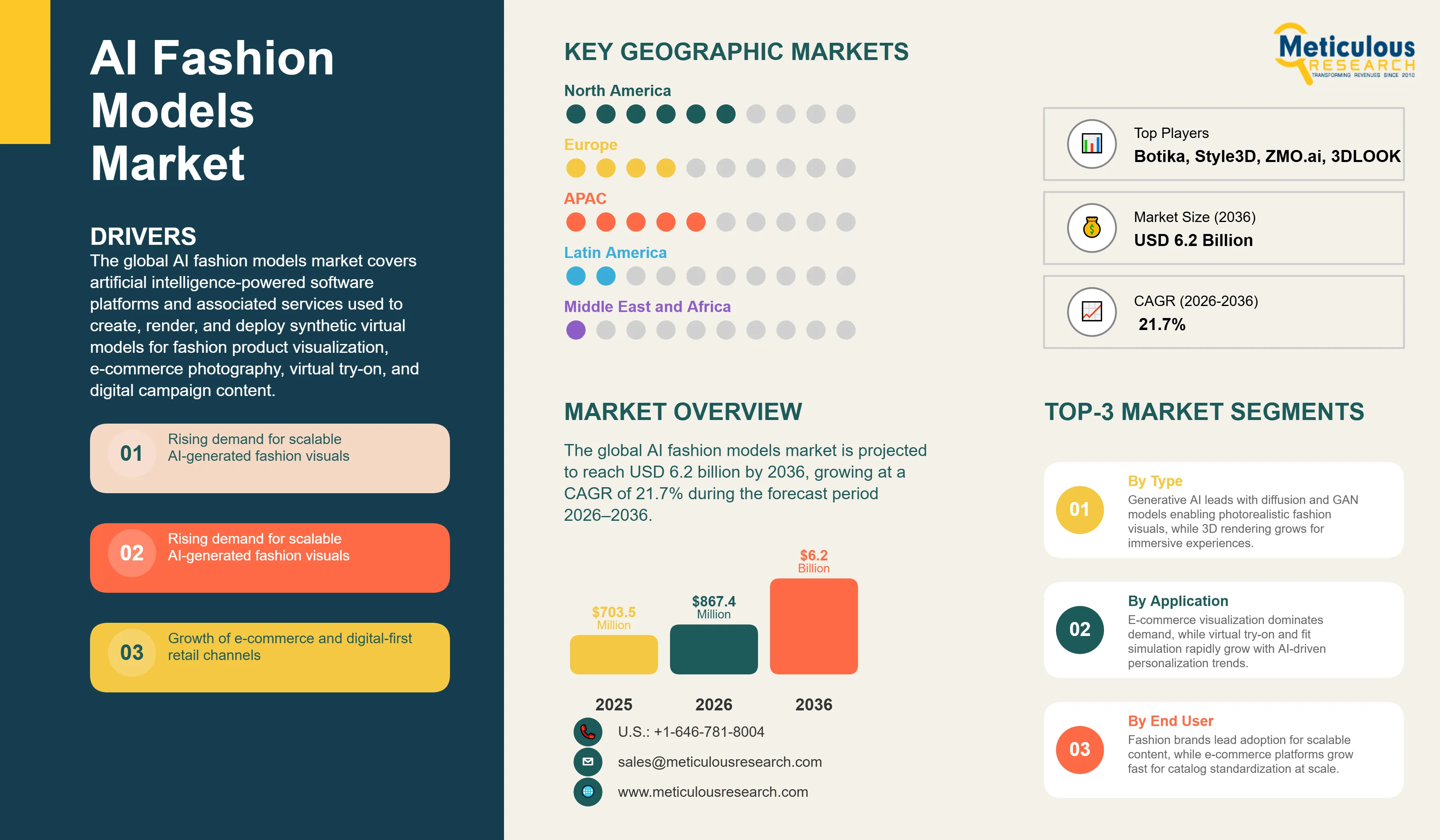
The global AI fashion models market was valued at USD 703.5 million in 2025. The market is projected to reach USD 6.2 billion by 2036 from an estimated USD 867.4 million in 2026, growing at a CAGR of 21.7% during the forecast period 2026–2036.
- Published
- Apr 2026
- Pages
- 273
- Format
- PDF + Excel
- Report ID
- MR-1918
- Base year
- 2025
- 2025 · BASELINE
- $703.5M
- 2036
- $6.20B
- CAGR 2026–2036
- 21.7%
2025 baseline · 2026–2036 forecast at 21.7% CAGR · hover a bar for the value
Key highlights
The global AI fashion models market is projected to reach USD 6.2 billion by 2036.
The market is expected to grow at a CAGR of 21.7% during the forecast period 2026–2036.
The global AI fashion models market was valued at USD 703.5 million in 2025 and is estimated to reach USD 867.4 million in 2026.
North America is expected to dominate the global AI fashion models market with the largest share of the global market in 2026, driven by high e-commerce penetration, the presence of leading generative AI and computer vision technology vendors, and the early adoption of AI-generated imagery by major fashion retailers and advertising agencies headquartered in the United States.
Asia Pacific AI fashion models market is projected to register the fastest growth during the forecast period, driven by China’s high-volume fast-fashion e-commerce ecosystem and the increasing need for scalable AI-generated model imagery across digital commerce platforms.
By technology, generative AI models are expected to account for the largest share in 2026, driven by their dominant role in photorealistic virtual model creation, garment visualization, and AI-generated campaign imagery.
By technology, 3D and neural rendering technologies, including NeRF, are projected to register the highest CAGR during the forecast period, driven by rising demand for immersive virtual try-on and multi-angle garment visualization.
By component, software platforms are expected to account for the largest share in 2026, reflecting the SaaS-led structure of the AI fashion models ecosystem and the strong adoption of AI model generation and visualization tools.
By component, services are projected to register the highest CAGR during the forecast period, driven by increasing demand for implementation support, creative customization, and continuous model optimization across enterprise accounts.
By application, e-commerce product visualization is expected to hold the largest share in 2026, as online fashion retailers increasingly adopt scalable AI-generated model imagery across high-SKU catalogs.
By application, virtual try-on and fit simulation are projected to register the highest CAGR during the forecast period, driven by the rapid deployment of AI-powered fit recommendation and avatar-based shopping experiences.
By end user, fashion brands and apparel retailers are expected to account for the largest market share in 2026, while e-commerce platforms and marketplaces are projected to witness the fastest growth during the forecast period.
Report summary
| Particulars | Details |
|---|---|
| Market Size by 2036 | USD 6.2 Billion |
| Market Size in 2026 | USD 867.4 Million |
| Market Size in 2025 | USD 703.5 Million |
| Revenue Growth Rate (2026–2036) | CAGR of 21.7% |
| Format | PDF, Excel & Cloud Portal · 273 pages |
| Dominating Technology | Generative AI Models |
| Fastest Growing Technology | 3D / Neural Radiance Field (NeRF) Rendering |
| Dominating Component | Software Platforms |
| Fastest Growing Component | Services |
| Dominating Application | E-Commerce Product Visualization |
| Fastest Growing Application | Virtual Try-On & Fit Simulation |
| Dominating End User | Fashion Brands & Apparel Retailers |
| Fastest Growing End User | E-Commerce Platforms & Marketplaces |
| Dominating Geography | North America |
| Fastest Growing Geography | Asia Pacific |
| Base Year | 2025 |
| Forecast Period | 2026 to 2036 |
Report overview
Segments covered: technology, component, application, end user, deployment mode.
The global AI fashion models market covers artificial intelligence-powered software platforms and associated services used to create, render, and deploy synthetic virtual models for fashion product visualization, e-commerce photography, virtual try-on, and digital campaign content. The market includes generative AI solutions based on diffusion models and generative adversarial networks (GANs) that enable photorealistic on-model imagery generation from flat product images, mannequin shots, or existing studio assets. It also includes computer vision and body-mapping technologies that support garment segmentation, pose estimation, fit simulation, and realistic fabric draping across diverse body types, along with 3D and neural rendering solutions such as Neural Radiance Field (NeRF)-based visualization environments for immersive product presentation and virtual styling experiences.
These solutions are increasingly serving as a scalable alternative and complementary layer to traditional fashion photography workflows, enabling brands and online retailers to generate catalog-ready imagery, editorial content, and social commerce visuals at significantly lower cost and turnaround time compared with conventional studio-based photoshoots. Key performance parameters include image photorealism, garment-detail fidelity, model diversity across body types and skin tones, integration with e-commerce and product information management (PIM) systems, batch rendering scalability, and the accuracy of fit visualization and size recommendation outputs.
The dominance of this segment is further driven by the increasing accessibility of generative AI tools across enterprise, mid-market, and SMB fashion brands.
SaaS-based platforms such as Botika, ZMO.ai, FASHN AI, and Style3D are making AI-generated fashion imagery commercially viable for independent designers and small brands through subscription-led pricing models, thereby significantly driving the growth of this market.
The growth of this segment is also driven by the continuous improvement in model quality, particularly in terms of photorealism, garment-detail fidelity, body-shape adaptability, and styling consistency.
Specialized fashion-focused diffusion models are increasingly delivering superior outputs compared with general-purpose image generation engines, further strengthening adoption across commercial fashion workflows.
As fashion brands continue to invest in digital sampling and virtual validation workflows to reduce physical prototyping costs and accelerate time-to-market, the adoption of 3D and neural rendering solutions is expected to increase significantly.
The large share of this segment is primarily attributed to the SaaS-led commercial structure of the AI fashion models market.
Most leading solution providers, such as Browzwear (with Lalaland.ai), Botika, ZMO.ai, Style3D, FASHN AI, and CLO Virtual Fashion, deliver their capabilities through cloud-based subscription platforms.
This business model supports recurring revenue streams, relatively high gross margins, and stronger customer retention through brand-specific model customization, historical asset libraries, and workflow integrations.
The AI fashion model software platforms market is further driven by the rapid adoption of API-first architectures across the AI fashion models ecosystem.
Vendors are increasingly enabling seamless integration with existing e-commerce technology stacks, including product information management (PIM), digital asset management (DAM), and online storefront systems such as Shopify and Adobe Inc. Commerce, allowing fashion brands to embed AI-generated model workflows directly into their merchandising operations.
The large share of this segment is primarily driven by the substantial demand from global fashion e-commerce operators for scalable and cost-efficient on-model imagery across high-volume product catalogs.
The continued expansion of online fashion retail, coupled with increasingly frequent assortment refresh cycles, is generating substantial demand for product visuals that accurately represent garment fit, styling, and appearance in a digital shopping environment.
This demand is especially evident among fast-fashion retailers, marketplaces, and D2C brands managing high-SKU catalogs and rapid product launches.
Traditional studio-based photography workflows are increasingly difficult to scale in line with merchandising velocity, especially for retailers introducing thousands of new SKUs on a recurring basis.
As a result, AI-generated product visualization solutions are emerging as a commercially viable alternative for producing catalog-ready on-model imagery at scale.
The growth of this segment is further driven by the measurable commercial impact of on-model imagery relative to flat-lay and mannequin-based product visuals.
Fashion retailers continue to prioritize human-model visualization formats due to their stronger performance across click-through, add-to-cart, and purchase conversion metrics, thereby strengthening the business case for AI-generated model imagery across e-commerce operations.
Recent deployments by online fashion retailers such as Zalando indicate that AI-enabled virtual try-on capabilities are improving shopper confidence while helping reduce return-related costs.
As AI fashion model platforms increasingly integrate with virtual try-on stacks to enable real-time fit visualization based on consumer body measurements and preferences, this application segment is expected to witness growth significantly above the overall market average.
The large share of this segment is primarily driven by the direct commercial imperative for branded fashion companies to produce high volumes of on-model product imagery for e-commerce listings, seasonal campaigns, and digital marketing workflows at a scale that is increasingly difficult to support through traditional photography economics.
Large enterprise fashion brands, including H&M, Mango, and Levi Strauss & Co., have emerged as early adopters of AI model platforms, driven by high annual SKU volumes, multi-market localization requirements, and increasing operational focus on digital sampling and faster campaign deployment.
In 2025, H&M officially launched its first set of AI-enabled digital twin imagery, while Mango has also deployed AI-generated model visuals in campaign content.
These deployments by leading global brands are expected to drive broader enterprise adoption across the segment during the forecast period.
Marketplace operators face a more complex visualization challenge, as image quality standards vary significantly across seller-uploaded content, while the platform remains responsible for the overall customer experience.
AI-generated model imagery enables these platforms to standardize product visuals at scale, improve shopper confidence, and enhance conversion performance across large catalog ecosystems.
Report infographic
Market dynamics
3 factors across 1 forceGenerative AI Democratizing High-Quality Fashion Visual Content at Scale
Generative AI is emerging as one of the key trends driving the global AI fashion models market, significantly democratizing access to high-quality fashion visual content at scale. The rapid commercialization of diffusion model-based image generation engines, including Stable Diffusion, Midjourney, Adobe Inc. Firefly, and specialized fashion AI platforms, has fundamentally transformed the economics of fashion content production by enabling brands of all sizes to generate photorealistic on-model imagery without relying on traditional studio-based photography infrastructure.
Fashion-focused generative AI platforms have proven the ability to produce catalog-ready visuals suitable for e-commerce listings, digital advertising campaigns, and social commerce applications. Companies such as FASHN AI, Botika, and ZMO.ai enable brands to convert flat product images or mannequin shots into multiple on-model visualizations across diverse body types, skin tones, poses, and background settings within minutes, substantially reducing production timelines compared with conventional photography workflows.
The impact of this trend is notably significant across fast-fashion retailers and marketplace operators managing high-velocity SKU catalogs. Large fashion e-commerce players such as Zara and Zalando are increasingly leveraging generative AI to accelerate campaign creation and catalog image production. Recent industry deployments indicate that AI-enabled workflows can reduce content production costs by nearly 90% while compressing image rollout timelines from several weeks to a few days, thereby significantly improving merchandising agility and speed-to-market.
This trend is expected to remain a key growth driver for the market during the forecast period, especially as image realism, garment-detail fidelity, and platform-level integrations with commerce ecosystems such as Shopify, Adobe Inc. Commerce, and Salesforce Commerce continue to improve, reducing adoption barriers for mid-sized and enterprise fashion brands.
3D Garment Simulation and NeRF Rendering Enabling Pre-Production Visualization
3D garment simulation and Neural Radiance Field (NeRF) rendering are emerging as a technically significant trend in the global AI fashion models market. Unlike 2D generative AI approaches that primarily overlay garment textures onto flat product images or model photographs, 3D simulation platforms create physically accurate digital representations of garments by incorporating fabric weight, drape, stretch, and material behavior. These solutions enable garments to be rendered on configurable virtual human models across a wide range of sizes, body types, and poses, significantly enhancing visualization accuracy during early-stage product development.
This trend is notably important during the pre-production and design validation phase of the fashion development cycle, where 3D digital twins can substantially reduce or eliminate the need for physical sample production. Several apparel brands adopting 3D sampling workflows have reported shorter prototyping cycles, reduced textile waste, and faster product development timelines. The integration of AI-generated virtual models with 3D garment environments further accelerates the process by enabling brands to evaluate fit, drape, and on-body aesthetics across multiple body shapes and styling scenarios before a physical sample is produced.
The integration of 3D garment simulation and AI-powered model generation is creating a highly efficient end-to-end digital workflow across the fashion value chain. Brands can now design garments in a 3D environment, validate fit and visual appeal on diverse synthetic models, generate e-commerce and campaign-ready imagery, and prepare buyer presentation materials prior to physical production.
This trend is expected to witness strong adoption among premium and luxury fashion brands, where per-sample production costs are significantly higher and the value of early-stage virtual validation is comparatively greater.
Integration of AI Models with Virtual Try-On and Fit Prediction Platforms
The integration of AI fashion model generation with virtual try-on and fit prediction technologies is emerging as one of the most commercially significant platform trends in the global AI fashion models market. AI-generated models are increasingly evolving beyond static product visualization assets to function as interactive digital avatars that enable consumers to assess garment fit, style, and appearance based on individual body dimensions, proportions, and preferences. This shift is reshaping AI models from back-end content generation tools into front-end experience engines embedded directly within the digital shopping journey.
This integration is enabling the development of a closed-loop content and commerce pipeline, wherein a single platform can support product image generation for e-commerce listings, interactive virtual try-on experiences across consumer-facing websites and mobile applications, and fit prediction and size recommendation capabilities within an integrated technology stack. Several 3D visualization and body-scanning solution providers are increasingly combining AI-driven avatar generation, synthetic fashion model creation, and physics-based garment draping into unified solutions that serve both merchandising and customer engagement workflows.
The commercial case for this trend is further strengthened by the performance benefits associated with virtual try-on deployments. Fashion brands and online retailers adopting AR- and AI-powered try-on solutions have reported improvements in conversion rates along with notable reductions in apparel return rates, primarily driven by better fit visualization and improved purchase confidence.
Given the significant cost burden associated with online apparel returns, including shipping, reverse logistics, processing, and restocking costs, the economic value proposition of the integrated AI model and virtual try-on platforms is becoming increasingly compelling. This trend is expected to accelerate strategic partnerships, platform integrations, and consolidation activity across the AI fashion models ecosystem over the forecast period.
Table of contents
12 chapters · 154 sections · 273 pages · click to expandSegmental analysis
| Segment | Largest share (2026) | Fastest growth (2026–2036) |
|---|---|---|
| By Technology | Generative AI models | 3D and neural rendering technologies |
| Other segments | Generative AI Models | 3D & Neural Rendering Technologies |
| By Application | E-commerce product visualization | Virtual try-on and fit simulation |
| By Component | Software platforms | Services |
| By End User | Fashion brands and apparel retailers | E-commerce platforms and marketplaces |
By Technology
- The global AI fashion models market is segmented into Generative AI Models, Computer Vision & Image Intelligence, 3D & Neural Rendering Technologies, and LLM-Driven Styling & Personalization.
Other segments
- The Generative AI Models segment is expected to account for the largest share of the overall AI fashion models market.
- However, the 3D & Neural Rendering Technologies segment is projected to grow at the fastest CAGR from 2026 to 2036.
- The high growth of this segment is primarily driven by increasing demand for immersive, multi-angle garment visualization, virtual try-on experiences, and digital twin-based pre-production workflows that require accurate 3D body simulation, fabric draping physics, and photorealistic rendering from multiple viewpoints.
- The Software Platforms segment is expected to account for the largest share of the global AI fashion models market in value terms.
- However, the Services segment is projected to register the highest CAGR during the forecast period.
- The high growth of this segment is primarily driven by the increasing complexity of enterprise-scale deployments, which require implementation support, workflow integration, brand-specific model customization, creative content services, and ongoing optimization.
- As large fashion brands and marketplace operators transition from pilot-stage adoption to full-scale commercial deployment, demand for professional and managed services is expected to increase significantly over the forecast period.
By Application
- The large share of this segment is primarily attributed to the extensive commercial deployment of diffusion model- and GAN-based platforms across e-commerce product visualization, AI-generated on-model photography, and digital campaign content creation.
- These solutions form the core image generation layer of the AI fashion models ecosystem, enabling brands and online retailers to convert flat product images or mannequin shots into photorealistic on-model visuals across multiple body types, poses, and styling environments.
- The global AI fashion models market is segmented into E-Commerce Product Visualization, Virtual Try-On & Fit Simulation, Catalog Image Conversion / On-Model Transformation, AI-Assisted Fashion Design, Campaign & Editorial Photography, and Social Commerce & Influencer Content.
- The E-Commerce Product Visualization segment is expected to account for the largest share of the global AI fashion models market.
- However, the Virtual Try-On & Fit Simulation segment is projected to register the highest CAGR through 2036.
- The strong growth of this segment is primarily driven by the growing deployment of AI-powered fit recommendation engines, body-scanning technologies, and avatar-based try-on experiences across major fashion e-commerce platforms.
By Component
- The global AI fashion models market is segmented into Software Platforms and Services.
By End User
- The global AI fashion models market is segmented into fashion brands & apparel retailers, E-commerce platforms & marketplaces, advertising & creative agencies, luxury & haute couture houses, and D2C brands, independent designers & SMBs.
- The fashion brands & apparel retailers segment is expected to account for the largest share of the global AI fashion models market.
- However, the AI fashion models market for E-commerce platforms & marketplaces is projected to grow at the fastest CAGR during the forecast period.
- The strong growth of this segment is primarily driven by the operational need for marketplace operators such as Zalando, Amazon Fashion, ASOS, and Myntra to generate consistent, high-quality on-model imagery across large third-party seller catalogs.
Geographic analysis
North America
Largest shareIn 2026, North America is expected to account for the largest share of the global AI fashion models market. The largest share of North America is primarily supported by the strong concentration of generative AI technology developers, cloud infrastructure providers, and digital commerce innovation ecosystems in the region, mainly in the U.S. The region benefits from the presence of leading technology companies such as Google, Microsoft, Adobe Inc., and Meta Platforms, which continue to expand capabilities across generative AI, creative tools, visual commerce, and digital shopping experiences. The large regional share is further driven by the scale of the U.S. digital commerce market. Total U.S. e-commerce sales reached approximately USD 1.19 trillion in 2024 and are projected to increase to USD 1.29 trillion in 2025, reflecting significant growth in online retail demand. In addition, online penetration in the apparel category continues to rise, further supporting enterprise demand for AI-driven product visualization, virtual try-on, and personalized fashion content solutions. North America U.S. Canada Mexico
Asia-Pacific
Fastest growthHowever, Asia Pacific AI fashion models market is expected to grow at the fastest CAGR during the forecast period. The strong growth of this region is primarily driven by the scale and velocity of its fashion e-commerce ecosystem, led by China. The worldwide fashion e-commerce market generated approximately USD 1.31 trillion in 2025, with Greater China accounting for one of the largest revenue pools globally through platforms such as Tmall, Taobao, JD.com, Pinduoduo, and Douyin. The rapid SKU turnover, mobile-first shopping behavior, and highly competitive merchandising cycles are further creating strong demand for scalable AI-generated model imagery and automated product visualization workflows. Additional growth in the region is expected from South Korea, Japan, and India. South Korea’s digitally mature retail ecosystem and globally influential K-fashion industry continue driving the adoption of AI-driven fashion visualization solutions, while India’s fast-growing online fashion platforms, such as Myntra and Ajio are expanding demand for scalable visual commerce tools. The combination of strong digital retail growth, high fashion commerce volumes, and increasing accessibility of cloud-based AI platforms is expected to drive robust adoption of AI fashion models across the Asia Pacific during the forecast period. By Geography (Revenue, USD Million, 2026–2036) China India Japan Australia Rest of Asia Pacific
Europe
U.K. Germany France Italy Spain Netherlands Rest of Europe
Middle East & Africa
UAE Saudi Arabia South Africa Rest of Middle East & Africa
Competitive landscape
- Mad Street Den, Inc. (Vue.ai)
- Botika
- Style3D
- ZMO.ai
- CLO Virtual Fashion
- Adobe Inc.
- Perfect Corp.
- 3DLOOK
- Raspberry AI
- Modelia
- FASHN AI
- OnModel.ai
Frequently asked questions
The global AI fashion models market is expected to reach USD 6.2 billion by 2036 from an estimated USD 867.4 million in 2026, at a CAGR of 21.7% during the forecast period 2026–2036.
Cite this report
Meticulous Research. (2026). AI Fashion Models Market - Global Opportunity Analysis And Industry Forecasts (2026-2036) (Report No. MR-1918). Meticulous Market Research Pvt. Ltd. https://www.meticulousresearch.com/product/ai-fashion-models-market-6601