
AI Governance Market (2025-2035)
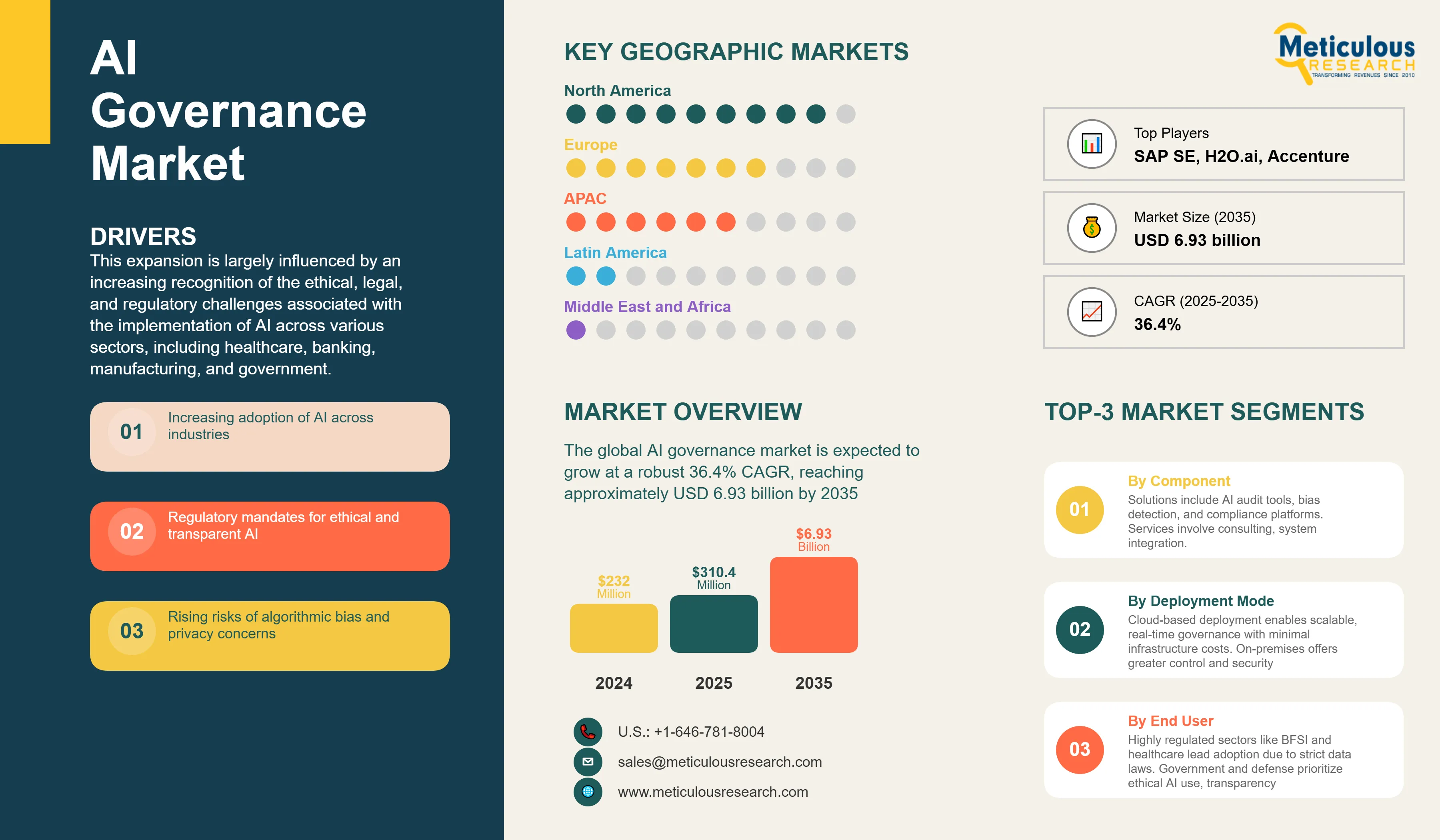
The global AI governance market was valued at USD 232 million in 2024. This market is expected to grow at a robust 36.4% CAGR, reaching approximately USD 6.93 billion by 2035 from USD 310.4 million in 2025.
- Published
- Aug 2025
- Pages
- 190
- Format
- PDF + Excel
- Report ID
- MRICT - 1041545
- Base year
- 2024
- 2024 · BASELINE
- $232.0M
- 2035
- $6.93B
- CAGR 2025–2035
- 36.4%
2024 baseline · 2025–2035 forecast at 36.4% CAGR · hover a bar for the value
Key highlights
The global AI governance market was valued at USD 232 million in 2024.
This market is expected to grow at a robust 36.4% CAGR, reaching approximately USD 6.93 billion by 2035 from USD 310.4 million in 2025.
Cloud-First AI Governance Platforms Scale Rapidly on Embedded Compliance and SME Adoption
North America represents approximately 35-40% of the global AI governance market, driven by robust regulatory frameworks like the effects of GDPR on US multinationals and the expected introduction of the AI Bill of Rights by the US government.
The Asia-Pacific AI governance market is experiencing significant growth and is expected to grow at a CAGR of 41.2% through 2035, driven by nations such as China, India, and South Korea.
Germany leads the Europe AI Governance market accounting for leading share of 25-30% in 2025. The AI governance market in Germany demonstrates the European Union's rigorous approach to privacy, encompassing the General Data Protection Regulation and the forthcoming AI Act frameworks.
Report summary
| Particulars | Details |
|---|---|
| Market size (2025) | USD 310.4 million |
| Revenue forecast in 2035 | USD 6.93 billion |
| CAGR (2025-2035) | 36.5% |
| Format | PDF, Excel & Cloud Portal · 190 pages |
| Base Year | 2024 |
| Forecast period | 2025 – 2035 |
| Report coverage | Market size and forecast, competitive landscape and benchmarking, country/regional level analysis, key trends, growth drivers and restraints |
| Segments covered | Component Type (Solution, Services), Deployment Mode (On-Premises, Cloud), Organization Size, End-use Vertical (BFSI, Government & Defense, Healthcare and Life Sciences), Geography |
| Regional scope | North America, Europe, Asia-Pacific, Latin America, and Middle East & Africa |
| Key companies profiled | International Business Machines Corporation (IBM); Alphabet Inc. (Google LLC); Microsoft Corporation; SAP SE; SAS Institute Inc.; Dataiku Inc.; Atos SE; Fair Isaac Corporation (FICO); H2O.ai, Inc.; Informatica Inc.; Salesforce, Inc.; Oracle Corporation; Amazon Web Services, Inc.; Accenture plc; NTT DATA Corporation (Nippon Telegraph and Telephone Corporation); Deloitte Touche Tohmatsu Limited; PwC (PricewaterhouseCoopers International Limited); IBM Watson OpenScale. |
| Customization | Comprehensive report customization with purchase. Addition or modification to country, regional & segment scope available |
| Pricing Details | Access customized purchase options to meet your specific research requirements. Explore flexible pricing models |
Report overview
Segments covered: component type, deployment mode, organization size, end-use vertical.
This expansion is largely influenced by an increasing recognition of the ethical, legal, and regulatory challenges associated with the implementation of AI across various sectors, including healthcare, banking, manufacturing, and government. The rise in legal requirements, including frameworks like GDPR in Europe and forthcoming AI-specific regulations, has prompted businesses and governments to establish thorough AI governance frameworks. These frameworks emphasise transparency, fairness, accountability, and the implementation of risk mitigation measures to address issues such as bias and data misuse. The market is advancing due to increasing investments in AI audit, risk management, and compliance solutions. North America and Europe are at the forefront of adoption, driven by stringent data protection regulations. Meanwhile, emerging economies in the Asia-Pacific region are making significant investments to enhance their AI governance capabilities in response to the increasing adoption of AI technologies.
The government and defense segment is set to expand at substantial pace owing to increasing emphasis on national security, data privacy, and strict regulatory compliance.
To mitigate risks associated with AI use and manage sensitive information, these sectors necessitate AI governance frameworks that are both highly secure and controlled.
Governance is a critical component of the AI strategy of government agencies, as they frequently emphasize transparency, accountability, and the ethical use of AI.
Additionally, defense organizations employ sophisticated AI systems for mission-critical operations, necessitating robust governance solutions to guarantee responsible deployment.
Report infographic
Key Factors Impacting Global AI Governance Market (2025–2035)
Base CAGR: 36.4%
|
Category |
Key Factor |
Short-Term Impact (2025–2028) |
Long-Term Impact (2029–2035) |
Estimated CAGR Impact |
|
Drivers |
1. Regulatory Push for Ethical and Transparent AI |
Accelerated policy adoptions |
Global governance standards |
▲ +6.0% |
|
2. Ethical Concerns |
Heightened auditing requirements |
Embedded ethics-by-design |
▲ +5.5% |
|
|
3. Increasing AI Adoption in Regulated Industries |
Rapid tool integration |
Mature compliance ecosystems |
▲ +5.2% |
|
|
Restraints |
1. Disparate Regulatory Frameworks Across Regions |
Fragmented compliance efforts |
Harmonization slow |
▼ −2.3% |
|
2. Integration Challenges Within AI Ecosystems |
Complex system interoperability |
Unified platform standards |
▼ −2.0% |
|
|
Opportunities |
1. Rapid growth of explainable AI solutions and audit tools |
Improved transparency offerings |
Standardized explainability |
▲ +4.8% |
|
2. Expanding demand from regulated industries |
New compliance tool deployments |
Industry-wide AI governance norms |
▲ +4.4% |
|
|
Trends |
1. Rise of automated AI model monitoring and compliance systems |
Real-time risk alerts |
Fully automated governance flows |
▲ +3.7% |
|
Challenges |
1. Managing governance for large-scale, dynamic AI deployments |
Strain on oversight frameworks |
Scalable governance architectures |
▼ −1.8% |
Market dynamics
7 factors across 2 forcesRegulatory Initiatives for Ethical and Transparent AI
Governments across the globe are implementing laws that require transparency in AI and the management of associated risks. For example, the GDPR and the EU's AI Act mandate that organisations establish transparent audit trails and conduct fairness assessments for AI models. Organisations that invest in compliance frameworks seek to mitigate penalties and protect their reputation, thereby expediting the implementation of AI governance platforms.
Increasing Instances of AI Bias and Ethical Considerations
Increased recognition of AI's capacity for biassed decision-making poses a risk to stakeholder confidence. Organisations employ governance tools to identify and rectify model biases, thereby promoting fairness in hiring, lending, and patient care. Survey data reveals that more than 70% of companies implementing AI now emphasise the importance of mitigating ethical risks, according to the Deloitte AI Ethics Report.
Enhancing AI Implementation in Regulated Sectors
Healthcare, financial services, and government sectors face ongoing regulatory oversight. These sectors are at the forefront of AI governance investments to fulfil compliance obligations, protect sensitive information, and ensure model validation through robust governance software.
Increasing Investments in AI Audit and Risk Management Solutions
Organisations are acknowledging the significance of ongoing AI auditing standards. The implementation of sophisticated AI governance tools aimed at enhancing explainability, incident detection, and process automation has experienced a 40% compound annual growth rate, as organisations strive to embed AI ethics and compliance into their operations.
Table of contents
13 chapters · 144 sections · 190 pages · click to expandSegmental analysis
By Component Type
- Cloud-First AI Governance Platforms Scale Rapidly on Embedded Compliance and SME Adoption
- Cloud implementations accounted for 70-75% share of the AI Governance market and are expected to grow at a CAGR of 38% through 2035.
- The platform services are directly embedded with governance hooks by providers, who provide automatic upgrades that monitor the changing rules.
- A single console can inspect prompts, training runs, and inference logs across multi-region data centers, thereby reducing compliance overhead.
- These pay-as-you-go options are preferred by SMEs due to the minimal upfront capital requirements.
Geographic analysis
North America
North America represents approximately 35-40% of the global AI governance market, driven by robust regulatory frameworks like the effects of GDPR on US multinationals and the expected introduction of the AI Bill of Rights by the US government. Leading companies such as IBM and Microsoft are significantly focused on developing governance tools tailored for highly regulated industries, including healthcare, financial services, and government agencies. Growing legislative frameworks necessitate transparency and strength in AI deployment, driving the adoption of governance platforms. The U.S. recorded a market value of USD 61.6 million in 2024, with forecasts anticipating an increase to USD 1.78 billion by 2035, driven by a CAGR of 29.8%. The early legislation in the country, such as the AI Bill of Rights initiative and stringent privacy laws, promotes the swift adoption of AI governance, particularly within highly regulated sectors like finance and healthcare. Leading companies like Microsoft, IBM, and SAP offer extensive governance solutions that assist organisations in reducing bias, improving auditability, and adhering to new standards. North America: Compliance and Advancement Leadership in Artificial Intelligence Governance United States: Early Mover in AI Governance with Robust Regulatory Initiatives
Asia-Pacific
The Asia-Pacific AI governance market is experiencing significant growth and is expected to grow at a CAGR of 41.2% through 2035, driven by nations such as China, India, and South Korea. The necessity of governance frameworks to mitigate the risks associated with AI deployment is being acknowledged by governments and businesses in the region, particularly in sectors such as finance and healthcare. Although formal AI governance policies are still in the early stages of development in certain countries, there is a growing trend toward the establishment of regulatory frameworks. South Korea is experiencing consistent growth through heightened Investments are being made in AI ethics and governance tools to meet the objective of fulfilling both local and international regulatory standards. South Korea’s AI Basic Act, effective of January 2026, expands transparency compliances, whereas India’s state initiatives add funding for responsible-AI sandboxes. Companies in the Asia Pacific region are also investing in AI auditing, bias detection, and compliance tools to ensure the responsible use of AI technologies. China's AI governance market is rapidly expanding, establishing itself as the leader in the APAC region, with projections indicating a market share of 50-60% by 2035. Governments are taking proactive steps to advance AI ethics and ensure responsible usage by implementing regulations that require transparency and fairness. Organisations in various sectors, particularly in manufacturing, finance, and public safety, are rapidly adopting AI governance tools designed to address these needs. Collaborations between local technology companies and international vendors enhance the scope and capabilities of solutions. Asia-Pacific: Accelerated Development with Emphasis on Compliance and Ethical Standards China: Dominant Growth with Stringent Compliance Frameworks
Europe
Largest shareGermany leads the Europe AI Governance market accounting for leading share of 25-30% in 2025. The AI governance market in Germany demonstrates the European Union's rigorous approach to privacy, encompassing the General Data Protection Regulation and the forthcoming AI Act frameworks. German companies are making significant investments in explainable AI systems and bias mitigation protocols, emphasising their commitment to ethical AI adoption. Cooperation among industry leaders, government entities, and academic institutions fosters the advancement and execution of AI governance standards, especially within the automotive, industrial, and healthcare sectors. Germany: Emphasis on Data Privacy and Ethical AI Compliance
Competitive landscape
The AI governance sector is highly competitive, featuring both well-established technology leaders and new specialists offering a variety of governance, audit, and compliance solutions. IBM, Microsoft, SAP, Infosys, ABB, and DXC Technology are recognised as prominent organisations, focussing on sector-specific challenges and adherence to regulatory standards. Vendors set themselves apart by focussing on AI explainability, conducting thorough risk assessments, and integrating ethical AI tools. Partnerships between technology firms and consulting agencies are increasing to develop tailored solutions for regulated sectors like financial services and healthcare, focussing on real-time policy enforcement and audit preparedness.
- Q1 2025
IBM has launched an AI governance suite that includes real-time monitoring, bias detection, and policy compliance modules specifically designed for the finance and healthcare industries. Early adopters have observed a reduction in governance-related risks, highlighting the suite's influence on operational resilience.
- Q3 2024
Microsoft has enhanced its AI governance capabilities within Azure by incorporating fairness and interpretability tools into developer pipelines. This enhancement promotes compliance with regulations and bolsters the ethical AI commitments of global clients.
- International Business Machines Corporation (IBM)
- Alphabet Inc. (Google LLC)
- Microsoft Corporation
- SAP SE
- SAS Institute Inc.
- Dataiku Inc.
- Atos SE
- Fair Isaac Corporation (FICO)
- H2O.ai, Inc.
- Informatica Inc.
- Salesforce, Inc.
- Oracle Corporation
- Amazon Web Services, Inc.
- Accenture plc
- Deloitte Touche Tohmatsu Limited
- PwC (PricewaterhouseCoopers International Limited)
- IBM Watson OpenScale
Frequently asked questions
The AI governance market size is estimated to be USD 310.4 million in 2025 and grow at a CAGR of 36.4% to reach USD 6.93 billion by 2035.
Cite this report
Meticulous Research. (2025). AI Governance Market - Global Opportunity Analysis and Industry Forecast (2025–2035) (Report No. MRICT - 1041545). Meticulous Market Research Pvt. Ltd. https://www.meticulousresearch.com/product/ai-governance-6228