Resources
About Us
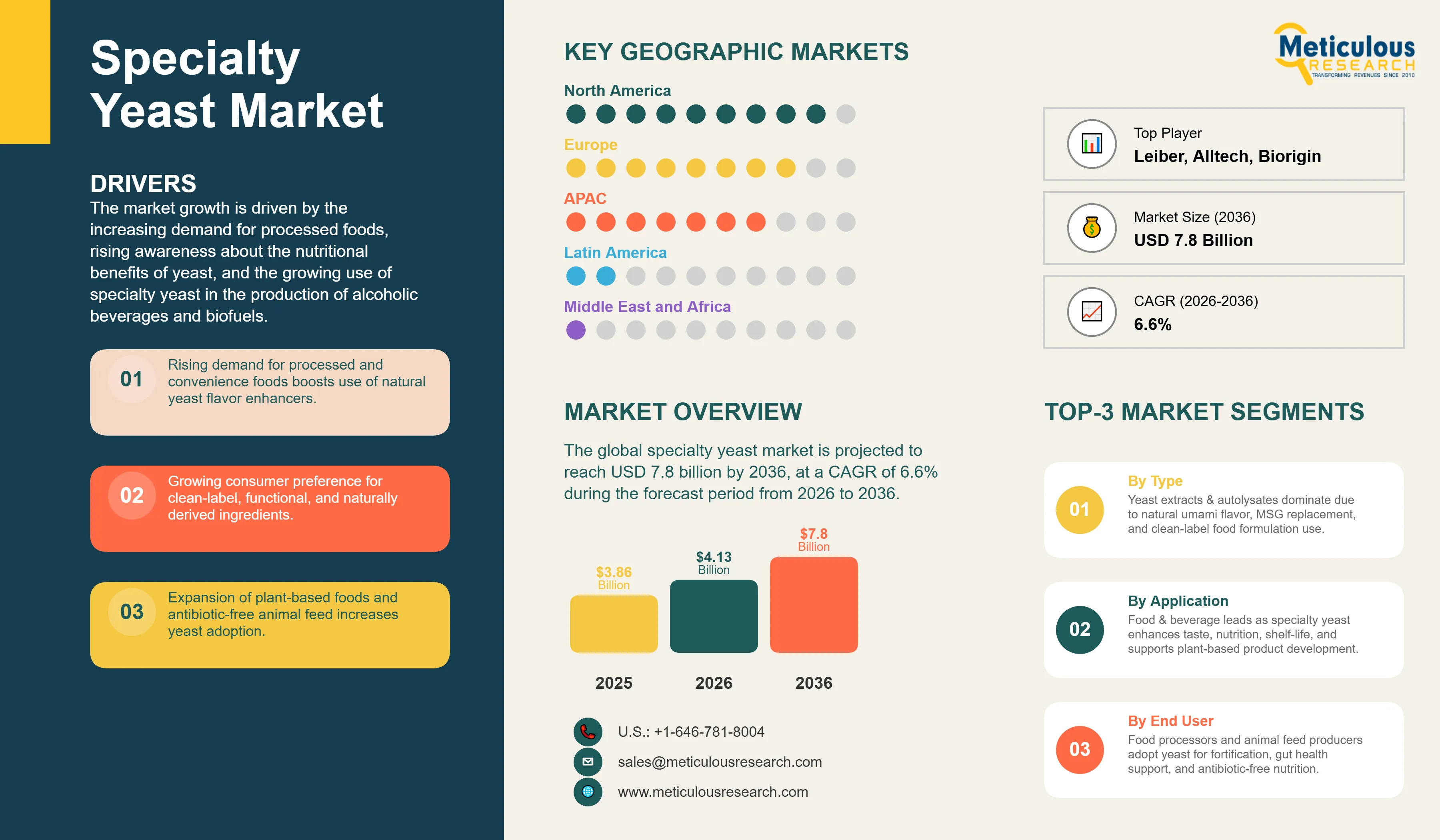
The global specialty yeast market is valued at USD 3.86 billion in 2025. This market is projected to reach USD 7.8 billion by 2036 from USD 4.13 billion in 2026, at a CAGR of 6.6% during the forecast period from 2026 to 2036. The market growth is driven by the increasing demand for processed foods, rising awareness about the nutritional benefits of yeast, and the growing use of specialty yeast in the production of alcoholic beverages and biofuels.
Click here to: Get Free Sample Pages of this Report
The specialty yeast market is a rapidly evolving segment within the global fermentation-based ingredients industry, driven by the increasing demand for functional, bioactive, and naturally derived additives across food processing, animal nutrition, and nutraceutical applications. Specialty yeast derivatives, including yeast extracts, beta-glucans, mannan-oligosaccharides (MOS), and nucleotides, are widely utilized for their functional properties such as flavor enhancement, immune modulation, and digestive health support.
The market is witnessing increased adoption of yeast-based ingredients as manufacturers seek alternatives to synthetic additives, antibiotic growth promoters, and monosodium glutamate (MSG) in food and feed formulations. In recent years, leading ingredient producers have expanded their specialty yeast portfolios to support sodium reduction in processed foods, improve gut health in livestock, and enhance protein content in plant-based food products. These developments are contributing to the growing commercialization of yeast-derived functional ingredients across multiple end-use industries.
Increasing Use of Specialty Yeast in Sodium Reduction and Antibiotic-Free Feed Formulations
The growing demand for sodium reduction in processed foods and the global shift toward antibiotic-free animal nutrition are emerging as key trends driving the specialty yeast market. Yeast extracts are increasingly being used as natural flavor enhancers in savory food applications to replace or reduce sodium content while maintaining taste profiles. This has led to their widespread adoption in processed foods such as soups (Kerry's reduced-sodium bouillon bases), sauces (Angelyeast's low-NaCl soy alternatives), snacks (DSM-Firmenich's seasoned chips), and ready-to-eat meals, achieving significant flavor retention at lower salt levels.
In addition, specialty yeast derivatives such as beta-glucans (Lallemand's Immunostimulin SP for enhanced poultry immunity) and MOS (Biorigin's Actigall range effectively binding pathogens in swine) are gaining traction as functional feed additives that support immune function and gut health in poultry, swine, and aquaculture species. With regulatory restrictions on antibiotic growth promoters across regions, including the EU/U.S. 2024 bans and China's 2026 phase-out, feed manufacturers are increasingly incorporating yeast-based additives like Alltech's Integral A+ as natural performance enhancers delivering improved feed efficiency.
Furthermore, the expansion of plant-based food formulations has increased the use of nutritional yeast as a protein-rich ingredient (12-15% complete amino acid profile) and flavor enhancer, exemplified by Leiber's Yeaspin in plant-based nuggets and Ohly's nutritional flakes in vegan cheese analogs. As manufacturers continue to develop functional yeast-based solutions for food fortification (beta-glucan-enriched baking mixes) and precision animal nutrition (strain-specific probiotics), the applications of specialty yeast are expected to expand steadily over the forecast period.
The global specialty yeast market is valued at USD 3.86 billion in 2025. This market is projected to reach USD 7.8 billion by 2036 from USD 4.13 billion in 2026, at a CAGR of 6.6% during the forecast period from 2026 to 2036.
|
Parameters |
Details |
|
Market Size by 2036 |
USD 7.8 Billion |
|
Market Size in 2026 |
USD 4.13 Billion |
|
Revenue Growth Rate (2026-2036) |
CAGR of 6.6% |
|
Dominating Type |
Yeast Extract |
|
Leading Application |
Food |
|
Leading Geographic Region |
North America |
|
Base Year |
2025 |
|
Forecast Period |
2026 to 2036 |
Drivers: Increasing Demand for Processed and Functional Food Products
The increasing demand for processed and convenience food products such as bakery items, savory snacks, soups, sauces, and ready-to-eat meals is a key factor driving the growth of the specialty yeast market. Specialty yeast derivatives, including yeast extracts like Lesaffre's Nurri series and autolysates from Kerry Group, are widely utilized in processed food formulations to enhance flavor profiles through natural glutamates, improve texture via water-binding properties, and support nutritional fortification with B-vitamins and amino acids.
In recent years, food manufacturers have increasingly incorporated yeast-based ingredients as natural flavor enhancers, such as AngelYeast's low-salt yeast extracts, reducing NaCl by 25% in bouillon cubes while maintaining taste and mouthfeel.
Additionally, the growing consumption of plant-based and protein-enriched food products has accelerated the use of nutritional yeast, providing 12-15% complete protein alongside cheesy umami notes, in vegan cheeses (Leiber's Yeaspin), meat analogs, and fortified dairy alternatives. Rapid urbanization, evolving dietary habits toward clean-label convenience foods, and increasing demand for functional food ingredients are further contributing to the adoption of specialty yeast across food processing applications.
Why are Yeast Extracts & Autolysates the Dominant Product Type in the Market?
Yeast extracts and autolysates are expected to account for the largest share of the global specialty yeast market in 2026, due to their extensive application as natural flavor enhancers and functional ingredients in processed food and beverage formulations, with DSM-Firmenich's yeast extract portfolio enabling 30-50% MSG replacement across global product lines. These derivatives are rich in amino acids, peptides, 5'-nucleotides, and organic acids that contribute to savory taste profiles and umami enhancement in food products ranging from snack seasonings to soup bases.
Furthermore, yeast extracts like Biorigin's Savory Flavors series are increasingly being used as clean-label alternatives to monosodium glutamate (MSG) in soups, sauces, seasonings, and ready meals, while providing functional benefits such as improved water-binding capacity (reducing drip loss by 15% in processed meats) and texture stabilization in plant-based burgers. The growing adoption of yeast extracts across sodium reduction initiatives, for instance, Lallemand's Peptone YE in low-sodium ready meals, is expected to drive growth of this segment over the forecast period.
Why is the Food & Beverage Segment the Largest Application for Specialty Yeast?
The food & beverage segment is expected to account for the largest share of the global specialty yeast market during the forecast period, primarily driven by the widespread use of specialty yeast derivatives in bakery (AB Mauri's fermented dough enhancers), dairy (Ohly's nutritional yeast in cheese powders), processed foods, and savory product applications like sauces and snacks. Specialty yeast ingredients are utilized to improve taste through natural umami, aroma via volatile esters, and shelf-life stability through antimicrobial peptides in food formulations.
In addition, the growing demand for natural flavor enhancers and plant-based protein sources has increased the use of nutritional yeast in vegan food products, dairy alternatives like oat milk fortifications, and meat substitutes incorporating 5-10% yeast for binding and nutrition. The incorporation of yeast-derived ingredients, such as beta-glucans from Alltech in functional beverages, is further supporting the growth of this segment. As food manufacturers continue to reformulate products to meet consumer demand for healthier and minimally processed ingredients, the use of specialty yeast in food applications is expected to expand steadily.
The key players profiled in the global specialty yeast market report include Associated British Foods plc (AB Mauri), Archer Daniels Midland Company, Lesaffre Group, Lallemand Inc., AngelYeast Co., Ltd., Kerry Group plc, DSM-Firmenich AG, Biorigin, Alltech, Inc., Leiber GmbH,Pakmaya, Ohly GmbH, and AEB Group SpA, among others.
The global specialty yeast market is valued at USD 4.13 billion in 2026 and is projected to reach approximately USD 7.8 billion by 2036.
The market is expected to grow at a CAGR of 6.6% during the forecast period from 2026 to 2036.
The key players operating in the global specialty yeast market include Associated British Foods plc (AB Mauri), Lesaffre Group, Lallemand Inc., AngelYeast Co., Ltd., Archer Daniels Midland Company, Kerry Group plc, DSM-Firmenich AG, Alltech, Inc., and Leiber GmbH, among others.
The primary factors driving market growth include the increasing demand for natural flavor enhancers in processed foods, rising adoption of yeast-based functional ingredients in animal nutrition, and growing use of nutritional yeast in plant-based food formulations.
North America is expected to account for a significant share of the market, driven by high consumption of processed and convenience foods, strong presence of leading ingredient manufacturers, and increasing adoption of functional food additives across the region.
1. Introduction
1.1. Market Definition
1.2. Market Ecosystem
1.3. Market Value Chain Analysis
1.4. Currency Considered
1.5. Limitations & Assumptions
1.6. Key Stakeholders
2. Research Methodology
2.1. Research Process
2.2. Secondary Research
2.3. Primary Research
2.4. Market Size Estimation
2.5. Forecast Methodology
2.6. Data Triangulation
2.7. Assumptions for the Study
3. Executive Summary
4. Market Insights
4.1. Overview
4.2. Market Dynamics
4.2.1. Drivers
4.2.1.1. Increasing Demand for Clean-Label Flavoring Ingredients
4.2.1.2. Growth in Functional Animal Nutrition
4.2.1.3. Rising Demand for Plant-Based Protein Alternatives
4.2.2. Restraints
4.2.2.1. Volatility in Molasses & Fermentation Feedstock Prices
4.2.2.2. Regulatory Approval Requirements for Feed Additives
4.2.3. Opportunities
4.2.3.1. Expansion of Yeast-Based Immune Health Ingredients
4.2.3.2. Increasing Application in Nutraceutical Formulations
4.2.4. Challenges
4.2.4.1. Process Standardization
4.2.4.2. Shelf-Life Stability of Functional Yeast Fractions
4.2.5. Market Trends
4.2.5.1. Salt Reduction Using Yeast-Derived Umami Solutions
4.2.5.2. Antibiotic Replacement in Animal Feed
4.2.6. Market Share Analysis, by Key Player
5. Global Specialty Yeast Market, by Product Type
5.1. Yeast Extracts & Autolysates
5.2. Specialty Active Yeast (e.g., Selenium Yeast, Probiotic Yeast)
5.3. Nutritional Yeast
5.4. Inactive Yeast & Functional Ingredients (e.g., Beta-Glucans)
5.5. Other Specialty Strains (e.g., Pichia, Probiotic Yeasts)
6. Global Specialty Yeast Market, by Application
6.1. Food & Beverages
6.2. Animal Nutrition
6.3. Human Nutrition & Nutraceuticals
6.4. Industrial Fermentation
6.5. Pharmaceuticals
6.6. Other Applications (e.g., Cosmetics, Biofuels)
7. Global Specialty Yeast Market, by Geography
7.1. North America
7.1.1. U.S.
7.1.2. Canada
7.2. Europe
7.2.1. Germany
7.2.2. U.K.
7.2.3. France
7.2.4. Italy
7.2.5. Spain
7.2.6. Netherlands
7.2.7. Rest of Europe
7.3. Asia-Pacific
7.3.1. China
7.3.2. Japan
7.3.3. India
7.3.4. South Korea
7.3.5. Australia
7.3.6. Indonesia
7.3.7. Rest of Asia-Pacific
7.4. Latin America
7.4.1. Brazil
7.4.2. Mexico
7.4.3. Argentina
7.4.4. Rest of Latin America
7.5. Middle East & Africa
7.5.1. Saudi Arabia
7.5.2. UAE
7.5.3. South Africa
7.5.4. Rest of Middle East & Africa
8. Competitive Landscape
8.1. Competitive Benchmarking
8.2. Market Share Analysis
8.3. Key Strategic Developments
8.3.1. Product Launches
8.3.2. Partnerships & Collaborations
8.3.3. Mergers & Acquisitions
8.3.4. Expansion Strategies
9. Company Profiles
9.1. Associated British Foods plc (AB Mauri)
9.2. Lesaffre Group
9.3. Lallemand Inc.
9.4. AngelYeast Co., Ltd.
9.5. Kerry Group plc
9.6. DSM-Firmenich AG
9.7. Archer Daniels Midland Company
9.8. Alltech, Inc.
9.9. Leiber GmbH
9.10. Biorigin
9.11. LeSaffre Animal Care (Phileo)
9.12. AEB Group SpA
9.13. Ohly GmbH
9.14. Pakmaya
9.15. Others
10. Appendix
10.1. Questionnaire
10.2. Abbreviations






















Published Date: Oct-2024
Published Date: Aug-2024
Published Date: Jan-2024
Published Date: Jan-2025
Subscribe to get the latest industry updates