Resources
About Us
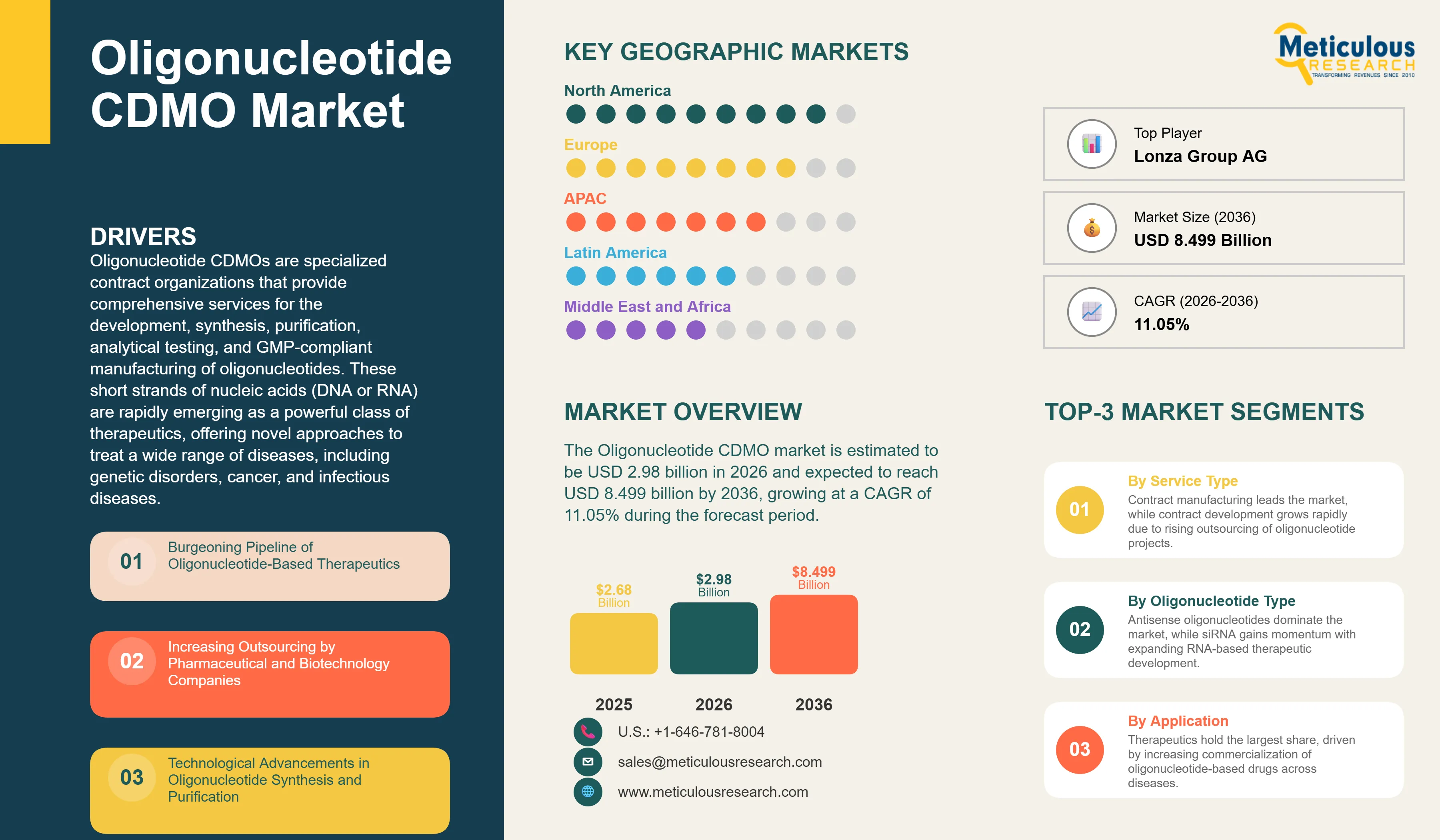
The global Oligonucleotide CDMO (Contract Development and Manufacturing Organization) market is estimated to be USD 2.98 billion in 2026. This market is expected to reach USD 8.499 billion by 2036, growing at a CAGR of 11.05% during the forecast period. The growth of this market is primarily driven by the burgeoning pipeline of oligonucleotide-based therapeutics, the increasing demand for specialized manufacturing expertise, and the strategic outsourcing by pharmaceutical and biotechnology companies to streamline drug development and production.
 Click here to: Get Free Sample Pages of this Report
Oligonucleotide CDMOs are specialized contract organizations that provide comprehensive services for the development, synthesis, purification, analytical testing, and GMP-compliant manufacturing of oligonucleotides. These short strands of nucleic acids (DNA or RNA) are rapidly emerging as a powerful class of therapeutics, offering novel approaches to treat a wide range of diseases, including genetic disorders, cancer, and infectious diseases. According to the International Agency for Research on Cancer, approximately 20 million new cancer cases were diagnosed globally in 2022, with the number projected to increase to more than 35 million by 2050, highlighting the growing need for next-generation precision therapeutics such as oligonucleotide-based medicines. As the complexity and regulatory requirements for oligonucleotide drugs increase, pharmaceutical and biotechnology companies are increasingly relying on the specialized expertise and infrastructure of CDMOs to navigate the intricate journey from discovery to commercialization.
The oligonucleotide CDMO market plays a pivotal role in accelerating the translation of scientific breakthroughs into life-saving medicines. These organizations offer critical capabilities such as custom synthesis, process development, scale-up, quality control, and regulatory support, enabling clients to overcome manufacturing challenges, reduce costs, and expedite time-to-market. According to the American Society of Gene & Cell Therapy, more than 4,000 cell, gene, and RNA-based therapies were in active development globally in 2024, reflecting the rapid expansion of advanced therapeutics that increasingly rely on specialized CDMO manufacturing capabilities. The market's expansion is intrinsically linked to the success of oligonucleotide therapeutics, which are gaining significant traction due to their high specificity, diverse mechanisms of action, and potential to address previously untreatable conditions.
Drivers
Restraints
Opportunities
Challenges
The global oligonucleotide CDMO market is shaped by several pivotal trends. A significant trend is the increasing demand for end-to-end integrated services, where CDMOs offer comprehensive solutions from preclinical development to commercial manufacturing, streamlining the entire drug development process for clients. Another key trend is the growing focus on process intensification and continuous manufacturing to improve efficiency, reduce costs, and enhance the scalability of oligonucleotide production. The market is also witnessing a rise in the adoption of advanced analytical techniques for more robust characterization and quality control of complex oligonucleotide structures. Furthermore, there is an increasing emphasis on sustainable manufacturing practices and the development of greener chemistries to minimize environmental impact. Finally, the strategic consolidation of the CDMO landscape through mergers and acquisitions is a notable trend, as companies seek to expand their capabilities, capacity, and geographic footprint to meet the escalating demand for oligonucleotide therapeutics.
Analysis by Service Type: Contract Manufacturing Dominating the Landscape
Based on service type, the contract manufacturing segment is expected to hold the largest share of the global oligonucleotide CDMO market. This dominance is attributed to the high capital investment required for specialized manufacturing facilities, the need for GMP compliance, and the technical expertise demanded for large-scale oligonucleotide production, making outsourcing a strategic choice for many companies. The contract development segment is anticipated to witness the fastest CAGR, driven by the increasing complexity of novel oligonucleotide designs and the growing need for specialized process development and analytical method development support.
Analysis by Oligonucleotide Type: Antisense Oligonucleotides (ASOs) Leading the Way
Based on oligonucleotide type, Antisense Oligonucleotides (ASOs) are expected to command the largest share of the global oligonucleotide CDMO market. ASOs have a well-established therapeutic history and a robust pipeline, driving consistent demand for their synthesis and manufacturing. The small interfering RNA (siRNA) segment is anticipated to exhibit the fastest CAGR, propelled by the significant advancements in RNA interference technology and the increasing number of siRNA-based therapeutics entering clinical trials.
Analysis by Application: Therapeutics at the Forefront
Based on application, the therapeutics segment is projected to account for the largest share of the oligonucleotide CDMO market. This is due to the rapidly expanding pipeline and commercialization of oligonucleotide drugs for various diseases, driving the demand for GMP-compliant manufacturing services. The diagnostics segment is expected to grow at the fastest CAGR, fueled by the increasing use of oligonucleotides in molecular diagnostics, PCR-based assays, and genetic testing.
Analysis by End User: Pharmaceutical & Biopharmaceutical Companies as Key Clients
Based on end user, pharmaceutical & biopharmaceutical companies are expected to command the largest share of the global oligonucleotide CDMO market. These companies are the primary developers and commercializers of oligonucleotide therapeutics, driving the bulk of outsourcing demand for specialized CDMO services. The academic & research institutes segment is anticipated to exhibit the fastest CAGR, driven by the increasing funding for basic research in nucleic acid biology and the growing need for custom oligonucleotide synthesis for discovery and preclinical studies.
North America: A Global Leader in Biopharmaceutical Innovation
North America is expected to hold the largest share of the global Oligonucleotide CDMO market. This dominance is attributed to a highly developed biopharmaceutical industry, significant R&D investments in nucleic acid therapeutics, the presence of numerous key market players and research institutions, and a robust regulatory framework that supports drug development. The United States, in particular, is a major contributor due to its large patient population and strong funding for biotechnology research.
Europe: Advancing Nucleic Acid Drug Development with Strong Research Ecosystems
Europe is expected to hold a significant share of the global Oligonucleotide CDMO market, driven by a well-established pharmaceutical sector, strong academic research ecosystems, and increasing government support for biotechnology and life sciences. Countries like Germany, the U.K., and Switzerland are key contributors due to their advanced research capabilities and the presence of leading CDMOs. The key companies operating in the European market are Lonza Group AG, AGC Biologics, and CordenPharma International.
Asia-Pacific: Rapid Growth Fueled by Expanding Biopharmaceutical Manufacturing
Asia-Pacific is projected to witness the fastest CAGR during the forecast period. This rapid growth is driven by improving healthcare infrastructure, increasing investments in biopharmaceutical manufacturing capabilities, a growing pool of skilled scientific talent, and the rising demand for cost-effective CDMO services in countries like China, India, and South Korea. Government initiatives to promote biotechnology and attract foreign investment also contribute to the region's market expansion. The key companies operating in the Asia-Pacific market are WuXi AppTec, Samsung Biologics, and GenScript Biotech Corporation.
Latin America: Emerging Opportunities in Biopharmaceutical Outsourcing
Latin America is anticipated to witness steady growth in the Oligonucleotide CDMO market, primarily due to increasing investments in biopharmaceutical R&D, a rising focus on local drug manufacturing, and growing awareness about advanced therapeutic modalities in countries like Brazil and Mexico. The modernization of healthcare facilities and the adoption of international quality standards also contribute to the demand for CDMO services. The key companies operating in the Latin American market are Thermo Fisher Scientific Inc. (with regional presence) and Merck KGaA (with regional presence).
Middle East & Africa: Gradual Expansion with Developing Biopharma Sector
The Middle East & Africa region is expected to experience gradual growth in the Oligonucleotide CDMO market, driven by increasing healthcare investments, government initiatives to develop local biopharmaceutical industries, and a growing focus on adopting advanced medical technologies. Countries like UAE and Saudi Arabia are investing in biotechnology research and manufacturing, leading to a gradual increase in demand for CDMO services. The key companies operating in the Middle East & Africa market are Thermo Fisher Scientific Inc. (with regional presence) and Merck KGaA (with regional presence).
The global Oligonucleotide CDMO market is characterized by a dynamic and highly competitive landscape. It features a mix of large, integrated CDMOs, specialized oligonucleotide manufacturers, and contract research organizations (CROs) offering synthesis services. Key players are focusing on expanding their manufacturing capacity, investing in advanced synthesis and purification technologies, offering integrated end-to-end solutions, and forming strategic partnerships or acquisitions to strengthen their market positions. The competitive strategy often revolves around demonstrating technical expertise, ensuring regulatory compliance, providing high-quality GMP-grade materials, and offering flexible and cost-effective solutions to clients. Companies are also investing heavily in R&D to develop novel chemistries and processes for next-generation oligonucleotide therapeutics.
The global Oligonucleotide CDMO market is estimated at USD 2.98 billion in 2026 and is projected to reach USD 8.499 billion by 2036, growing at a CAGR of 11.05%.
The market is driven by the burgeoning pipeline of oligonucleotide-based therapeutics, increasing outsourcing by pharmaceutical and biotechnology companies, technological advancements in synthesis and purification, and growing investment in gene therapy and RNA-based medicines.
Key restraints include high cost of synthesis and manufacturing, stringent regulatory requirements, limited availability of skilled workforce, and intellectual property concerns.
Opportunities include expansion into emerging oligonucleotide modalities, development of advanced conjugation and delivery technologies, geographic expansion, and strategic partnerships.
Challenges include scalability for large-scale GMP production, analytical characterization and quality assurance, competition from in-house manufacturing, and rapidly evolving technology landscape.
Contract manufacturing holds the largest share, while contract development is expected to grow the fastest.
Antisense Oligonucleotides (ASOs) command the largest share, and small interfering RNA (siRNA) is projected to have the fastest CAGR.
Therapeutics accounts for the largest share, and diagnostics is anticipated to grow the fastest.
Which end-user segment accounts for the largest share, and which is anticipated to grow the fastest?
Pharmaceutical & biopharmaceutical companies hold the largest share, and academic & research institutes are expected to grow the fastest.
North America leads the market, and Asia-Pacific is projected to exhibit the fastest growth.
Key players include Lonza Group AG, AGC Biologics, CordenPharma International, WuXi AppTec, Samsung Biologics, GenScript Biotech Corporation, Thermo Fisher Scientific Inc., Merck KGaA, Agilent Technologies, and Eurofins Scientific SE.
1. Introduction
1.1. Market Definition & Scope
1.2. Market Ecosystem
1.3. Currency Considered
1.4. Key Stakeholders
2. Research Methodology
2.1. Research Approach
2.2. Data Collection and Validation
2.2.1. Secondary Research
2.2.2. Primary Research/KOL Interviews
2.3. Market Sizing and Forecast
2.3.1. Market Size Estimation Approach
2.3.1.1. Bottom-Up Approach
2.3.1.2. Top-Down Approach
2.3.2. Growth Forecast Approach
2.3.3. Assumptions for the Study
3. Executive Summary
3.1. Overview
3.2. Segmental Analysis
3.2.1. Market Analysis, by Service Type
3.2.2. Market Analysis, by Oligonucleotide Type
3.2.3. Market Analysis, by Application
3.2.4. Market Analysis, by End User
3.2.5. Market Analysis, by Geography
3.3. Competitive Analysis
4. Market Insights
4.1. Overview
4.2. Factors Affecting Market Growth
4.2.1. Drivers
4.2.1.1. Burgeoning Pipeline of Oligonucleotide-Based Therapeutics
4.2.1.2. Increasing Outsourcing by Pharmaceutical and Biotechnology Companies
4.2.1.3. Technological Advancements in Oligonucleotide Synthesis and Purification
4.2.1.4. Growing Investment in Gene Therapy and RNA-Based Medicines
4.2.2. Restraints
4.2.2.1. High Cost of Oligonucleotide Synthesis and Manufacturing
4.2.2.2. Stringent Regulatory Requirements and Quality Control
4.2.2.3. Limited Availability of Skilled Workforce and Specialized Expertise
4.2.2.4. Intellectual Property (IP) Concerns and Confidentiality
4.2.3. Opportunities
4.2.3.1. Expansion into Emerging Oligonucleotide Modalities
4.2.3.2. Development of Advanced Conjugation and Delivery Technologies
4.2.3.3. Geographic Expansion into Emerging Biopharmaceutical Hubs
4.2.3.4. Strategic Partnerships and Consolidations
4.2.4. Challenges
4.2.4.1. Scalability Challenges for Large-Scale GMP Production
4.2.4.2. Analytical Characterization and Quality Assurance
4.2.4.3. Competition from In-House Manufacturing
4.2.4.4. Rapidly Evolving Technology Landscape
4.2.5. Key Trends
4.3. Porter’s Five Forces Analysis
4.4. Regulatory Landscape
4.5. Value Chain Analysis
5. Global Oligonucleotide CDMO Market, by Service Type
5.1. Overview
5.2. Contract Manufacturing
5.3. Contract Development
5.4. Analytical Services
5.5. Process Development
6. Global Oligonucleotide CDMO Market, by Oligonucleotide Type
6.1. Overview
6.2. Antisense Oligonucleotides (ASOs)
6.3. Small Interfering RNA (siRNA)
6.4. Aptamers
6.5. microRNA (miRNA)
6.6. Other Oligonucleotide Types
7. Global Oligonucleotide CDMO Market, by Application
7.1. Overview
7.2. Therapeutics
7.2.1. Oncology
7.2.2. Genetic Disorders
7.2.3. Infectious Diseases
7.2.4. Cardiovascular Diseases
7.2.5. Other Therapeutic Areas
7.3. Diagnostics
7.4. Research & Development
8. Global Oligonucleotide CDMO Market, by End User
8.1. Overview
8.2. Pharmaceutical & Biopharmaceutical Companies
8.3. Academic & Research Institutes
8.4. Contract Research Organizations (CROs)
9. Global Oligonucleotide CDMO Market, by Geography
9.1. Overview
9.2. North America
9.2.1. U.S.
9.2.2. Canada
9.3. Europe
9.3.1. Germany
9.3.2. U.K.
9.3.3. France
9.3.4. Italy
9.3.5. Spain
9.3.6. Rest of Europe
9.4. Asia-Pacific
9.4.1. China
9.4.2. Japan
9.4.3. India
9.4.4. South Korea
9.4.5. Rest of Asia-Pacific
9.5. Latin America
9.5.1. Brazil
9.5.2. Mexico
9.5.3. Rest of Latin America
9.6. Middle East & Africa
9.6.1. UAE
9.6.2. Saudi Arabia
9.6.3. Rest of Middle East & Africa
10. Competitive Landscape
10.1. Overview
10.2. Key Growth Strategies
10.3. Competitive Benchmarking
10.4. Competitive Dashboard
10.4.1. Industry Leaders
10.4.2. Market Differentiators
10.4.3. Vanguards
10.4.4. Emerging Companies
10.5. Market Share/Ranking Analysis, By Key Player (2025)
11. Company Profiles (Business Overview, Financial Overview, Product Portfolio, Strategic Developments, SWOT Analysis)
11.1. Lonza Group AG
11.2. AGC Biologics
11.3. CordenPharma International
11.4. WuXi AppTec
11.5. Samsung Biologics
11.6. GenScript Biotech Corporation
11.7. Thermo Fisher Scientific Inc.
11.8. Merck KGaA
11.9. Agilent Technologies
11.10. Eurofins Scientific SE
12. Appendix
12.1. Abbreviations
12.2. Bibliography
12.3. Disclaimer











Published Date: Jun-2026
Published Date: Sep-2018
Published Date: Oct-2018
Published Date: Jan-2023
Published Date: Jul-2024
Subscribe to get the latest industry updates