Resources
About Us
Surgical Helmets Market Size, Share & Trends Analysis by Product Type, Application, End User, and Geography - Global Opportunity Analysis and Industry Forecast (2026-2036)
Report ID: MRHC - 1042093 Pages: 290 Jun-2026 Formats*: PDF Category: Healthcare Delivery: 24 to 72 Hours Download Free Sample Report
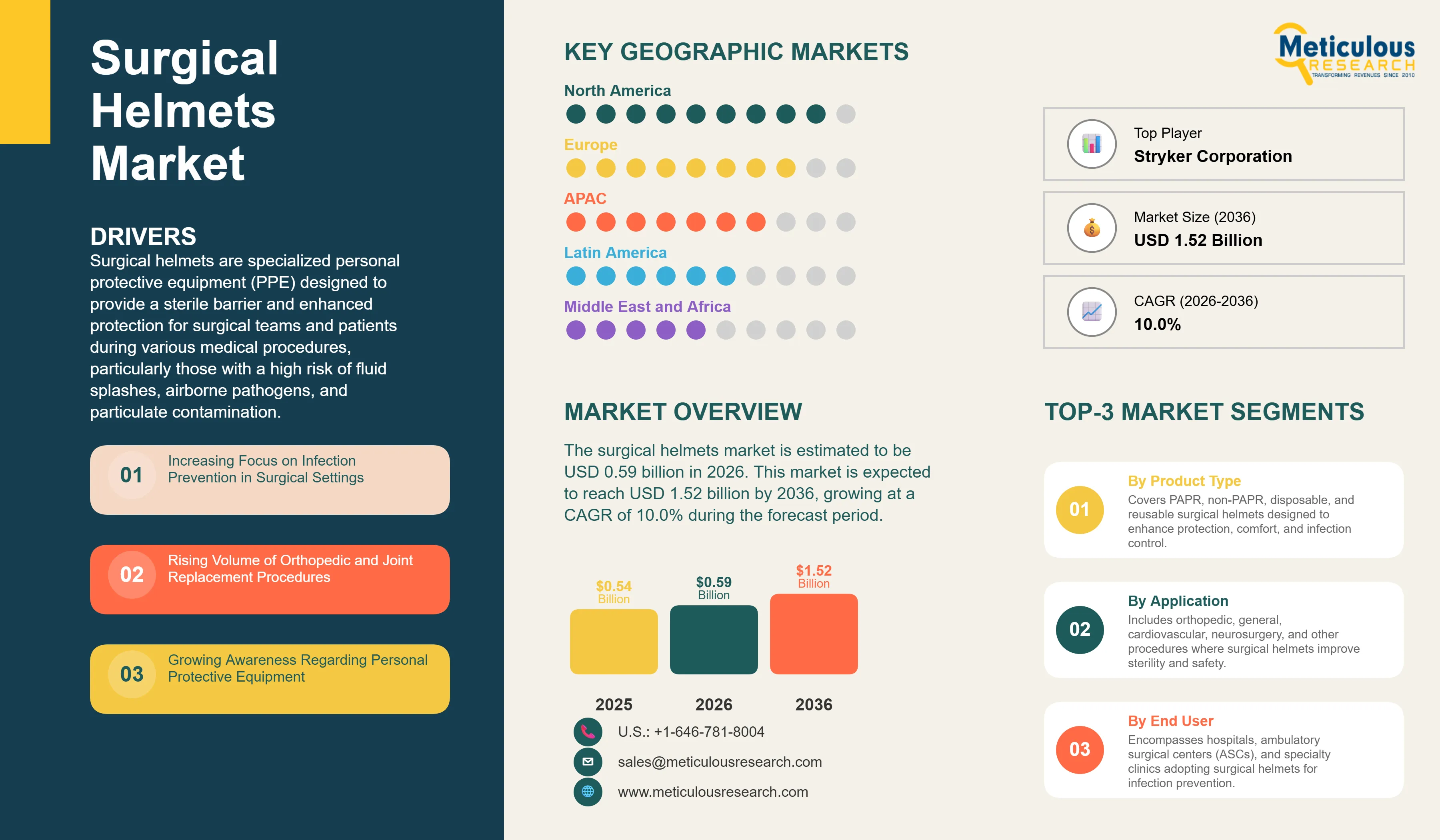
The global surgical helmets market is estimated to be USD 0.59 billion in 2026. This market is expected to reach USD 1.52 billion by 2036, growing at a CAGR of 10.0% during the forecast period. The growth of this market is primarily driven by the increasing focus on infection prevention in surgical settings, the rising volume of orthopedic and joint replacement procedures, and the growing awareness among healthcare professionals regarding personal protective equipment (PPE) for enhanced safety and sterility.
 Click here to: Get Free Sample Pages of this Report
Surgical helmets are specialized personal protective equipment (PPE) designed to provide a sterile barrier and enhanced protection for surgical teams and patients during various medical procedures, particularly those with a high risk of fluid splashes, airborne pathogens, and particulate contamination. These systems typically consist of a lightweight helmet, a clear visor, and an integrated ventilation system that filters air and keeps the surgeon cool and comfortable, ensuring clear visibility throughout long procedures.
The adoption of surgical helmets has become increasingly critical in modern operating theaters due to the rising complexity of surgical procedures, the imperative to minimize surgical site infections (SSIs), and the need to protect healthcare workers from exposure to infectious agents. These devices play a vital role in maintaining a sterile field, reducing the risk of cross-contamination, and improving overall surgical outcomes. The continuous evolution of surgical techniques and the emphasis on patient and staff safety are driving innovations in surgical helmet design and functionality.
Drivers
Restraints
Opportunities
Challenges
The global surgical helmets market is characterized by several evolving trends. A significant trend is the increasing demand for integrated systems that combine advanced filtration, cooling, and lighting within a single, lightweight unit, enhancing surgeon comfort and performance during lengthy procedures. Another key trend is the growing focus on disposable components and modular designs, which simplify sterilization processes, reduce cross-contamination risks, and offer cost-effective solutions. The market is also witnessing the integration of enhanced communication systems within helmets, allowing for clearer dialogue among the surgical team without compromising sterility. Furthermore, there is a rising emphasis on ergonomic designs and customizable fits to accommodate diverse user needs and improve overall user experience. Finally, the development of smart surgical helmets with potential for augmented reality overlays or real-time data display is an emerging trend, promising to revolutionize surgical navigation and information access in the operating room.
Analysis by Product Type: Powered Air-Purifying Respirators (PAPRs) Leading the Way
Based on product type, Powered Air-Purifying Respirator (PAPR) helmets are expected to hold the largest share of the global surgical helmets market. Their superior filtration capabilities, positive pressure airflow, and ability to provide respiratory protection against airborne contaminants make them highly effective in maintaining a sterile environment and protecting surgical teams. The disposable helmets segment is anticipated to witness the fastest CAGR, driven by the increasing demand for single-use solutions to minimize cross-contamination risks and simplify sterilization protocols.
Analysis by Application: Orthopedic Surgeries Dominating Adoption
The orthopedic surgeries segment is projected to account for the largest share of the surgical helmets market. This is due to the high incidence of bone dust, aerosols, and potential for infection during procedures like joint replacements and spinal surgeries, where surgical helmets provide essential protection. The general surgeries segment is expected to grow at the fastest CAGR, propelled by the increasing awareness of infection control across a broader range of surgical interventions and the expanding use of surgical helmets beyond traditional orthopedic applications.
Analysis by End User: Hospitals at the Forefront of Adoption
Based on end user, hospitals are expected to command the largest share of the global surgical helmets market. Hospitals are the primary settings for complex surgical procedures and have stringent infection control policies, driving the demand for advanced protective equipment like surgical helmets. The ambulatory surgical centers (ASCs) segment is anticipated to exhibit the fastest CAGR, driven by the increasing shift of surgical procedures to outpatient settings and the growing need for robust infection prevention measures in these facilities.
North America: A Leader in Surgical Safety Standards
North America is expected to hold the largest share of the global Surgical Helmets market. This dominance is attributed to several factors, including a highly developed healthcare infrastructure, stringent infection control regulations, high volume of surgical procedures (especially orthopedics), and strong awareness and adoption of advanced PPE among healthcare professionals. The United States, in particular, is a major contributor due to its large patient population and significant investments in surgical safety technologies.
Europe: Advancing Surgical Protection with Robust Regulations
Europe is expected to hold a significant share of the global Surgical Helmets market, driven by a well-established healthcare system, strong regulatory emphasis on occupational safety and infection control in operating rooms, and the presence of leading medical device manufacturers. Countries like Germany, the U.K., and France are key contributors due to their high surgical volumes and proactive adoption of advanced surgical safety equipment. The key companies operating in the European market are Zimmer Biomet, Stryker Corporation, and Ecolab Inc.
Asia-Pacific: Rapid Growth Fueled by Healthcare Modernization
Asia-Pacific is projected to witness the fastest CAGR during the forecast period. This rapid growth is driven by the improving healthcare infrastructure, increasing surgical volumes due to a growing and aging population, rising awareness about infection control, and increasing healthcare expenditure in countries like China, India, and Japan. Government initiatives to enhance patient safety and modernize healthcare facilities also contribute to the region's market expansion. The key companies operating in the Asia-Pacific market are Zimmer Biomet and Stryker Corporation.
Latin America: Emerging Opportunities in Surgical Safety
Latin America is anticipated to witness steady growth in the Surgical Helmets market, primarily due to increasing investments in pharmaceutical production facilities, rising demand for high-quality drugs, and growing awareness about infection prevention in countries like Brazil and Mexico. The modernization of healthcare facilities and the adoption of international safety standards also contribute to the demand for surgical helmets. The key companies operating in the Latin American market are Zimmer Biomet and Stryker Corporation.
Middle East & Africa: Gradual Expansion with Healthcare Development
The Middle East & Africa region is expected to experience gradual growth in the Surgical Helmets market, driven by increasing healthcare investments, government initiatives to improve healthcare quality and safety, and a growing focus on adopting advanced medical technologies. Countries like UAE and Saudi Arabia are leading the adoption of modern surgical practices and equipment in the region. The key companies operating in the Middle East & Africa market are Zimmer Biomet and Stryker Corporation.
The global Surgical Helmets market is characterized by a dynamic and evolving competitive landscape. It features a mix of established medical device manufacturers, specialized PPE providers, and innovative startups. Key players are focusing on product innovation, strategic partnerships, mergers and acquisitions, and geographic expansion to strengthen their market positions. The competitive strategy often revolves around developing highly effective, comfortable, and compliant surgical helmet systems that address the unique needs of surgical teams and enhance patient safety. Companies are also investing heavily in clinical research and user feedback to refine their product offerings and gain a competitive edge.
The global Surgical Helmets market is estimated at USD 0.59 billion in 2026 and is projected to reach USD 1.52 billion by 2036, growing at a CAGR of 10.0%.
The market is driven by increasing focus on infection prevention, rising volume of orthopedic procedures, growing awareness of PPE, and technological advancements in helmet design.
Key restraints include high initial investment costs, discomfort and ergonomic challenges, maintenance and sterilization requirements, and availability of alternative infection control measures.
Opportunities include development of disposable solutions, integration with advanced surgical technologies, expansion into new surgical specialties, and growing demand in emerging markets.
Challenges include user acceptance and training, supply chain management, environmental impact of disposables, and regulatory harmonization.
Powered Air-Purifying Respirator (PAPR) helmets hold the largest share, while disposable helmets are expected to grow the fastest.
Orthopedic surgeries dominate the market, and general surgeries are projected to have the fastest CAGR.
Which end-user segment accounts for the largest share, and which is anticipated to grow the fastest?
Hospitals hold the largest share, and ambulatory surgical centers (ASCs) are expected to grow the fastest.
North America leads the market, and Asia-Pacific is projected to exhibit the fastest growth.
Key players include Zimmer Biomet, Stryker Corporation, Ecolab Inc., 3M Company, and Medline Industries, LP.





















Published Date: Jul-2026
Published Date: Jul-2026
Published Date: Jan-2025
Published Date: Jan-2025
Please enter your corporate email id here to view sample report.
Subscribe to get the latest industry updates


