Resources
About Us

Pharmaceutical Robots Market Size, Share & Trends Analysis by Product Type, Application, End User, and Geography - Global Opportunity Analysis and Industry Forecast (2026-2036)
Report ID: MRHC - 1042086 Pages: 310 Jun-2026 Formats*: PDF Category: Healthcare Delivery: 24 to 72 Hours Download Free Sample Report
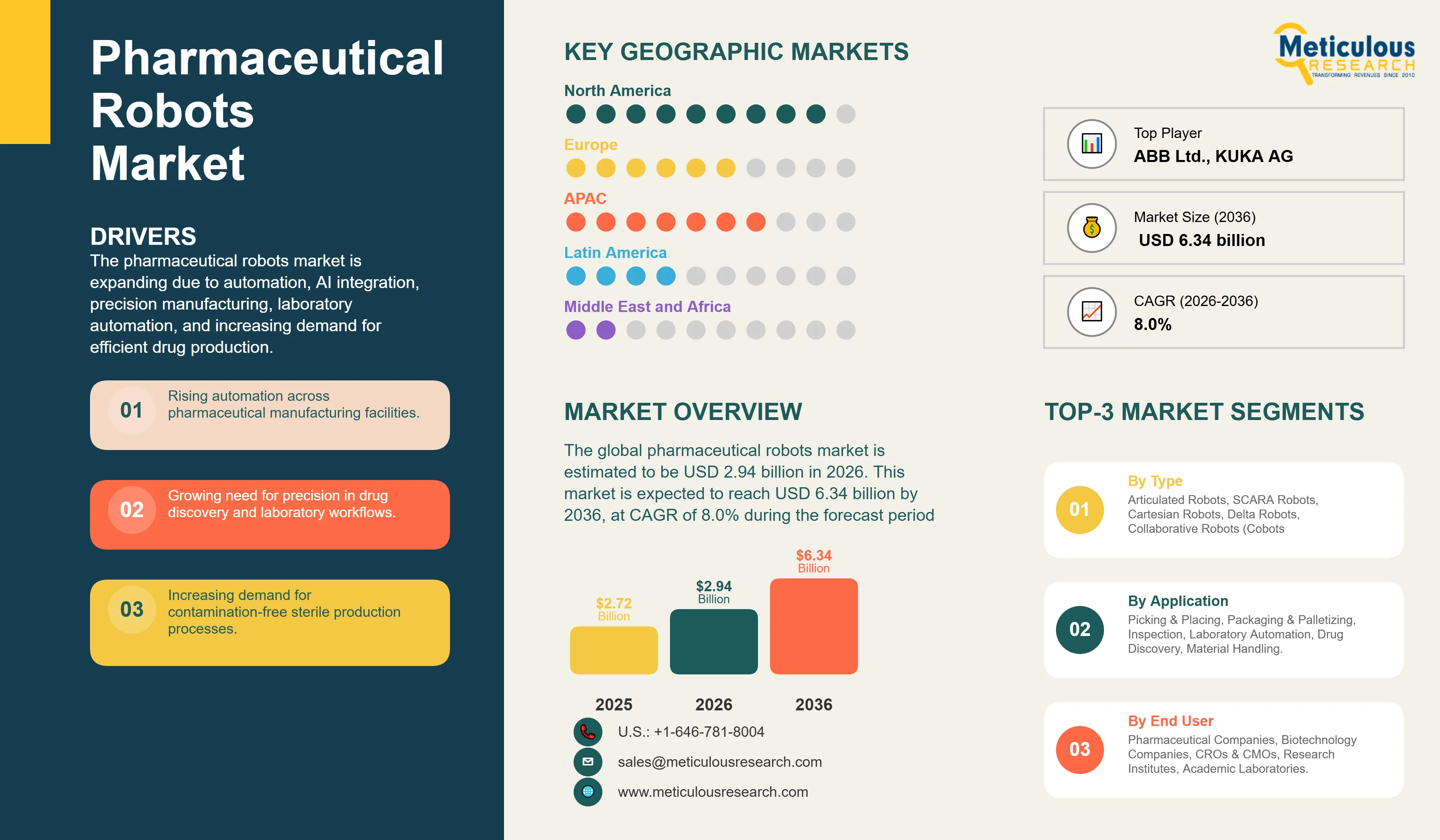
The global pharmaceutical robots market is estimated to be USD 2.94 billion in 2026. This market is expected to reach USD 6.34 billion by 2036, at CAGR of 8.0% during the forecast period. The growth of this market is primarily driven by the increasing demand for automation in pharmaceutical manufacturing, the need for enhanced precision and accuracy in drug discovery and development, and the growing focus on reducing human error and contamination risks in sterile environments.
 Click here to: Get Free Sample Pages of this Report
Pharmaceutical robots are advanced automated systems designed to perform a wide range of tasks within the pharmaceutical industry, from drug discovery and development to manufacturing, packaging, and quality control. These robots offer unparalleled precision, repeatability, and efficiency, significantly reducing manual labor, minimizing contamination risks, and accelerating production cycles. The integration of robotics addresses critical challenges faced by pharmaceutical companies, including stringent regulatory requirements, the need for high-throughput screening, and the increasing complexity of drug formulations.
The pharmaceutical industry is undergoing a significant transformation, driven by the imperative to bring new drugs to market faster, reduce costs, and ensure product quality and safety. Robotics plays a pivotal role in this evolution by automating repetitive and hazardous tasks, thereby freeing human personnel to focus on more complex, value-added activities. This shift towards automation is not only enhancing operational efficiency but also enabling breakthroughs in personalized medicine and advanced therapeutic development.
Drivers
Restraints
Opportunities
Challenges
The global pharmaceutical robots market is witnessing several transformative trends. A prominent trend is the increasing adoption of collaborative robots (cobots), which are designed to work safely alongside human operators, enhancing flexibility and efficiency in tasks like assembly, inspection, and packaging. Another key trend is the growing integration of Artificial Intelligence (AI) and Machine Learning (ML) into robotic systems, enabling predictive maintenance, adaptive control, and intelligent decision-making, thereby optimizing pharmaceutical operations. The market is also seeing a shift towards modular and flexible robotic solutions that can be easily reconfigured for different production needs, crucial for personalized medicine and small-batch manufacturing. Furthermore, there is a rising demand for robots capable of operating in sterile and aseptic environments, ensuring compliance with stringent regulatory standards and minimizing contamination risks. Finally, the expansion of robotics beyond manufacturing into drug discovery, laboratory automation, and quality control is a significant trend, driving innovation across the entire pharmaceutical value chain.
Analysis by Product Type: Articulated Robots Leading the Way
Based on product type, articulated robots are expected to hold the largest share of the global pharmaceutical robots market in 2026. Their versatility, high degree of freedom, and ability to perform complex movements make them ideal for various tasks, including pick-and-place, assembly, and dispensing in pharmaceutical manufacturing. The collaborative robots (cobots) segment is anticipated to witness the fastest CAGR, driven by their safety features, ease of programming, and ability to work alongside humans, making them increasingly popular for tasks requiring human-robot interaction.
Analysis by Application: Dominance of Picking & Placing, Growth in Drug Discovery
The picking & placing segment is projected to account for the largest share of the pharmaceutical robots market. This is due to the high volume of repetitive tasks involved in pharmaceutical packaging, sorting, and material handling, where robots offer superior speed and accuracy. The drug discovery & laboratory automation segment is expected to grow at the fastest CAGR, propelled by the increasing need for high-throughput screening, automated sample preparation, and precision in research and development activities.
Analysis by End User: Pharmaceutical Companies at the Forefront
Based on end user, pharmaceutical companies are expected to command the largest share of the global pharmaceutical robots market. These companies are the primary adopters of robotic systems for large-scale manufacturing, quality control, and research and development to enhance efficiency and comply with regulatory standards. The contract research organizations (CROs) and contract manufacturing organizations (CMOs) segment** is anticipated to exhibit the fastest CAGR, driven by the outsourcing trend in drug development and manufacturing, where these organizations leverage robotics to offer specialized and efficient services.
North America: A Leader in Pharmaceutical Automation
North America is expected to hold the largest share of the global Pharmaceutical Robots market. This dominance is attributed to several factors, including a well-established pharmaceutical industry, significant investments in R&D, stringent regulatory requirements promoting automation for quality control, and the presence of key robotic technology providers. The United States, in particular, is a major contributor due to its large pharmaceutical market and early adoption of advanced manufacturing technologies.
Europe: Advancing Automation with Strong Regulatory Support
Europe is expected to hold a significant share of the global Pharmaceutical Robots market, driven by a robust pharmaceutical sector, strong emphasis on automation for compliance with Good Manufacturing Practices (GMP), and government initiatives supporting advanced manufacturing. Countries like Germany, Switzerland, and the U.K. are key contributors due to their leading pharmaceutical companies and advanced research capabilities. The key companies operating in the European market are ABB Ltd., KUKA AG, and Stäubli International AG.
Asia-Pacific: Rapid Growth Fueled by Manufacturing Expansion
Asia-Pacific is projected to witness the fastest CAGR during the forecast period. This rapid growth is driven by the expanding pharmaceutical manufacturing base in countries like China, India, and Japan, increasing investments in automation to improve efficiency and quality, and the growing demand for affordable drugs. Government support for local manufacturing and technological advancements also contribute to the region's market expansion. The key companies operating in the Asia-Pacific market are Kawasaki Heavy Industries, Ltd., Yaskawa Electric Corporation, and FANUC Corporation.
Latin America: Emerging Opportunities in Pharmaceutical Production
Latin America is anticipated to witness steady growth in the Pharmaceutical Robots market, primarily due to increasing investments in pharmaceutical production facilities, rising demand for high-quality drugs, and growing awareness about the benefits of automation in countries like Brazil and Mexico. The modernization of healthcare infrastructure also contributes to the adoption of robotic solutions. The key companies operating in the Latin American market are ABB Ltd. and KUKA AG.
Middle East & Africa: Gradual Expansion with Healthcare Modernization
The Middle East & Africa region is expected to experience gradual growth in the Pharmaceutical Robots market, driven by increasing healthcare investments, government initiatives to develop local pharmaceutical manufacturing capabilities, and a growing focus on improving product quality and efficiency. Countries like Saudi Arabia and UAE are leading the adoption of advanced manufacturing technologies in the region. The key companies operating in the Middle East & Africa market are ABB Ltd. and FANUC Corporation.
The global Pharmaceutical Robots market is characterized by a dynamic and evolving competitive landscape. It features a mix of established industrial robot manufacturers, specialized pharmaceutical automation providers, and innovative startups. Key players are focusing on product innovation, strategic partnerships, mergers and acquisitions, and geographic expansion to strengthen their market positions. The competitive strategy often revolves around developing highly precise, flexible, and compliant robotic solutions that address the unique needs of pharmaceutical manufacturing and research. Companies are also investing heavily in software development for robot control and integration with existing pharmaceutical systems.
ABB Ltd.; KUKA AG; FANUC Corporation; Yaskawa Electric Corporation; Stäubli International AG; Kawasaki Heavy Industries, Ltd.; Universal Robots (Teradyne Inc.); Epson Robots; Denso Wave Incorporated; Mitsubishi Electric Corporation; Omron Corporation; Shibuya Corporation; Tecan Group Ltd.; Hamilton Company; Festo AG & Co. KG; Genesis Systems Group (Lincoln Electric); Remtec Automation LLC; Syntegon Technology GmbH; Marchesini Group S.p.A.; Optima Packaging Group GmbH
The global Pharmaceutical Robots market is estimated at USD 2.94 billion in 2026 and is projected to reach USD 6.35 billion by 2036, growing at a CAGR of 8.0%.
The market is driven by increasing demand for automation, need for enhanced precision, focus on reducing human error and contamination, and rising labor costs.
Key restraints include high initial investment costs, complexity of integration, lack of skilled personnel, and stringent regulatory requirements.
Opportunities include the emergence of collaborative robots, growth in personalized medicine, expansion into emerging markets, and advancements in AI/ML integration.
Challenges include data security, standardization issues, resistance to change, and high maintenance costs.
Articulated robots hold the largest share, while collaborative robots (cobots) are expected to grow the fastest.
North America leads the market, and Asia-Pacific is projected to exhibit the fastest growth.
Key players include ABB Ltd., KUKA AG, FANUC Corporation, Yaskawa Electric Corporation, and Stäubli International AG.
























Published Date: Jan-2025
Published Date: Jul-2024
Published Date: Apr-2024
Published Date: Sep-2013
Published Date: Sep-2013
Please enter your corporate email id here to view sample report.
Subscribe to get the latest industry updates


