European Laboratory Informatics Market (2018-2024)
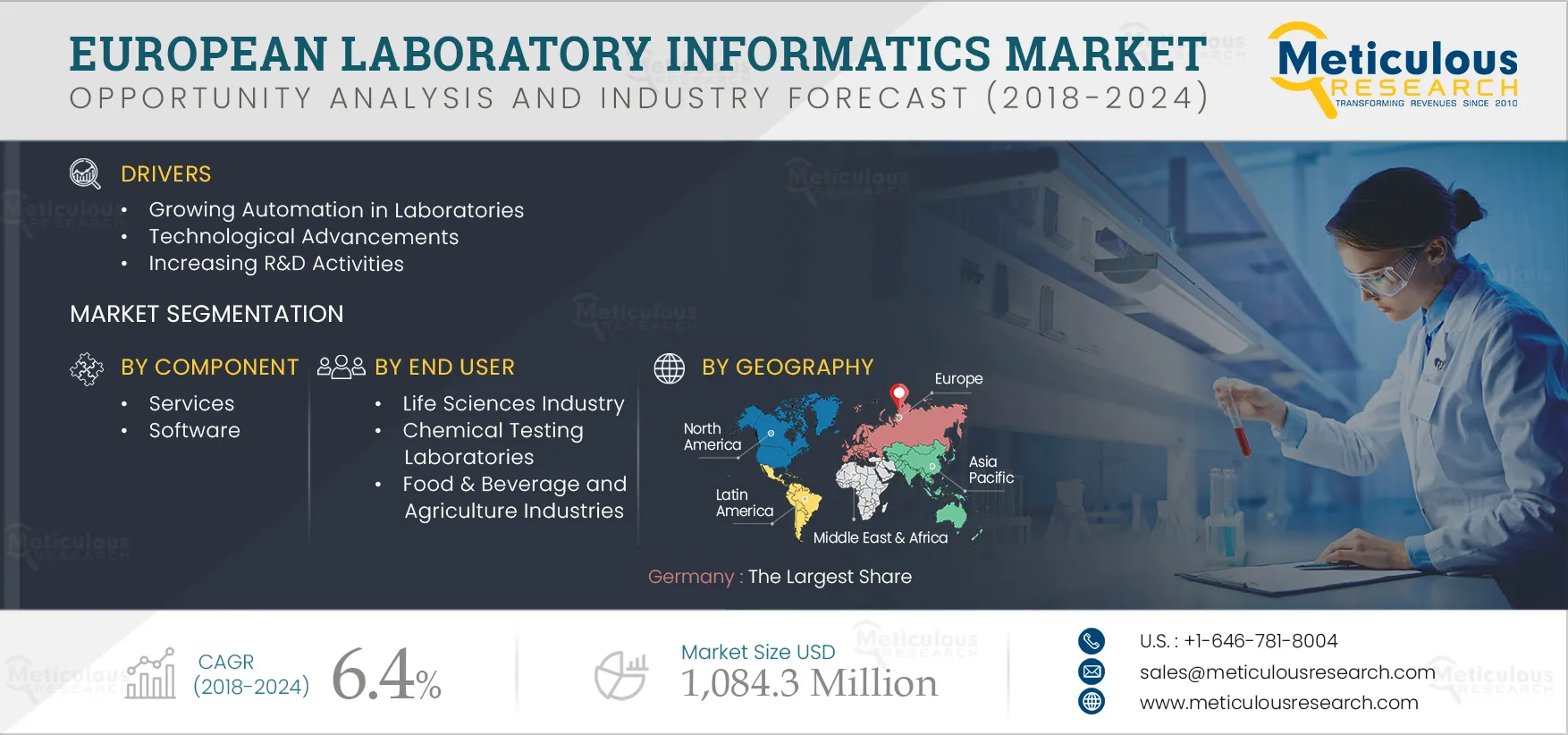
The European laboratory informatics market is expected to reach $1,084.3 million by 2024, growing at a CAGR of 6.4% during the forecast period of 2018 to 2024.
- Published
- Oct 2018
- Pages
- 153
- Format
- PDF + Excel
- Report ID
- MRHC - 10422
- Base year
- 2017
- 2024 · FORECAST
- $1.08B
- 2024
- $1.08B
- CAGR 2018–2024
- 6.4%
2017 baseline · 2018–2024 forecast at 6.4% CAGR · hover a bar for the value
Key highlights
LIMS solutions are widely adopted as they meet broad range of scientific needs with their ability to provide a suitable environment that is easy to use across multiple disciplines. Moreover, LIMS help laboratories to reduce manual efforts, labor cost, cost of error, and throughput time; offer paperless information management and effective data analytics; improve data traceability, accessibility, security and sharing; streamline processes; enhance quality management; abide by the regulatory requirements; and provide better control of all business processes and decision support. Such factors contribute to the largest share and fastest growth of LIMS market during the forecast period.
On-premise informatics dominates the market as it has been traditionally adopted mode of software delivery, and provides better customization options, total ownership and authority, and security. However, cloud-based informatics segment is expected to witness the highest CAGR during the forecast period owing to factors such as no upfront capital investment for hardware, extreme storage flexibility and scalability, real-time accessibility from anywhere, and pay-as-you-go pricing features.
Based on components, the European laboratory informatics market study covers services as well as software. Services accounted major share in 2017 and are also expected to dominate the market during the forecast period due to growing demand for cloud services and increasing laboratory automation subsequently driving the demand for laboratory informatics services such as implementation, validation, integration, maintenance, training and support.
Life sciences industry is expected to continue dominate the European laboratory informatics market during the forecast period. The high growth of this end-user segment is mainly attributed to growing R&D activities and outsourcing to CROs, presence of strict regulatory guidelines, growing academic research, increasing biobanks and biorepositories, replacement of old legacy systems with advanced informatics solutions, growing automation and rising need to integrate laboratory systems.
Report summary
| Particulars | Details |
|---|---|
| Base Year | 2017 |
| Estimated Year | 2018 |
| Forecast Period | 2018–2024 |
| Market Size (2024) | USD 1.08 billion |
| CAGR (2018–2024) | 6.4% |
| Format | PDF, Excel & Cloud Portal · 153 pages |
| Segments Covered | By Product: Laboratory Information Management System (LIMS), Electronic Lab Notebook (ELN), Chromatography Data Systems (CDS), Electronic Data Capture (EDC) & Clinical Data Management System (CDMS), Laboratory Execution System (LES), Enterprise Content Management (ECM), Scientific Data Management System (SDMS) · By Mode of Delivery: On-premise solutions, Cloud-based solutions, Web-based solutions · By Component: Services, Software · By End User: Life Sciences Industry Pharmaceutical and Biotechnology Companies, Biobanks & Biorepositories, Molecular Diagnostics & Clinical Research Labs |
| Countries Covered | Europe (U.K., France, Italy, Spain, Benelux, Nordics, Rest of Europe) |
Report overview
Segments covered: product, mode of delivery, component, end user. Regions: Europe.
The life science industry and other research and industrial laboratories across European region are increasingly modernizing their approach and using laboratory informatics solutions for capturing, tracking, managing, and sharing their research and manufacturing data. Moreover, scientific advances in the fields of genomics, proteomics, and personalized medicine exponentially increase the need for efficient data management. Laboratory informatics solutions are helping researchers and scientists seamlessly gather, store, retrieve, monitor, search, share, report and collaborate their work, thereby saving time and simplifying work procedures.
R&D is crucial for drug discovery and development. This in turn, boosts the demand for efficient lab and data management. Growing number of organizations involved in R&D are shifting from traditional old systems to digital laboratory solutions. Laboratory informatics solutions allow researchers to capture the experiment process, relevant data, and conclusions that were drawn, while simultaneously facilitating a searchable repository of experimental data that researchers can access for effective collaboration. In European region, Germany accounted for the largest share of 26.0% of the total R&D spending in 2016 in Europe as stated by R&D Magazine, 2017. According to UNESCO Institute for Statistics, Germany is among the top 10 countries, accounting for 80% of global spending on R&D. Germany spends 2.9% of GDP on R&D and have pledged to substantially increase public & private R&D spending as well as number of researchers by 2030, as part of the Sustainable Development Goals (SDGs).
The European Commission’s new framework, Horizon 2020 is the largest ever research and innovation programme in Europe for various fields including life sciences with a budget of $95 billion (€77 billion) from 2014-2020. In October 2017, The European Commission announced its plans to invest $37 billion (€30 billion) of this fund during 2018-2020 including $2.5 billion (€2 billion) to support Open Science, and $740 million (€600 million) for the European Open Science Cloud, European data infrastructure and high-performance computing. Horizon 2020 opened funding opportunities for future and emerging technologies and ICT Work Programme for life science researchers. Thus, increasing R&D activities and government funding will ultimately boost the demand for effective data management and hence drive the laboratory informatics market in Europe.
Report infographic
Scope of European Laboratory Informatics Market report
Recent partnerships, acquisitions, approvals, and expansions have taken place in the europian laboratory informatics market
- What companies have recently merged/acquired and how will these unions affect the competitive landscape of the laboratory informatics space?
- What companies have created partnerships and how will these partnerships promote a competitive advantage?
- Who are the major players in the laboratory informatics market and what share of the market do they hold?
- Who are the local emerging players in the laboratory informatics market and how do they compete with the global players?
Table of contents
12 chapters · 80 sections · 153 pages · click to expandSegmental analysis
By Component
- Service segment account for a relatively large proportion of laboratory informatics solutions globally
Geographic analysis
Europe
Largest shareThis research report analyzes the European market including Germany, U.K., France, Italy, Spain, Benelux, Nordics and Rest of Europe (RoE). Germany majorly dominates the European laboratory informatics market owing to the advanced laboratory infrastructure, growing demand for integration of laboratory systems, growing digitalization, rising government funding for research activities, easy availability of laboratory informatics products and services, and stringent regulatory requirements across industries. Laboratory infrastructure and automation in the country is changing the workflow of laboratories and it is helping to penetrate technologies and workflows in research & development labs, food & beverage industries, CROs & CMOs, and various other sectors. Germany comprises the largest share in European laboratory informatics market
Competitive landscape
- —
The major players operating in the laboratory informatics market are focusing on organic and inorganic growth strategies to leverage growth opportunities in European laboratory informatics market. For instance, in June 2017, Dassault Systemes, SE conducted 2017 European BIOVIA Forum in London, U.K. to discuss benefits of implementing laboratory informatics, new capabilities & product releases, integration, and cloud and hybrid deployments. In November 2016, Autoscribe Informatics opened a new office in the U.K. Further, in July 2016, Autoscribe Informatics appointed Ritme as its distributor for the Matrix Gemini LIMS in France, Italy and Switzerland to expand its penetration into European laboratory informatics market. In March 2015, IDBS (acquired by Danaher Group) expanded its European footprint with the launch of a full-service office in Paris, France.
Cite this report
Meticulous Research. (2018). European Laboratory Informatics Market - Opportunity Analysis and Industry Forecast (2018-2024) (Report No. MRHC - 10422). Meticulous Market Research Pvt. Ltd. https://www.meticulousresearch.com/product/european-laboratory-informatics-market-4632