Resources
About Us
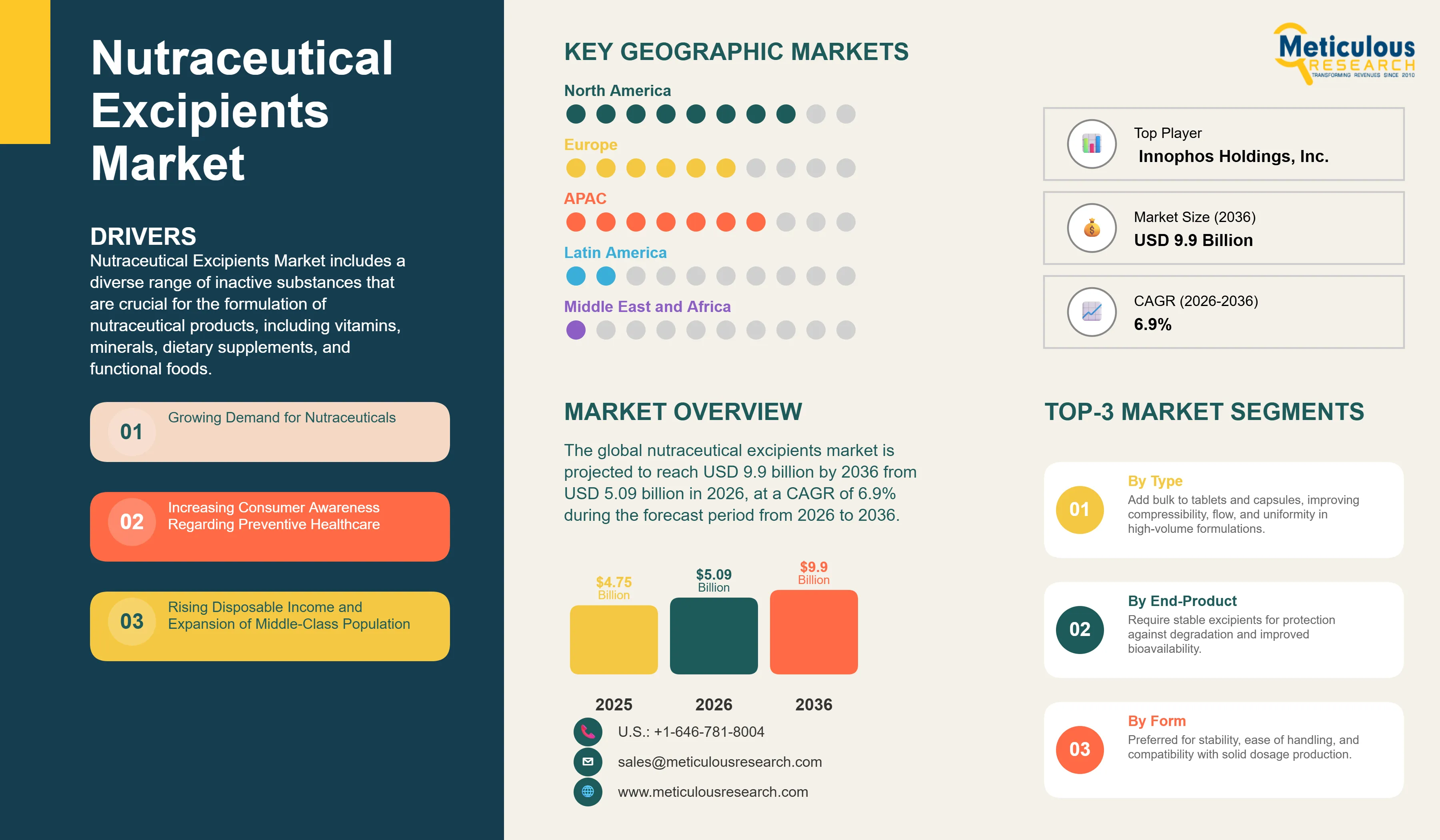
The global nutraceutical excipients market was valued at USD 4.75 billion in 2025. This market is projected to reach USD 9.9 billion by 2036 from USD 5.09 billion in 2026, at a CAGR of 6.9% during the forecast period from 2026 to 2036.
This nutraceutical excipients market includes a diverse range of inactive substances that are crucial for the formulation of nutraceutical products, including vitamins, minerals, dietary supplements, and functional foods. The primary function of these excipients is to act as carriers for active ingredients, ensure product stability, improve manufacturing efficiency, and enhance patient compliance through better taste and appearance. The robust growth of this market is primarily driven by the expansion of the overall nutraceutical industry, which is being propelled by a global shift towards preventive healthcare, increasing consumer awareness about the benefits of dietary supplements, a growing aging population, and the rising incidence of lifestyle-associated diseases. The continuous innovation in excipient technology, particularly the development of multifunctional and clean-label excipients, is further expected to create significant growth avenues for market players.
 Click here to: Get Free Sample Pages of this Report
The nutraceutical excipients are no longer just inert fillers; they are functional components that can significantly impact the bioavailability, stability, and sensory profile of the final nutraceutical product. The market landscape is composed of large, multinational corporations such as Kerry Group plc, DuPont, and Cargill, Incorporated, which provide a vast portfolio of excipients, alongside smaller, specialized firms that are carving out niches by focusing on innovative areas like clean-label, organic, and non-GMO excipients. This competitive environment fosters continuous innovation and pushes manufacturers to develop solutions that meet the increasingly complex demands of the nutraceutical industry.
A pivotal factor shaping the market is the clean-label movement, a consumer-driven trend demanding transparency and simplicity in product ingredients. This has catalyzed a significant shift away from synthetic excipients towards natural, plant-based alternatives. Ingredients derived from sources such as starch, cellulose, seaweed, and natural gums are experiencing a surge in demand. This trend is further supported by the growing popularity of personalized nutrition, which requires versatile excipients suitable for a wide array of customized formulations, from tablets and capsules to functional beverages and powders. Advanced manufacturing technologies, such as spray drying and microencapsulation, are also playing a crucial role, enabling the creation of excipients with superior properties, such as enhanced flowability, controlled release, and effective taste-masking, thereby addressing key challenges in nutraceutical formulation.
Development of Multifunctional and Co-Processed Excipients
A prominent trend in the market is the development of multifunctional and co-processed excipients. These advanced ingredients are engineered to provide multiple benefits in a single component, thereby simplifying the formulation process, reducing manufacturing costs, and improving product quality. For instance, a co-processed excipient can function as a binder, filler, and disintegrant, eliminating the need for multiple individual ingredients. Leading companies like JRS PHARMA and Roquette Freres SA are pioneering this trend with products like JRS PHARMA's Prosolv EASYtab SP (2025 variant offering 20% faster disintegration and enhanced flow for direct compression tablets, cutting processing steps by half) and Roquette's PEARLIT SE (co-processed starch-lactose blend improving tablet hardness by 12-18% in high-dose nutraceutical formats). This not only streamlines the supply chain but also enhances the consistency and performance of the final dosage form.
Growing Demand for Natural and Clean-Label Excipients
The demand for natural, organic, and clean-label nutraceuticals is a powerful consumer-driven trend, driving the excipients market. This trend is compelling manufacturers to reformulate their products, replacing synthetic excipients with natural alternatives. Excipients derived from plant-based sources like corn, tapioca, potato, and seaweed are becoming increasingly popular. For example, Ingredion Incorporated offers clean-label starches like NOVATION® Indulge 5700 (tapioca-based texturizer with full non-GMO certification, enabling 25% smoother textures in probiotic gummies) and DuPont's STAR-DRI tapioca maltodextrin (providing superior solubility for omega-3 softgels without synthetic additives). This shift is not merely about aligning with consumer preferences; it is also about enhancing the safety and perceived health benefits of nutraceutical products, as natural excipients are generally considered to be safer and have fewer potential side effects.
|
Parameters |
Details |
|
Market Size by 2036 |
USD 9.9 Billion |
|
Market Size in 2026 |
USD 5.09 Billion |
|
Revenue Growth Rate (2026-2036) |
CAGR of 6.9% |
|
Dominating Excipient Type |
Fillers & Diluents |
|
Largest End-Product Segment |
Proteins & Amino Acids |
|
Dominant Form |
Dry Form |
|
Leading Geographic Region |
North America |
|
Fastest Growing Region |
Asia-Pacific |
|
Base Year |
2025 |
|
Forecast Period |
2026 to 2036 |
Drivers: Growing Demand for Nutraceuticals and Functional Foods
The primary engine of growth for the nutraceutical excipients market is the significant expansion of the global nutraceutical industry, with global nutraceutical products market exceeding USD 600 billion by 2030. This growth is fueled by a paradigm shift in consumer behavior towards preventive healthcare and wellness, evidenced by over 70% of urban consumers in key markets now prioritizing daily supplementation for immunity and cognitive support. An increasingly informed consumer base, coupled with rising disposable incomes, such as average household wellness spending hitting USD 1,200 yearly in mid-tier cities, and a greater understanding of the connection between diet and health, is driving the demand for dietary supplements like vitamin D and probiotic blends, functional foods fortified with omega-3s, and other nutraceutical products.
As the demand for these end products escalates, so does the corresponding need for high-quality, functional excipients like microcrystalline cellulose and maltodextrins to formulate them effectively, with manufacturers reporting 25-30% higher excipient volumes tied to these trends. The growing middle class in developing economies, particularly in China and India, represents a massive, largely untapped market that is expected to be a significant contributor to this growth.
Opportunity: Expansion in Emerging Markets and Development of Novel Excipients
Emerging markets, particularly in the Asia-Pacific region, are expected to offer significant growth opportunities for the nutraceutical excipients market, driven by expanding supplement manufacturing capacity and increasing digital retail penetration. Online platforms now account for a substantial share of supplement sales across Southeast Asia, enhancing accessibility to nutraceutical products.
In addition, growing demand for novel excipients with enhanced functionalities is creating opportunities for manufacturers to invest in R&D. Technologies such as cyclodextrin-based complexes (e.g., Roquette’s KLEPTOSE®) and multifunctional carbohydrate excipients (e.g., JRS Pharma’s EMDEX®) are increasingly used to improve bioavailability, enable taste masking, and support controlled-release delivery. The development of application-specific excipients for segments such as sports nutrition, infant nutrition, and personalized supplements is expected to further drive the growth of nutraceutical excipients market.
Why Do Proteins & Amino Acids Dominate the Market?
The proteins and amino acids segment accounts for the largest share of the nutraceutical excipients market in 2026, primarily driven by the growth of the global sports nutrition and wellness supplements industry, where protein formulations captured over 45% of new product launches in 2025 across powders, bars, and RTD shakes.
The widespread adoption of protein-based products, including powders like whey isolates and vegan blends, nutrition bars with 20g+ protein profiles, and ready-to-drink formulations for applications such as muscle recovery (e.g., post-workout BCAAs), weight management (high-protein meal replacements), and general health support, has increased the demand for excipients such as binders like microcrystalline cellulose for compressibility, fillers such as maltodextrins for bulk density, flavoring agents including natural vanillin extracts, and sweeteners like stevia-rebaudioside blends to balance bitterness.
Which Type Segment Holds the Largest Share in the Nutraceutical Excipients Market?
Based on type, the fillers & diluents account for the largest share of the overall nutraceutical excipients market in 2026, owing to their widespread use in tablet and capsule formulations. These excipients play a critical role in improving the bulk properties and manufacturability of nutraceutical products, particularly in high-volume supplement applications such as vitamins (e.g., mannitol-dicalcium phosphate blends for chewables), minerals (magnesium stearate-lubricated calcium blends), and protein-based formulations where lactose monohydrate fillers enable 30% higher tablet weights without capping.
However, binders and disintegrants are expected to witness steady growth due to their increasing application in solid dosage forms such as chewable tablets and effervescent supplements. These excipients are essential for maintaining structural integrity via hydroxypropyl cellulose films while enabling effective disintegration and release of active ingredients during consumption, as seen in Roquette's Lycoperl DIS for 20% faster probiotic tablet breakdown in gastric simulation tests.
The key players profiled in the global nutraceutical excipients market report include Kerry Group plc, Innophos Holdings, Inc., JRS PHARMA, Sensient Colors LLC, Hilmar Ingredients, Ingredion Incorporated, Cargill, Incorporated, Roquette Frères S.A., DuPont de Nemours, Inc., Meggle Group Wasserburg, and ABF Ingredients, among others.
The global nutraceutical excipients market is valued at approximately USD 5.09 billion in 2026 and is projected to reach around USD 9.90 billion by 2036.
The market is anticipated to grow at a CAGR of 6.9% during the forecast period from 2026 to 2036.
Key players in the market include Kerry Group plc, Innophos Holdings, Inc., JRS PHARMA, Cargill, Incorporated, Roquette Frères S.A., Ingredion Incorporated, and DuPont de Nemours, Inc., among others.
Market growth is primarily driven by the rising demand for nutraceutical products, increasing consumer awareness regarding preventive healthcare, and the development of multifunctional excipients for advanced supplement formulations.
North America is expected to maintain a significant market share, while the Asia-Pacific region is projected to witness the fastest growth during the forecast period.
1. Introduction
1.1. Market Definition
1.2. Market Ecosystem
1.3. Currency and Limitations
1.3.1. Currency
1.3.2. Limitations
1.4. Key Stakeholders
2. Research Methodology
2.1. Research Process
2.1.1. Secondary Research
2.1.2. Primary Research
2.2. Data Collection & Validation
2.3. Market Assessment
2.3.1. Market Size Estimation
2.3.2. Bottom-Up Approach
2.3.3. Top-Down Approach
2.3.4. Growth Forecast
2.4. Assumptions for the Study
2.5. Limitations for the Study
3. Executive Summary
4. Market Insights
4.1. Market Overview
4.2. Market Dynamics
4.2.1. Drivers
4.2.1.1. Growing Demand for Nutraceuticals
4.2.1.2. Increasing Consumer Awareness Regarding Preventive Healthcare
4.2.1.3. Rising Disposable Income and Expansion of Middle-Class Population
4.2.2. Restraints
4.2.2.1. Limited R&D Investments in Nutraceutical Excipient Development
4.2.3. Opportunities
4.2.3.1. Development of Multifunctional and Co-Processed Excipients
4.2.4. Challenges
4.2.4.1. Stability Issues Associated with Nutraceutical Active Ingredients
4.3. Value Chain Analysis
4.4. Regulatory Landscape
4.5. Porter's Five Forces Analysis
5. Nutraceutical Excipients Market, by Form
5.1. Introduction
5.2. Dry
5.3. Wet
6. Nutraceutical Excipients Market, by Type
6.1. Introduction
6.2. Fillers & Diluents
6.3. Coating Agents
6.4. Binders
6.5. Disintegrants
6.6. Colorants & Sweeteners
6.7. Flavouring Agents
6.8. Lubricants
6.9. Other Excipients
7. Nutraceutical Excipients Market, by End Product
7.1. Introduction
7.2. Proteins & Amino Acids
7.3. Vitamins
7.4. Minerals
7.5. Omega-3 Fatty Acids
7.6. Prebiotics & Probiotics
7.7. Other End Products
8. Nutraceutical Excipients Market, by Geography
8.1. Introduction
8.2. North America
8.2.1. U.S.
8.2.2. Canada
8.3. Europe
8.3.1. Germany
8.3.2. France
8.3.3. U.K.
8.3.4. Italy
8.3.5. Spain
8.3.6. Rest of Europe
8.4. Asia-Pacific
8.4.1. China
8.4.2. Japan
8.4.3. India
8.4.4. South Korea
8.4.5. Australia
8.4.6. Rest of Asia-Pacific
8.5. Latin America
8.5.1. Brazil
8.5.2. Mexico
8.5.3. Argentina
8.5.4. Rest of Latin America
8.6. Middle East & Africa
8.6.1. Saudi Arabia
8.6.2. UAE
8.6.3. South Africa
8.6.4. Rest of Middle East & Africa
9. Competitive Landscape
9.1. Introduction
9.2. Key Growth Strategies
9.3. Competitive Benchmarking
9.4. Market Share Analysis
9.5. Vendor Positioning Matrix
10. Company Profiles
10.1. Kerry Group Plc
10.2. Innophos Holdings, Inc.
10.3. JRS Pharma
10.4. Sensient Colors LLC
10.5. Hilmar Ingredients
10.6. Ingredion Incorporated
10.7. Cargill, Incorporated
10.8. Roquette Frères S.A.
10.9. DuPont de Nemours, Inc.
10.10. Meggle Group Wasserburg
10.11. ABF Ingredients
10.12. Other Key Players
11. Appendix
11.1. Questionnaire
11.2. Available Customization
























Published Date: Feb-2026
Published Date: Jun-2023
Published Date: Jun-2023
Published Date: Jun-2024
Published Date: May-2024
Subscribe to get the latest industry updates