Resources
About Us
Non-Alcoholic Wine Market Size & Forecast
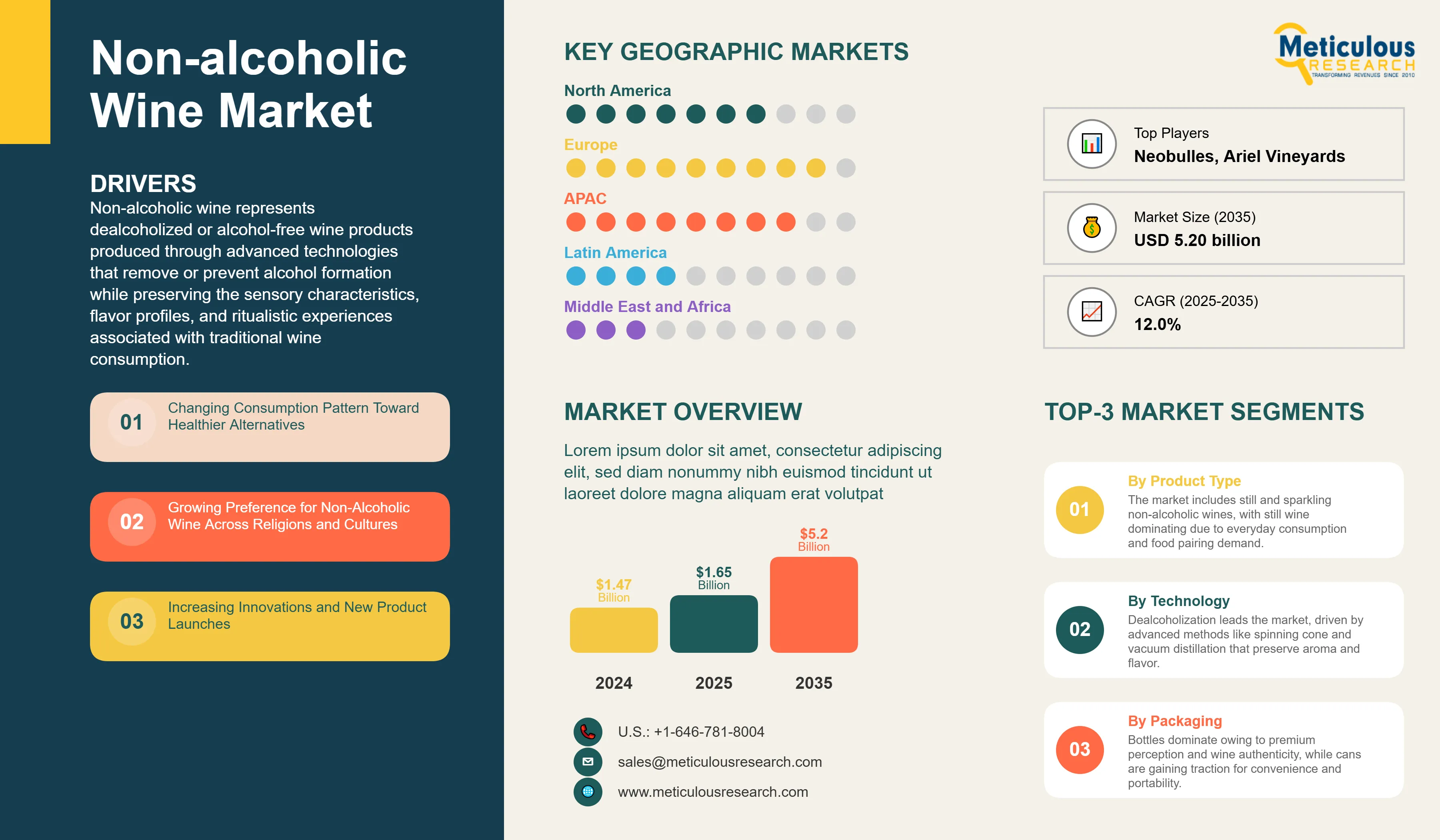
The global non-alcoholic wine market is projected to reach USD 5.20 billion by 2035 from an estimated USD 1.65 billion in 2025, at a CAGR of 12.0% during the forecast period from 2025 to 2035.
Non-alcoholic wine represents dealcoholized or alcohol-free wine products produced through advanced technologies that remove or prevent alcohol formation while preserving the sensory characteristics, flavor profiles, and ritualistic experiences associated with traditional wine consumption. These products, typically containing less than 0.5% alcohol by volume (ABV) or 0.0% ABV depending on regional regulations and production methods, serve consumers seeking wine-like experiences without alcohol for health, religious, cultural, lifestyle, or social reasons.
Key drivers of this market include changing consumption patterns toward healthier alternatives driven by wellness consciousness and moderation trends, growing preference for non-alcoholic wine across religions and cultures that restrict alcohol consumption, increasing innovations and new product launches utilizing advanced dealcoholization technologies, and rising acceptance in social drinking gatherings as hospitality venues normalize zero-proof beverage programs. The "sober curious" movement has gained mainstream acceptance, particularly among Generation Z and Millennials who account for a substantial share of incremental buyers, while scientific research validates benefits such as improved physical health, better sleep quality, and enhanced mental clarity from reduced alcohol consumption.
Non-alcoholic wine production employs sophisticated dealcoholization technologies including vacuum distillation, spinning cone column systems, reverse osmosis, and membrane filtration, alongside restricted fermentation techniques that limit alcohol formation during winemaking. At the 2023 World Alcohol-Free Awards, spinning cone technology accounted for eight of nine gold medals, underscoring advancement in premium production quality. The category encompasses both still wines (red, white, rosé) and sparkling wines across multiple varietals including Cabernet Sauvignon, Chardonnay, Pinot Noir, Sauvignon Blanc, and prosecco-style offerings, with products increasingly positioned as premium lifestyle beverages rather than mere substitutes for traditional wine.
With advances in production techniques including spinning cone technology and aroma-capture systems that preserve flavor authenticity, increasing demand for premium non-alcoholic wines positioned at the intersection of health, indulgence, and sophistication, expansion of online retail channels, and growing focus on low-calorie and no-sugar options, the non-alcoholic wine market is expected to expand significantly, driven by wellness trends, social acceptance, and technological innovation in an increasingly health-conscious global beverage landscape.
Click here to: Get Free Sample Pages of this Report
Changing Consumption Pattern Toward Healthier Alternatives
A key driver of growth in the non-alcoholic wine market is the structural shift in consumer behavior toward healthier lifestyle choices and moderation in alcohol consumption. Research indicates that nearly half of consumers actively seek zero-alcohol alternatives, motivated by wellness considerations, while a significant majority of millennials aim to reduce their alcohol intake. This behavioral transformation reflects heightened awareness of health risks associated with alcohol, including liver disease, mental health disorders, cardiovascular complications, and addiction concerns.
The "sober curious" movement has gained mainstream acceptance, particularly among Generation Z and Millennials, who account for a substantial share of incremental buyers in the non-alcoholic wine category. Scientific research further validates this trend, highlighting benefits such as improved physical health, better sleep quality, and enhanced mental clarity from reduced alcohol consumption. Cultural initiatives like Dry January and Sober October have evolved from short-term challenges into year-round mindful drinking practices, with a growing proportion of consumers expressing interest in zero-alcohol beverages.
Additionally, the preference for low-calorie options provides further momentum for non-alcoholic wine adoption. Dealcoholized wines typically contain fewer calories than traditional wines due to the absence of alcohol, which contributes approximately seven calories per gram. Health-conscious consumers, particularly those monitoring sugar intake or following calorie-controlled diets, increasingly view non-alcoholic wine as a positive lifestyle choice rather than simply an abstinence alternative. This positioning reinforces its appeal as part of a balanced, health-oriented lifestyle, driving sustained market growth across demographics and consumption occasions.
Growing Preference for Non-Alcoholic Wine Across Religions and Cultures
Non-alcoholic wine is unlocking significant market opportunities among populations where religious or cultural norms restrict or prohibit alcohol consumption. Countries with large Muslim populations such as Saudi Arabia, the United Arab Emirates, Indonesia, Malaysia, and other Middle Eastern and Southeast Asian nations represent high-potential markets where alcohol-free wine enables consumers to enjoy the sophistication of wine culture without violating religious principles. Demand for compliant beverage alternatives continues to rise in these regions as consumers seek premium experiences aligned with their values.
Beyond religious considerations, cultural factors also drive adoption among individuals who abstain from alcohol for personal or health reasons but still wish to participate in social drinking occasions. This includes pregnant women, designated drivers, individuals with medical conditions that contraindicate alcohol, and those in recovery from alcohol dependency. Brands are increasingly recognizing these segments; for example, French Bloom positioned its non-alcoholic sparkling wine launch in March 2024 as an elegant option for pregnant women seeking celebratory beverages during life milestones.
Globalization of wine culture further amplifies demand for non-alcoholic alternatives, particularly in Asia-Pacific markets where Western lifestyle trends are gaining traction among urban populations. Countries such as Japan, China, India, and South Korea are witnessing growing interest in wine experiences, with non-alcoholic options serving as accessible entry points for consumers unfamiliar with traditional wine or seeking moderation. As product quality approaches parity with alcoholic counterparts, cultural acceptance of non-alcoholic wine continues to expand, legitimizing the category across diverse social and cultural contexts.
Increasing Innovations and New Product Launches
Innovation continues to be a defining growth driver for the non-alcoholic wine market, with momentum accelerating into 2025 and beyond. Manufacturers are responding to consumer demand for authenticity, premium quality, and variety by introducing advanced dealcoholization technologies, heritage-style aging, and functional enhancements. More than 60 SKUs were launched globally in 2023-2024, and this trend has intensified with high-profile releases and trade events in 2025, signaling a new era of category sophistication.
Recent examples underscore this evolution. In May 2025, St. Buena Vida debuted its dry sparkling Chardonnay, crafted from organic Spanish vineyards and dealcoholized in Germany using Solos aroma-capture technology, which preserves complexity and depth of flavor. At Wine Paris 2025, the non-alcoholic wine segment expanded its footprint by 30%, with 75% of traditional producers showcasing alcohol-free variants. Notable launches included Zerinomo's 20-year-aged dealcoholized red wine, targeting connoisseurs seeking mature flavors without alcohol, and Villa Noria Levin's lacto-fermented grape must Pet Nat-style beverage, which leverages upcycled grape pressings for added aromatic sophistication.
Looking ahead, Wine Paris 2026 will introduce "Be No," the first dedicated global platform for alcohol-free wines, spirits, and RTDs—underscoring the category's rapid mainstreaming. Innovation is also diversifying beyond traditional grape-based wines to include exotic fruit blends, botanical infusions, and functional ingredients. Producers are experimenting with herbs and spices such as rosemary, cinnamon, and vanilla, while premium segments increasingly incorporate adaptogens and antioxidants to deliver added health benefits. These advancements position non-alcoholic wine as more than an abstinence alternative, evolving into a premium lifestyle choice aligned with wellness, sustainability, and cultural inclusivity.
Rising Acceptance in Social Drinking Gatherings
Social acceptance of non-alcoholic wine has accelerated, transforming its perception from a niche abstinence product into a mainstream beverage choice. Recent consumer research indicates that more than 22% of drinkers now alternate between full-strength and alcohol-free wine options, signaling a shift toward moderation rather than binary choices between drinking and abstaining. This behavioral evolution expands the total addressable market beyond committed abstainers, creating new consumption occasions centered on flexibility and wellness.
Hospitality adoption has further legitimized non-alcoholic wine in premium on-premise settings. By late 2025, nearly one-third of luxury hotels in Europe and the Middle East featured curated zero-alcohol wine lists, while Michelin-starred restaurants began offering dedicated non-alcoholic pairings alongside traditional wine programs. Weddings and celebratory events are also embracing inclusivity: industry surveys show that over 20% of weddings in France, the UK, and the U.S. now include non-alcoholic sparkling wine options for guests who prefer moderation or abstinence.
Corporate and professional environments are reinforcing this trend. Business dinners, client entertainment, and high-profile networking events increasingly feature premium non-alcoholic wine selections, driven by organizational awareness of alcohol-related risks and a commitment to inclusivity. This institutional acceptance reduces the stigma historically associated with non-alcoholic beverages, positioning them as sophisticated alternatives suitable for diverse social and cultural contexts. As these practices become normalized, non-alcoholic wine is emerging as a lifestyle choice integrated seamlessly into social rituals worldwide.
Advances in Production Techniques
Technological innovation in non-alcoholic wine production continues to present significant opportunities for quality enhancement and market expansion. In 2025, industry efforts have centered on preserving flavor and aroma through advanced dealcoholization methods such as vacuum distillation, membrane-based processes (reverse osmosis, nanofiltration, pervaporation), and spinning cone column technology—all of which operate at lower temperatures or under reduced pressure to better retain volatile compounds.
Spinning cone technology, in particular, is gaining prominence in premium segments. Brands like St. Buena Vida have adopted related aroma-preserving innovation: their May 2025 dry sparkling Chardonnay uses Solos Aromatic Recovery System, capturing authentic aromatic profiles through advanced aroma recovery processes. Meanwhile, major technology providers are scaling infrastructure and introducing next-generation systems. Solos opened a 2,400 m² facility in Valencia in mid-2025, combining vacuum distillation with aroma recovery tools capable of processing 16 million liters annually.
BevZero, in partnership with Tomsa Destil, launched the ClearAlc vacuum distillation system in early 2025—a single-pass, highly energy-efficient unit capable of reducing alcohol to 0.05% ABV while preserving aromatic integrity. This system received the 2025 WINnovation Award at WIN Expo. Emerging membrane-pervaporation techniques are also gaining traction. These allow aroma-selective extraction without heating, making them ideal for preserving delicate fruit and botanical notes and are already being applied at commercial scale. Castel Frères is piloting cold-dealcoholization retrofits expected to capture up to 90% of original aroma compounds—a promising advance in sensory preservation. Together, these innovations are narrowing the sensory gap between non-alcoholic and traditional wines, enabling producers to offer premium-quality, flavor-authentic products that resonate with discerning consumers.
Increasing Demand for Premium Non-Alcoholic Wines
Premiumization is emerging as one of the strongest growth opportunities in the non-alcoholic wine market, driven by consumers seeking sophisticated alternatives that replicate the complexity and elegance of traditional wines. Recent industry surveys indicate that over 65% of manufacturers and distributors are prioritizing premium offerings, signaling a clear shift toward quality-focused innovation. This trend is reinforced by strong performance in established premium segments—Giesen 0%, for example, continues to dominate the U.S. premium still wine category, demonstrating consumer willingness to pay for authenticity and craftsmanship.
Luxury positioning is gaining traction globally. French Bloom, which targets high-end celebratory occasions, expanded its portfolio in 2025 with limited-edition sparkling cuvées priced above GBP 100 per bottle, following Moët Hennessy's strategic investment in late 2024. Similarly, Bordeaux's Château Edmus introduced Zero Edmus, a 0% ABV still wine crafted from Merlot and Cabernet Franc, signaling fine wine estates' entry into the alcohol-free category. Pernod Ricard's Pierre Zéro brand continues to strengthen its luxury positioning through partnerships with premium hospitality venues across Europe and Asia.
Premium non-alcoholic wines are also finding strong demand in wellness tourism and luxury hospitality channels. Global wellness travel surpassed 350 million trips in 2025, with resorts in Bali, Maldives, and Phuket reporting increased uptake of curated non-alcoholic wine menus. High-end hotels and Michelin-starred restaurants are incorporating premium alcohol-free pairings into tasting experiences, creating new distribution opportunities for brands positioned at the intersection of health, indulgence, and sophistication.
By Product Type: The Still Wine Segment Dominated the Non-Alcoholic Wine Market in 2025
Based on product type, the non-alcoholic wine market is segmented into still wine and sparkling wine. In 2025, the still non-alcoholic wine segment accounted for the largest share of 67.1% of the non-alcoholic wine market. The large market share is attributed to rising demand for alcohol-free alternatives for regular consumption, increasing awareness of moderation trends, expanding availability across retail and foodservice channels, and continuous advancements in dealcoholization technologies that have improved product quality, particularly in terms of aroma preservation, taste balance, and mouthfeel.
Red non-alcoholic wines account for the largest share of the still wine segment, driven by consumer preference for richer flavor profiles and compatibility with a wide range of food applications, with commonly available varietals including Cabernet Sauvignon, Merlot, and Pinot Noir. The still wine segment is increasingly positioned as suitable for everyday dining and food pairing occasions.
However, the sparkling wine segment is expected to register significant growth at a CAGR of 13.5% during the forecast period, driven by strong association with celebratory and social occasions including weddings, corporate events, holidays, and informal gatherings where effervescence and toasting rituals remain important. Sparkling non-alcoholic wines demonstrate strong performance in premium positioning, with products increasingly targeted at consumers seeking indulgent, alcohol-free alternatives for special occasions.
By Technology: The Dealcoholization Segment Dominated the Non-Alcoholic Wine Market in 2025
Based on technology, the non-alcoholic wine market is segmented into dealcoholization and restricted fermentation. In 2025, the dealcoholization segment accounted for the largest share of 79.0% of the non-alcoholic wine market. Dealcoholization represents the dominant production methodology, enabling producers to create authentic wine experiences by starting with traditionally fermented wines and subsequently removing alcohol content while preserving the complex chemical matrix developed during conventional winemaking, including flavor compounds, tannins, and aromatic elements that define varietal character.
Distillation-based methods, particularly vacuum distillation including spinning cone column (SCC) technology, represent the benchmark for premium non-alcoholic wine production due to superior aroma retention capabilities. Leading suppliers such as BevZero operate production facilities in major wine-producing regions, while significant investments by producers like Giesen Group (over USD 8 million since 2020) and Torres (EUR 6 million) demonstrate growing confidence in distillation-based technologies.
Moreover, the dealcoholization segment is also expected to register the highest CAGR of 12.6% during the forecast period, driven by continuous technological improvements, increasing investments in advanced equipment, and growing consumer demand for authentic wine-like experiences.
By Packaging: The Bottles Segment Dominated the Non-Alcoholic Wine Market in 2025
Based on packaging, the non-alcoholic wine market is segmented into bottles and cans. In 2025, the bottle segment accounted for the largest share of 85.1% of the non-alcoholic wine market. The large market share is attributed to traditional consumer associations between bottled presentation and wine authenticity, superior preservation performance of glass as an inert material that prevents chemical interaction and ensures flavor integrity, strong premium perception enabling luxury positioning and higher price points, and compatibility with established wine service rituals in both retail and hospitality settings.
Glass bottles convey quality perceptions aligned with conventional wine categories, with premium producers like French Bloom leveraging bottled formats to support ultra-premium positioning at prices exceeding GBP 100 per bottle.
However, the can segment is projected to grow at the fastest CAGR of 15.8% during the forecast period, driven by convenience-oriented consumers, outdoor activity enthusiasts, and younger demographics who prioritize portability, single-serve portions, and sustainable packaging attributes. Recent product launches illustrate accelerating adoption: TÖST Beverages expanded its portfolio in early 2025 by introducing 250ml aluminum cans specifically targeting portability-driven occasions, while Eisberg launched its "Be Free" canned range featuring sparkling white and rosé variants.
By Distribution Channel: The Off-Trade Segment Dominated the Non-Alcoholic Wine Market in 2025
Based on distribution channel, the non-alcoholic wine market is segmented into off-trade and on-trade channels. In 2025, the off-trade segment accounted for the largest share of 82.8% of the non-alcoholic wine market. The large market share is attributed to strategic emphasis on product visibility in retail environments, greater accessibility across diverse retail formats, improved shopping experiences in modern retail that enable product evaluation, wider product selection facilitating consumer experimentation, and cost advantages compared to on-premise pricing.
Within off-trade, supermarkets and hypermarkets represent the largest sub-channel, with major retailers like Target establishing national partnerships and Walmart reporting consistent grocery growth including expanded alcohol-free assortments. E-commerce has emerged as a strategically significant channel, with more than half of millennial buyers now purchasing non-alcoholic wine online, benefiting from convenience, home delivery, subscription programs, and access to specialty brands unavailable through local retail.
Moreover, the off-trade segment is also expected to register the highest CAGR of 12.5% during the forecast period, driven by expanding retail distribution, growing e-commerce penetration, and increasing consumer preference for at-home consumption occasions.
Europe Dominated the Non-Alcoholic Wine Market in 2025
Based on geography, the global non-alcoholic wine market is segmented into North America, Europe, Asia-Pacific, Latin America, and the Middle East & Africa. In 2025, Europe accounted for the largest share of approximately 45% of the global non-alcoholic wine market. Europe's dominance is attributed to the continent's deep-rooted wine culture and strong presence of major wine producers who have invested significantly in dealcoholization technology and non-alcoholic product development, well-developed retail and e-commerce infrastructure supporting broad consumer access, early regulatory adaptation through EU Regulation 2021/2117 that established standardized terminology for dealcoholized wine products, and strong consumer acceptance in Western and Northern Europe where health consciousness and moderation trends are well-established.
Leading wine-producing countries including Germany, France, the United Kingdom, Spain, and Italy are at the forefront of regional development, with Germany recognized for its long tradition of dealcoholized beverage offerings and France demonstrating rapid innovation with nearly 40-50 new SKUs entering the market between 2023 and 2025.
North America follows with approximately 28% market share in 2025, driven primarily by the United States market where health consciousness and moderation trends have achieved mainstream acceptance. The US represents the dominant market within North America, with an estimated 36 million bottles sold annually. Consumer engagement with Dry January, Sober October, and year-round "sober curious" lifestyles has transitioned from niche behaviors to mainstream consumption patterns.
However, Asia-Pacific is expected to register the highest CAGR of approximately 13.7% during the forecast period, outpacing global averages. The rapid growth is driven by rising disposable incomes, increasing health consciousness among urbanized populations, growing adoption of Western lifestyle products including wine culture, and expanding e-commerce infrastructure facilitating consumer access.
Key Companies
Major companies in the global non-alcoholic wine market have implemented various strategies to expand their product offerings and augment their market shares. The key strategies followed by most companies include product launches and enhancements leveraging spinning cone technology and aroma-capture systems, strategic partnerships with specialty retailers and hospitality venues, mergers and acquisitions including luxury conglomerate investments, significant capital investments in dealcoholization infrastructure, and premiumization through luxury positioning and terroir-driven branding.
Some of the prominent players operating in the global non-alcoholic wine market include Schloss Wachenheim AG, Sutter Home Fre, Giesen Group Ltd, Domaines Pierre Chavin, Ariel Vineyards, Torres Natureo, Carl Jung Winery, Weingut Leitz KG, Thomson & Scott Ltd, Neobulles SA, Australian Vintage Limited, Hill Incorporated, Le Petit Béret SAS, and Tost Beverages, Inc.
Non-Alcoholic Wine Market Industry Overview: Latest Developments from Key Industry Players
|
Particulars |
Details |
|
Number of Pages |
212 |
|
Format |
|
|
Forecast Period |
2025–2035 |
|
Base Year |
2024 |
|
CAGR (Value) |
12.0% |
|
Market Size (Value) in 2025 |
USD 1.65 Billion |
|
Market Size (Value) in 2035 |
USD 5.20 Billion |
|
Segments Covered |
By Product Type
By Distribution Channel
|
|
Countries Covered |
North America (U.S., Canada), Europe (Germany, France, U.K., Italy, Spain, and Rest of Europe), Asia-Pacific (China, India, Japan, Australia, South Korea, and Rest of Asia-Pacific), Latin America (Brazil, Mexico, Argentina, and Rest of Latin America), and the Middle East & Africa (Saudi Arabia, UAE, and Rest of Middle East & Africa) |
|
Key Companies |
Schloss Wachenheim AG, Sutter Home Fre, Giesen Group Ltd, Domaines Pierre Chavin, Ariel Vineyards, Torres Natureo, Carl Jung Winery, Weingut Leitz KG, Thomson & Scott Ltd, Neobulles SA, Australian Vintage Limited, Hill Incorporated, Le Petit Béret SAS, and Tost Beverages, Inc. |
The global non-alcoholic wine market size is projected to reach USD 1.65 billion in 2025.
The market is projected to grow from USD 1.65 billion in 2025 to USD 5.10 billion by 2035, at a CAGR of 12.0%.
The non-alcoholic wine market analysis indicates substantial growth, with projections indicating the market will reach USD 5.10 billion by 2035, at a compound annual growth rate (CAGR) of 12.0% from 2025 to 2035.
The key companies operating in this market include Schloss Wachenheim AG, Sutter Home Fre, Giesen Group Ltd, Domaines Pierre Chavin, Ariel Vineyards, Torres Natureo, Carl Jung Winery, Weingut Leitz KG, Thomson & Scott Ltd, Neobulles SA, Australian Vintage Limited, Hill Incorporated, Le Petit Béret SAS, and Tost Beverages, Inc.
Growing focus on low-calorie and no-sugar options, expansion of online retail channels, and premiumization through luxury positioning are prominent trends in the non-alcoholic wine market.
By product type, the still wine segment is forecasted to hold the largest market share during 2025-2035; by technology, the dealcoholization segment is expected to dominate; by packaging, the bottles segment is expected to hold the largest share; by distribution channel, the off-trade segment is expected to dominate; and by geography, Europe is expected to hold the largest share of the market during 2025-2035.
By region, Europe held the largest share of the non-alcoholic wine market in 2025. The large share is attributed to the continent's deep-rooted wine culture, strong presence of major wine producers, and early regulatory adaptation. However, Asia-Pacific is expected to register the highest growth rate during the forecast period, driven by rising disposable incomes and increasing health consciousness.
Key drivers include changing consumption patterns toward healthier alternatives driven by wellness consciousness, growing preference for non-alcoholic wine across religions and cultures, increasing innovations and new product launches utilizing advanced dealcoholization technologies, and rising acceptance in social drinking gatherings. These factors are collectively driving the adoption of non-alcoholic wine across consumer segments and consumption occasions.
1. Introduction
1.1. Market Definition
1.2. Currency & Limitations
2. Research Methodology
2.1. Research Approach
2.2. Data Collection & Validation
2.2.1. Secondary Research
2.2.2. Primary Research
2.3. Market Assessment
2.3.1. Market Size Estimation
2.3.2. Bottom-Up Approach
2.3.3. Top-Down Approach
2.3.4. Growth Forecast
2.4. Assumptions for the Study
3. Executive Summary
4. Market Insights
4.1. Overview
4.2. Drivers
4.2.1. Changing Consumption Pattern Toward Healthier Alternatives
4.2.2. Growing Preference for Non-Alcoholic Wine Across Religions and Cultures
4.2.3. Increasing Innovations and New Product Launches
4.2.4. Rising Acceptance in Social Drinking Gatherings
4.3. Restraints
4.3.1. Flavor and Aroma Loss during Dealcoholization
4.3.2. Higher Cost than Alcoholic Wine
4.4. Opportunities
4.4.1. Advances in Production Techniques
4.4.2. Increasing Demand for Premium Non-Alcoholic Wines
4.5. Challenges
4.5.1. Replicating the Complex Flavors and Aromas of Alcoholic Wines
4.5.2. Compliance With Regulations
4.6. Trends
4.6.1. Growing Focus on Low-Calorie and No-Sugar Options
4.6.2. Expansion of Online Retail Channels
4.7. Porter's Five Forces Analysis
4.7.1. Bargaining Power of Suppliers
4.7.2. Bargaining Power of Buyers
4.7.3. Threat of Substitutes
4.7.4. Threat of New Entrants
4.7.5. Degree of Competition
4.8. Value Chain Analysis
4.9. Pricing Analysis, By Product
4.9.1. Still Non-Alcoholic Wine
4.9.2. Sparkling Non-Alcoholic Wine
4.10. Regulatory Analysis
4.10.1. Overview
4.10.2. North America
4.10.3. Europe
4.10.4. Asia-Pacific
4.10.5. Latin America
4.10.6. Middle East & Africa
5. Global Non-Alcoholic Wine Market, By Product
5.1. Overview
5.2. Still Wine
5.3. Sparkling Wine
6. Global Non-Alcoholic Wine Market, By Technology
6.1. Overview
6.2. Dealcoholization
6.2.1. Distillation
6.2.2. Membrane Filtration
6.2.3. Other Dealcoholization Techniques
6.3. Restricted Fermentation
7. Global Non-Alcoholic Wine Market, By Packaging
7.1. Overview
7.2. Bottle
7.3. Can
8. Global Non-Alcoholic Wine Market, By Distribution Channel
8.1. Overview
8.2. Off-Trade (Off-Premise Trade)
8.2.1. Supermarkets and Hypermarkets
8.2.2. Liquor Stores
8.2.3. Convenience Stores
8.2.4. E-Commerce
8.2.5. Others
8.3. On-Trade (On-Premise Trade)
8.3.1. Hotels, Restaurants, and Bars
8.3.2. Quick Service Restaurants (QSR)
8.3.3. Others
9. Non-Alcoholic Wine Market Assessment, By Geography
9.1. Overview
9.2. North America
9.2.1. U.S.
9.2.2. Canada
9.3. Europe
9.3.1. Germany
9.3.2. France
9.3.3. U.K.
9.3.4. Italy
9.3.5. Spain
9.3.6. Rest of Europe
9.4. Asia-Pacific
9.4.1. China
9.4.2. India
9.4.3. Japan
9.4.4. Australia
9.4.5. Rest of Asia-Pacific
9.5. Latin America
9.5.1. Brazil
9.5.2. Mexico
9.5.3. Argentina
9.5.4. Rest of Latin America
9.6. Middle East & Africa
9.6.1. UAE
9.6.2. Saudi Arabia
9.6.3. South Africa
9.6.4. Rest of Middle East & Africa
10. Competitive Landscape
10.1. Introduction
10.2. Key Growth Strategies
10.3. Competitive Benchmarking
10.4. Competitive Dashboard
10.4.1. Industry Leaders
10.4.2. Market Differentiators
10.4.3. Vanguards
10.4.4. Emerging Companies
11. Company Profiles
11.1. Schloss Wachenheim AG
11.1.1. Company Overview
11.1.2. Financial Overview
11.1.3. Product Portfolio
11.1.4. Strategic Developments
11.2. Sutter Home Fre (Trinchero Family Estates)
11.2.1. Company Overview
11.2.2. Product Portfolio
11.2.3. Strategic Developments
11.3. Giesen Group Ltd
11.3.1. Company Overview
11.3.2. Product Portfolio
11.3.3. Strategic Developments
11.4. Domaines Pierre Chavin / Maison Pierre Chavin
11.4.1. Company Overview
11.4.2. Product Portfolio
11.4.3. Strategic Developments
11.5. Ariel Vineyards (J. Lohr Vineyards & Wines)
11.5.1. Company Overview
11.5.2. Product Portfolio
11.5.3. Strategic Developments
11.6. Torres Natureo (Familia Torres / Bodegas Torres)
11.6.1. Company Overview
11.6.2. Product Portfolio
11.6.3. Strategic Developments
11.7. Carl Jung Winery
11.7.1. Company Overview
11.7.2. Product Portfolio
11.8. Weingut Leitz KG (Leitz)
11.8.1. Company Overview
11.8.2. Product Portfolio
11.9. Thomson & Scott Ltd
11.9.1. Company Overview
11.9.2. Product Portfolio
11.9.3. Strategic Developments
11.10. Neobulles SA
11.10.1. Company Overview
11.10.2. Product Portfolio
11.11. Australian Vintage Limited
11.11.1. Company Overview
11.11.2. Financial Overview
11.11.3. Product Portfolio
11.11.4. Strategic Developments
11.12. Hill Incorporated (Hill Street Beverage Company)
11.12.1. Company Overview
11.12.2. Product Portfolio
11.13. Le Petit Béret SAS
11.13.1. Company Overview
11.13.2. Product Portfolio
12. Appendix
12.1. Available Customization
12.2. Related Reports
List of Tables
Table 1 ASPs for Still Non-Alcoholic Wine, By Country/Region, 2025
Table 2 ASPs for Sparkling Non-Alcoholic Wine, By Country/Region, 2025
Table 3 Global Non-Alcoholic Wine Market, By Product, 2025-2035 (USD Million)
Table 4 Global Still Non-Alcoholic Wine Market, By Country/Region, 2023-2035 (USD Million)
Table 5 Global Sparkling Non-Alcoholic Wine Market, By Country/Region, 2023-2035 (USD Million)
Table 6 Global Non-Alcoholic Wine Market, By Technology, 2025-2035 (USD Million)
Table 7 Global Dealcoholization Based Non-Alcoholic Wine Market, By Type, 2025-2035 (USD Million)
Table 8 Global Dealcoholization Based Non-Alcoholic Wine Market, By Country/Region, 2023-2035 (USD Million)
Table 9 Global Distillation Based Non-Alcoholic Wine Market, By Country/Region, 2023-2035 (USD Million)
Table 10 Global Membrane Filtration Based Non-Alcoholic Wine Market, By Country/Region, 2023-2035 (USD Million)
Table 11 Global Other Dealcoholization Techniques Based Non-Alcoholic Wine Market, By Country/Region, 2023-2035 (USD Million)
Table 12 Global Restricted Fermentation Based Non-Alcoholic Wine Market, By Country/Region, 2023-2035 (USD Million)
Table 13 Global Non-Alcoholic Wine Market, By Packaging, 2025–2035 (USD Million)
Table 14 Global Bottle Based Non-Alcoholic Wine Market, By Country/Region, 2023-2035 (USD Million)
Table 15 Global Can Based Non-Alcoholic Wine Market, By Country/Region, 2023-2035 (USD Million)
Table 16 Global Non-Alcoholic Wine Market, By Distribution Channel, 2025–2035 (USD Million)
Table 17 Global Non-Alcoholic Wine Market for Off-Trade Channel, By Type, 2023-2035 (USD Million)
Table 18 Global Non-Alcoholic Wine Market for Off-Trade Channel, By Country/Region, 2023-2035 (USD Million)
Table 19 Global Non-Alcoholic Wine Market for Supermarkets and Hypermarkets, By Country/Region, 2023-2035 (USD Million)
Table 20 Global Non-Alcoholic Wine Market for Liquor Stores, By Country/Region, 2023-2035 (USD Million)
Table 21 Global Non-Alcoholic Wine Market for Convenience Stores, By Country/Region, 2023-2035 (USD Million)
Table 22 Global Non-Alcoholic Wine Market for E-Commerce, By Country/Region, 2023-2035 (USD Million)
Table 23 Global Non-Alcoholic Wine Market for Other Off-Trade Channel, By Country/Region, 2023-2035 (USD Million)
Table 24 Global Non-Alcoholic Wine Market for On-Trade Channel, By Type, 2023-2035 (USD Million)
Table 25 Global Non-Alcoholic Wine Market for On-Trade Channel, By Country/Region, 2023-2035 (USD Million)
Table 26 Global Non-Alcoholic Wine Market for Hotels, Restaurants, and Bars, By Country/Region, 2023-2035 (USD Million)
Table 27 Global Non-Alcoholic Wine Market for Quick-Service Restaurants, By Country/Region, 2023-2035 (USD Million)
Table 28 Global Non-Alcoholic Wine Market for Other On-Trade Channel, By Country/Region, 2023-2035 (USD Million)
Table 29 North America: Non-Alcoholic Wine Market, By Product Type, 2023-2035 (USD Million)
Table 30 North America: Non-Alcoholic Wine Market, By Product Type, 2023-2035 (USD Million)
Table 31 North America: Non-Alcoholic Wine Market, By Technology, 2023-2035 (USD Million)
Table 32 North America: Dealcoholization Based Non-Alcoholic Wine Market, By Type, 2023-2035 (USD Million)
Table 33 North America: Non-Alcoholic Wine Market, By Packaging, 2023-2035 (USD Million)
Table 34 North America: Non-Alcoholic Wine Market, By Distribution Channel, 2023-2035 (USD Million)
Table 35 North America: Non-Alcoholic Wine Market for Off-Trade Channel, By Type, 2023-2035 (USD Million)
Table 36 North America: Non-Alcoholic Wine Market for On-Trade Channel, By Type, 2023-2035 (USD Million)
Table 37 U.S.: Non-Alcoholic Wine Market, By Product Type, 2023-2035 (USD Million)
Table 38 U.S.: Non-Alcoholic Wine Market, By Technology, 2023-2035 (USD Million)
Table 39 U.S.: Dealcoholization Based Non-Alcoholic Wine Market, By Type, 2023-2035 (USD Million)
Table 40 U.S.: Non-Alcoholic Wine Market, By Packaging, 2023-2035 (USD Million)
Table 41 U.S.: Non-Alcoholic Wine Market, By Distribution Channel, 2023-2035 (USD Million)
Table 42 U.S.: Non-Alcoholic Wine Market for Off-Trade Channel, By Type, 2023-2035 (USD Million)
Table 43 U.S.: Non-Alcoholic Wine Market for On-Trade Channel, By Type, 2023-2035 (USD Million)
Table 44 Canada: Non-Alcoholic Wine Market, By Product Type, 2023-2035 (USD Million)
Table 45 Canada: Non-Alcoholic Wine Market, By Technology, 2023-2035 (USD Million)
Table 46 Canada: Dealcoholization Based Non-Alcoholic Wine Market, By Type, 2023-2035 (USD Million)
Table 47 Canada: Non-Alcoholic Wine Market, By Packaging, 2023-2035 (USD Million)
Table 48 Canada: Non-Alcoholic Wine Market, By Distribution Channel, 2023-2035 (USD Million)
Table 49 Canada: Non-Alcoholic Wine Market for Off-Trade Channel, By Type, 2023-2035 (USD Million)
Table 50 Canada: Non-Alcoholic Wine Market for On-Trade Channel, By Type, 2023-2035 (USD Million)
Table 51 Europe: Non-Alcoholic Wine Market, By Country, 2023-2035 (USD Million)
Table 52 Europe: Non-Alcoholic Wine Market, By Product Type, 2023-2035 (USD Million)
Table 53 Europe: Non-Alcoholic Wine Market, By Technology, 2023-2035 (USD Million)
Table 54 Europe: Dealcoholization Based Non-Alcoholic Wine Market, By Type, 2023-2035 (USD Million)
Table 55 Europe: Non-Alcoholic Wine Market, By Packaging, 2023-2035 (USD Million)
Table 56 Europe: Non-Alcoholic Wine Market, By Distribution Channel, 2023-2035 (USD Million)
Table 57 Europe: Non-Alcoholic Wine Market for Off-Trade Channel, By Type, 2023-2035 (USD Million)
Table 58 Europe: Non-Alcoholic Wine Market for On-Trade Channel, By Type, 2023-2035 (USD Million)
Table 59 Germany: Non-Alcoholic Wine Market, By Product Type, 2023-2035 (USD Million)
Table 60 Germany: Non-Alcoholic Wine Market, By Technology, 2023-2035 (USD Million)
Table 61 Germany: Dealcoholization Based Non-Alcoholic Wine Market, By Type, 2023-2035 (USD Million)
Table 62 Germany: Non-Alcoholic Wine Market, By Packaging, 2023-2035 (USD Million)
Table 63 Germany: Non-Alcoholic Wine Market, By Distribution Channel, 2023-2035 (USD Million)
Table 64 Germany: Non-Alcoholic Wine Market for Off-Trade Channel, By Type, 2023-2035 (USD Million)
Table 65 Germany: Non-Alcoholic Wine Market for On-Trade Channel, By Type, 2023-2035 (USD Million)
Table 66 France: Non-Alcoholic Wine Market, By Product Type, 2023-2035 (USD Million)
Table 67 France: Non-Alcoholic Wine Market, By Technology, 2023-2035 (USD Million)
Table 68 France: Dealcoholization Based Non-Alcoholic Wine Market, By Type, 2023-2035 (USD Million)
Table 69 France: Non-Alcoholic Wine Market, By Packaging, 2023-2035 (USD Million)
Table 70 France: Non-Alcoholic Wine Market, By Distribution Channel, 2023-2035 (USD Million)
Table 71 France: Non-Alcoholic Wine Market for Off-Trade Channel, By Type, 2023-2035 (USD Million)
Table 72 France: Non-Alcoholic Wine Market for On-Trade Channel, By Type, 2023-2035 (USD Million)
Table 73 U.K.: Non-Alcoholic Wine Market, By Product Type, 2023-2035 (USD Million)
Table 74 U.K.: Non-Alcoholic Wine Market, By Technology, 2023-2035 (USD Million)
Table 75 U.K.: Dealcoholization Based Non-Alcoholic Wine Market, By Type, 2023-2035 (USD Million)
Table 76 U.K.: Non-Alcoholic Wine Market, By Packaging, 2023-2035 (USD Million)
Table 77 U.K.: Non-Alcoholic Wine Market, By Distribution Channel, 2023-2035 (USD Million)
Table 78 U.K.: Non-Alcoholic Wine Market for Off-Trade Channel, By Type, 2023-2035 (USD Million)
Table 79 U.K.: Non-Alcoholic Wine Market for On-Trade Channel, By Type, 2023-2035 (USD Million)
Table 80 Italy: Non-Alcoholic Wine Market, By Product Type, 2023-2035 (USD Million)
Table 81 Italy: Non-Alcoholic Wine Market, By Technology, 2023-2035 (USD Million)
Table 82 Italy: Dealcoholization Based Non-Alcoholic Wine Market, By Type, 2023-2035 (USD Million)
Table 83 Italy: Non-Alcoholic Wine Market, By Packaging, 2023-2035 (USD Million)
Table 84 Italy: Non-Alcoholic Wine Market, By Distribution Channel, 2023-2035 (USD Million)
Table 85 Italy: Non-Alcoholic Wine Market for Off-Trade Channel, By Type, 2023-2035 (USD Million)
Table 86 Italy: Non-Alcoholic Wine Market for On-Trade Channel, By Type, 2023-2035 (USD Million)
Table 87 Spain: Non-Alcoholic Wine Market, By Product Type, 2023-2035 (USD Million)
Table 88 Spain: Non-Alcoholic Wine Market, By Technology, 2023-2035 (USD Million)
Table 89 Spain: Dealcoholization Based Non-Alcoholic Wine Market, By Type, 2023-2035 (USD Million)
Table 90 Spain: Non-Alcoholic Wine Market, By Packaging, 2023-2035 (USD Million)
Table 91 Spain: Non-Alcoholic Wine Market, By Distribution Channel, 2023-2035 (USD Million)
Table 92 Spain: Non-Alcoholic Wine Market for Off-Trade Channel, By Type, 2023-2035 (USD Million)
Table 93 Spain: Non-Alcoholic Wine Market for On-Trade Channel, By Type, 2023-2035 (USD Million)
Table 94 Rest of Europe: Non-Alcoholic Wine Market, By Product Type, 2023-2035 (USD Million)
Table 95 Rest of Europe: Non-Alcoholic Wine Market, By Technology, 2023-2035 (USD Million)
Table 96 Rest of Europe: Dealcoholization Based Non-Alcoholic Wine Market, By Type, 2023-2035 (USD Million)
Table 97 Rest of Europe: Non-Alcoholic Wine Market, By Packaging, 2023-2035 (USD Million)
Table 98 Rest of Europe: Non-Alcoholic Wine Market, By Distribution Channel, 2023-2035 (USD Million)
Table 99 Rest of Europe: Non-Alcoholic Wine Market for Off-Trade Channel, By Type, 2023-2035 (USD Million)
Table 100 Rest of Europe: Non-Alcoholic Wine Market for On-Trade Channel, By Type, 2023-2035 (USD Million)
Table 101 Asia-Pacific: Non-Alcoholic Wine Market, By Country, 2023-2035 (USD Million)
Table 102 Asia-Pacific: Non-Alcoholic Wine Market, By Product Type, 2023-2035 (USD Million)
Table 103 Asia-Pacific: Non-Alcoholic Wine Market, By Technology, 2023-2035 (USD Million)
Table 104 Asia-Pacific: Dealcoholization Based Non-Alcoholic Wine Market, By Type, 2023-2035 (USD Million)
Table 105 Asia-Pacific: Non-Alcoholic Wine Market, By Packaging, 2023-2035 (USD Million)
Table 106 Asia-Pacific: Non-Alcoholic Wine Market, By Distribution Channel, 2023-2035 (USD Million)
Table 107 Asia-Pacific: Non-Alcoholic Wine Market for Off-Trade Channel, By Type, 2023-2035 (USD Million)
Table 108 Asia-Pacific: Non-Alcoholic Wine Market for On-Trade Channel, By Type, 2023-2035 (USD Million)
Table 109 China: Non-Alcoholic Wine Market, By Product Type, 2023-2035 (USD Million)
Table 110 China: Non-Alcoholic Wine Market, By Technology, 2023-2035 (USD Million)
Table 111 China: Dealcoholization Based Non-Alcoholic Wine Market, By Type, 2023-2035 (USD Million)
Table 112 China: Non-Alcoholic Wine Market, By Packaging, 2023-2035 (USD Million)
Table 113 China: Non-Alcoholic Wine Market, By Distribution Channel, 2023-2035 (USD Million)
Table 114 China: Non-Alcoholic Wine Market for Off-Trade Channel, By Type, 2023-2035 (USD Million)
Table 115 China: Non-Alcoholic Wine Market for On-Trade Channel, By Type, 2023-2035 (USD Million)
Table 116 India: Non-Alcoholic Wine Market, By Product Type, 2023-2035 (USD Million)
Table 117 India: Non-Alcoholic Wine Market, By Technology, 2023-2035 (USD Million)
Table 118 India: Dealcoholization Based Non-Alcoholic Wine Market, By Type, 2023-2035 (USD Million)
Table 119 India: Non-Alcoholic Wine Market, By Packaging, 2023-2035 (USD Million)
Table 120 India: Non-Alcoholic Wine Market, By Distribution Channel, 2023-2035 (USD Million)
Table 121 India: Non-Alcoholic Wine Market for Off-Trade Channel, By Type, 2023-2035 (USD Million)
Table 122 India: Non-Alcoholic Wine Market for On-Trade Channel, By Type, 2023-2035 (USD Million)
Table 123 Japan: Non-Alcoholic Wine Market, By Product Type, 2023-2035 (USD Million)
Table 124 Japan: Non-Alcoholic Wine Market, By Technology, 2023-2035 (USD Million)
Table 125 Japan: Dealcoholization Based Non-Alcoholic Wine Market, By Type, 2023-2035 (USD Million)
Table 126 Japan: Non-Alcoholic Wine Market, By Packaging, 2023-2035 (USD Million)
Table 127 Japan: Non-Alcoholic Wine Market, By Distribution Channel, 2023-2035 (USD Million)
Table 128 Japan: Non-Alcoholic Wine Market for Off-Trade Channel, By Type, 2023-2035 (USD Million)
Table 129 Japan: Non-Alcoholic Wine Market for On-Trade Channel, By Type, 2023-2035 (USD Million)
Table 130 Australia: Non-Alcoholic Wine Market, By Product Type, 2023-2035 (USD Million)
Table 131 Australia: Non-Alcoholic Wine Market, By Technology, 2023-2035 (USD Million)
Table 132 Australia: Dealcoholization Based Non-Alcoholic Wine Market, By Type, 2023-2035 (USD Million)
Table 133 Australia: Non-Alcoholic Wine Market, By Packaging, 2023-2035 (USD Million)
Table 134 Australia: Non-Alcoholic Wine Market, By Distribution Channel, 2023-2035 (USD Million)
Table 135 Australia: Non-Alcoholic Wine Market for Off-Trade Channel, By Type, 2023-2035 (USD Million)
Table 136 Australia: Non-Alcoholic Wine Market for On-Trade Channel, By Type, 2023-2035 (USD Million)
Table 137 Rest of Asia-Pacific: Non-Alcoholic Wine Market, By Product Type, 2023-2035 (USD Million)
Table 138 Rest of Asia-Pacific: Non-Alcoholic Wine Market, By Technology, 2023-2035 (USD Million)
Table 139 Rest of Asia-Pacific: Dealcoholization Based Non-Alcoholic Wine Market, By Type, 2023-2035 (USD Million)
Table 140 Rest of Asia-Pacific: Non-Alcoholic Wine Market, By Packaging, 2023-2035 (USD Million)
Table 141 Rest of Asia-Pacific: Non-Alcoholic Wine Market, By Distribution Channel, 2023-2035 (USD Million)
Table 142 Rest of Asia-Pacific: Non-Alcoholic Wine Market for Off-Trade Channel, By Type, 2023-2035 (USD Million)
Table 143 Rest of Asia-Pacific: Non-Alcoholic Wine Market for On-Trade Channel, By Type, 2023-2035 (USD Million)
Table 144 Latin America: Non-Alcoholic Wine Market, By Country, 2023-2035 (USD Million)
Table 145 Latin America: Non-Alcoholic Wine Market, By Product Type, 2023-2035 (USD Million)
Table 146 Latin America: Non-Alcoholic Wine Market, By Technology, 2023-2035 (USD Million)
Table 147 Latin America: Dealcoholization Based Non-Alcoholic Wine Market, By Type, 2023-2035 (USD Million)
Table 148 Latin America: Non-Alcoholic Wine Market, By Packaging, 2023-2035 (USD Million)
Table 149 Latin America: Non-Alcoholic Wine Market, By Distribution Channel, 2023-2035 (USD Million)
Table 150 Latin America: Non-Alcoholic Wine Market for Off-Trade Channel, By Type, 2023-2035 (USD Million)
Table 151 Latin America: Non-Alcoholic Wine Market for On-Trade Channel, By Type, 2023-2035 (USD Million)
Table 152 Brazil: Non-Alcoholic Wine Market, By Product Type, 2023-2035 (USD Million)
Table 153 Brazil: Non-Alcoholic Wine Market, By Technology, 2023-2035 (USD Million)
Table 154 Brazil: Dealcoholization Based Non-Alcoholic Wine Market, By Type, 2023-2035 (USD Million)
Table 155 Brazil: Non-Alcoholic Wine Market, By Packaging, 2023-2035 (USD Million)
Table 156 Brazil: Non-Alcoholic Wine Market, By Distribution Channel, 2023-2035 (USD Million)
Table 157 Brazil: Non-Alcoholic Wine Market for Off-Trade Channel, By Type, 2023-2035 (USD Million)
Table 158 Brazil: Non-Alcoholic Wine Market for On-Trade Channel, By Type, 2023-2035 (USD Million)
Table 159 Mexico: Non-Alcoholic Wine Market, By Product Type, 2023-2035 (USD Million)
Table 160 Mexico: Non-Alcoholic Wine Market, By Technology, 2023-2035 (USD Million)
Table 161 Mexico: Dealcoholization Based Non-Alcoholic Wine Market, By Type, 2023-2035 (USD Million)
Table 162 Mexico: Non-Alcoholic Wine Market, By Packaging, 2023-2035 (USD Million)
Table 163 Mexico: Non-Alcoholic Wine Market, By Distribution Channel, 2023-2035 (USD Million)
Table 164 Mexico: Non-Alcoholic Wine Market for Off-Trade Channel, By Type, 2023-2035 (USD Million)
Table 165 Mexico: Non-Alcoholic Wine Market for On-Trade Channel, By Type, 2023-2035 (USD Million)
Table 166 Argentina: Non-Alcoholic Wine Market, By Product Type, 2023-2035 (USD Million)
Table 167 Argentina: Non-Alcoholic Wine Market, By Technology, 2023-2035 (USD Million)
Table 168 Argentina: Dealcoholization Based Non-Alcoholic Wine Market, By Type, 2023-2035 (USD Million)
Table 169 Argentina: Non-Alcoholic Wine Market, By Packaging, 2023-2035 (USD Million)
Table 170 Argentina: Non-Alcoholic Wine Market, By Distribution Channel, 2023-2035 (USD Million)
Table 171 Argentina: Non-Alcoholic Wine Market for Off-Trade Channel, By Type, 2023-2035 (USD Million)
Table 172 Argentina: Non-Alcoholic Wine Market for On-Trade Channel, By Type, 2023-2035 (USD Million)
Table 173 Rest of Latin America: Non-Alcoholic Wine Market, By Product Type, 2023-2035 (USD Million)
Table 174 Rest of Latin America: Non-Alcoholic Wine Market, By Technology, 2023-2035 (USD Million)
Table 175 Rest of Latin America: Dealcoholization Based Non-Alcoholic Wine Market, By Type, 2023-2035 (USD Million)
Table 176 Rest of Latin America: Non-Alcoholic Wine Market, By Packaging, 2023-2035 (USD Million)
Table 177 Rest of Latin America: Non-Alcoholic Wine Market, By Distribution Channel, 2023-2035 (USD Million)
Table 178 Rest of Latin America: Non-Alcoholic Wine Market for Off-Trade Channel, By Type, 2023-2035 (USD Million)
Table 179 Rest of Latin America: Non-Alcoholic Wine Market for On-Trade Channel, By Type, 2023-2035 (USD Million)
Table 180 Middle East and Africa: Non-Alcoholic Wine Market, By Country, 2023-2035 (USD Million)
Table 181 Middle East and Africa: Non-Alcoholic Wine Market, By Product Type, 2023-2035 (USD Million)
Table 182 Middle East and Africa: Non-Alcoholic Wine Market, By Technology, 2023-2035 (USD Million)
Table 183 Middle East and Africa: Dealcoholization Based Non-Alcoholic Wine Market, By Type, 2023-2035 (USD Million)
Table 184 Middle East and Africa: Non-Alcoholic Wine Market, By Packaging, 2023-2035 (USD Million)
Table 185 Middle East and Africa: Non-Alcoholic Wine Market, By Distribution Channel, 2023-2035 (USD Million)
Table 186 Middle East and Africa: Non-Alcoholic Wine Market for Off-Trade Channel, By Type, 2023-2035 (USD Million)
Table 187 Middle East and Africa: Non-Alcoholic Wine Market for On-Trade Channel, By Type, 2023-2035 (USD Million)
Table 188 UAE: Non-Alcoholic Wine Market, By Product Type, 2023-2035 (USD Million)
Table 189 UAE: Non-Alcoholic Wine Market, By Technology, 2023-2035 (USD Million)
Table 190 UAE: Dealcoholization Based Non-Alcoholic Wine Market, By Type, 2023-2035 (USD Million)
Table 191 UAE: Non-Alcoholic Wine Market, By Packaging, 2023-2035 (USD Million)
Table 192 UAE: Non-Alcoholic Wine Market, By Distribution Channel, 2023-2035 (USD Million)
Table 193 UAE: Non-Alcoholic Wine Market for Off-Trade Channel, By Type, 2023-2035 (USD Million)
Table 194 UAE: Non-Alcoholic Wine Market for On-Trade Channel, By Type, 2023-2035 (USD Million)
Table 195 Saudi Arabia: Non-Alcoholic Wine Market, By Product Type, 2023-2035 (USD Million)
Table 196 Saudi Arabia: Non-Alcoholic Wine Market, By Technology, 2023-2035 (USD Million)
Table 197 Saudi Arabia: Dealcoholization Based Non-Alcoholic Wine Market, By Type, 2023-2035 (USD Million)
Table 198 Saudi Arabia: Non-Alcoholic Wine Market, By Packaging, 2023-2035 (USD Million)
Table 199 Saudi Arabia: Non-Alcoholic Wine Market, By Distribution Channel, 2023-2035 (USD Million)
Table 200 Saudi Arabia: Non-Alcoholic Wine Market for Off-Trade Channel, By Type, 2023-2035 (USD Million)
Table 201 Saudi Arabia: Non-Alcoholic Wine Market for On-Trade Channel, By Type, 2023-2035 (USD Million)
Table 202 South Africa: Non-Alcoholic Wine Market, By Product Type, 2023-2035 (USD Million)
Table 203 South Africa: Non-Alcoholic Wine Market, By Technology, 2023-2035 (USD Million)
Table 204 South Africa: Dealcoholization Based Non-Alcoholic Wine Market, By Type, 2023-2035 (USD Million)
Table 205 South Africa: Non-Alcoholic Wine Market, By Packaging, 2023-2035 (USD Million)
Table 206 South Africa: Non-Alcoholic Wine Market, By Distribution Channel, 2023-2035 (USD Million)
Table 207 South Africa: Non-Alcoholic Wine Market for Off-Trade Channel, By Type, 2023-2035 (USD Million)
Table 208 South Africa: Non-Alcoholic Wine Market for On-Trade Channel, By Type, 2023-2035 (USD Million)
Table 209 Rest of Middle East & Africa: Non-Alcoholic Wine Market, By Product Type, 2023-2035 (USD Million)
Table 210 Rest of Middle East & Africa: Non-Alcoholic Wine Market, By Technology, 2023-2035 (USD Million)
Table 211 Rest of Middle East & Africa: Dealcoholization Based Non-Alcoholic Wine Market, By Type, 2023-2035 (USD Million)
Table 212 Rest of Middle East & Africa: Non-Alcoholic Wine Market, By Packaging, 2023-2035 (USD Million)
Table 213 Rest of Middle East & Africa: Non-Alcoholic Wine Market, By Distribution Channel, 2023-2035 (USD Million)
Table 214 Rest of Middle East & Africa: Non-Alcoholic Wine Market for Off-Trade Channel, By Type, 2023-2035 (USD Million)
Table 215 Rest of Middle East & Africa: Non-Alcoholic Wine Market for On-Trade Channel, By Type, 2023-2035 (USD Million)
Table 216 Recent Developments, By Company, 2023-2025
List of Figures
Figure 1 Research Process
Figure 2 Key Secondary Sources
Figure 3 Primary Research Techniques
Figure 4 Key Executives Interviewed
Figure 5 Breakdown of Primary Interviews (Supply-Side & Demand-Side)
Figure 6 Market Sizing and Growth Forecast Approach
Figure 7 Global Non-Alcoholic Wine Market, By Product Type, 2025 Vs. 2035 (USD Million)
Figure 8 Global Non-Alcoholic Wine Market, By Technology, 2025 Vs. 2035 (USD Million)
Figure 9 Global Non-Alcoholic Wine Market, By Packaging, 2025 Vs. 2035 (USD Million)
Figure 10 Global Non-Alcoholic Wine Market, By Distribution Channel, 2025 Vs. 2035 (USD Million)
Figure 11 Non-Alcoholic Wine Market, By Geography, 2025 Vs. 2035 (USD Million)
Figure 12 Factors Affecting Market Growth
Figure 13 Global Non-Alcoholic Wine Market, By Product, 2025 Vs. 2035 (USD Million)
Figure 14 Global Non-Alcoholic Wine Market, By Technology, 2025 Vs. 2035 (USD Million)
Figure 15 Global Non-Alcoholic Wine Market, By Packaging, 2025 Vs. 2035 (USD Million)
Figure 16 Global Non-Alcoholic Wine Market, By Distribution Channel, 2025 Vs. 2035 (USD Million)
Figure 17 Global Non-Alcoholic Wine Market, By Region, 2025 Vs. 2035 (USD Million)
Figure 18 North America: Non-Alcoholic Wine Market Snapshot
Figure 19 Europe: Non-Alcoholic Wine Market Snapshot
Figure 20 Asia-Pacific: Non-Alcoholic Wine Market Snapshot
Figure 21 Latin America: Non-Alcoholic Wine Market Snapshot
Figure 22 Middle East and Africa: Non-Alcoholic Wine Market Snapshot
Figure 23 Key Growth Strategies Adopted By Leading Players, 2023-2025
Figure 24 Non-Alcoholic Wine: Competitive Benchmarking, By Region
Figure 25 Competitive Dashboard: Non-Alcoholic Wine Market
Figure 26 Schloss Wachenheim AG: Financial Overview (2024)
Figure 27 Australian Vintage Ltd.: Financial Overview (2024)
























Published Date: Mar-2025
Published Date: Aug-2024
Published Date: Jan-2025
Published Date: Mar-2024
Published Date: Jun-2024
Subscribe to get the latest industry updates