
Taste Modulators Market (2024-2031)
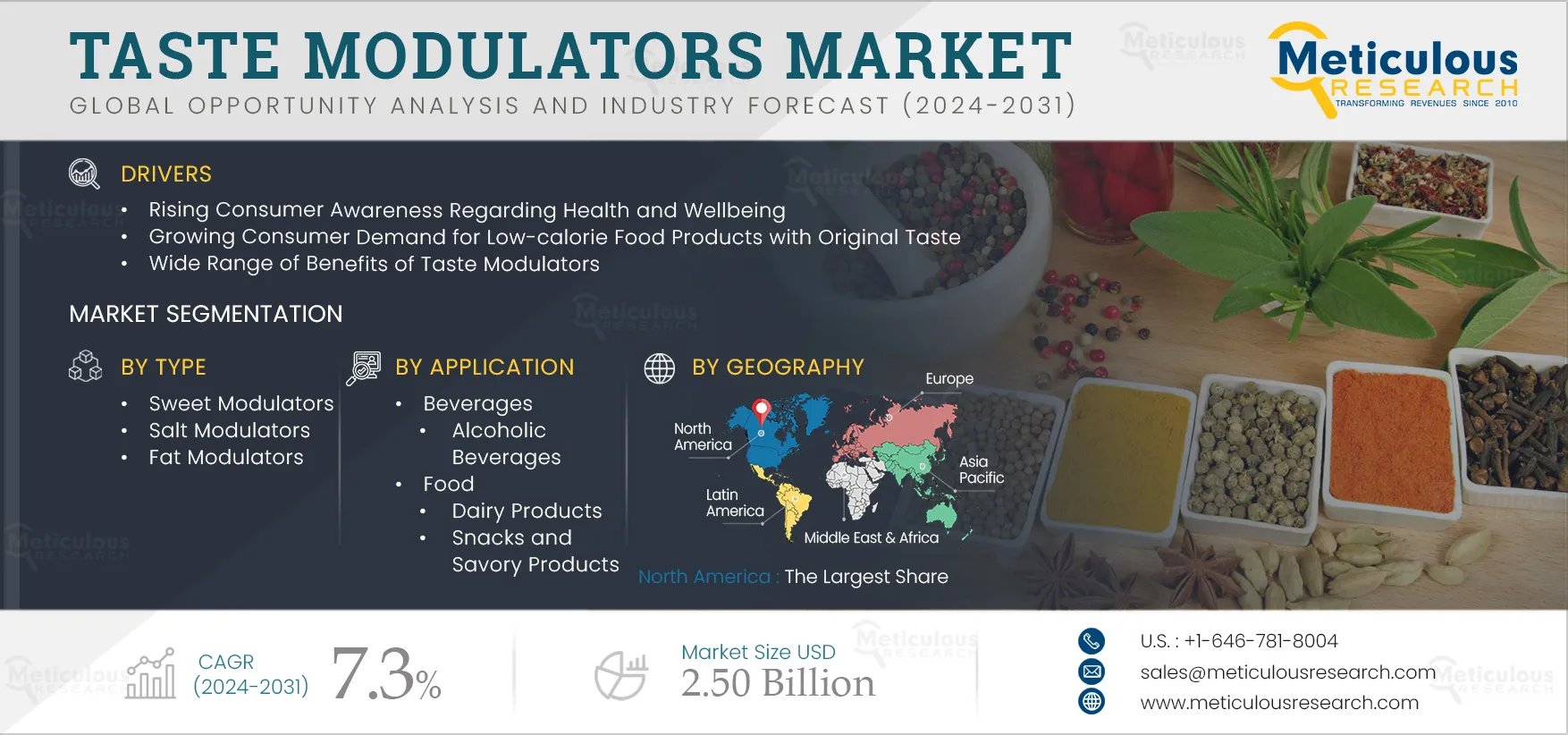
The Taste Modulators Market was valued at $1.43 billion in 2023. This market is expected to reach $2.50 billion by 2031 from an estimated $1.53 billion in 2024, at a CAGR of 7.3% during the forecast period from 2024 to 2031. Taste Modulators Market Size & Forecast This market's growth is driven by
- Published
- Aug 2024
- Pages
- 201
- Format
- PDF + Excel
- Report ID
- MRFB - 10414
- Base year
- 2023
- 2023 · BASELINE
- $1.43B
- 2031
- $2.50B
- CAGR 2024–2031
- 7.3%
2023 baseline · 2024–2031 forecast at 7.3% CAGR · hover a bar for the value
Key highlights
In 2024, the Sweet Modulators Segment to Dominate the Taste modulators Market
In 2024, the Liquid Segment to Dominate the Taste Modulators Market
In 2024, the Beverages Segment to Dominate the Taste Modulators Market
Report summary
| Particulars | Details |
|---|---|
| Number of Pages | 201 |
| Format | |
| Forecast Period | 2024–2031 |
| Base Year | 2023 |
| CAGR (Value) | 7.3% |
| Market Size (Value) | USD 2.50 Billion by 2031 |
| Segments Covered | By Type · Sweet Modulators · Salt Modulators · Fat Modulators · Other Taste Modulators · By Form · Liquid · Solid · By Application · Beverages · Non-alcoholic Beverages · Alcoholic Beverages · Food · Bakery and Confectionary · Dairy Products · Snacks and Savory Products · Meat, Poultry, and Seafood · Other Food Products · Other Applications |
| Countries Covered | North America (U.S., Canada), Europe (Germany, U.K., France, Spain, Italy, Rest of Europe), Asia-Pacific (China, Japan, India, Australia, Rest of Asia-Pacific), Latin America (Brazil, Mexico, Argentina, Rest of Latin America), and Middle East & Africa |
| Key Companies | DSM-Firmenich AG (Switzerland), International Flavors & Fragrances Inc. (U.S.), Archer-Daniels-Midland Company (U.S.), Kerry Group plc (Ireland), Ingredion Incorporated (U.S.), Givaudan SA (Switzerland), Symrise AG (Germany), Sensient Technologies Corporation (U.S.), Tate & Lyle PLC (U.K.), The Flavor Factory, Inc. (U.S.), Carmi Flavor & Fragrance Co., Inc. (U.S.), Corbion N.V. (Netherlands), Flavorchem Corporation (U.S.), Icon Foods (U.S.), and Synergy Flavors, Inc. (U.S.) |
Report overview
Segments covered: type, form, application. Regions: North America, Europe, Asia-Pacific, Latin America.
This market's growth is driven by rising health awareness among consumers, the growing demand for low-calorie food products that do not compromise taste, and the benefits of taste modulators. However, stringent regulations and international standards restrain market growth.
Furthermore, the increasing demand for innovative beverages and the expanding functional foods industry are expected to generate growth opportunities for market stakeholders. On the other hand, high R&D costs are a major challenge for the players operating in this market.
The latest trends in the taste modulators market include rising demand for novel beverages and the emergence of clean-label taste modulation solutions.
Report infographic
Market dynamics
4 factors across 3 forcesRising Health Awareness Among Consumers
Well-being is becoming a global movement, with consumers seeking to ensure healthy lives for as long as possible. Over the last decade, industrialization, urbanization, economic development, and globalization have led to rapid changes in diets and lifestyles, significantly impacting health and nutritional status, particularly in developing countries.
The global population is growing rapidly. According to the Population Reference Bureau (PRB), the global human population is expected to grow by 75 million (1.1%) annually. With this rapid increase, the world population is expected to reach 9.9 billion in 2050, increasing 33% from an estimated 7.4 billion in 2017. The growing global population will boost the demand for high-nutrition food products that offer great taste, which in turn will boost the demand for taste modulators.
Consumers are becoming increasingly mindful of their health, recognizing that regular diet and hydration are essential for the human body. The trend toward healthier lives is influencing shopping preferences in a variety of demographics. Consumers are actively seeking items that support their wellness goals, whether it is cutting back on sugar and salt or using natural ingredients. This tendency is especially noticeable among millennials and Generation Z, who value health-conscious consuming habits. As a result, food & beverage manufacturers are under pressure to innovate and reformulate their offerings to cater to these evolving preferences. The incorporation of taste modulators allows them to meet the demand for healthier options while maintaining the sensory appeal that consumers require.
Furthermore, consumers are increasingly turning to functional foods and beverages that offer nutritional benefits. Taste modulators play a crucial role in enhancing the palatability of these products, making them more appealing to health-conscious consumers. Thus, the rising health awareness among consumers is increasing the adoption of taste modulators, driving the growth of this market.
Growing Demand for Low-calorie Food Products
As health concerns develop, consumers are increasingly focusing on eating healthier. The global demand for low-calorie foods is primarily driven by expanding health awareness, illness prevalence, micronutrient shortages, and rising disposable incomes.
In 2021, the International Diabetes Federation (IDF) reported that approximately 537 million adults aged 20 to 79 had diabetes. This number is projected to rise to 783 million by 2045. The increasing global prevalence of chronic diseases is driving consumers to seek more nutritious foods. According to an NIH-funded study, a healthy diet can enhance overall health and lower the risk of heart disease, stroke, and Type 2 diabetes. Consequently, the trend towards healthier eating is gaining momentum, leading to a rise in the development and production of nutritious, low-calorie foods. Sweetness modulators, which have fewer calories than sugar, are increasingly being used in food products to cater to this growing demand.
Furthermore, the demand for products offering immunity-boosting and specific health benefits has increased notably since the COVID-19 pandemic. For instance, the International Food Information Council’s (IFIC) Food and Health Survey revealed that in 2023, 63% of millennials aged 27 to 42 followed specific diets, a significant rise from 19% in 2021. The primary reasons for adopting these diets were weight loss (43%), improved physical health (39%), prevention of future health issues (37%), and avoidance of weight gain (38%). Low-calorie foods, which contain minimal to no simple sugars, are preferred as they are lower in calories and may help reduce the risk of various diseases associated with high sugar consumption.
Thus, the growing demand for low-calorie food products that do not compromise on taste is boosting the adoption of taste modulators, driving the growth of this market.
Table of contents
11 chapters · 117 sections · 201 pages · click to expandSegmental analysis
| Segment | Largest share (2024) | Fastest growth (2024–2031) |
|---|---|---|
| By Type | Sweet Modulators | Sweet modulators |
| By Form | Liquid | Liquid |
| By Application | Beverages | Beverages |
By Type
- The Sweet Modulators Segment to Dominate the Taste modulators Market
- The sweet modulators segment is expected to account for the largest share of 47.7% and is expected to register the highest CAGR of 8.0% during the forecast period.
- The segment’s major share is attributed to the desire for reduced sugar consumption, rising awareness about the adverse effects of excessive sugar consumption, the growing incidence of diabetes and obesity, and the high demand for healthier and low-calorie foods.
By Form
- The Liquid Segment to Dominate the Taste Modulators Market
- The liquid segment is expected to account for a larger share of 57.5% and is estimated to register the highest CAGR of 7.5% during the forecast period.
- The segment's large market share is attributed to the rising demand for convenient and ready-to-use liquid taste modulators in various food & beverage applications.
- Moreover, in product manufacturing, liquid taste modulators help improve product viscosity, mouthfeel, stability, texture, shelf life, taste, and visual aspects.
By Application
- The Beverages Segment to Dominate the Taste Modulators Market
- The beverages segment is expected to account for the largest share of 44.3% and is projected to record the highest CAGR of 8.0% during the forecast period.
- This substantial market share is due to the surge in demand for healthy & functional beverages, high adoption of taste modulators in non-alcoholic beverages, strong growth in the beverage industry, and increased promotional & advertisement strategies regarding clean labels by beverage manufacturers.
Geographic analysis
North America
Largest shareIn 2024, North America is expected to account for the largest share of 36.7% of the global taste modulators market. This regional market is estimated to be worth USD 559.2 million in 2024. This significant market share is primarily attributed to the increasing consumer preference for healthy food products, high consumption of low-fat and low-calorie foods, growing concerns about health & wellness, rising prevalence of chronic diseases, rising incidence of obesity and diabetes, and a well-established food & beverage industry.
Asia-Pacific
Fastest growthHowever, Asia-Pacific is estimated to register the highest CAGR of 9.2% during the forecast period. This regional market's growth is driven by the rising number of food & beverage manufacturing companies, rising health awareness among consumers, and rising prevalence of obesity and diabetes, leading to an increase in the adoption of sugar-free products.
Competitive landscape
- April 2024
International Flavors & Fragrances (IFF) established a new co-creation center in Wageningen, Netherlands, within the 'Food Valley' to improve research, innovation, and customer collaboration. The center, which includes modern lab facilities, a demo kitchen, and innovation spaces, will boost IFF's partnerships with significant clients and Wageningen University.
- March 2024
DSM-Firmenich established a new pilot plant in Plainsboro, New Jersey. The state-of-the-art facility will help customers to quickly scale up their innovative food & beverages.
- June 2023
Kerry Group introduced Tastesense Advanced, its next-generation solution tailored for low or zero-sugar products.
- June 2023
Ingredion launched PureCircle Clean Taste Solution, a zero-calorie sweetening solution designed for specific applications to enhance the overall eating and drinking experience.
- DSM-Firmenich AG · Switzerland
- International Flavors & Fragrances Inc. (U.S.)
- Archer-Daniels-Midland Company (U.S.)
- Kerry Group plc · Ireland
- Ingredion Incorporated (U.S.)
- Givaudan SA · Switzerland
- Symrise AG · Germany
- Sensient Technologies Corporation (U.S.)
- Tate & Lyle PLC (U.K.)
- Flavor Factory, Inc. (U.S.)
- Carmi Flavor & Fragrance Co., Inc. (U.S.)
- Corbion N.V. · Netherlands
- Flavorchem Corporation (U.S.)
- Icon Foods (U.S.)
- Synergy Flavors, Inc. (U.S.)
Frequently asked questions
This taste modulators market report provides a detailed market assessment and valuable insights into the market size & forecasts in terms of value by type, form, application, and geography. Each segment provides the market size & forecast for five key geographies (North America, Europe, Asia-Pacific, Latin America, and the Middle East & Africa) along with the key countries.
Cite this report
Meticulous Research. (2024). Taste Modulators Market - Global Opportunity Analysis And Industry Forecast (2024-2031) (Report No. MRFB - 10414). Meticulous Market Research Pvt. Ltd. https://www.meticulousresearch.com/product/taste-modulators-market-4715