Resources
About Us
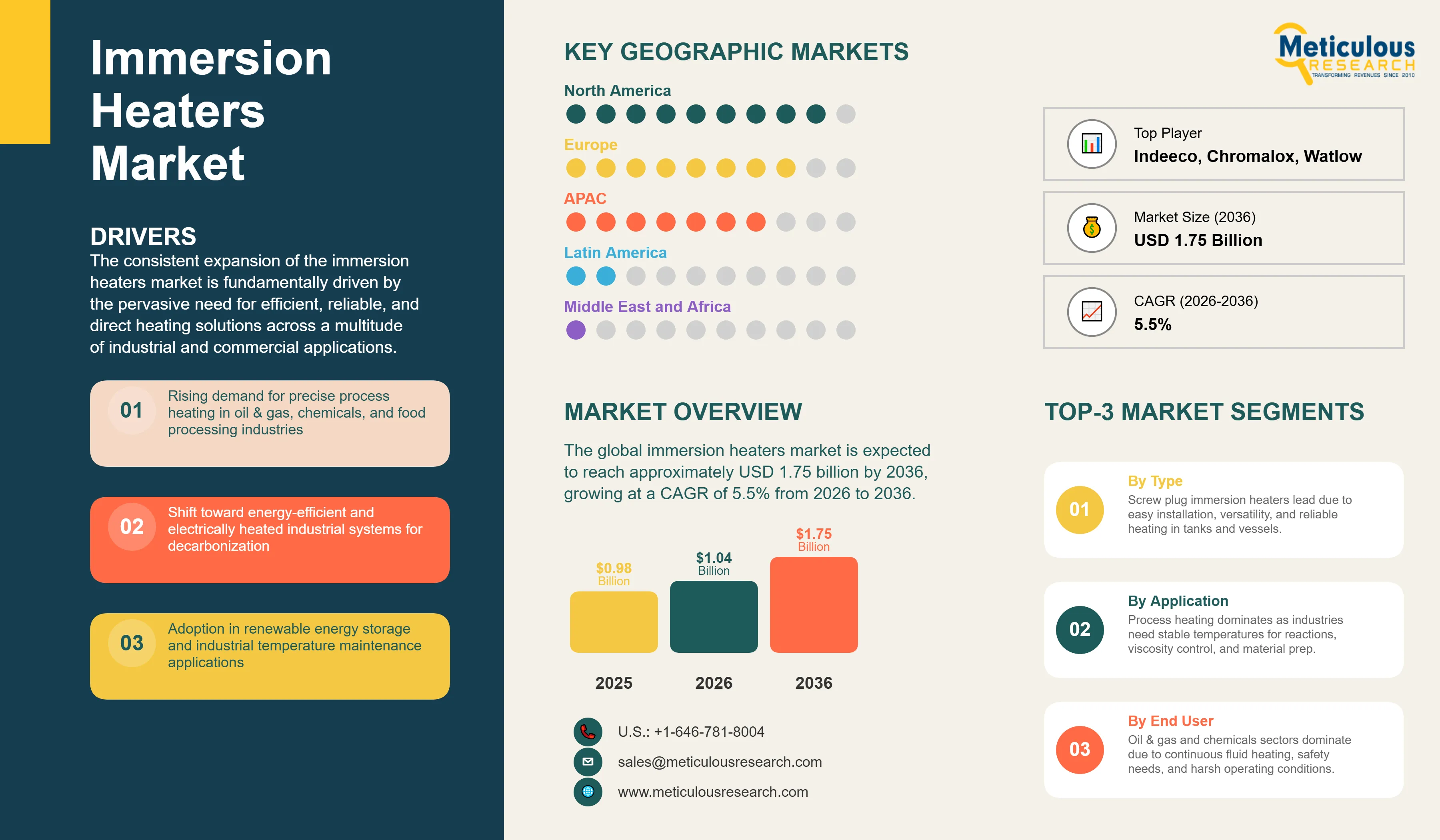
The global immersion heaters market was valued at USD 0.98 billion in 2025. The market is expected to reach approximately USD 1.75 billion by 2036 from USD 1.04 billion in 2026, growing at a CAGR of 5.5% from 2026 to 2036. The consistent expansion of the immersion heaters market is fundamentally driven by the pervasive need for efficient, reliable, and direct heating solutions across a multitude of industrial and commercial applications. As industries continue to prioritize energy efficiency, precise temperature control, and operational safety, immersion heaters stand out as a preferred choice due to their ability to transfer heat directly into liquids, gases, and other mediums. Key catalysts include the increasing demand for process heating in sectors such as oil & gas, chemicals, and food & beverage, the growing adoption of renewable energy sources requiring specialized heating solutions, and the continuous advancements in material science leading to more durable and corrosion-resistant designs. Furthermore, the integration of smart control systems and IoT capabilities is transforming immersion heaters into intelligent components of modern industrial processes, further solidifying their market position.
Click here to: Get Free Sample Pages of this Report
Immersion heaters are indispensable components in a vast array of industrial and commercial settings, providing controlled and efficient thermal energy for critical operations. These robust devices are designed for direct immersion into a liquid or gas medium, ensuring rapid and uniform heat transfer. Typically comprising a heating element (often tubular) encased in a protective sheath and connected to a terminal housing, immersion heaters convert electrical energy directly into heat, offering unparalleled precision, cleanliness, and safety compared to indirect heating methods. The market is characterized by a diverse portfolio of product types, including screw plug, flanged, over-the-side, and circulation heaters, each engineered for specific applications—from heating water and oils to corrosive chemical solutions and gases.
The evolution of immersion heaters is marked by a continuous drive towards enhanced efficiency, greater durability, and smarter integration. Modern immersion heaters often incorporate advanced materials like Incoloy, stainless steel, and titanium for superior corrosion resistance and high-temperature performance, extending their operational lifespan in demanding environments. The increasing adoption of smart control systems and IoT capabilities is transforming these heaters into intelligent, interconnected devices. Integration with advanced temperature controllers and digital communication protocols allows for real-time monitoring, predictive maintenance, and precise thermal profiling, enabling manufacturers to optimize energy consumption, reduce downtime, and ensure consistent process temperatures. This technological advancement is crucial for industries facing escalating energy costs, stringent environmental regulations, and the demand for higher production throughput and quality.
The global industrial landscape is undergoing a significant transformation, driven by the twin imperatives of sustainability and operational excellence. This shift is accelerating the adoption of immersion heating solutions as industries seek to optimize thermal processes, minimize energy waste, and achieve tighter control over their manufacturing operations. The inherent advantages of immersion heaters—such as their high efficiency, direct heat transfer, and precise temperature control—make them ideal for this transition. Furthermore, the growing trend towards electrification of industrial processes and the increasing complexity of thermal management requirements are creating a fertile ground for the sustained growth of the immersion heaters market. This market is not just about heating; it’s about enabling cleaner, smarter, and more efficient industrial operations globally.
Advancements in Material Science for Enhanced Durability and Performance
The immersion heaters market is witnessing significant advancements in material science, driven by the need for enhanced durability, corrosion resistance, and high-temperature performance in increasingly demanding industrial environments. Manufacturers are increasingly utilizing specialized alloys such as Incoloy, Inconel, and titanium for the heating element sheaths, moving beyond traditional stainless steel for applications involving corrosive chemicals, high-purity water, or extreme temperatures. For instance, Chromalox offers immersion heaters with various sheath materials tailored to specific chemical compatibility, ensuring extended operational life and reduced maintenance in harsh conditions. Similarly, Watlow’s advanced material research focuses on developing elements that can withstand aggressive media and prevent premature failure. This trend is critical for industries like chemical processing, pharmaceuticals, and oil & gas, where heater reliability directly impacts safety, process efficiency, and product quality.
Integration of Smart Controls and IoT for Optimized Thermal Management
The global push towards Industry 4.0 and smart manufacturing is profoundly impacting the immersion heaters market, driving the integration of these components with advanced control systems and IoT capabilities. Modern immersion heaters are increasingly being designed to work seamlessly with sophisticated temperature controllers, sensors, and digital communication protocols. This integration allows for real-time monitoring of heater performance, precise temperature profiling, and predictive maintenance. For example, Indeeco offers immersion heaters that can be connected to centralized control platforms, enabling operators to remotely adjust settings, monitor energy consumption, and receive alerts for potential issues. This trend empowers industries to optimize their thermal processes, enhance energy efficiency, reduce downtime through proactive fault detection, and leverage data analytics for continuous improvement in production quality and throughput.
|
Parameter |
Details |
|
Market Size by 2036 |
USD 1.75 Billion |
|
Market Size in 2026 |
USD 1.04 Billion |
|
Market Size in 2025 |
USD 0.98 Billion |
|
Market Growth Rate (2026–2036) |
CAGR of 5.5% |
|
Dominating Region |
North America |
|
Fastest Growing Region |
Asia-Pacific |
|
Base Year |
2025 |
|
Forecast Period |
2026 to 2036 |
|
Segments Covered |
Product Type, Heating Medium, Application, End-use Vertical, and Region |
|
Regions Covered |
North America, Europe, Asia-Pacific, Latin America, and Middle East & Africa |
Drivers: Increasing Demand for Process Heating in Industrial Applications
The global immersion heaters market is significantly driven by the escalating demand for precise and efficient process heating across a wide range of industrial applications. Industries such as oil & gas, chemicals & petrochemicals, food & beverage, and pharmaceuticals rely heavily on controlled heating for various operations, including maintaining viscosity, preventing freezing, sterilization, and chemical reactions. Immersion heaters, with their ability to deliver direct and uniform heat transfer, offer superior efficiency and temperature control compared to indirect heating methods. As industrial processes become more complex and require tighter thermal tolerances, the demand for reliable and adaptable immersion heating solutions continues to grow. This driver is further amplified by the continuous expansion of manufacturing capabilities globally.
Opportunity: Growing Adoption in Renewable Energy and Energy Storage Systems
A significant growth opportunity for immersion heaters lies in the rapidly expanding renewable energy and energy storage sectors. Immersion heaters are increasingly being utilized in applications such as thermal energy storage systems, where excess renewable energy is converted into heat and stored for later use, and in the pre-heating of various fluids in concentrated solar power (CSP) plants. Furthermore, they play a role in maintaining optimal operating temperatures for certain types of batteries and fuel cells. As the world transitions towards cleaner energy sources and invests heavily in energy storage infrastructure, the demand for reliable and efficient heating elements for these critical applications is set to surge. This represents a substantial new vertical for immersion heater manufacturers, requiring specialized designs for high-efficiency and long-duration performance.
Why Do Screw Plug Heaters Lead the Market?
The screw plug immersion heaters segment accounts for a significant portion of the overall market in 2026. This is mainly attributed to their versatile design, ease of installation, and cost-effectiveness in a wide range of applications. These heaters are directly threaded into tanks or vessels, providing efficient, direct heating for water, oils, and various chemical solutions. Their widespread use in manufacturing, food & beverage, and chemical processing for applications requiring precise temperature control in smaller containers solidifies their market dominance. However, the flanged heaters segment is expected to grow at a steady CAGR, driven by the growing need for high-wattage heating solutions in large-scale industrial processes, such as in the oil & gas and power generation sectors.
How Does Water Heating Dominate the Market?
Based on heating medium, water heating holds the largest share of the overall market in 2026. This is primarily due to the fundamental need for hot water across countless industrial, commercial, and institutional applications, including sanitation, process heating, and comfort heating. Immersion heaters provide a highly efficient and reliable method for heating water in boilers, tanks, and process equipment. The oil heating segment is also significant, driven by the need to reduce the viscosity of various oils for efficient pumping and processing in industries like power generation and manufacturing.
Why Does Process Heating Command the Largest Market Share?
The process heating segment commands the largest share of the global immersion heaters market in 2026. This dominance stems from its critical role in a vast array of industrial operations where precise and controlled thermal energy is required to facilitate chemical reactions, maintain fluid viscosity, and prepare materials for further processing. Industries such as chemicals, pharmaceuticals, and food & beverage rely heavily on immersion heaters for their core operations. However, the freeze protection segment is poised for steady growth, fueled by the increasing need to protect critical equipment and fluids from damage in cold climates and unheated industrial environments.
How Do the Oil & Gas and Chemical Sectors Drive Market Demand?
The oil & gas and chemicals & petrochemicals sectors collectively represent the largest share of the immersion heaters market in 2026. This is primarily due to the critical need for precise, reliable, and safe heating in their complex and often hazardous operating environments. Immersion heaters are essential for applications such as crude oil pre-heating, maintaining reaction temperatures, and preventing the solidification of sensitive materials. The food & beverage industry is expected to witness the fastest growth during the forecast period, driven by the increasing demand for hygienic and efficient heating solutions for sanitation, pasteurization, and cooking processes, in line with stringent food safety regulations.
How is North America Maintaining Dominance in the Global Immersion Heaters Market?
North America holds the largest share of the global immersion heaters market in 2026. This dominance is primarily attributable to the region’s highly developed industrial infrastructure, significant investments in advanced manufacturing technologies, particularly in the oil & gas, chemicals, and food & beverage sectors, and stringent safety and environmental regulations that necessitate efficient and controlled heating solutions. The United States and Canada, in particular, are at the forefront of adopting advanced thermal management systems. The presence of key market players, coupled with robust R&D capabilities and a proactive approach to industrial automation, further solidifies North America’s leading position. The key companies operating in North America market are Watlow Electric Manufacturing Company, Chromalox, Inc., and Indeeco.
Which Factors Support Asia-Pacific and Europe Market Growth?
Asia-Pacific is projected to be the fastest-growing regional market for immersion heaters during the forecast period. This rapid growth is fueled by the region’s ongoing industrialization, the expansion of its manufacturing base (especially in China, India, and Southeast Asia), and increasing investments in infrastructure development. The growing awareness and adoption of energy-efficient and environmentally friendly industrial practices are also significant drivers. Governments across the region are actively promoting cleaner production technologies, which include efficient heating solutions, further accelerating market expansion. The key companies operating in Asia-Pacific market are Sanwa Electric Co., Ltd., NIBE Industrier AB (through its element division), and Tempco Electric Heater Corporation.
Europe represents a substantial and steadily growing share of the global market, driven by its stringent environmental regulations, strong focus on energy efficiency, and a mature industrial base. Countries like Germany, the UK, and France are actively investing in modernizing their industrial processes and transitioning towards sustainable heating solutions. The region’s commitment to reducing carbon emissions and its well-established manufacturing sector create a consistent demand for advanced immersion heaters. The key companies operating in Europe market are Zoppas Industries S.p.A., Elstein-Werk, and Backer Group.
The global immersion heaters market is expected to grow from USD 1.04 billion in 2026 to USD 1.75 billion by 2036.
The global immersion heaters market is projected to grow at a CAGR of 5.5% from 2026 to 2036.
Screw plug immersion heaters are expected to dominate the market in 2026 due to their versatility, ease of installation, and widespread use in various liquid and gas heating applications. Flanged immersion heaters are projected to accelerate their growth as industries demand more robust and high-capacity heating solutions for large tanks and pressure vessels.
Advancements in material science are transforming the market by enabling the development of more durable, corrosion-resistant, and high-performance immersion heaters. The use of specialized alloys like Incoloy, Inconel, and titanium extends operational life in harsh environments, improves safety, and enhances efficiency, meeting the stringent requirements of industries such as chemical processing and pharmaceuticals.
North America holds the largest share of the global market in 2026. The region’s dominance is primarily driven by its highly developed industrial infrastructure, significant investments in advanced manufacturing, and stringent safety and environmental regulations.
he leading companies include Watlow Electric Manufacturing Company, Chromalox, Inc., Indeeco, Thermon, Inc., WATTCO, Hubbell Heaters, Eurotherm, NIBE Industrier AB, Zoppas Industries S.p.A., Sanwa Electric Co., Ltd., Elstein-Werk, Backer Group, Tutco-Farnam, Durex Industries, and Tempco Electric Heater Corporation
1. Introduction
1.1 Market Definition
1.2 Market Scope
1.3 Research Methodology
1.4 Assumptions & Limitations
2. Executive Summary
3. Market Overview
3.1 Introduction
3.2 Market Dynamics
3.2.1 Drivers
3.2.2 Restraints
3.2.3 Opportunities
3.2.4 Challenges
3.3 Impact of Material Science Advancements and IoT on Immersion Heater Adoption
3.4 Regulatory Landscape and Compliance Requirements
3.5 Porter's Five Forces Analysis
4. Global Immersion Heaters Market, by Product Type
4.1 Introduction
4.2 Screw Plug Immersion Heaters
4.3 Flanged Immersion Heaters
4.4 Over-the-Side Immersion Heaters
4.5 Circulation Immersion Heaters
4.6 Tubular Immersion Heaters
4.7 Other Product Types (e.g., Coil Immersion Heaters, Bayonet Heaters)
5. Global Immersion Heaters Market, by Heating Medium
5.1 Introduction
5.2 Water
5.3 Oil
5.4 Chemical Solutions
5.5 Gases
5.6 Other Heating Mediums
6. Global Immersion Heaters Market, by Application
6.1 Introduction
6.2 Process Heating
6.3 Freeze Protection
6.4 Water Heating
6.5 Oil Heating
6.6 Other Applications (e.g., Sterilization, Viscosity Control)
7. Global Immersion Heaters Market, by End-use Vertical
7.1 Introduction
7.2 Oil & Gas
7.3 Chemicals & Petrochemicals
7.4 Food & Beverage
7.5 Pharmaceuticals
7.6 Power Generation
7.7 Metals & Mining
7.8 Other End-use Verticals (e.g., Automotive, Marine, HVAC)
8. Global Immersion Heaters Market, by Region
8.1 Introduction
8.2 North America
8.2.1 U.S.
8.2.2 Canada
8.3 Europe
8.3.1 Germany
8.3.2 U.K.
8.3.3 France
8.3.4 Italy
8.3.5 Spain
8.3.6 Rest of Europe
8.4 Asia-Pacific
8.4.1 China
8.4.2 Japan
8.4.3 India
8.4.4 South Korea
8.4.5 Rest of Asia-Pacific
8.5 Latin America
8.5.1 Brazil
8.5.2 Mexico
8.5.3 Argentina
8.5.4 Rest of Latin America
8.6 Middle East & Africa
8.6.1 UAE
8.6.2 Saudi Arabia
8.6.3 South Africa
8.6.4 Rest of Middle East & Africa
9. Competitive Landscape
9.1 Overview
9.2 Key Growth Strategies
9.3 Competitive Benchmarking
9.4 Competitive Dashboard
9.4.1 Industry Leaders
9.4.2 Market Differentiators
9.4.3 Vanguards
9.4.4 Emerging Companies
9.5 Market Ranking / Positioning Analysis of Key Players, 2025
10. Company Profiles
10.1 Watlow Electric Manufacturing Company
10.1.1 Business Overview
10.1.2 Financial Overview
10.1.3 Product Portfolio
10.1.4 Strategic Developments
10.1.5 SWOT Analysis
10.2 Chromalox, Inc.
10.2.1 Business Overview
10.2.2 Financial Overview
10.2.3 Product Portfolio
10.2.4 Strategic Developments
10.2.5 SWOT Analysis
10.3 Indeeco
10.3.1 Business Overview
10.3.2 Financial Overview
10.3.3 Product Portfolio
10.3.4 Strategic Developments
10.3.5 SWOT Analysis
10.4 Thermon, Inc.
10.4.1 Business Overview
10.4.2 Financial Overview
10.4.3 Product Portfolio
10.4.4 Strategic Developments
10.4.5 SWOT Analysis
10.5 WATTCO
10.5.1 Business Overview
10.5.2 Financial Overview
10.5.3 Product Portfolio
10.5.4 Strategic Developments
10.5.5 SWOT Analysis
10.6 Hubbell Heaters
10.6.1 Business Overview
10.6.2 Financial Overview
10.6.3 Product Portfolio
10.6.4 Strategic Developments
10.6.5 SWOT Analysis
10.7 Eurotherm (Part of Schneider Electric)
10.7.1 Business Overview
10.7.2 Financial Overview
10.7.3 Product Portfolio
10.7.4 Strategic Developments
10.7.5 SWOT Analysis
10.8 NIBE Industrier AB (through its element division)
10.8.1 Business Overview
10.8.2 Financial Overview
10.8.3 Product Portfolio
10.8.4 Strategic Developments
10.8.5 SWOT Analysis
10.9 Zoppas Industries S.p.A.
10.9.1 Business Overview
10.9.2 Financial Overview
10.9.3 Product Portfolio
10.9.4 Strategic Developments
10.9.5 SWOT Analysis
10.10 Sanwa Electric Co., Ltd.
10.10.1 Business Overview
10.10.2 Financial Overview
10.10.3 Product Portfolio
10.10.4 Strategic Developments
10.10.5 SWOT Analysis
10.11 Elstein-Werk
10.11.1 Business Overview
10.11.2 Financial Overview
10.11.3 Product Portfolio
10.11.4 Strategic Developments
10.11.5 SWOT Analysis
10.12 Backer Group
10.12.1 Business Overview
10.12.2 Financial Overview
10.12.3 Product Portfolio
10.12.4 Strategic Developments
10.12.5 SWOT Analysis
10.13 Durex Industries
10.13.1 Business Overview
10.13.2 Financial Overview
10.13.3 Product Portfolio
10.13.4 Strategic Developments
10.13.5 SWOT Analysis
10.14 Tempco Electric Heater Corporation
10.14.1 Business Overview
10.14.2 Financial Overview
10.14.3 Product Portfolio
10.14.4 Strategic Developments
10.14.5 SWOT Analysis
10.15 Process Technology
10.15.1 Business Overview
10.15.2 Financial Overview
10.15.3 Product Portfolio
10.15.4 Strategic Developments
10.15.5 SWOT Analysis
11. Appendix
11.1 Questionnaire
11.2 Available Customization
















Published Date: Mar-2026
Published Date: Mar-2026
Published Date: Mar-2026
Published Date: Oct-2024
Subscribe to get the latest industry updates