Resources
About Us
Industrial Electric Heaters Market by Product Type (Immersion Heaters, Circulation Heaters, Flange Heaters), Technology (Resistance Heating, Induction Heating, Dielectric Heating, Infrared Heating), Application, and End-use Vertical- Global Forecast to 2036
Report ID: MRSE - 1041821 Pages: 286 Mar-2026 Formats*: PDF Category: Semiconductor and Electronics Delivery: 24 to 72 Hours Download Free Sample Report
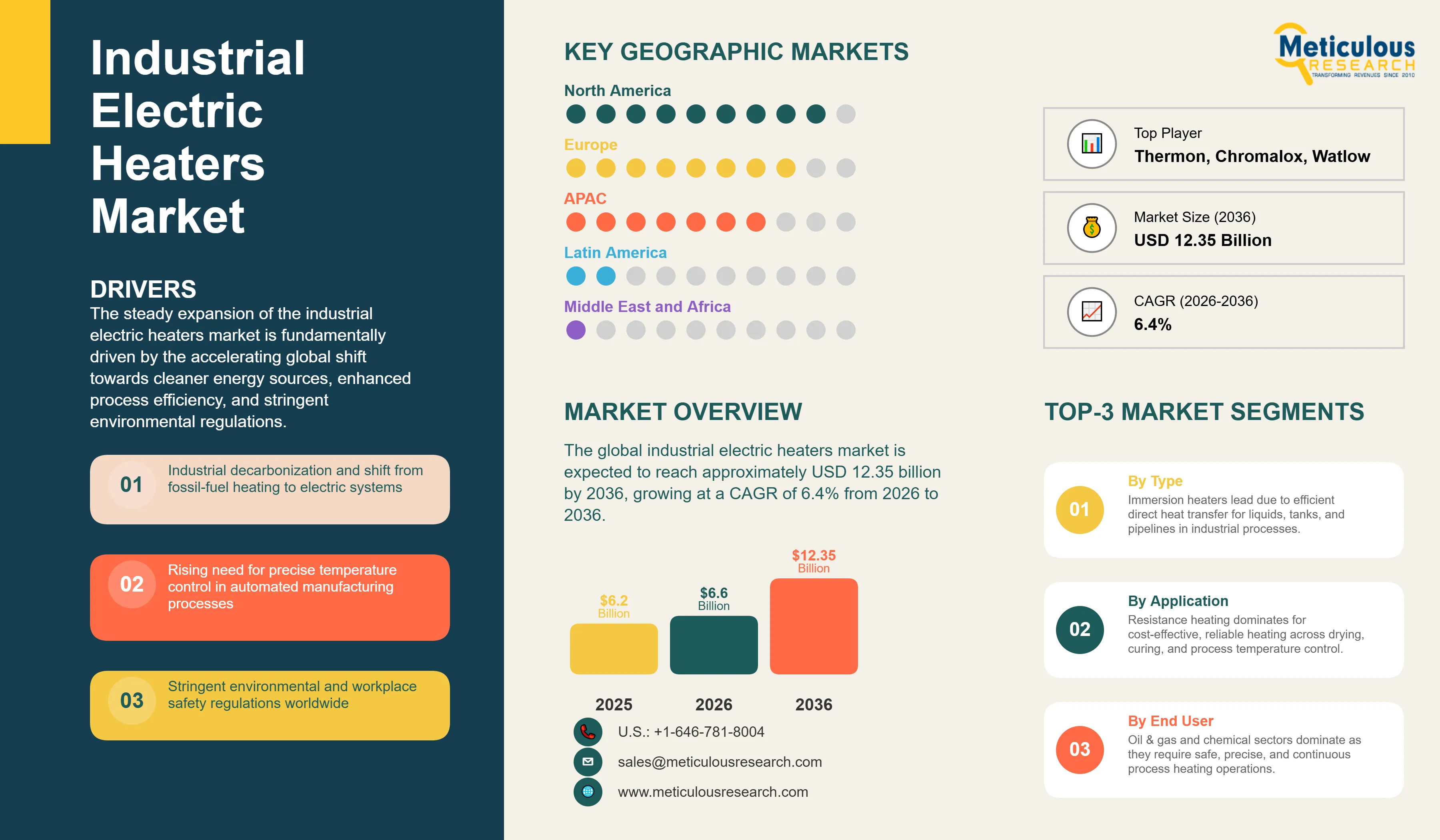
The global industrial electric heaters market was valued at USD 6.2 billion in 2025. The market is expected to reach approximately USD 12.35 billion by 2036 from USD 6.6 billion in 2026, growing at a CAGR of 6.4% from 2026 to 2036. The steady expansion of the industrial electric heaters market is fundamentally driven by the accelerating global shift towards cleaner energy sources, enhanced process efficiency, and stringent environmental regulations. As industries across the spectrum—from oil & gas to pharmaceuticals—seek precise, reliable, and environmentally compliant heating solutions, electric heaters are increasingly becoming the preferred choice over traditional fossil fuel-based systems. Key catalysts include the imperative for decarbonization, the rising adoption of automation in manufacturing, and the inherent advantages of electric heating such as superior temperature control, rapid response times, and minimal maintenance requirements. Furthermore, the increasing integration of smart control systems and IoT capabilities is transforming electric heaters into intelligent components of modern industrial processes, further solidifying their market position.
Click here to: Get Free Sample Pages of this Report
Industrial electric heaters are indispensable components in a vast array of manufacturing and processing environments, providing controlled and efficient thermal energy for critical operations. These sophisticated devices convert electrical energy directly into heat, offering unparalleled precision, cleanliness, and safety compared to conventional heating methods. The market is characterized by a diverse portfolio of product types, each engineered for specific applications—from direct immersion in liquids and gases to radiant heating of surfaces and precise temperature maintenance in sensitive processes. The core functionality revolves around delivering consistent, controllable heat, which is vital for optimizing chemical reactions, maintaining viscosity, preventing freezing, and ensuring product quality across numerous industrial sectors.
The evolution of industrial electric heaters is marked by a continuous drive towards enhanced efficiency, greater durability, and smarter integration. Modern electric heaters often incorporate advanced materials, robust construction, and sophisticated control systems that allow for granular temperature management and remote monitoring. The increasing adoption of IoT and AI in industrial settings is transforming these heaters into intelligent, interconnected devices capable of predictive maintenance, energy optimization, and seamless integration into broader automation systems. This technological advancement is crucial for industries facing escalating energy costs, stringent environmental regulations, and the demand for higher production throughput and quality.
The global industrial landscape is undergoing a significant transformation, driven by the twin imperatives of sustainability and operational excellence. This shift is accelerating the adoption of electric heating solutions as industries move away from fossil fuels to reduce their carbon footprint and comply with stricter emission standards. The inherent advantages of electric heaters—such as zero direct emissions, high energy conversion efficiency, and precise temperature control—make them ideal for this transition. Furthermore, the growing trend towards electrification of industrial processes, coupled with the expansion of renewable energy sources, is creating a fertile ground for the sustained growth of the industrial electric heaters market. This market is not just about heating; it’s about enabling cleaner, smarter, and more efficient industrial operations globally.
Integration of Smart Controls and IoT for Enhanced Efficiency and Predictive Maintenance
The industrial electric heaters market is witnessing a profound transformation driven by the pervasive integration of smart controls and Internet of Things (IoT) capabilities. Leading manufacturers are embedding advanced sensors, communication modules, and data analytics into their heating solutions, moving beyond basic temperature regulation. For instance, Watlow’s intelligent heating systems offer real-time monitoring of operational parameters, allowing for precise energy management and proactive identification of potential failures. This enables facilities to optimize energy consumption, reduce downtime through predictive maintenance, and ensure consistent process temperatures. Similarly, Chromalox’s smart heaters can be integrated into broader industrial automation platforms, providing centralized control and data insights that enhance overall plant efficiency. This trend is critical for industries seeking to maximize operational uptime, minimize energy waste, and leverage data-driven decision-making in their heating processes.
Shift Towards Electrification and Decarbonization in Industrial Processes
The global push for decarbonization and the increasing availability of renewable energy sources are significantly accelerating the adoption of industrial electric heaters. Industries are actively seeking alternatives to fossil fuel-based heating systems to reduce greenhouse gas emissions and comply with evolving environmental regulations. Electric heaters offer a clean, zero-emission solution at the point of use, making them a cornerstone of industrial electrification strategies. Companies like Thermon are developing high-efficiency electric heating solutions that support this transition, enabling industries to achieve their sustainability goals without compromising performance. This trend is particularly prominent in sectors such as chemicals, oil & gas, and power generation, where large-scale process heating is critical, and the environmental impact of traditional methods is under intense scrutiny. The ability of electric heaters to integrate seamlessly with renewable energy grids further solidifies their role in the future of sustainable industrial heating.
|
Parameter |
Details |
|
Market Size by 2036 |
USD 12.35 Billion |
|
Market Size in 2026 |
USD 6.6 Billion |
|
Market Size in 2025 |
USD 6.2 Billion |
|
Market Growth Rate (2026–2036) |
CAGR of 6.4% |
|
Dominating Region |
North America |
|
Fastest Growing Region |
Asia-Pacific |
|
Base Year |
2025 |
|
Forecast Period |
2026 to 2036 |
|
Segments Covered |
Product Type, Technology, Application, End-use Vertical, and Region |
|
Regions Covered |
North America, Europe, Asia-Pacific, Latin America, and Middle East & Africa |
Drivers: Accelerating Global Industrial Electrification and Decarbonization Initiatives
The global industrial electric heaters market is significantly driven by the widespread adoption of electrification and decarbonization strategies across various industries. As governments and corporations commit to ambitious climate targets, there is an increasing imperative to replace fossil fuel-based heating systems with cleaner, more efficient electric alternatives. This shift is fueled by stringent environmental regulations, carbon pricing mechanisms, and corporate sustainability goals. Electric heaters offer a direct pathway to reducing greenhouse gas emissions at the point of use, aligning perfectly with the broader energy transition. Their ability to integrate with renewable energy sources further enhances their appeal, making them a cornerstone of modern, environmentally responsible industrial operations.
Opportunity: Growing Demand for Precision Heating in Advanced Manufacturing and Specialized Processes
A substantial growth opportunity for industrial electric heaters lies in the escalating demand for precision heating solutions within advanced manufacturing and specialized industrial processes. Industries such as semiconductors, pharmaceuticals, aerospace, and automotive require extremely accurate and consistent temperature control for critical applications like curing, drying, sterilization, and material processing. Electric heaters, with their inherent ability to deliver precise and localized heat, offer superior control and repeatability compared to other heating methods. This precision minimizes waste, improves product quality, and enhances process efficiency, creating a strong demand pull from high-value manufacturing sectors that are continuously innovating and expanding.
How is North America Maintaining Dominance in the Global Industrial Electric Heaters Market?
North America holds the largest share of the global industrial electric heaters market in 2026. This dominance is primarily attributable to the region’s highly developed industrial infrastructure, significant investments in advanced manufacturing technologies, and a robust regulatory environment that emphasizes safety and energy efficiency. The United States and Canada, in particular, are at the forefront of adopting electric heating solutions across diverse sectors, including oil & gas, chemicals, and automotive. The presence of key market players, coupled with strong R&D capabilities and a proactive approach to industrial automation and decarbonization, further solidifies North America’s leading position. The key companies operating in North America market are Watlow, Chromalox, and Thermon.
Which Factors Support Asia-Pacific and Europe Market Growth?
Asia-Pacific is projected to be the fastest-growing regional market for industrial electric heaters during the forecast period. This rapid growth is fueled by the region’s ongoing industrialization, the expansion of its manufacturing base (especially in China, India, and Southeast Asia), and increasing investments in infrastructure development. The growing awareness and adoption of energy-efficient and environmentally friendly industrial practices are also significant drivers. Governments across the region are actively promoting cleaner production technologies, which include electric heating, further accelerating market expansion. The key companies operating in Asia-Pacific market are Sanwa Electric Co., Ltd., Nibe Industrier AB (through its element division), and Tutco-Farnam.
Europe represents a substantial and steadily growing share of the global market, driven by its stringent environmental regulations, strong focus on energy efficiency, and a mature industrial base. Countries like Germany, the UK, and France are actively investing in modernizing their industrial processes and transitioning towards sustainable heating solutions. The region’s commitment to reducing carbon emissions and its well-established manufacturing sector create a consistent demand for advanced industrial electric heaters. The key companies operating in Europe market are Zoppas Industries, Elstein-Werk, and Backer Group.
The global industrial electric heaters market is expected to grow from USD 6.6 billion in 2026 to USD 12.35 billion by 2036.
The global industrial electric heaters market is projected to grow at a CAGR of 6.4% from 2026 to 2036.
Immersion heaters are expected to dominate the market in 2026 due to their high efficiency and direct heat transfer capabilities across various industrial processes. The flexible heaters segment is projected to accelerate its growth as industries demand more adaptable and precise heating solutions for complex geometries and specialized applications.
IoT is transforming the market by enabling platforms to move beyond basic temperature control toward autonomous efficiency optimization, dynamic load adjustment, and predictive maintenance. Leading vendors are embedding advanced sensors and communication modules directly into their core architectures, enabling enterprises to significantly reduce operational costs and downtime while minimizing reliance on manual monitoring.
North America holds the largest share of the global market in 2026. The region’s dominance is primarily driven by its highly developed industrial infrastructure, significant investments in advanced manufacturing, and stringent safety and energy efficiency regulations.
The leading companies include Watlow Electric Manufacturing Company, Chromalox, Inc., Thermon, Inc., NIBE Industrier AB, Zoppas Industries S.p.A., Sanwa Electric Co., Ltd., Elstein-Werk, Backer Group, Tutco-Farnam, Durex Industries, Tempco Electric Heater Corporation, O.E.M. Heaters, Inc., Delta T Corporation, Process Technology, and WATTCO.
























Published Date: Mar-2026
Published Date: Mar-2026
Published Date: Oct-2024
Published Date: Sep-2024
Published Date: Sep-2019
Please enter your corporate email id here to view sample report.
Subscribe to get the latest industry updates


