Resources
About Us
Data Center Circuit Breaker Market Size, Share & Trends Analysis by Type (Air Circuit Breakers, Vacuum Circuit Breakers), Voltage Level (High Voltage, Medium Voltage, Low Voltage), Application (Hyperscale, Colocation, Enterprise, Edge), and Geography — Global Opportunity Analysis and Industry Forecast (2026–2036)
Report ID: MRSE - 1042003 Pages: 268 Jun-2026 Formats*: PDF Category: Semiconductor and Electronics Delivery: 24 to 72 Hours Download Free Sample Report
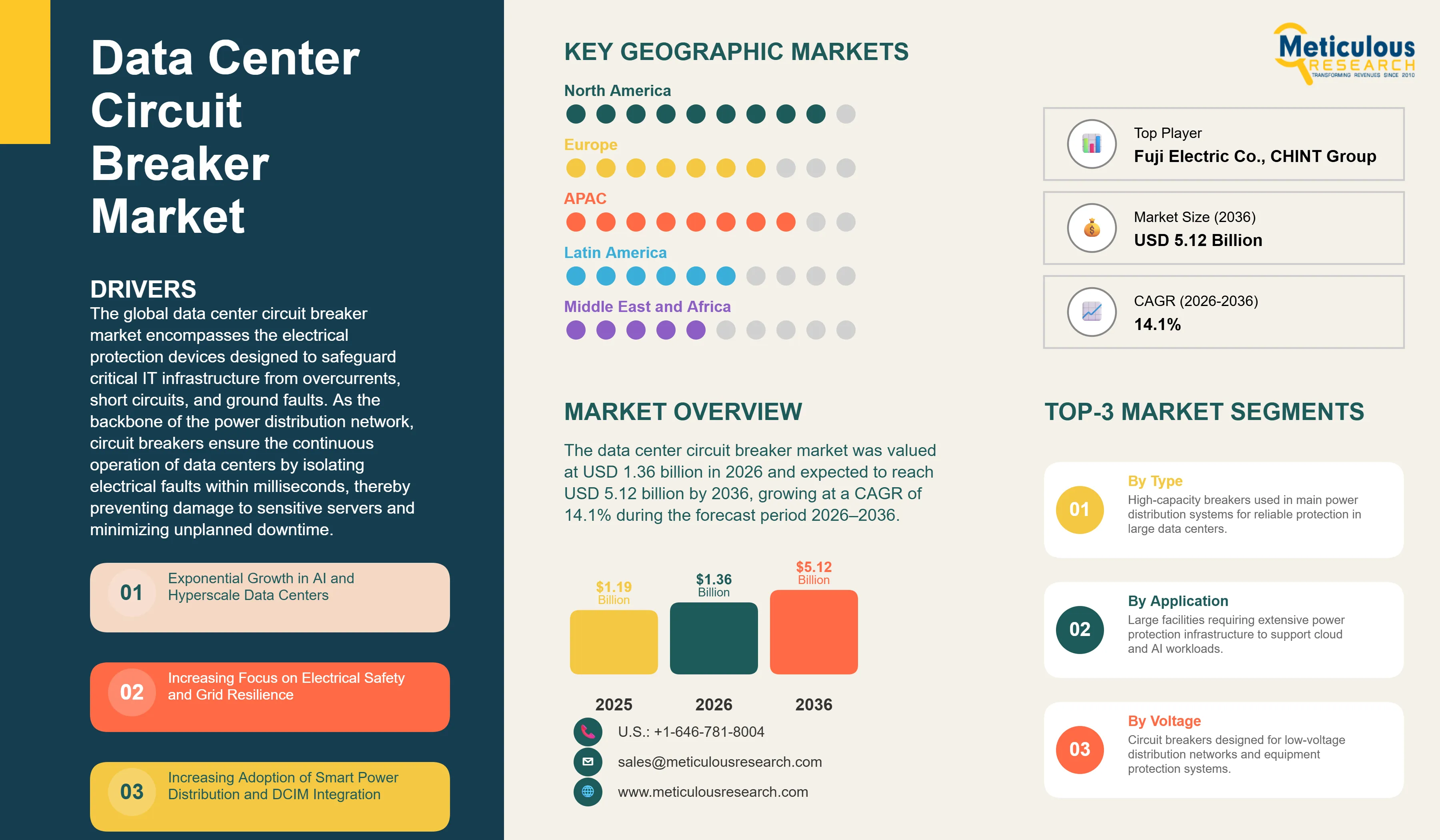
The global data center circuit breaker market was valued at USD 1.36 billion in 2026. This market is expected to reach USD 5.12 billion by 2036, growing at a CAGR of 14.1% during the forecast period 2026–2036.
The global data center circuit breaker market encompasses the electrical protection devices designed to safeguard critical IT infrastructure from overcurrents, short circuits, and ground faults. As the backbone of the power distribution network, circuit breakers ensure the continuous operation of data centers by isolating electrical faults within milliseconds, thereby preventing damage to sensitive servers and minimizing unplanned downtime. The market is characterized by a transition from traditional mechanical protection to intelligent, digitally-connected breakers that provide real-time data on energy consumption and asset health.
According to the International Energy Agency (IEA), global electricity consumption from data centers is projected to reach approximately 950 TWh by 2030, roughly doubling from 2025 levels, which directly correlates with the increasing demand for robust circuit protection solutions.
The growth of this market is primarily driven by the rapid expansion of hyperscale and colocation facilities, the intensification of AI-driven workloads, and the global modernization of aging power distribution chains. As data centers evolve to support higher rack power densities—often exceeding 50-100kW—the complexity of electrical protection has escalated. The U.S. Department of Energy (DOE) estimates that data center load growth has tripled over the past decade and is projected to double or triple by 2028. This surge in demand necessitates the installation of high-capacity Air Circuit Breakers (ACBs) at the main switchboard level and versatile Molded Case Circuit Breakers (MCCBs) for rack-level protection. Furthermore, the adoption of Tier III and Tier IV data center standards, which mandate high levels of redundancy, effectively doubles the circuit breaker count per facility to ensure seamless failover.
However, the market faces significant restraints, including high initial capital expenditure and extended lead times for specialized electronic trip units. Advanced 'Smart Breakers' equipped with IoT connectivity can cost 30-50% more than standard units, posing a financial challenge for enterprise operators with limited budgets. Additionally, the industry is grappling with supply chain bottlenecks; Bloom Energy reports a 1.5-2 year gap between utility power delivery and hyperscaler expectations, partly due to delays in receiving critical electrical infrastructure. Regulatory compliance with evolving standards such as UL 489, IEC 60947-2, and the 2026 updates to the National Electrical Code (NEC) also requires continuous innovation and testing by manufacturers.
On the other hand, the emergence of solid-state circuit breakers (SSCBs) and the integration of circuit breakers into Data Center Infrastructure Management (DCIM) systems present substantial growth opportunities. SSCBs offer near-instantaneous fault isolation, which is critical for preventing arc flashes in high-power environments. The ability of modern breakers to act as sensors for real-time energy monitoring allows operators to optimize power usage and implement predictive maintenance strategies. Geographic expansion in regions like Asia-Pacific, driven by rapid urbanization and cloud adoption, further supports the long-term outlook of the market.
 Click here to: Get Free Sample Pages of this Report
The primary driver for the global data center circuit breaker market is the unprecedented expansion of AI and hyperscale computing. Training large language models (LLMs) and running generative AI applications require high-density power infrastructure, often exceeding 100MW per facility. This intensification of load requires circuit breakers with higher interrupting ratings (e.g., 100kA-150kA) to safely manage potential short-circuit currents. The Brookings Institution estimates that global data center energy consumption could approach 1,050 TWh by 2026, driven by AI workloads. This growth directly translates to an increased demand for high-performance ACBs and MCCBs to ensure the safety and reliability of the power chain.
Another key driver is the increasing focus on electrical safety and grid resilience. As data centers become more interconnected with the utility grid, the risk of external electrical disturbances increases. Data center operators are investing in advanced breakers with integrated communication capabilities that allow for remote monitoring and automated fault diagnostics. This reduces the time to identify and resolve electrical issues, minimizing the risk of unplanned outages. The modernization of aging electrical grids in developed markets also provides a tailwind, as utilities and data center operators collaborate to build more robust interconnection points featuring advanced protection relaying.
A major restraint in the market is the high capital cost associated with 'Smart' and 'Digital' circuit breakers. While these units provide superior visibility and control, they can cost significantly more than traditional thermal-magnetic breakers. For enterprise data centers or those with limited budgets, the cost of upgrading to these advanced systems can be a barrier to adoption. Additionally, the industry is facing extended lead times for critical electronic components and specialized trip units. Supply chain disruptions have made it difficult for manufacturers to meet the rapid demand from hyperscale operators, potentially delaying the commissioning of new data center capacity.
The adoption of solid-state circuit breaker (SSCB) technology presents a substantial growth opportunity. Unlike mechanical breakers, SSCBs use semiconductor switches to interrupt current, allowing for fault isolation in microseconds. This speed is critical for preventing arc flashes and protecting sensitive electronic equipment from voltage transients. As data centers move toward higher voltages and currents, the safety benefits of SSCBs make them an attractive option for high-power applications. Furthermore, the growth of DC-powered data centers offers an opportunity for manufacturers to develop specialized DC-rated breakers that can efficiently interrupt high DC fault currents.
The data center circuit breaker market faces a critical challenge in managing heat dissipation within switchgear cabinets. As circuit breakers handle higher amperages to support high-density racks, they generate substantial heat, which can lead to premature tripping or equipment degradation if not properly managed. This requires advanced thermal management and cabinet cooling solutions. Furthermore, the increasing connectivity of circuit breakers introduces cybersecurity risks. Protecting digital breakers from unauthorized access in interconnected SCADA and BMS systems is a growing concern, requiring robust security frameworks and continuous monitoring to safeguard critical electrical infrastructure.
While SF6 gas has traditionally been used for insulation in high-voltage circuit breakers, its high global warming potential is driving a shift toward eco-friendly alternatives. Manufacturers are increasingly developing vacuum-based and air-insulated breakers for medium-voltage applications to meet stringent environmental regulations. This trend is mainly prominent in Europe, where the EU F-gas Regulation is pushing for the phase-out of SF6 in new electrical equipment, influencing data center design choices globally.
The use of digital twin technology for electrical infrastructure is a growing trend. By creating a digital replica of the circuit breaker network, operators can simulate different fault scenarios and optimize trip settings without interrupting live operations. When combined with real-time data from smart breakers, digital twins enable predictive maintenance, allowing operators to identify potential failures before they occur. This shift from reactive to proactive maintenance is critical for achieving the 'five nines' (99.999%) of uptime required by modern data centers.
Based on type, the data center circuit breaker market is segmented into Air Circuit Breakers (ACBs), Molded Case Circuit Breakers (MCCBs), Vacuum Circuit Breakers (VCBs), and others. In 2026, the ACB segment is expected to hold the largest share of the market. ACBs are primarily used at the main incoming switchboard and for primary power distribution where high interrupting capacities and reliable performance are required. Their ability to handle large currents (up to 6300A) and provide precise protection for transformers and generators makes them the preferred choice for primary data center power distribution.
However, the MCCB segment is projected to register the highest CAGR during the forecast period. This growth is driven by the increasing number of Power Distribution Units (PDUs) and Remote Power Panels (RPPs) in modern data centers. MCCBs are widely used for sub-distribution and rack-level protection due to their compact size, versatility, and availability with electronic trip units that offer high levels of adjustability for diverse IT loads.
North America is expected to dominate the global data center circuit breaker market in 2026, primarily due to the high concentration of hyperscale facilities and the presence of major technology companies such as Amazon, Google, and Microsoft. The U.S. Congress reports that data center annual energy use reached ~176 TWh in 2023, representing ~4.4% of total U.S. electricity, highlighting the massive scale of the market. The key companies operating in the North American market are Schneider Electric SE, ABB Ltd., Siemens Energy AG, Eaton Corporation plc, and GE Vernova.
Asia-Pacific data center circuit breaker market is projected to witness the fastest growth during the forecast period. This growth is driven by rapid digital transformation initiatives, increasing internet penetration, and significant investments in data center infrastructure in countries like China and India. China's state-led 'East-to-West' computing project is a major driver for new power infrastructure. The key companies operating in the Asia-Pacific market are Mitsubishi Electric Corporation, Fuji Electric Co., Ltd., LS ELECTRIC Co., Ltd., CHINT Group, and Toshiba Energy Systems & Solutions Corporation.
The market is projected to reach USD 5.12 billion by 2036, growing at a CAGR of 14.1% from 2026 to 2036.
The Air Circuit Breaker (ACB) segment is expected to hold the largest share in 2026, as they are essential for main power distribution.
The rapid expansion of hyperscale data centers and the increasing power density of AI-driven workloads are the primary drivers.
Asia-Pacific is projected to witness the highest CAGR due to rapid digitalization and infrastructure development in China and India.
SSCBs offer near-instantaneous fault isolation, which significantly reduces the risk of arc flashes and protects sensitive equipment.
Digitalization enables real-time energy monitoring, predictive maintenance, and better integration with DCIM software.
MCCBs are used for sub-distribution and rack-level protection, offering a compact and adjustable solution for PDUs and RPPs.
Primary standards include UL 489 for molded-case breakers and IEC 60947-2 for industrial circuit breakers.
It is creating a growing demand for specialized DC-rated breakers capable of interrupting high DC fault currents.
Challenges include the rising cost of raw materials like copper and the extended lead times for specialized electronic components.
























Published Date: Apr-2026
Published Date: Feb-2026
Published Date: Feb-2026
Published Date: Feb-2026
Please enter your corporate email id here to view sample report.
Subscribe to get the latest industry updates


