Resources
About Us
Autonomous AI and Autonomous Agents Market Analysis and Forecast Booms as Intelligent Automation and Multi-Domain Applications Drive Growth
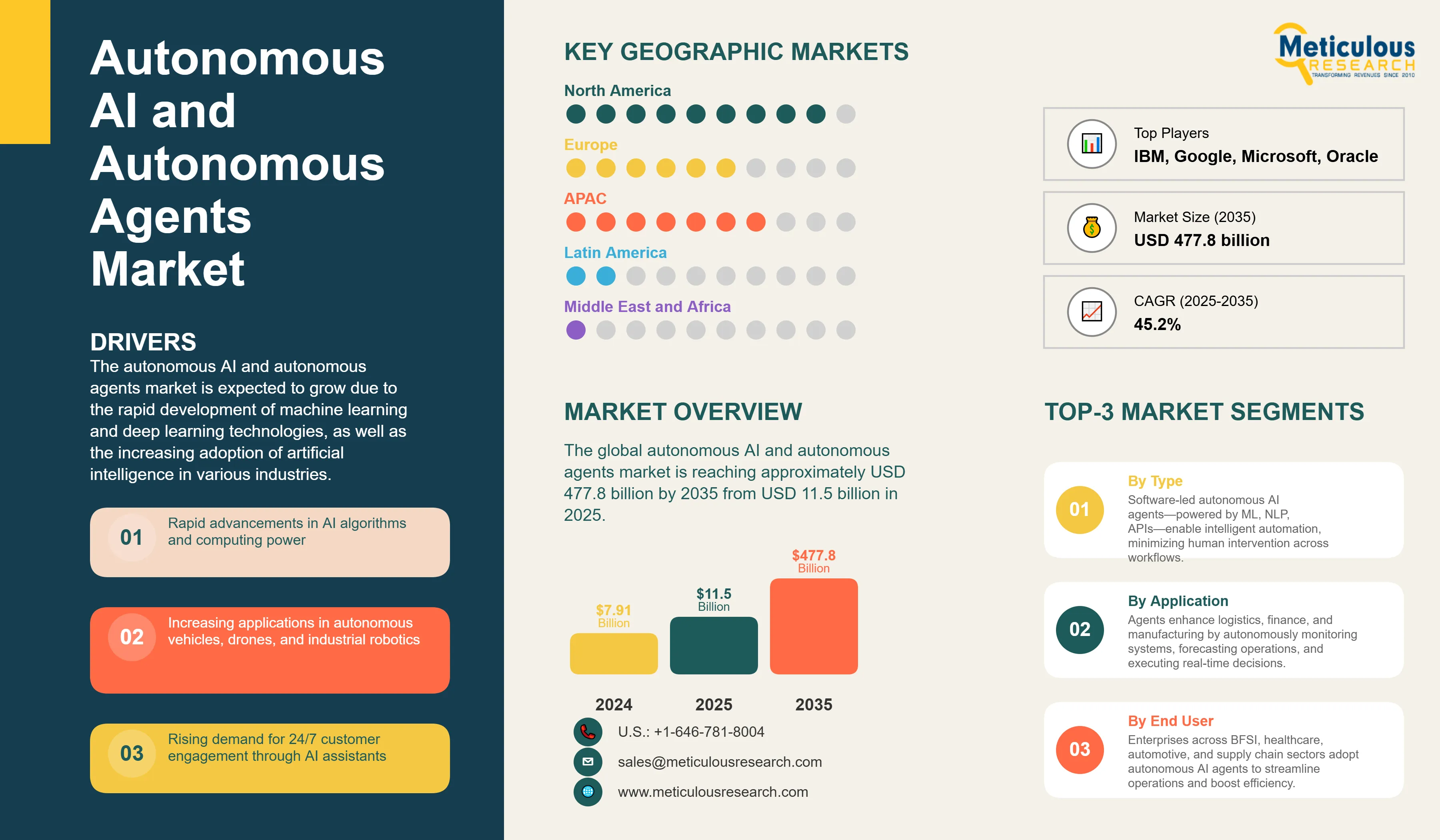
The global autonomous AI and autonomous agents market was valued at USD 7.91 billion in 2024. This market is expected to grow at 45.2% CAGR, reaching approximately USD 477.8 billion by 2035 from USD 11.5 billion in 2025.
The autonomous AI and autonomous agents market is expected to grow due to the rapid development of machine learning and deep learning technologies, as well as the increasing adoption of artificial intelligence in various industries. The utilization of autonomous agents in the financial sector enhances efficiency and contributes to greater accuracy in decision-making, helping financial institutions navigate the complexities of today's dynamic markets.
Machine learning & deep learning are key technologies in the auto industry. ML and deep learning allow the car to learn from its data and enhance its driving performance over time. Neural networks, for instance, are trained to identify objects and recognize traffic signals and signs. These advancements in autonomous AI, bolstered by machine learning and deep learning technologies, are not only revolutionizing vehicle safety but also paving the way for the development of self-driving cars that can navigate complex environments with precision and reliability.
Competitive Scenario and Insights
Click here to: Get Free Sample Pages of this Report
The autonomous AI and autonomous agents market is quite competitive and major high holders are interested in being innovative, scalable, and be able to integrate it with their activities or offerings. The old technology giants such as Google DeepMind, IBM, Microsoft, and Amazon are continuing to build on their formidable AI research and cloud capabilities to offer advanced autonomous solutions, with new startups, including Adept AI and Fetch.ai offering highly focused, and niche use-cases. The factor further contributes to competition as companies invest heavily in R&D to increase flexibility of adaptation and accurate decision making and real-time processing. Strategic alliances, acquisitions and cross-industry cooperation are also prevalent, and allow the players to integrate AI skills with their own knowledge in specific area e.g. having AI experts combine with automotive developers on autonomous vehicles.
Recent Developments
Wipro & Google Cloud Launching Agentic AI Solutions
In August 2025, Wipro, an Indian IT giant has collaborated with Google Cloud to roll-out 200 AI agents across healthcare, banking, retail, manufacturing and IT. The initiative involves the application of domain knowledge and expertise of Wipro and the reliable cloud capabilities of Google to offer scalable industry specific agentic AI capabilities.
Manus Launches Broad Research Platform for Multi-Agent Collaboration
In July 2025, Singaporean (China-based) startup Manus AI launched a new platform, called Broad Research, will enable the deployment and operation of more than 100 general-purpose artificial intelligence agents in parallel. Each agent is independent, although together they work on projects that require many people, including product analysis and web scraping, report writing and creative content.
Key Market Drivers
Key Market Restraints
Table: Key Factors Impacting Global Autonomous AI and Autonomous Agents Market Analysis and Forecast (2025–2035)
Base CAGR: 45.2%
|
Category |
Key Factor |
Short-Term Impact (2025–2028) |
Long-Term Impact (2029–2035) |
Estimated CAGR Impact |
|
Drivers |
1. Rising Demand for Automation Across Industries |
Increased deployment of autonomous agents in logistics, customer service, and manufacturing |
Integrated DEW systems become standard in naval, air, and ground forces |
▲ +3.4% |
|
2. Advancements in AI Algorithms & Processing Power |
Enhanced decision-making speed and accuracy for complex tasks |
AI agents capable of fully autonomous, multi-domain problem-solving |
▲ +3.1% |
|
|
3. Growth in Autonomous Mobility & Robotics |
Expanded adoption in self-driving vehicles, drones, and service robots |
Autonomous transportation and robotics becoming mainstream in urban and industrial ecosystems |
▲ +2.9% |
|
|
Restraints |
1. High Development & Deployment Costs |
Limits adoption among SMEs due to upfront investment |
Cost reduction through economies of scale and AI-as-a-Service models |
▼ −1.5% |
|
2. Data Privacy & Security Concerns |
Risk of breaches slowing adoption in sensitive sectors like finance and healthcare |
Implementation of advanced encryption, compliance frameworks, and secure AI models |
▼ −1.3% |
|
|
Opportunities |
1. Expansion into Smart Cities & Healthcare Automation |
Deployment of AI agents for traffic management, patient monitoring, and city services |
Fully autonomous city infrastructure and AI-driven healthcare systems |
▲ +3.0% |
|
2. Integration with IoT & Edge Computing |
Real-time AI decision-making in connected devices and sensors |
Large-scale, low-latency AI ecosystems with autonomous coordination |
▲ +2.7% |
|
|
Trends |
1. Multi-Agent Collaboration Platforms |
Early adoption of platforms enabling coordinated task execution by multiple agents |
Industry-wide standardization for distributed autonomous agent networks |
▲ +2.5% |
|
Challenges |
1. Ethical & Regulatory Uncertainty |
Delays in adoption due to unclear compliance requirements |
Establishment of global AI governance and ethical standards |
▼ −1.0% |
Regional Analysis
North America Dominates the Autonomous Agents and Autonomous AI Market
North America is estimated to hold the largest revenue share of around 40% in the autonomous AI and autonomous agents market in 2025, because of a powerful technological infrastructure, the high adoption rate in the sectors, and considerable investments in the major AI companies. The grazing of the market by the giants such as Google, Microsoft, IBM and Amazon, has fast-tracked the growth and introduction of the sophisticated autonomous agents across the domains of money, shipping, medicine, and even cars. For instance, Waymo, an autonomous driving company owned by Alphabet, has led the way in the autonomous vehicle industry.
By 2024, the Waymo ride-hailing service, Waymo One was available in several American cities, such as Phoenix, San Francisco, and Los Angeles. The service has recorded more than 250,000 self-driving taxi rides weekly proving the feasibility and practicality of autonomous agents in the city-driven transport.
Asia Pacific Rises as the Fastest Growing Region
The Asia Pacific region is expected to witness a rapid CAGR of around 50% during the forecast period, primarily due to a high level of digitalization, massive AI research, and government-funded automation programs. Countries such as China, Japan and South Korea are progressively investing in AI-led robotics, self-governing vehicles, and clever foundation assignments. For instance, Apollo autonomous driving program developed by Baidu in China presents the achievements of the Chinese region in terms of the scale of autonomous mobility solutions deployment in the region and indicates its fast-growing growth curve.
Country-level Analysis
Strong Innovation and Enterprise Adoption in the U.S.
The autonomous AI and autonomous agents market is dominated by the United States with its extensive technological infrastructure, extensive research and development potential, and the presence of worldwide artificial intelligence frontrunners, Google, IBM, Microsoft, and Amazon. Various industries such autonomous driving, defense, healthcare, and the finance industry in the country have witnessed wide usage of AI agents. An example of large-scale, real-world adoption of AI with regard to transport is the Waymo self-driving city-based ride-hailing service in places such as Phoenix.
China’s Government Support and Large-Scale Deployment
China is actively developing the autonomous AI which is also supported by well-developed government policies, large investments in AI research, and the rapid development of industrial automation. The largest technology companies such as Baidu, Alibaba, and Tencent are working on autonomous vehicle AI agents, smart city/manufacturing AI agents. As an example, the Baidu Apollo Go robotaxi service is available in several cities, emphasising the potential of China to scale the autonomous mobility option across the country.
Emerging Hub for Autonomous AI Development in India
India is also taking its place as a major actor in the self-driving AI and autonomous agents industry, where more than 80% of the companies are currently working on developing the autonomous agents. This rather significant increase toward Agentic AI implies that more people become interested in the possibility to use autonomous agents to improve the business activities. Although India has adopted major progress in the development of AI, a few challenges still face the development of the basis of AI technologies, which will eventually constrain universal competitiveness in the global AI competition.
Segmental Analysis
By Component, Software Segment Dominated the Market with Highest Revenue Share of 50-60%.
The software component segment accounted for the highest revenue share of 50-60% in the autonomous AI and autonomous agents market. This supremacy is supported by the mainstreaming of AI algorithms, machine learner models, natural language processors, and application programming interfaces (APIs) that help autonomous agents carry out complex processes with little human interference. For instance, AI agents in Salesforce using Agentforce technology have processed 66% of inquiries made on the website and 84% of queries made by customers, which immensely improved operational efficiency and customer satisfaction.
Similarly, in April 2025, Nvidia targets has launched the the NeMo microservices platform by enabling the construction of autonomous AI agents through offering businesses marine flexible, open-weight AI systems that contain less reliance on proprietary systems. These developments indicate the paramount importance of software in developing the growth and operation of autonomous AI systems across the industries.
By Technology, Machine Learning Segment held the Majority Share of 35-40%
The majority of the market share of 35-40% of the autonomous AI and autonomous agents market was expected to acquire by machine learning segment. The possibility to use machine learning algorithms to analyze large data, identify patterns, and make predictive decisions about autonomous agents in various activities contributes to the growth of this segment. Banks, healthcare and retail institutions are seeing an increased trend in deploying machine learning agents to automate risk analysis, diagnosis and prognosis, inventory planning and personalized suggestions.
For instance, in BFSI sector, the modern credit scoring models supported by AI and machine learning have reached USD 2 million loan applications monthly replacing manual effort and increasing accuracy of approvals. Moreover, advances in reinforcement learning and neural network structures are advancing in making agents in autonomous systems more versatile and versatile, which makes machine learning the most critical technology in market growth.
|
Report Attribute |
Details |
|
Market size (2025) |
USD 11.5 billion |
|
Revenue forecast in 2035 |
USD 477.8 billion |
|
CAGR (2025-2035) |
45.2% |
|
Base Year |
2024 |
|
Forecast period |
2025 – 2035 |
|
Report coverage |
Market size and forecast, competitive landscape and benchmarking, country/regional level analysis, key trends, growth drivers and restraints |
|
Segments covered |
Component (Services, Software, and Hardware), Technology (NLP, Machine Learning, Computer Vision, and Context Awareness), Deployment, End-Use Industry, Geography |
|
Regional scope |
North America, Europe, Asia-Pacific, Latin America, and Middle East & Africa |
|
Key companies profiled |
IBM, Google, Microsoft, Waymo LLC, Oracle, Nvidia Corporation, Deepmind, Salesforce, OpenAI, SAP SE, and Other Key Players. |
|
Customization |
Comprehensive report customization with purchase. Addition or modification to country, regional & segment scope available |
|
Pricing Details |
Access customized purchase options to meet your specific research requirements. Explore flexible pricing models |
Market Segmentation
The autonomous AI and autonomous agents market size is estimated to be USD 11.5 billion in 2025 and grow at a CAGR of 45.2% to reach USD 477.8 billion by 2035.
In 2024, the autonomous AI and autonomous agents market size was estimated at USD 7.9 billion, with projections to reach USD 11.5 billion in 2025.
IBM, Google, Microsoft, Waymo LLC, Oracle, and Nvidia Corporation are the major companies operating in the autonomous AI and autonomous agents market.
The Asia Pacific region is projected to grow at the highest CAGR over the forecast period (2025-2035), driven by high level of digitalization, massive AI research, and government-funded automation programs.
By Component, in 2025, software segment is expected to account for the largest market share in the autonomous AI and Autonomous Agents market
1. Market Definition & Scope
1.1. Market Definition
1.2. Market Ecosystem
1.3. Currency
1.4. Key Stakeholders
2. Research Methodology
2.1. Research Approach
2.2. Process of Data Collection and Validation
2.2.1. Secondary Research
2.2.2. Primary Research/Interviews with Key Opinion Leaders from the Industry
2.3. Market Sizing and Forecast
2.3.1. Market Size Estimation Approach
2.3.1.1. Bottom-up Approach
2.3.1.2. Top-down Approach
2.3.2. Growth Forecast Approach
2.3.3. Assumptions for the Study
3. Executive Summary
3.1. Overview
3.2. Segmental Analysis
3.2.1. Autonomous AI and Autonomous Agents Market, by Component
3.2.2. Autonomous AI and Autonomous Agents Market, by Technology
3.2.3. Autonomous AI and Autonomous Agents Market, by Deployment
3.2.4. Autonomous AI and Autonomous Agents Market, by End-Use Industry
3.2.5. Autonomous AI and Autonomous Agents Market, by Region
3.3. Competitive Landscape
3.4. Strategic Recommendations
4. Market Insights
4.1. Overview
4.2. Factors Affecting Market Growth
4.2.1. Drivers
4.2.1.1. Rapid advancements in AI algorithms and computing power
4.2.1.2. Increasing applications in autonomous vehicles, drones, and industrial robotics
4.2.1.3. Rising demand for 24/7 customer engagement through AI assistants
4.2.2. Restraints
4.2.2.1. High development, deployment, and maintenance costs
4.2.2.2. Data privacy and cybersecurity risks
4.2.2.3. Lack of skilled professionals for AI system management
4.2.3. Opportunities
4.2.3.1. Expansion into emerging sectors like smart cities and healthcare automation
4.2.3.2. Integration with IoT and edge computing for real-time decision-making
4.2.4. Trends
4.2.4.1. Growing use of multi-agent collaboration platforms (e.g., Manus Broad Research)
4.2.4.2. Adoption of agentic AI in enterprise-level automation solutions
4.2.5. Challenges
4.2.5.1. Ethical concerns and bias in AI decision-making
4.2.5.2. Regulatory uncertainties across different regions
4.3. Porter's Five Forces Analysis
4.3.1. Bargaining Power of Suppliers
4.3.2. Bargaining Power of Buyers
4.3.3. Threat of Substitutes
4.3.4. Threat of New Entrants
4.3.5. Degree of Competition
4.4. Technology Impact on Autonomous AI and Autonomous Agents Market
4.4.1. Advanced Natural Language Processing (NLP)
4.4.1.1. Enables contextual understanding for more human-like interactions
4.4.1.2. Supports multi-language capabilities for global deployment
4.4.1.3. Improves sentiment analysis for better customer engagement
4.4.2. Reinforcement Learning & Adaptive Decision-Making
4.4.2.1. Allows agents to learn from real-time feedback
4.4.2.2. Enhances performance in dynamic and unpredictable environments
4.4.2.3. Supports self-optimization without human intervention
5. Impact of Sustainability on Autonomous AI and Autonomous Agents Market
5.1. Reducing energy consumption in AI operations
5.2. Optimizing resource usage via intelligent automation
5.3. Lowering carbon footprint of data centers
5.4. Promoting eco-friendly software and hardware solutions
5.5. Enhancing operational efficiency across industries sustainably
5.6. Encouraging green AI adoption in enterprises
5.7. Supporting long-term environmental compliance initiatives
6. Competitive Landscape
6.1. Overview
6.2. Key Growth Strategies
6.3. Competitive Benchmarking
6.4. Competitive Dashboard
6.4.1. Industry Leaders
6.4.2. Market Differentiators
6.4.3. Vanguards
6.4.4. Contemporary Stalwarts
6.5. Market Share/Ranking Analysis, by Key Players, 2024
7. Autonomous AI and Autonomous Agents Market Assessment—By Component Type
7.1. Overview
7.2. Services
7.3. Software
7.4. Hardware
8. Autonomous AI and Autonomous Agents Market Assessment—By Technology
8.1. Overview
8.2. NLP
8.3. Machine Learning
8.4. Computer Vision
8.5. Context Awareness
9. Autonomous AI and Autonomous Agents Market Assessment—By Deployment
9.1. Overview
9.2. Airborne-based DEW
9.3. Land-based DEW
9.4. Ship-based DEW
9.5. Space-based DEW
10. Autonomous AI and Autonomous Agents Market Assessment—By End-Use Industry
10.1. Overview
10.2. Defense
10.3. BFSI
10.4. IT/Telecom
10.5. Healthcare
10.6. Automotive & Transportation
10.7. Manufacturing
10.8. Retail & E-commerce
10.9. Energy & Utilities
10.10. Other End-use Industries
11. Autonomous AI and Autonomous Agents Market Assessment—By Geography
11.1. Overview
11.2. North America
11.2.1. U.S.
11.2.2. Canada
11.3. Europe
11.3.1. Germany
11.3.2. U.K.
11.3.3. France
11.3.4. Netherlands
11.3.5. Switzerland
11.3.6. Rest of Europe
11.4. Asia-Pacific
11.4.1. China
11.4.2. Japan
11.4.3. South Korea
11.4.4. Taiwan
11.4.5. India
11.4.6. Singapore
11.4.7. Australia
11.4.8. Rest of Asia-Pacific
11.5. Latin America
11.5.1. Brazil
11.5.2. Mexico
11.5.3. Argentina
11.5.4. Rest of Latin America
11.6. Middle East & Africa
11.6.1. UAE
11.6.2. Saudi Arabia
11.6.3. Israel
11.6.4. South Africa
11.6.5. Rest of Middle East & Africa
12. Company Profiles (Business Overview, Financial Overview, Product Portfolio, Strategic Developments, and SWOT Analysis)
12.1. IBM
12.2. Google
12.3. Microsoft
12.4. Waymo LLC
12.5. Oracle
12.6. Nvidia Corporation
12.7. Deepmind
12.8. Salesforce
12.9. OpenAI
12.10. SAP SE
12.11. Other Key Players
13. Appendix
13.1. Available Customization
13.2. Related Reports





















Published Date: Jan-2023
Published Date: Sep-2024
Subscribe to get the latest industry updates