
Industrial Edge Devices Market (2026-2036)
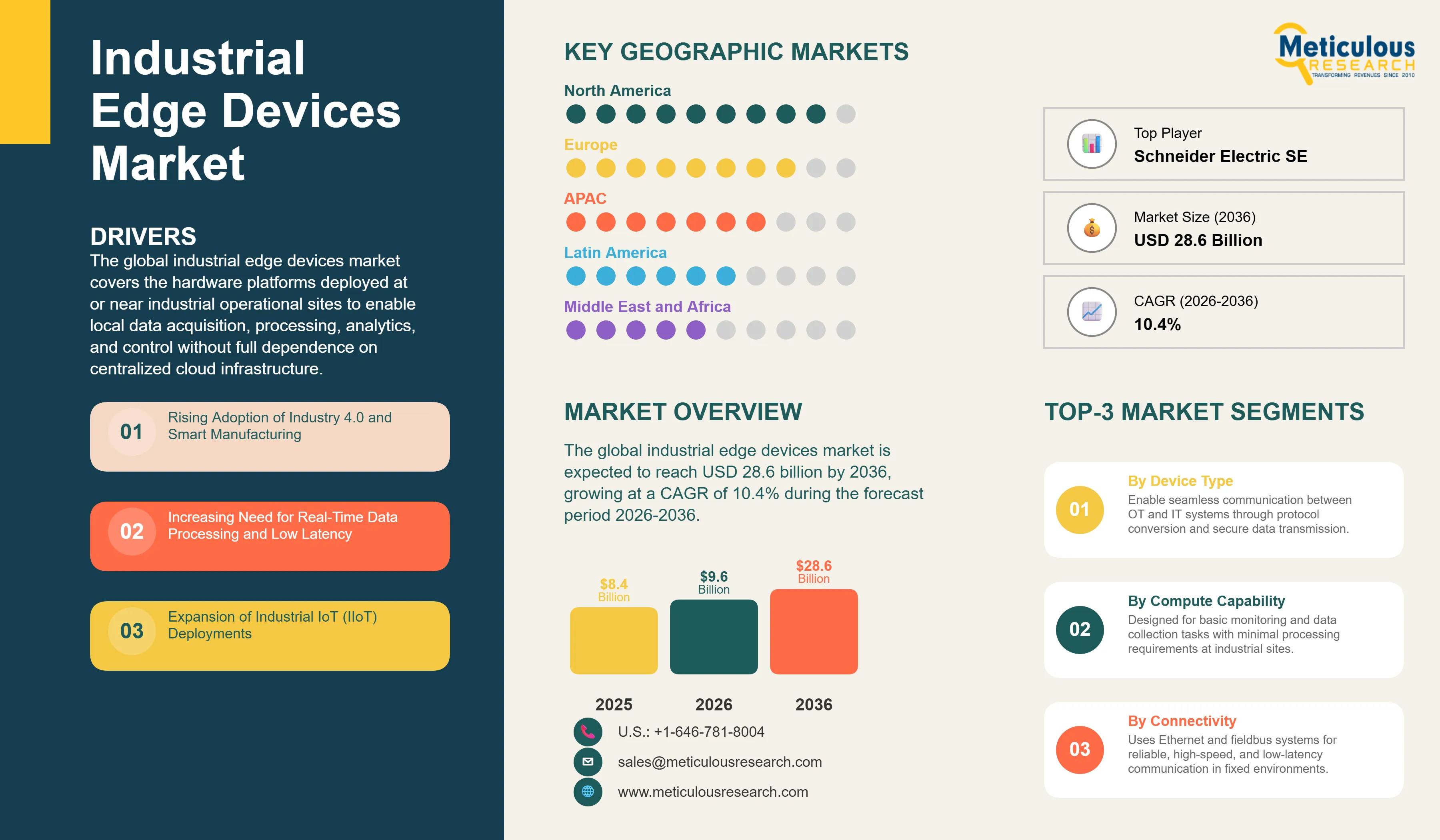
The global industrial edge devices market was valued at USD 8.4 billion in 2025. This market is expected to reach USD 28.6 billion by 2036 from an estimated USD 9.6 billion in 2026, growing at a CAGR of 10.4% during the forecast period 2026-2036.
- Published
- Apr 2026
- Pages
- 277
- Format
- PDF + Excel
- Report ID
- MR-1895
- Base year
- 2025
- 2025 · BASELINE
- $8.40B
- 2036
- $28.60B
- CAGR 2026–2036
- 10.4%
2025 baseline · 2026–2036 forecast at 10.4% CAGR · hover a bar for the value
Key highlights
The global industrial edge devices market is projected to reach USD 28.6 billion by 2036.
The market is expected to grow at a CAGR of 10.4% during the forecast period 2026-2036.
The market was valued at USD 8.4 billion in 2025 and is estimated to reach USD 9.6 billion in 2026.
North America is expected to dominate the global industrial edge devices market with the largest market share in 2026.
By device type, the edge gateways segment is expected to hold the largest share in 2026.
By compute capability, the medium-compute devices segment is expected to hold the largest share in 2026.
By connectivity, the wired connectivity segment is expected to hold the largest share in 2026.
By deployment mode, the on-premises edge deployment segment is expected to hold the largest share in 2026.
By application, the manufacturing and smart factories segment is expected to hold the largest share in 2026.
By end user, the large enterprises segment is expected to hold the largest share in 2026.
By industry vertical, the automotive segment is expected to hold the largest share in 2026.
Report summary
| Particulars | Details |
|---|---|
| Market Size by 2036 | USD 28.6 Billion |
| Market Size in 2026 | USD 9.6 Billion |
| Market Size in 2025 | USD 8.4 Billion |
| Revenue Growth Rate (2026-2036) | CAGR of 10.4% |
| Format | PDF, Excel & Cloud Portal · 277 pages |
| Dominating Device Type | Edge Gateways |
| Fastest Growing Device Type | Edge AI Devices |
| Dominating Compute Capability | Medium-Compute Devices |
| Fastest Growing Compute Capability | High-Compute Devices (AI/ML) |
| Dominating Connectivity | Wired Connectivity (Ethernet, Fieldbus) |
| Fastest Growing Connectivity | Cellular Connectivity (4G, 5G) |
| Dominating Deployment Mode | On-Premises Edge Deployment |
| Fastest Growing Deployment Mode | Hybrid Edge-Cloud Deployment |
| Dominating Application | Manufacturing and Smart Factories |
| Fastest Growing Application | Transportation and Logistics |
| Dominating End User | Large Enterprises |
| Fastest Growing End User | Small and Medium Enterprises (SMEs) |
| Dominating Industry Vertical | Automotive |
| Fastest Growing Industry Vertical | Pharmaceuticals |
| Dominating Geography | North America |
| Fastest Growing Geography | Asia-Pacific |
| Base Year | 2025 |
| Forecast Period | 2026 to 2036 |
Report overview
Segments covered: device type, compute capability, connectivity, deployment mode, application, end user, industry vertical.
The global industrial edge devices market covers the hardware platforms deployed at or near industrial operational sites to enable local data acquisition, processing, analytics, and control without full dependence on centralized cloud infrastructure. The market encompasses edge gateways that bridge operational technology and information technology networks, edge controllers including programmable logic controllers and programmable automation controllers, industrial edge computers and rugged servers, smart sensors and data acquisition systems, and edge AI devices including AI accelerators and vision processing units. These devices collectively serve manufacturing, energy, oil and gas, transportation, healthcare, and warehouse automation applications where low-latency decision-making, network resilience, and data sovereignty requirements make on-premises edge compute essential.
The market's growth is anchored in the accelerating adoption of Industry 4.0 frameworks across global manufacturing, with industrial enterprises investing in edge devices as the foundational data layer for predictive maintenance, quality inspection, autonomous robotics, and real-time process optimization. The convergence of edge compute with embedded AI inference capabilities is transforming edge devices from passive data collectors to active intelligence nodes capable of executing machine learning models locally, enabling applications such as computer vision-based defect detection, anomaly detection in rotating machinery, and automated process control that require sub-millisecond response times incompatible with cloud-round-trip latency.
Despite strong growth fundamentals, the market faces structural constraints. High upfront capital expenditure for edge device deployment, particularly for large-scale IIoT rollouts across distributed industrial sites, limits adoption velocity among cost-sensitive manufacturers and small to medium enterprises. Integration of new edge devices with decades-old operational technology infrastructure, including legacy programmable logic controllers, SCADA systems, and proprietary industrial communication protocols, requires significant engineering effort and system integration expertise that prolongs deployment timelines and increases total cost of ownership.
These constraints are progressively being addressed. Standardization around open protocols including OPC UA over TSN, MQTT, and containerized edge software frameworks such as AWS Greengrass, Azure IoT Edge, and Linux Foundation's LF Edge is reducing interoperability friction. The growing availability of managed edge-as-a-service offerings from Siemens, Rockwell Automation, and Schneider Electric is lowering the operational burden on industrial customers without deep edge compute expertise, making broader deployment economically viable across the SME segment for the first time.
Report infographic
Market dynamics
9 factors across 3 forcesRising Adoption of Industry 4.0 and Smart Manufacturing
The global rollout of Industry 4.0 frameworks across discrete and process manufacturing is the primary structural driver of industrial edge device demand. Smart factory initiatives at automotive OEMs, electronics manufacturers, and heavy industry operators require a dense network of edge devices to collect, process, and act on production data in real time. Siemens' Industrial Metaverse program, Rockwell Automation's Connected Enterprise, and Schneider Electric's EcoStruxure architecture all position edge devices as the essential on-premises infrastructure layer enabling digital twin synchronization, closed-loop quality control, and autonomous production scheduling. Government manufacturing competitiveness programs including Germany's Platform Industrie 4.0, China's Made in China 2025, and the U.S. Department of Energy's Manufacturing USA network are co-funding smart factory deployments that directly drive industrial edge hardware procurement across their respective national manufacturing bases.
4.2.1.2 Need for Real-Time Data Processing and Low Latency
Industrial applications including robotic motion control, machine vision quality inspection, process safety interlocks, and autonomous guided vehicle navigation require deterministic response times of less than one millisecond that cannot be achieved through cloud-dependent architectures. Edge devices process sensor and machine data locally at the point of generation, enabling control loop response within the microsecond to millisecond range required for these applications without network round-trip delay. The deployment of time-sensitive networking standards including IEEE 802.1 TSN across industrial Ethernet infrastructure is enabling edge devices to guarantee deterministic latency across multi-node industrial networks, supporting synchronized multi-axis motion control and real-time safety system applications that previously required proprietary fieldbus architectures.
Table of contents
15 chapters · 174 sections · 277 pages · click to expandSegmental analysis
| Segment | Largest share (2026) | Fastest growth (2026–2036) |
|---|---|---|
| By Device Type | Edge Gateways | Edge AI devices |
| By Application | Manufacturing and Smart Factories | Transportation and logistics |
| By End User | Large Enterprises | SME |
| By Industry Vertical | Automotive | Pharmaceuticals |
By Device Type
- Edge Gateways to Dominate
- The edge gateways segment is expected to account for the largest share of the market.
- Edge gateways serve as the universal connectivity and protocol translation layer bridging operational technology equipment using legacy industrial protocols including Modbus, PROFIBUS, EtherNet/IP, and HART with IP-based enterprise and cloud networks.
- Their role as the entry point for IIoT connectivity deployments across installed base manufacturing equipment makes them the most broadly deployed industrial edge device category, with near-universal adoption across greenfield and brownfield industrial IoT projects.
- Leading gateway suppliers including Advantech, Moxa, Cisco, and Siemens serve millions of installed units across automotive, process industry, and utility sector deployments.
- Edge AI devices is projected to register the highest CAGR during the forecast period.
- The deployment of AI inference accelerator hardware for visual inspection, predictive maintenance, and autonomous guidance applications is expanding the edge AI device market rapidly as AI model development tools, pre-trained industrial model libraries, and edge AI deployment frameworks mature, reducing the development burden for industrial customers deploying AI at the edge for the first time.
- Medium-Compute Devices to Hold the Largest Share
- The medium-compute devices segment is expected to account for the largest share, reflecting the broad deployment of edge gateways and industrial PCs capable of real-time data processing, protocol translation, and lightweight analytics across the majority of industrial IoT applications that do not require dedicated AI inference silicon.
- Medium-compute platforms from Advantech, Kontron, and Beckhoff address the mainstream industrial computing market with sufficient processing capability for most data aggregation, visualization, and condition monitoring applications.
- High-compute devices (AI/ML processing) is projected to register the highest CAGR, driven by the structural adoption of edge AI inference for machine vision, predictive analytics, and autonomous control applications that require GPU, VPU, or custom AI accelerator processing capability not available in conventional embedded industrial compute platforms.
- Wired Connectivity to Hold the Largest Share
- The wired connectivity segment is expected to account for the largest share, reflecting the dominance of Industrial Ethernet including PROFINET, EtherNet/IP, and EtherCAT as the primary connectivity standard for deterministic, high-bandwidth machine control and data acquisition in fixed industrial plant environments where wired infrastructure provides reliability, latency, and bandwidth advantages over wireless alternatives.
- Cellular connectivity (4G, 5G) is projected to register the highest CAGR, driven by the deployment of private 5G networks at automotive, mining, and port facilities enabling mobile industrial edge applications including autonomous guided vehicles, remote-operated equipment, and distributed sensor networks that require cellular connectivity to serve mobile or geographically dispersed asset monitoring applications.
- On-Premises Edge Deployment to Hold the Largest Share
- The on-premises deployment segment is expected to account for the largest share, driven by industrial customers' operational continuity requirements, data sovereignty regulations, and the latency-critical nature of real-time process control applications that mandate local processing independent of internet connectivity availability.
- Process industries including oil and gas, chemicals, and power generation favor pure on-premises edge architectures for safety-critical control loop applications.
- Hybrid edge-cloud deployment is projected to register the highest CAGR as cloud-connected edge architectures mature, enabling customers to run time-critical control and safety applications locally while offloading historical data storage, advanced analytics, digital twin synchronization, and fleet-level predictive maintenance model training to cloud platforms, achieving the operational benefits of both local and cloud computing within a unified architecture.
By Application
- Manufacturing and Smart Factories to Hold the Largest Share
- The manufacturing and smart factories segment is expected to account for the largest share of the market.
- Manufacturing represents the broadest and most mature deployment domain for industrial edge devices, encompassing discrete manufacturing for automotive, electronics, and aerospace as well as process manufacturing for chemicals, food and beverage, and pharmaceuticals.
- The density of edge device deployments per factory floor, combined with the large global installed base of manufacturing facilities undergoing smart factory transformation, makes manufacturing the dominant application segment by both device unit volume and revenue value.
- Transportation and logistics is projected to register the highest CAGR during the forecast period, driven by the deployment of edge intelligence for autonomous port operations, smart railway infrastructure, connected vehicle telematics, and warehouse automation including autonomous mobile robot fleets that require real-time edge compute at distributed logistics nodes.
By End User
- Large Enterprises to Hold the Largest Share
- The large enterprises segment is expected to account for the largest share of the market, reflecting the concentration of industrial edge device procurement at global manufacturers, utilities, and oil and gas majors with the capital budgets, IT/OT integration teams, and organizational scale required to deploy edge infrastructure across multi-site production networks.
- Large enterprises including Toyota, BASF, Siemens Energy, and BP are deploying edge compute at hundreds to thousands of facilities simultaneously, generating procurement volumes that dominate market revenue.
- The SME segment is projected to register the highest CAGR during the forecast period, driven by the proliferation of affordable, simplified edge device platforms and managed service consumption models that are progressively making industrial edge compute accessible to smaller manufacturers previously priced out of enterprise-grade edge infrastructure.
By Industry Vertical
- Automotive to Hold the Largest Share
- The automotive segment is expected to account for the largest share of the market.
- Automotive manufacturing plants deploy some of the highest densities of industrial edge devices globally, spanning programmable logic controllers for robotic welding and assembly lines, edge vision systems for quality inspection, edge compute nodes for autonomous guided vehicle fleets, and private 5G gateways for mobile manufacturing applications.
- The automotive industry's advanced Industry 4.0 adoption maturity and high capital investment capacity make it the dominant industry vertical by edge device deployment scale and spend.
- This segment is particularly important for demand mapping given its high edge device intensity per production facility and the ongoing retooling of automotive manufacturing for electric vehicle production.
- Pharmaceuticals is projected to register the highest CAGR during the forecast period, driven by the pharmaceutical industry's accelerating adoption of digital manufacturing frameworks under the FDA's Pharma 4.0 initiative and the European Medicines Agency's digital manufacturing guidance, which require real-time process analytical technology data collection, continuous process verification, and electronic batch record systems that depend on industrial edge infrastructure for low-latency data acquisition and process control at manufacturing critical quality attributes.
Geographic analysis
North America
Largest shareIn 2026, North America is expected to account for the largest share of the global industrial edge devices market. The region's dominance reflects the concentration of leading industrial automation technology vendors, the advanced Industry 4.0 adoption maturity of U.S. and Canadian manufacturing, and the significant federal investment in industrial digitalization through the Department of Energy's Manufacturing USA institutes and the Department of Commerce's CHIPS Act-linked smart manufacturing programs. The United States hosts the largest installed base of connected industrial facilities outside of East Asia, with automotive, aerospace, oil and gas, and food and beverage manufacturers deploying edge infrastructure across hundreds of thousands of production sites. The presence of dominant market participants including Rockwell Automation, Cisco, Dell, HPE, Intel, Honeywell, and Emerson Electric in the United States creates a structurally strong domestic supply and systems integration ecosystem that accelerates enterprise edge adoption relative to other regions.
Europe
Europe represents the second largest regional market, anchored by Germany's world-leading industrial automation heritage and its structural position as the global center of Industry 4.0 technology development. German manufacturing conglomerates including Siemens, Bosch Rexroth, and Festo are among the most advanced adopters and developers of industrial edge infrastructure globally, and their supply to European and global customers creates substantial domestic market activity. The EU's European Green Deal industrial digitalization programs, the European Chips Act supporting domestic semiconductor and edge hardware manufacturing, and the strong manufacturing bases of Germany, France, Italy, the Netherlands, and Sweden collectively make Europe a high-value market for premium edge device solutions with strong regulatory compliance and cybersecurity requirements under the EU Cyber Resilience Act applicable to industrial connected devices from 2027.
Asia-Pacific
Fastest growthHowever, Asia-Pacific is expected to grow at the fastest CAGR during the forecast period. China's enormous manufacturing base undergoing continuous smart factory transformation under national industrial policy programs, Japan's strong industrial automation culture and the domestic edge device ecosystem centered on Mitsubishi Electric, Yokogawa, and Keyence, South Korea's advanced electronics and automotive manufacturing sectors, and India's rapidly expanding manufacturing investment under the Production Linked Incentive scheme collectively create the region's dominant growth dynamic. The concentration of global electronics manufacturing in China, South Korea, Taiwan, and increasingly Vietnam and Thailand is driving high-volume edge device deployments for machine vision, quality control, and automated material handling applications that are expanding the Asia-Pacific addressable market at above-global-average growth rates through the forecast period.
Competitive landscape
- Siemens AG · Germany
- Rockwell Automation Inc. (U.S.)
- Schneider Electric SE · France
- Cisco Systems Inc. (U.S.)
- Advantech Co. Ltd. · Taiwan
- Dell Technologies Inc. (U.S.)
- Hewlett Packard Enterprise (U.S.)
- IBM Corporation (U.S.)
- Intel Corporation (U.S.)
- ABB Ltd. · Switzerland
- Honeywell International Inc. (U.S.)
- Emerson Electric Co. (U.S.)
- Mitsubishi Electric Corporation · Japan
- Bosch Rexroth AG · Germany
- Yokogawa Electric Corporation · Japan
Frequently asked questions
The global industrial edge devices market is expected to reach USD 28.6 billion by 2036 from an estimated USD 9.6 billion in 2026, at a CAGR of 10.4% during the forecast period 2026-2036.
Cite this report
Meticulous Research. (2026). Industrial Edge Devices Market - Global Opportunity Analysis and Industry Forecast (2026-2036) (Report No. MR-1895). Meticulous Market Research Pvt. Ltd. https://www.meticulousresearch.com/product/industrial-edge-devices-market-6578