Resources
About Us
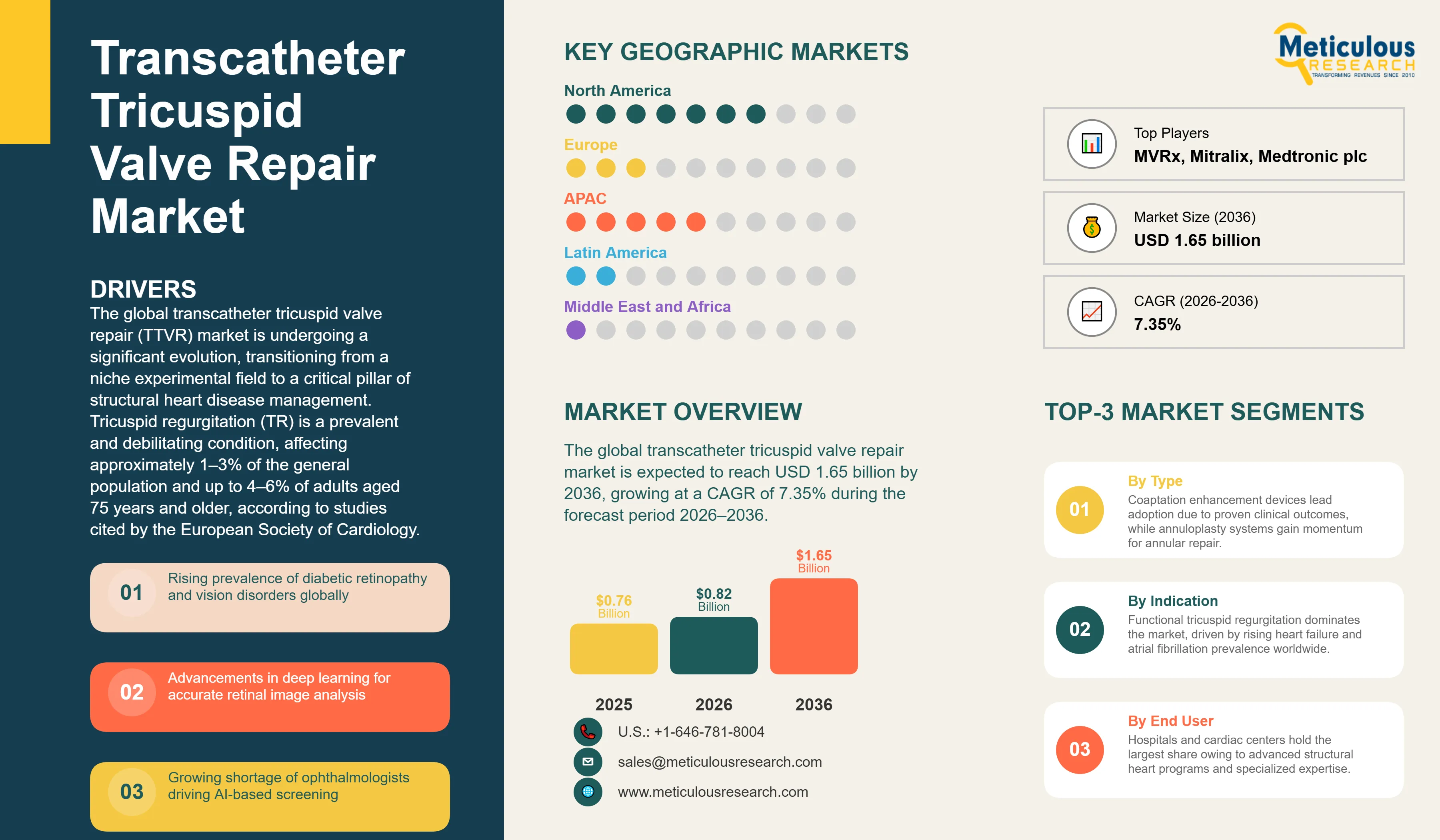
The global transcatheter tricuspid valve repair market was valued at USD 0.82 billion in 2026. This market is expected to reach USD 1.65 billion by 2036, growing at a CAGR of 7.35% during the forecast period 2026–2036.
Click here to: Get Free Sample Pages of this Report
The global transcatheter tricuspid valve repair (TTVR) market is undergoing a significant evolution, transitioning from a niche experimental field to a critical pillar of structural heart disease management. Tricuspid regurgitation (TR) is a prevalent and debilitating condition, affecting approximately 1–3% of the general population and up to 4–6% of adults aged 75 years and older, according to studies cited by the European Society of Cardiology. The prevalence of TR continues to increase as populations age and the burden of heart failure and atrial fibrillation rises. Despite its substantial clinical impact, TR has historically been undertreated, with studies indicating that fewer than 1% of patients with significant tricuspid valve disease undergo surgical intervention. This treatment gap is largely attributable to the elevated procedural risk associated with conventional surgery, where isolated tricuspid valve operations have historically reported in-hospital mortality rates of approximately 8–10% in high-risk patient populations.
The emergence of transcatheter tricuspid valve repair technologies offers a minimally invasive alternative for patients who are poor surgical candidates. The growing clinical need is further underscored by the increasing prevalence of atrial fibrillation, which affects approximately 60 million people worldwide, according to the World Heart Federation, and is a major contributor to functional TR. As clinical evidence continues to demonstrate improvements in symptoms, quality of life, and heart failure outcomes following transcatheter intervention, TTVR is rapidly emerging as one of the fastest-growing segments within the structural heart disease market.
The market's growth is fundamentally supported by the aging global population and the increasing incidence of heart failure, which often leads to functional tricuspid regurgitation (FTR) due to right ventricular dilation or atrial fibrillation. FTR accounts for more than 90% of all clinical TR cases, making it the primary target for TTVR interventions. Clinical data from the landmark TRILUMINATE Pivotal trial has been a major catalyst for market confidence, demonstrating that transcatheter edge-to-edge repair (TEER) using clip-based systems reduced TR to moderate or less in 87% of patients at one year, compared to only 4.8% in the medical therapy control group. These results, combined with the FDA's approval of dedicated tricuspid repair systems in early 2024, have established TTVR as a viable and superior standard of care for symptomatic patients.
The technological landscape of the TTVR market is becoming increasingly granular, with a diverse range of devices tailored to the complex and variable anatomy of the tricuspid valve. Coaptation enhancement devices, particularly TEER clips, currently dominate the market due to their early clinical validation and procedural simplicity. However, transcatheter annuloplasty systems are gaining significant traction as they address the root cause of functional TR—annular dilation. Direct annuloplasty devices have demonstrated the ability to reduce annular diameter by up to 25%, leading to significant improvements in NYHA functional class in over 70% of patients. Furthermore, the development of suture-based systems and heterotopic caval valve implantation (CAVI) for patients with torrential TR or 'unclippable' anatomy is expanding the treatable patient population and providing clinicians with a comprehensive toolkit for personalized repair.
Geographically, the market is characterized by a strong concentration of procedural volume in North America and Europe, where advanced structural heart programs and favorable reimbursement frameworks are well-established. In the United States, more than 500 hospitals have already developed the multidisciplinary expertise required to perform TTVR procedures. Meanwhile, the Asia-Pacific region is projected to witness the fastest growth, with a CAGR exceeding 10% in markets like China and Japan. This growth is fueled by the rapid expansion of healthcare infrastructure and a rising volume of structural heart procedures in major metropolitan centers. As clinical experience grows and more long-term durability data becomes available, the TTVR market is expected to continue its upward trajectory, ultimately reducing the global mortality and morbidity associated with untreated tricuspid valve disease.
The primary driver for the TTVR market is the high unmet clinical need in the vast population of patients with symptomatic tricuspid regurgitation. Severe TR is a life-threatening condition with a one-year mortality rate of up to 36% if left untreated. With over 1.6 million patients in the U.S. suffering from moderate-to-severe TR and only 8,000 receiving surgery annually, the treatment gap exceeds 99%. The development of safe, minimally invasive transcatheter options provides a critical alternative for high-risk patients. Furthermore, the clinical success of the TRILUMINATE trial, which showed an 87% success rate in TR reduction, has significantly boosted physician confidence and patient referrals.
Technological advancements in dedicated repair systems and intraprocedural imaging are also major drivers. The tricuspid valve's anatomy is significantly more complex than the mitral valve, requiring devices specifically designed for its thin leaflets and large, variable annulus. The integration of 3D transesophageal echocardiography (TEE) and intracardiac echocardiography (ICE) has been essential in improving procedural success rates and patient safety. Additionally, the favorable regulatory environment and the FDA's approval of dedicated systems in 2024 are accelerating market entry and adoption.
The high cost of transcatheter repair devices and the specialized infrastructure required for these procedures act as significant restraints. TTVR procedures are expensive and require advanced hybrid operating rooms and a multidisciplinary heart team, which may limit adoption in smaller medical centers or cost-sensitive healthcare systems. Furthermore, the technical complexity of the tricuspid valve demands a high level of operator skill and specialized training. The proximity of the tricuspid valve to the conduction system also poses a risk of heart block during certain annuloplasty procedures, requiring careful patient selection and procedural planning.
Significant opportunities exist in the expansion of TTVR therapies into emerging markets with improving healthcare infrastructure and a rising prevalence of heart failure. The development of next-generation repair systems that offer better durability, easier delivery, and the ability to treat 'massive' and 'torrential' TR classifications will open new market segments. Furthermore, the potential for combining TTVR with other structural heart interventions, such as TAVR or mitral repair, presents a unique opportunity for comprehensive heart failure management in patients with multi-valvular disease. The rising volume of cardiac rhythm device implantations also creates an opportunity for lead-sparing tricuspid repair techniques.
A critical challenge is the lack of extensive long-term (10+ years) clinical data regarding the durability of transcatheter repair devices compared to the surgical gold standard. Establishing consistent reimbursement pathways across diverse international markets is also a complex and time-consuming process for new, high-cost technologies. Additionally, the ongoing competition from emerging transcatheter tricuspid valve replacement (TTVR) systems, which may offer a more complete resolution of TR for certain patient populations with severely damaged leaflets, requires repair manufacturers to continuously innovate and demonstrate superior clinical value and safety.
The most significant trend in the TTVR market is the integration of advanced 3D imaging technologies to overcome the anatomical challenges of the tricuspid valve. Specialized structural heart centers are increasingly utilizing a combination of TEE, ICE, and fusion imaging to guide device placement with high precision. This trend is accompanied by the rise of multidisciplinary heart teams, where interventionalists, surgeons, and imaging specialists collaborate to ensure optimal patient selection and procedural planning, leading to improved clinical outcomes and higher procedural volumes.
There is a growing clinical trend toward earlier intervention in TR patients to prevent irreversible right ventricular damage. This shift is supported by the new five-grade classification of TR (mild, moderate, severe, massive, and torrential), which allows for a more granular assessment of disease severity and treatment efficacy. Clinicians are increasingly recognizing that reducing TR from 'torrential' to 'moderate' can have a profound impact on patient quality of life, even if the regurgitation is not completely eliminated.
Based on product type, the market is segmented into Coaptation Enhancement Devices, Annuloplasty Systems, Suture-Based Systems, and Caval Valve Implantation (CAVI). In 2026, the Coaptation Enhancement Devices segment, primarily TEER clips, is expected to hold the largest share of the market. This dominance is due to the early regulatory approvals of systems like TriClip and PASCAL and the high volume of clinical data supporting their safety and efficacy in reducing TR severity. The procedural simplicity and high success rate of TEER make it the first-line choice for most structural heart teams.
The Annuloplasty Systems segment is projected to register the fastest CAGR during the forecast period. This growth is driven by the increasing recognition that annuloplasty more closely addresses the underlying pathology of functional TR by resizing the dilated tricuspid annulus. Direct annuloplasty devices have shown a 25% reduction in annular diameter, and as these devices achieve more regulatory clearances, they are expected to gain significant market share, often used in combination with coaptation enhancement for complex cases.
Based on indication, the market is segmented into Functional Tricuspid Regurgitation (FTR), Degenerative Tricuspid Regurgitation, and Pacemaker-Induced Tricuspid Regurgitation. In 2026, the Functional TR segment is expected to hold the largest share of the market, accounting for more than 90% of clinical cases. FTR is secondary to right ventricular dilation or atrial fibrillation, conditions that are highly prevalent in the aging heart failure population. The vast number of patients with symptomatic FTR who are ineligible for surgery makes this the primary revenue driver for the market.
The Pacemaker-Induced TR segment is projected to witness the fastest growth during the forecast period. This is due to the rising volume of cardiac rhythm device implantations and the increasing awareness of TR caused by lead interference. The development of lead-sparing transcatheter repair techniques is addressing this specific patient population, driving rapid growth in this segment.
North America is expected to hold the largest share of the global TTVR market in 2026, driven by the early adoption of innovative structural heart therapies and a robust regulatory environment. The United States is the primary market, with more than 500 hospitals already having dedicated structural heart programs. Favorable reimbursement policies for FDA-approved transcatheter devices and high healthcare spending further support market dominance. The key companies operating in the North American market are Abbott Laboratories and Edwards Lifesciences.
Asia-Pacific is projected to witness the fastest growth during the forecast period, with a CAGR exceeding 10%. This growth is supported by the rapid expansion of healthcare infrastructure, increasing prevalence of heart failure, and growing clinical expertise in transcatheter interventions in countries like China and Japan. The presence of domestic manufacturers in China is also expected to drive market competition and affordability. The key companies operating in the Asia-Pacific market are Abbott, Edwards, and MicroPort Scientific.
The global TTVR market is highly competitive and dominated by major medical device corporations with extensive structural heart portfolios. Abbott Laboratories and Edwards Lifesciences are the clear market leaders, leveraging their established transcatheter valve platforms and strong clinical data from trials like TRILUMINATE and CLASP II TR. The competition is centered on device safety, ease of use, and the ability to treat a wide range of tricuspid anatomies, including those with large coaptation gaps.
Strategic acquisitions and licensing agreements are common as major players seek to expand their structural heart capabilities. For example, the acquisition of smaller biotechnology firms with novel annuloplasty or suture-based technologies is a key strategy for market leaders to diversify their portfolios. Clinical trial results play a critical role in market positioning, with manufacturers investing heavily in large-scale pivotal studies to secure regulatory approvals and physician trust. Key players in the global transcatheter tricuspid valve repair market include Abbott Laboratories, Edwards Lifesciences Corporation, Medtronic plc, Boston Scientific Corporation, MicroPort Scientific Corporation, Venus Medtech (Hangzhou) Inc., and Lepu Medical Technology (Beijing) Co., Ltd.
The market is projected to reach USD 1,652.8 million by 2036, growing at a CAGR of 7.35% from 2026 to 2036.
Coaptation Enhancement Devices, specifically TEER clips, are expected to hold the largest share in 2026.
The primary driver is the high unmet clinical need in the large population of high-risk TR patients who are ineligible for surgery.
The Pacemaker-Induced TR segment is expected to grow the fastest due to the rising volume of cardiac rhythm device implantations.
The trial demonstrated that TEER reduced TR to moderate or less in 87% of patients, significantly improving quality of life.
Asia-Pacific is projected to witness the highest CAGR due to expanding infrastructure and a large patient base in China and Japan.
Challenges include thin leaflets, a large and variable annulus, and the close proximity of the conduction system.
They aim to reduce and stabilize the tricuspid annulus to restore leaflet coaptation, addressing the root cause of functional TR.
Advanced 3D TEE and ICE are essential for precise device placement and assessment of repair success in the complex tricuspid anatomy.
The market is led by Abbott Laboratories and Edwards Lifesciences, followed by Medtronic, Boston Scientific, and MicroPort.
1. Market Definition & Scope
1.1. Market Definition
1.2. Market Ecosystem
1.3. Currency Considered
1.4. Key Stakeholders
2. Research Methodology
2.1. Research Approach
2.2. Process of Data Collection and Validation
2.2.1. Secondary Research
2.2.2. Primary Research/Interviews with Key Opinion Leaders
2.3. Market Sizing and Forecast
2.3.1. Market Size Estimation Approach
2.3.1.1. Bottom-Up Approach
2.3.1.2. Top-Down Approach
2.3.2. Growth Forecast Approach
2.3.3. Assumptions for the Study
3. Executive Summary
3.1. Overview
3.2. Segmental Analysis
3.2.1. Market Analysis, by Product Type
3.2.2. Market Analysis, by Indication
3.2.3. Market Analysis, by End User
3.2.4. Market Analysis, by Geography
3.3. Competitive Analysis
4. Market Insights
4.1. Overview
4.2. Factors Affecting Market Growth
4.2.1. Drivers
4.2.1.1. High Unmet Need in Untreated TR Population (Stats: 1.6M patients in U.S.)
4.2.1.2. Advancements in Dedicated Transcatheter Repair Systems and Imaging
4.2.1.3. Favorable Clinical Data (TRILUMINATE Trial Success: 87% reduction)
4.2.2. Restraints
4.2.2.1. High Device Costs and Specialized Infrastructure Requirements
4.2.2.2. Technical Complexity and Risk of Conduction System Interference
4.2.3. Opportunities
4.2.3.1. Expansion into Emerging Markets and Specialized Structural Heart Centers
4.2.3.2. Development of Lead-Sparing Repair Techniques for Pacemaker-Induced TR
4.2.4. Challenges
4.2.4.1. Lack of Extensive Long-term Durability Data vs. Surgical Standards
4.2.4.2. Reimbursement Hurdles for High-Cost Medical Technologies
4.2.5. Trends
4.2.5.1. Shift Toward Early Intervention and the New Torrential TR Classification
4.2.5.2. Integration of 3D TEE and ICE in Procedural Guidance
4.3. Porter’s Five Forces Analysis
4.4. Regulatory Landscape
4.5. Value Chain Analysis
5. Global Transcatheter Tricuspid Valve Repair Market, by Product Type
5.1. Overview
5.2. Coaptation Enhancement Devices (TEER Clips)
5.3. Annuloplasty Systems
5.3.1. Direct Annuloplasty
5.3.2. Indirect Annuloplasty
5.4. Suture-Based Systems
5.5. Caval Valve Implantation (CAVI)
6. Global Transcatheter Tricuspid Valve Repair Market, by Indication
6.1. Overview
6.2. Functional Tricuspid Regurgitation (FTR)
6.3. Degenerative Tricuspid Regurgitation
6.4. Pacemaker-Induced Tricuspid Regurgitation
7. Global Transcatheter Tricuspid Valve Repair Market, by End User
7.1. Overview
7.2. Hospitals & Cardiac Centers
7.3. Specialty Clinics
7.4. Academic & Research Institutes
8. Global Transcatheter Tricuspid Valve Repair Market, by Geography
8.1. Overview
8.2. North America
8.2.1. U.S.
8.2.2. Canada
8.3. Europe
8.3.1. Germany
8.3.2. France
8.3.3. U.K.
8.3.4. Italy
8.3.5. Spain
8.3.6. Rest of Europe
8.4. Asia-Pacific
8.4.1. China
8.4.2. Japan
8.4.3. India
8.4.4. Australia
8.4.5. Rest of Asia-Pacific
8.5. Latin America
8.5.1. Brazil
8.5.2. Mexico
8.5.3. Rest of Latin America
8.6. Middle East & Africa
9. Competitive Landscape
9.1. Overview
9.2. Key Growth Strategies
9.3. Competitive Dashboard
9.4. Vendor Market Positioning
9.5. Market Share Analysis, 2025
10. Company Profiles
10.1. Abbott Laboratories
10.2. Edwards Lifesciences Corporation
10.3. Medtronic plc
10.4. Boston Scientific Corporation
10.5. Terumo Corporation
10.6. MicroPort Scientific Corporation
10.7. Venus Medtech (Hangzhou) Inc.
10.8. Lepu Medical Technology (Beijing) Co., Ltd.
10.9. 4C Medical Technologies, Inc.
10.10. Peijia Medical Limited
10.11. HLT, Inc. (Bracco Group)
10.12. Structural Heart, Inc.
10.13. Cardiac Success Ltd.
10.14. Valcare Medical
10.15. Mitralix Ltd.
10.16. CoreMedic GmbH
10.17. MVRx, Inc.
10.18. BioVentrix, Inc.
10.19. Ancora Heart, Inc.
11. Appendix
























Published Date: Jun-2026
Published Date: Jan-2025
Published Date: Jun-2026
Subscribe to get the latest industry updates