Left Atrial Appendage Closure (LAAC) Devices Market (2026-2036)
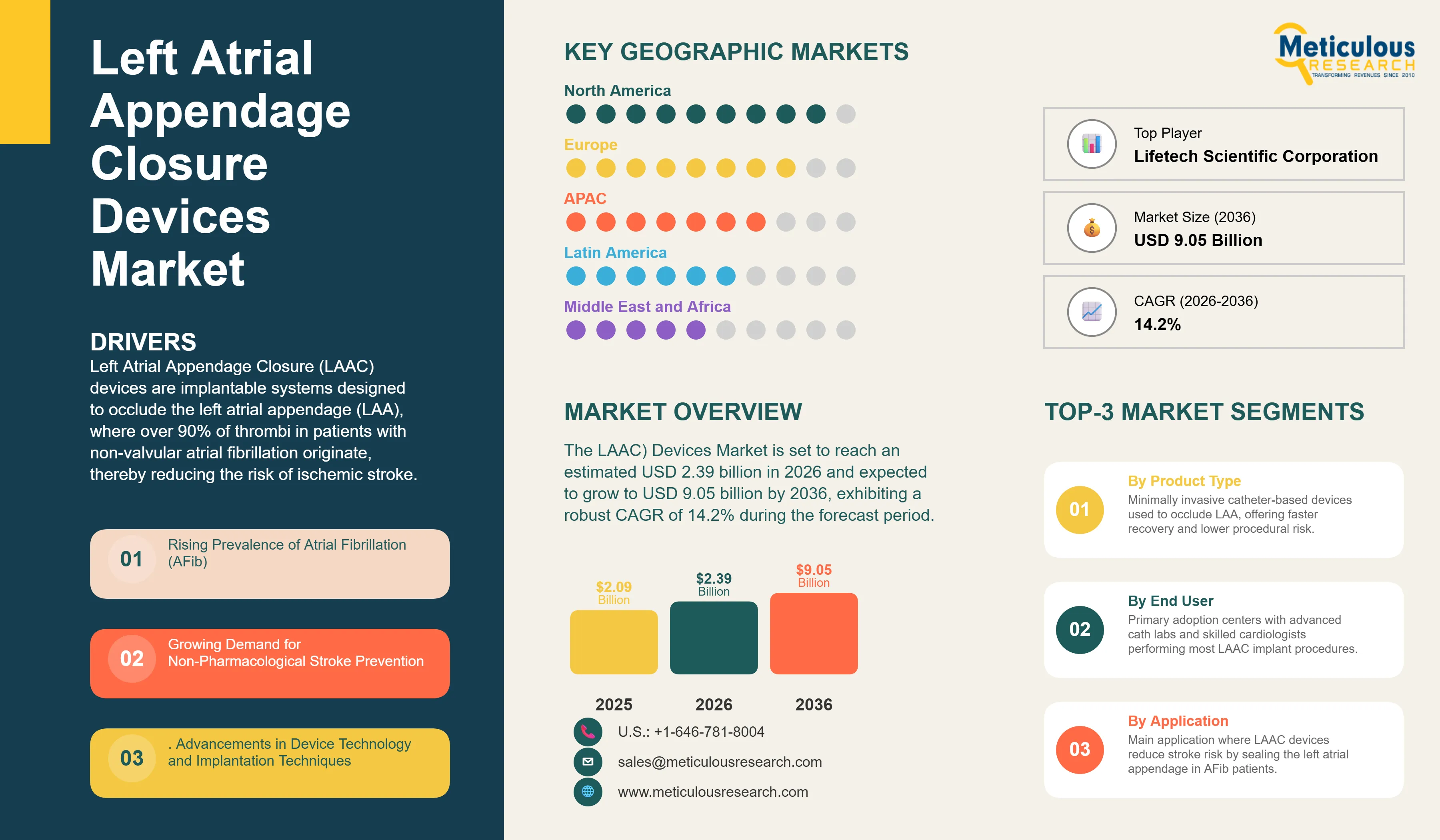
The global Left Atrial Appendage Closure (LAAC) Devices Market is projected to reach an estimated USD 2.39 billion in 2026 and is expected to grow significantly to USD 9.05 billion by 2036, exhibiting a robust Compound Annual Growth Rate (CAGR) of 14.2% during the forecast period.
- Published
- Jun 2026
- Pages
- 297
- Format
- PDF + Excel
- Report ID
- MR-2094
- Base year
- 2025
- 2026 · ESTIMATED
- $2.39B
- 2036
- $9.05B
- CAGR 2026–2036
- 14.2%
2025 baseline · 2026–2036 forecast at 14.2% CAGR · hover a bar for the value
Key highlights
The global Left Atrial Appendage Closure (LAAC) devices market is projected to reach USD 9.05 billion by 2036, growing at a CAGR of 14.2% during the forecast period 2026–2036.
North America is expected to dominate the global market in 2026, driven by the high prevalence of atrial fibrillation (AF), advanced cardiovascular care infrastructure, and favorable reimbursement policies for LAAC procedures.
Asia-Pacific is projected to witness the fastest growth, fueled by the rapidly aging population, rising prevalence of atrial fibrillation, and ongoing modernization of cardiovascular healthcare across emerging economies.
By product type, the endocardial (transcatheter) LAAC devices segment is expected to hold the largest share in 2026, owing to its minimally invasive approach, improved procedural outcomes, and faster patient recovery.
By application, the stroke prevention in atrial fibrillation segment is expected to account for the largest share in 2026, supported by increasing adoption of LAAC devices as an alternative to long-term oral anticoagulation in eligible patients.
By end user, the hospitals segment is expected to hold the largest share in 2026, as they remain the primary centers equipped with specialized cardiac catheterization laboratories and interventional cardiology expertise.
Key players operating in the global market include Boston Scientific Corporation, Abbott Laboratories, Medtronic plc, Johnson & Johnson, and AtriCure, Inc.
Report summary
| Particulars | Details |
|---|---|
| Base Year | 2025 |
| Estimated Year | 2026 |
| Forecast Period | 2026–2036 |
| Market Size (2026) | USD 2.39 billion |
| Market Size (2036) | USD 9.05 billion |
| CAGR (2026–2036) | 14.2% |
| Format | PDF, Excel & Cloud Portal · 297 pages |
| Segments Covered | By Product Type: Endocardial, Epicardial · By End User · By Application |
Report overview
Segments covered: product type, end user, application.
Left Atrial Appendage Closure (LAAC) devices are implantable systems designed to occlude the left atrial appendage (LAA), where over 90% of thrombi in patients with non-valvular atrial fibrillation originate, thereby reducing the risk of ischemic stroke. With more than 60 million people worldwide living with atrial fibrillation and AF contributing to approximately one in seven strokes in the U.S., LAAC has become an important treatment option for patients who are unsuitable for long-term oral anticoagulation because of bleeding risks or other contraindications.
The market comprises endocardial (transcatheter) and epicardial (surgical) LAAC devices. Growing recognition of the LAA as the primary source of cardioembolic stroke, coupled with advances in device design, minimally invasive implantation techniques, and expanding clinical evidence supporting safety and efficacy, continues to accelerate adoption. As guideline recommendations and reimbursement improve, LAAC devices are increasingly becoming a standard non-pharmacological strategy for stroke prevention in eligible atrial fibrillation patients.
Report infographic
Market dynamics
18 factors across 5 forcesRising Prevalence of Atrial Fibrillation (AFib)
The increasing global incidence and prevalence of atrial fibrillation, particularly in the aging population, is a primary driver for the LAAC devices market, as AFib is a major risk factor for stroke.
Growing Demand for Non-Pharmacological Stroke Prevention
For AFib patients unsuitable for long-term oral anticoagulation due to high bleeding risk or other contraindications, LAAC devices offer a vital non-pharmacological alternative for stroke prevention.
Advancements in Device Technology and Implantation Techniques
Continuous innovations in LAAC device design, including improved conformability, deliverability, and reduced profile, along with refined transcatheter implantation techniques, are enhancing procedural safety and efficacy.
Increasing Clinical Evidence and Favorable Reimbursement Policies
A growing body of clinical data demonstrating the long-term safety and effectiveness of LAAC devices, coupled with expanding reimbursement coverage in key regions, is accelerating market adoption.
Table of contents
11 chapters · 99 sections · 297 pages · click to expandSegmental analysis
| Segment | Largest share (2026) | Fastest growth (2026–2036) |
|---|---|---|
| By Product Type | Endocardial (transcatheter) LAAC devices | — |
| By End User | Hospitals | Ambulatory surgical centers (ASCs) |
| By Application | Analysis by Application: Stroke Prevention in Atrial Fibrillation | — |
By Product Type
- Analysis by Product Type: Endocardial Devices Leading the Way
- The endocardial (transcatheter) LAAC devices segment is expected to hold the largest share of the global LAAC devices market.
- This dominance is attributed to their minimally invasive nature, which offers significant advantages over surgical approaches, including reduced patient recovery time and lower procedural risks.
- The epicardial (surgical) LAAC devices segment is anticipated to witness a steady CAGR, particularly in conjunction with other cardiac surgeries, offering a complementary approach for LAA management.
By End User
- Analysis by End User: Hospitals as Primary Adoption Centers
- Hospitals are expected to command the largest share of the global LAAC devices market.
- This is due to hospitals being the primary facilities equipped with the necessary infrastructure, specialized cardiac catheterization labs, and interventional cardiology expertise required for performing LAAC procedures.
- The ambulatory surgical centers (ASCs) segment is anticipated to exhibit the fastest CAGR, driven by the increasing shift towards outpatient procedures and the potential for cost-effectiveness in suitable patient populations.
By Application
- Analysis by Application: Stroke Prevention in Atrial Fibrillation Dominating
- The stroke prevention in atrial fibrillation segment is projected to account for the largest share of the LAAC devices market.
- This is the primary and most established indication for LAAC devices, addressing the critical need to reduce stroke risk in AFib patients who cannot tolerate oral anticoagulants.
- The other applications segment (e.g., for patients with contraindications to long-term anticoagulation due to other medical conditions) is expected to grow at a significant CAGR as research expands the utility of LAAC devices.
Geographic analysis
North America
Largest shareNorth America is expected to hold the largest share of the global LAAC Devices market. This dominance is attributed to a high prevalence of atrial fibrillation, well-established healthcare infrastructure, significant investments in cardiovascular research and technology, the presence of numerous key market players, and favorable reimbursement policies for LAAC procedures. The United States, in particular, is a major contributor due to its large patient population and strong adoption of advanced interventional cardiology techniques. North America: A Leader in Advanced Cardiovascular Interventions
Europe
Europe is expected to hold a significant share of the global LAAC Devices market, driven by a growing aging population susceptible to AFib, well-established healthcare systems, increasing awareness about stroke prevention alternatives, and supportive regulatory frameworks. Countries like Germany, the U.K., and France are key contributors due to their advanced medical facilities and the presence of leading medical device manufacturers. The key companies operating in the European market are Boston Scientific Corporation, Abbott Laboratories, and Medtronic plc. Europe: Advancing Stroke Prevention Strategies with Robust Healthcare Systems
Asia-Pacific
Fastest growthAsia-Pacific is projected to witness the fastest CAGR during the forecast period. This rapid growth is driven by a large and aging population, increasing prevalence of atrial fibrillation, improving healthcare infrastructure, and growing awareness about advanced cardiovascular interventions in countries like China, Japan, and India. Government initiatives to combat cardiovascular diseases, coupled with the expanding presence of international medical device companies, also contribute to the region's market expansion. The key companies operating in the Asia-Pacific market are Boston Scientific Corporation (with regional presence), Abbott Laboratories (with regional presence), and Lifetech Scientific Corporation. Asia-Pacific: Rapid Growth Fueled by Rising AFib Prevalence and Healthcare Modernization
Latin America
Latin America is anticipated to witness steady growth in the LAAC Devices market, primarily due to increasing investments in healthcare infrastructure, a rising focus on improving cardiovascular care outcomes, and growing awareness about AFib and stroke prevention in countries like Brazil and Mexico. The modernization of medical facilities and the adoption of international guidelines for cardiovascular interventions also contribute to the demand for LAAC devices. The key companies operating in the Latin American market are Boston Scientific Corporation (with regional presence) and Abbott Laboratories (with regional presence). Latin America: Emerging Opportunities in Cardiovascular Device Adoption
Middle East & Africa
The Middle East & Africa region is expected to experience gradual growth in the LAAC Devices market, driven by increasing healthcare investments, government initiatives to develop local medical capabilities, and a growing focus on adopting advanced cardiovascular technologies. Countries like UAE and Saudi Arabia are investing in cardiovascular research and treatment, leading to a gradual increase in demand for LAAC devices. The key companies operating in the Middle East & Africa market are Boston Scientific Corporation (with regional presence) and Abbott Laboratories (with regional presence). Middle East & Africa: Gradual Expansion with Developing Healthcare Sectors
Competitive landscape
The global Left Atrial Appendage Closure (LAAC) Devices market is characterized by a dynamic and highly competitive landscape. It features a mix of large, diversified medical device companies and specialized cardiovascular technology firms. Key players are focusing on expanding their product portfolios, investing in R&D for next-generation devices with improved safety and efficacy, offering comprehensive physician training programs, and forming strategic collaborations or acquisitions to strengthen their market positions. The competitive strategy often revolves around demonstrating clinical superiority, ensuring regulatory approvals, providing robust post-market surveillance, and offering integrated solutions for stroke prevention in AFib patients. Companies are also investing heavily in expanding their geographic reach and increasing patient and physician awareness about the benefits of LAAC procedures.
Frequently asked questions
The global LAAC Devices market is estimated at USD 2.39 billion in 2026 and is projected to reach USD 9.05 billion by 2036, growing at a CAGR of 14.2%.
Cite this report
Meticulous Research. (2026). Left Atrial Appendage Closure (LAAC) Devices Market - Global Opportunity Analysis and Industry Forecast (2026-2036) (Report No. MR-2094). Meticulous Market Research Pvt. Ltd. https://www.meticulousresearch.com/product/left-atrial-appendage-closure-devices-market-6777