
Transcatheter Tricuspid Valve Repair Market (2026-2036)
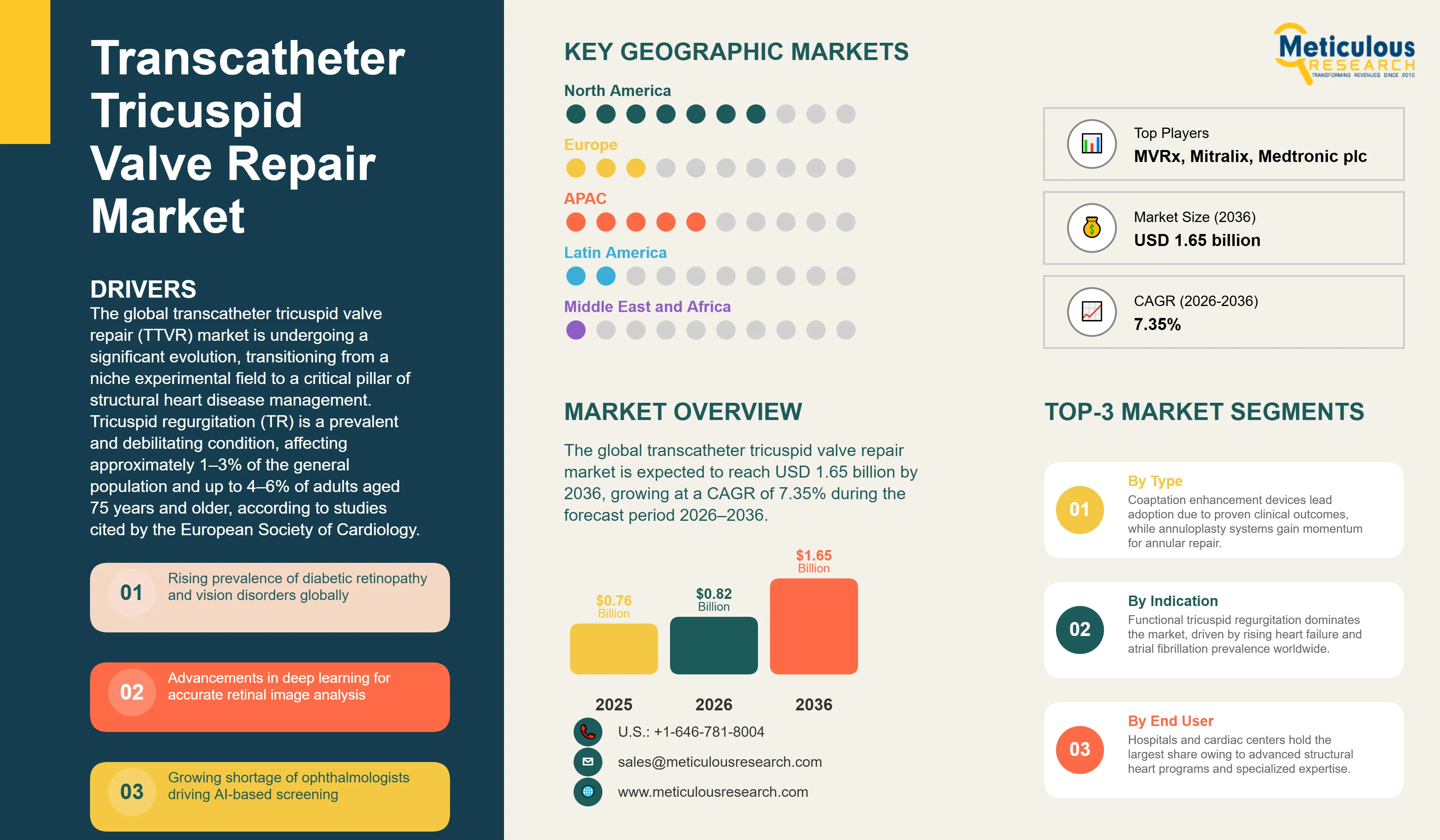
The global transcatheter tricuspid valve repair market was valued at USD 0.82 billion in 2026. This market is expected to reach USD 1.65 billion by 2036, growing at a CAGR of 7.35% during the forecast period 2026–2036.
- Published
- Jun 2026
- Pages
- 265
- Format
- PDF + Excel
- Report ID
- MRHC - 1042020
- Base year
- 2025
- 2026 · ESTIMATED
- $820.0M
- 2036
- $1.65B
- CAGR 2026–2036
- 7.35%
2025 baseline · 2026–2036 forecast at 7.35% CAGR · hover a bar for the value
Key highlights
The global transcatheter tricuspid valve repair market is projected to reach USD 1.65 billion by 2036.
The market is expected to grow at a CAGR of 7.35% during the forecast period 2026–2036.
The global market is estimated at USD 0.82 billion in 2026.
Tricuspid regurgitation affects over 70 million people worldwide, with a prevalence of 1.5% in people over age 70.
Severe TR is associated with a 1-year mortality rate of up to 36% if left untreated.
The Coaptation Enhancement Devices segment holds the largest share of the market, driven by the success of TEER clips.
Functional Tricuspid Regurgitation (FTR) accounts for more than 90% of clinical cases and is the largest indication segment.
North America accounts for over 40% of the global market share, with the U.S. being the primary driver.
Asia-Pacific is projected to witness the highest growth rate, fueled by expanding infrastructure in China and Japan.
Report summary
| Particulars | Details |
|---|---|
| Base Year | 2025 |
| Estimated Year | 2026 |
| Forecast Period | 2026–2036 |
| Market Size (2026) | USD 820.0 million |
| Market Size (2036) | USD 1.65 billion |
| CAGR (2026–2036) | 7.35% |
| Format | PDF, Excel & Cloud Portal · 265 pages |
| Segments Covered | By Product Type: Coaptation Enhancement Devices, Annuloplasty Systems · By Indication · By End User |
| Key Companies | Abbott Laboratories, Edwards Lifesciences Corporation, Medtronic plc, Boston Scientific Corporation, MicroPort Scientific Corporation |
Report infographic
Market dynamics
7 factors across 5 forcesThe primary driver for the TTVR
market is the high unmet clinical need in the vast population of patients with symptomatic tricuspid regurgitation. Severe TR is a life-threatening condition with a one-year mortality rate of up to 36% if left untreated. With over 1.6 million patients in the U.S. suffering from moderate-to-severe TR and only 8,000 receiving surgery annually, the treatment gap exceeds 99%. The development of safe, minimally invasive transcatheter options provides a critical alternative for high-risk patients. Furthermore, the clinical success of the TRILUMINATE trial, which showed an 87% success rate in TR reduction, has significantly boosted physician confidence and patient referrals.
Technological advancements in dedicated repair systems
and intraprocedural imaging are also major drivers. The tricuspid valve's anatomy is significantly more complex than the mitral valve, requiring devices specifically designed for its thin leaflets and large, variable annulus. The integration of 3D transesophageal echocardiography (TEE) and intracardiac echocardiography (ICE) has been essential in improving procedural success rates and patient safety. Additionally, the favorable regulatory environment and the FDA's approval of dedicated systems in 2024 are accelerating market entry and adoption.
Table of contents
11 chapters · 103 sections · 265 pages · click to expandSegmental analysis
| Segment | Largest share (2026) | Fastest growth (2026–2036) |
|---|---|---|
| By Product Type | Coaptation Enhancement Devices | Annuloplasty Systems |
| By Indication | Functional TR | Pacemaker-Induced TR |
By Product Type
- Coaptation Enhancement Devices to Hold Largest Share
- The Coaptation Enhancement Devices segment, primarily TEER clips, is expected to hold the largest share of the market.
- This dominance is due to the early regulatory approvals of systems like TriClip and PASCAL and the high volume of clinical data supporting their safety and efficacy in reducing TR severity.
- The procedural simplicity and high success rate of TEER make it the first-line choice for most structural heart teams.
- The Annuloplasty Systems segment is projected to register the fastest CAGR during the forecast period.
- This growth is driven by the increasing recognition that annuloplasty more closely addresses the underlying pathology of functional TR by resizing the dilated tricuspid annulus.
- Direct annuloplasty devices have shown a 25% reduction in annular diameter, and as these devices achieve more regulatory clearances, they are expected to gain significant market share, often used in combination with coaptation enhancement for complex cases.
By Indication
- Functional TR to Lead the Market
- The Functional TR segment is expected to hold the largest share of the market, accounting for more than 90% of clinical cases.
- FTR is secondary to right ventricular dilation or atrial fibrillation, conditions that are highly prevalent in the aging heart failure population.
- The vast number of patients with symptomatic FTR who are ineligible for surgery makes this the primary revenue driver for the market.
- The Pacemaker-Induced TR segment is projected to witness the fastest growth during the forecast period.
- This is due to the rising volume of cardiac rhythm device implantations and the increasing awareness of TR caused by lead interference.
- The development of lead-sparing transcatheter repair techniques is addressing this specific patient population, driving rapid growth in this segment.
Geographic analysis
North America
Largest shareNorth America is expected to hold the largest share of the global TTVR market in 2026, driven by the early adoption of innovative structural heart therapies and a robust regulatory environment. The United States is the primary market, with more than 500 hospitals already having dedicated structural heart programs. Favorable reimbursement policies for FDA-approved transcatheter devices and high healthcare spending further support market dominance. The key companies operating in the North American market are Abbott Laboratories and Edwards Lifesciences.
Asia-Pacific
Fastest growthAsia-Pacific is projected to witness the fastest growth during the forecast period, with a CAGR exceeding 10%. This growth is supported by the rapid expansion of healthcare infrastructure, increasing prevalence of heart failure, and growing clinical expertise in transcatheter interventions in countries like China and Japan. The presence of domestic manufacturers in China is also expected to drive market competition and affordability. The key companies operating in the Asia-Pacific market are Abbott, Edwards, and MicroPort Scientific.
Competitive landscape
- Abbott Laboratories, Edwards Lifesciences Corporation
- Medtronic plc
- Boston Scientific Corporation
- MicroPort Scientific Corporation
Frequently asked questions
The market is projected to reach USD 1,652.8 million by 2036, growing at a CAGR of 7.35% from 2026 to 2036.
Cite this report
Meticulous Research. (2026). Transcatheter Tricuspid Valve Repair Market - Global Opportunity Analysis and Industry Forecast (2026-2036) (Report No. MRHC - 1042020). Meticulous Market Research Pvt. Ltd. https://www.meticulousresearch.com/product/transcatheter-tricuspid-valve-repair-market-6703