Resources
About Us
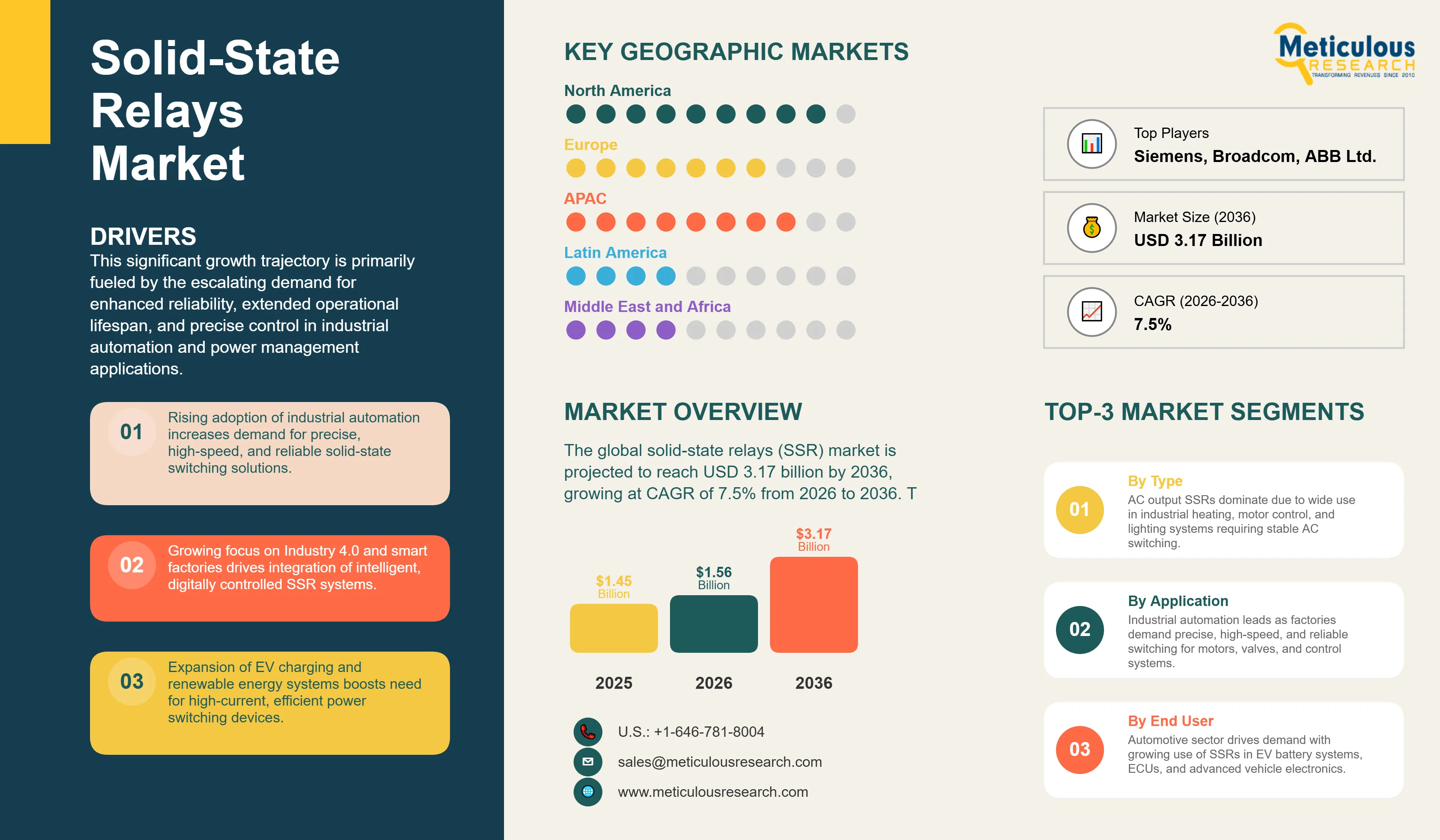
The global solid-state relays (SSR) market was valued at USD 1.45 billion in 2025. The market is projected to reach USD 3.17 billion by 2036 from USD 1.56 billion in 2026, growing at CAGR of 7.5% from 2026 to 2036. This significant growth trajectory is primarily fueled by the escalating demand for enhanced reliability, extended operational lifespan, and precise control in industrial automation and power management applications. Key drivers include the increasing adoption of automation across manufacturing sectors, the miniaturization of electronic components, and stringent safety regulations necessitating robust switching solutions. Furthermore, continuous advancements in semiconductor technology, the integration of smart control features, and the growing demand for energy-efficient solutions are collectively enhancing the efficacy and market appeal of solid-state relays worldwide.
Click here to: Get Free Sample Pages of this Report
Solid-state relays (SSRs) represent a sophisticated class of electronic switching devices engineered to meticulously control electrical loads without the use of moving parts. This mechanism leverages semiconductor components, such as thyristors, transistors, or MOSFETs, to perform the switching function, offering significant advantages over traditional electromechanical relays. Distinct from their mechanical counterparts, which rely on physical contacts, SSRs excel in environments characterized by the need for high switching speeds, extended operational lifespan, silent operation, and immunity to shock and vibration. These systems are indispensable for meticulously regulating power within sensitive industrial operations, thereby mitigating contact wear, ensuring precise control, and preserving the intrinsic integrity of automated processes. The market landscape for these devices is diverse, encompassing robust AC output SSRs tailored for extensive industrial heating and motor control applications, and agile DC output SSRs designed for rapid switching in battery-powered systems and telecommunications equipment.
The market is currently experiencing a dynamic phase of continuous innovation, primarily propelled by an industry-wide pursuit of superior energy efficiency, enhanced precision in control, and unwavering operational reliability. Contemporary SSRs frequently incorporate advanced semiconductor materials boasting augmented thermal stability, sophisticated isolation technologies engineered to prevent electrical interference, and highly intelligent control mechanisms. These cutting-edge systems are equipped with real-time diagnostic capabilities, advanced protection features (e.g., over-temperature, over-current), and seamless digital communication interfaces, facilitating remote management, predictive maintenance, and integration into broader industrial control systems. Manufacturers are strategically channeling their research and development efforts towards crafting solutions that not only minimize energy consumption and reduce maintenance overheads but also feature modular designs for effortless integration into existing electronic circuits or as standalone operational units. This emphasis on customization ensures that a broad spectrum of industrial and commercial demands can be met, ranging from the exacting standards of medical equipment to the protective requirements of high-power heating systems.
The global industrial and electronics ecosystem is increasingly characterized by an imperative for stringent operational control, driven by the need to adhere to rigorous quality benchmarks, optimize production workflows, and prolong the operational lifespan of sensitive equipment. Industries spanning industrial automation, HVAC, medical equipment, and telecommunications necessitate exceptionally reliable and precise switching solutions to avert equipment failure, mitigate safety risks, and prevent system downtime. The escalating awareness regarding the detrimental ramifications of uncontrolled power switching—encompassing contact arcing, electromagnetic interference, and reduced component lifespan—is significantly accelerating the adoption of advanced solid-state relay solutions. This burgeoning recognition of solid-state relays as a foundational component of modern electronic and industrial infrastructure is firmly establishing their indispensable role in contemporary operations.
Growing Emphasis on Miniaturization and High-Density Integration
The solid-state relays market is currently undergoing a transformative shift, marked by a pronounced emphasis on miniaturization and the strategic development of high-density integration solutions. This evolution is a direct response to the increasing demand for compact electronic systems, space-constrained industrial panels, and the pervasive trend towards smaller, more efficient devices across various end-use verticals. Manufacturers are actively seeking SSR technologies that not only minimize physical footprint but also reduce overall system weight, all while maintaining uncompromising standards of power handling and reliability. This trend is catalyzing significant innovations in packaging technologies, refining heat dissipation mechanisms, and fostering the integration of multiple switching functions into single, compact modules. Furthermore, the emergence of surface-mount device (SMD) SSRs and chip-scale packages offers an optimized performance envelope across a broader spectrum of electronic applications, delivering enhanced efficiency and operational flexibility, thereby positioning them as a pivotal differentiator in the competitive market landscape.
Integration of Smart Control Features and Enhanced Diagnostic Capabilities
Another defining trend shaping the solid-state relays market is the pervasive integration of smart control features and advanced diagnostic capabilities, coupled with continuous advancements in communication interfaces. This dual focus aims to deliver unparalleled precision, facilitate seamless remote management, and elevate overall system performance. Manufacturers are proactively embedding sophisticated microcontrollers, advanced algorithmic intelligence, and robust digital communication protocols (e.g., Modbus, Ethernet/IP) into their SSR systems. This technological synergy enables real-time data acquisition pertaining to load current, voltage, temperature, and switching cycles. The collected data is subsequently subjected to rigorous analysis via cloud-based platforms and artificial intelligence, yielding actionable insights into system efficiency, predicting impending maintenance requirements, and autonomously adjusting operational parameters to sustain optimal performance. Concurrently, intensive research and development endeavors are concentrated on engineering novel protection features that boast superior fault detection, enhanced surge immunity, and robust integration with broader industrial control and safety systems. These synergistic innovations are culminating in the creation of more intelligent, inherently efficient, and exceptionally reliable solid-state relays, adept at addressing the increasingly rigorous demands of diverse industrial applications.
|
Parameter |
Details |
|
Market Size by 2036 |
USD 3.17 Billion |
|
Market Size in 2026 |
USD 1.56 Billion |
|
Market Size in 2025 |
USD 1.45 Billion |
|
Market Growth Rate (2026–2036) |
CAGR of 7.5% |
|
Dominating Region |
North America |
|
Fastest Growing Region |
Asia-Pacific |
|
Base Year |
2025 |
|
Forecast Period |
2026 to 2036 |
|
Segments Covered |
Type, Mounting Type, Current Rating, Application, End-use Vertical, and Region |
|
Regions Covered |
North America, Europe, Asia-Pacific, Latin America, and Middle East & Africa |
Drivers: Increasing Adoption of Industrial Automation and Process Control
A primary driver for the solid-state relays market is the escalating need for precise and reliable switching components in the rapidly expanding industrial automation and process control sectors. Industries such as manufacturing, packaging, and material handling are increasingly deploying automated systems to enhance efficiency, reduce labor costs, and improve product quality. SSRs are critical in these applications for controlling motors, heaters, valves, and lighting due to their high switching speed, long lifespan, and silent operation, which are superior to traditional electromechanical relays. The continuous drive towards Industry 4.0, smart factories, and the integration of advanced robotics further amplifies this demand. The stringent requirements for uptime, repeatability, and safety in automated production lines make solid-state relays an indispensable component for maintaining operational continuity and optimizing performance.
Opportunity: Growth in Electric Vehicle (EV) Charging Infrastructure and Renewable Energy Systems
A significant growth opportunity for solid-state relays lies in the rapidly expanding electric vehicle (EV) charging infrastructure and renewable energy systems. In EV charging stations, SSRs are crucial for managing high-power switching, ensuring safety, and providing precise control for charging cycles. Their ability to handle high currents, offer fast switching, and provide robust protection against overloads makes them ideal for the demanding requirements of EV charging. Similarly, in solar inverters, wind turbine control systems, and battery energy storage systems, SSRs are used for efficient power conversion, grid synchronization, and protection circuits. As global investments in sustainable energy solutions and electric mobility continue to surge, so too will the need for reliable and efficient power switching components. This convergence of EV and renewable energy trends creates substantial new avenues for market expansion for solid-state relays.
Why Do AC Output SSRs Lead the Market?
The AC Output SSRs segment accounts for the largest share of the overall solid-state relays market in 2026. This dominance is primarily driven by their widespread use in industrial heating applications, motor control, lighting systems, and power supplies that operate on alternating current. AC output SSRs are designed to switch high AC voltages and currents with zero-cross switching capabilities, which minimizes electromagnetic interference (EMI) and extends the lifespan of both the relay and the load. Industries such as plastics processing, food & beverage, and HVAC systems heavily rely on AC output SSRs for precise temperature control and efficient power management. Their robust design, silent operation, and ability to handle frequent switching cycles make them an indispensable component in maintaining stable and efficient industrial processes.
The DC Output SSRs segment is expected to witness significant growth during the forecast period. This growth is fueled by the increasing demand for direct current switching in battery-powered systems, telecommunications equipment, automotive applications, and renewable energy systems. DC output SSRs offer fast switching speeds and are ideal for controlling DC motors, solenoids, and other DC loads where rapid response and high reliability are critical.
How Does the PCB Mount Segment Maintain Its Lead?
The PCB Mount segment holds the largest market share in 2026. This dominance is attributed to the pervasive trend of miniaturization in electronic devices and the increasing integration of control circuitry directly onto printed circuit boards (PCBs). PCB mount SSRs offer a compact footprint, allowing for high-density component placement, which is crucial for modern consumer electronics, embedded systems, and industrial control modules. Their direct soldering onto the PCB ensures a secure connection, reduces wiring complexity, and enhances overall system reliability by minimizing potential points of failure. This mounting type is highly favored in applications where space is at a premium and automated assembly processes are utilized, making them an indispensable choice for manufacturers aiming for compact and cost-effective designs.
The DIN Rail Mount segment is expected to witness steady growth during the forecast period. This growth is driven by the demand for modularity, ease of installation, and maintenance in industrial control panels and automation systems. DIN rail mount SSRs provide a standardized and organized solution for mounting multiple components within a control cabinet, facilitating quick installation and replacement, which is critical for reducing downtime in industrial environments.
Why Does the 10A-50A Segment Lead the Market?
The 10A-50A Current Rating segment accounts for the largest share of the overall solid-state relays market in 2026. This dominance is primarily driven by the extensive range of industrial and commercial applications that fall within this power requirement. Many common industrial loads, such as medium-sized motors, industrial heaters, and power supplies for machinery, typically operate within this current range. SSRs in this category offer a balanced combination of power handling capability, compact size, and cost-effectiveness, making them a versatile choice for a broad spectrum of applications. Their ability to provide reliable and precise switching for these mid-range power requirements makes them an indispensable component in industrial automation, HVAC systems, and various process control applications.
The Up to 10A segment is expected to witness steady growth, driven by the miniaturization of electronic devices and the increasing use of SSRs in low-power control circuits, consumer electronics, and embedded systems. The Above 50A segment is also projected for growth, fueled by the demand for high-power switching in heavy industrial machinery, large heating systems, and renewable energy applications.
How Does the Industrial Automation Segment Dominate?
The Industrial Automation segment commands the largest share of the global solid-state relays market in 2026. This leadership stems from the extensive and critical need for precise, reliable, and high-speed switching in automated manufacturing processes, robotics, and process control systems. SSRs are indispensable for controlling motors, valves, heating elements, and lighting in factories, offering superior performance over electromechanical relays in terms of lifespan, switching speed, and immunity to vibration and shock. The continuous drive towards Industry 4.0, smart factories, and the integration of advanced robotics further amplifies this demand. The stringent requirements for uptime, repeatability, and safety in automated production lines make solid-state relays a foundational component for maintaining operational continuity and optimizing performance.
The HVAC segment is expected to grow at a significant CAGR during the forecast period. The increasing demand for energy-efficient heating, ventilation, and air conditioning systems, coupled with the need for precise temperature control and silent operation, is fueling the adoption of SSRs in commercial and residential HVAC units.
Why Does the Automotive Sector Drive Significant Demand?
The Automotive sector is expected to account for a substantial share of the overall solid-state relays market in 2026. This is primarily due to the critical role of SSRs in various automotive applications, including engine control units (ECUs), lighting systems, power window controls, and increasingly, in electric vehicle (EV) battery management systems and charging infrastructure. SSRs offer superior reliability, resistance to vibration, and longer lifespan compared to traditional relays, which are crucial for the demanding automotive environment. The accelerating shift towards electric vehicles and autonomous driving technologies further amplifies the demand for high-performance and compact solid-state switching solutions, ensuring safety, efficiency, and advanced control in modern vehicles.
The Energy & Power sector is expected to witness robust growth during the forecast period. The demand for SSRs in renewable energy systems (solar inverters, wind turbines), smart grids, and power distribution units is driven by the need for efficient power management, grid synchronization, and protection circuits. The increasing focus on energy efficiency and reliable power delivery further amplifies the adoption of SSRs in this sector.
The global solid-state relays market is expected to grow from USD 1.56 billion in 2026 to USD 3.17 billion by 2036.
The global solid-state relays market is projected to grow at a CAGR of 7.5% from 2026 to 2036.
AC Output SSRs are expected to dominate the market due to their widespread use in industrial heating and motor control. The DC Output SSRs segment is projected to grow rapidly, driven by increasing demand in battery-powered systems and telecommunications.
PCB Mount SSRs will be a primary driver for market growth due to the miniaturization of electronic devices and high-density integration requirements. The DIN Rail Mount segment is also expected to see steady growth due to demand for modularity and ease of installation in industrial control panels.
The 10A-50A Current Rating segment is expected to hold the largest market share, driven by the extensive range of industrial and commercial applications that fall within this power requirement. The Up to 10A segment is also projected for growth due to low-power control circuits and consumer electronics.
The Industrial Automation segment is expected to hold the largest market share, driven by the critical need for precise, reliable, and high-speed switching in automated manufacturing processes. The HVAC segment will also see significant growth due to increasing demand for energy-efficient and precise temperature control systems.
The Automotive sector is expected to hold a substantial market share, driven by the critical role of SSRs in various automotive applications and the accelerating shift towards electric vehicles. The Energy & Power sector will also witness robust growth due to demand for efficient power management in renewable energy systems and smart grids.
North America holds the largest share of the global market in 2026. This dominance is primarily driven by its mature industrial infrastructure, significant investments in advanced manufacturing, and stringent safety standards promoting reliable control solutions.
The leading companies include Sensata Technologies (Crydom), Omron Corporation, Panasonic Holdings Corporation, Carlo Gavazzi Holding AG, ABB Ltd., TE Connectivity Ltd., Rockwell Automation, Inc., Celduc Relais, Fujitsu Limited, Phoenix Contact GmbH & Co. KG, Schneider Electric SE, Siemens AG, Vishay Intertechnology, Inc., Broadcom Inc., and Toshiba Corporation.
1. Introduction
1.1 Market Definition
1.2 Market Scope
1.3 Research Methodology
1.4 Assumptions & Limitations
2. Executive Summary
3. Market Overview
3.1 Introduction
3.2 Market Dynamics
3.2.1 Drivers
3.2.2 Restraints
3.2.3 Opportunities
3.2.4 Challenges
3.3 Impact of Industry 4.0 on Solid-State Relays Adoption
3.4 Regulatory Landscape and Compliance Requirements
3.5 Porter’s Five Forces Analysis
4. Global Solid-State Relays Market, by Type
4.1 Introduction
4.2 AC Output SSRs
4.3 DC Output SSRs
4.4 AC/DC Output SSRs
4.5 Other Types
5. Global Solid-State Relays Market, by Mounting Type
5.1 Introduction
5.2 Panel Mount
5.3 PCB Mount
5.4 DIN Rail Mount
5.5 Other Mounting Types
6. Global Solid-State Relays Market, by Current Rating
6.1 Introduction
6.2 Up to 10A
6.3 10A–50A
6.4 Above 50A
7. Global Solid-State Relays Market, by Application
7.1 Introduction
7.2 Industrial Automation
7.3 HVAC
7.4 Medical Equipment
7.5 Lighting Control
7.6 Food & Beverage
7.7 Other Applications
8. Global Solid-State Relays Market, by End-use Vertical
8.1 Introduction
8.2 Automotive
8.3 Energy & Power
8.4 Telecommunications
8.5 Consumer Electronics
8.6 Other End-use Verticals
9. Global Solid-State Relays Market, by Region
9.1 Introduction
9.2 North America
9.2.1 U.S.
9.2.2 Canada
9.3 Europe
9.3.1 Germany
9.3.2 U.K.
9.3.3 France
9.3.4 Italy
9.3.5 Spain
9.3.6 Russia
9.3.7 Rest of Europe
9.4 Asia-Pacific
9.4.1 China
9.4.2 India
9.4.3 Japan
9.4.4 South Korea
9.4.5 Australia & New Zealand
9.4.6 Rest of Asia-Pacific
9.5 Latin America
9.5.1 Brazil
9.5.2 Mexico
9.5.3 Argentina
9.5.4 Rest of Latin America
9.6 Middle East & Africa
9.6.1 UAE
9.6.2 Saudi Arabia
9.6.3 South Africa
9.6.4 Turkey
9.6.5 Rest of Middle East & Africa
10. Competitive Landscape
10.1 Key Players and Market Share Analysis
10.2 Competitive Dashboard
10.2.1 Industry Leaders
10.2.2 Market Differentiators
10.2.3 Vanguards
10.2.4 Emerging Companies
11. Company Profiles
(Business Overview, Financial Overview, Product Portfolio, Strategic Developments, SWOT Analysis)
11.1 Sensata Technologies (Crydom)
11.2 Omron Corporation
11.3 Panasonic Holdings Corporation
11.4 Carlo Gavazzi Holding AG
11.5 ABB Ltd.
11.6 TE Connectivity Ltd.
11.7 Rockwell Automation, Inc.
11.8 Celduc Relais
11.9 Fujitsu Limited
11.10 Phoenix Contact GmbH & Co. KG
11.11 Schneider Electric SE
11.12 Siemens AG
11.13 Vishay Intertechnology, Inc.
11.14 Broadcom Inc.
11.15 Toshiba Corporation
12. Appendix
12.1 Glossary
12.2 Abbreviations
12.3 Disclaimer
























Published Date: Aug-2024
Published Date: Jul-2022
Published Date: Jun-2024
Published Date: Jan-2025
Published Date: Nov-2022
Subscribe to get the latest industry updates