Battery Formation & Testing Equipment Market (2026-2036)
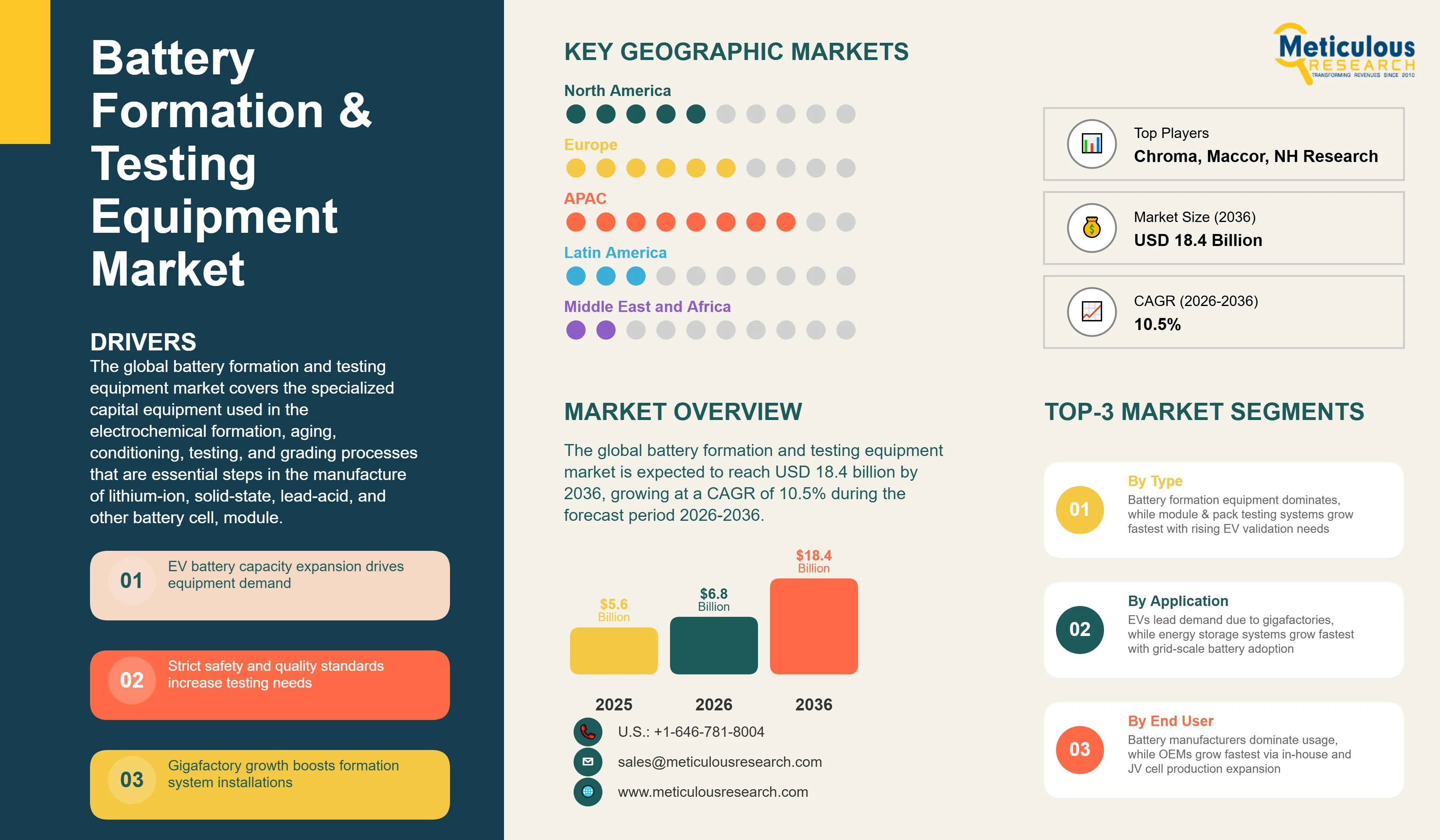
The global battery formation and testing equipment market was valued at USD 5.6 billion in 2025. This market is expected to reach USD 18.4 billion by 2036 from an estimated USD 6.8 billion in 2026, growing at a CAGR of 10.5% during the forecast period 2026-2036.
- Published
- Apr 2026
- Pages
- 285
- Format
- PDF + Excel
- Report ID
- MR-1897
- Base year
- 2025
- 2025 · BASELINE
- $5.60B
- 2036
- $18.40B
- CAGR 2026–2036
- 10.5%
2025 baseline · 2026–2036 forecast at 10.5% CAGR · hover a bar for the value
Key highlights
The global battery formation and testing equipment market is projected to reach USD 18.4 billion by 2036.
The market is expected to grow at a CAGR of 10.5% during the forecast period 2026-2036.
The global battery formation and testing equipment market was valued at USD 5.6 billion in 2025 and is estimated to reach USD 6.8 billion in 2026.
Asia-Pacific is expected to dominate the global battery formation and testing equipment market with the largest market share in 2026, while Europe is projected to register the highest CAGR during the forecast period.
By equipment type, the battery formation equipment segment is expected to hold the largest share of the market in 2026, while the module and pack testing equipment segment is projected to register the highest CAGR during the forecast period.
By battery chemistry, the lithium-ion batteries segment is expected to hold the largest share in 2026, while the solid-state batteries segment is projected to register the highest CAGR during the forecast period.
By battery format, the prismatic cells segment is expected to hold the largest share in 2026, while the cylindrical cells segment is projected to register the highest CAGR during the forecast period.
By application, the electric vehicles segment is expected to hold the largest share in 2026, while the energy storage systems segment is projected to register the highest CAGR during the forecast period.
By automation level, the semi-automated systems segment is expected to hold the largest share in 2026, while the fully automated systems segment is projected to register the highest CAGR during the forecast period.
By end user, the battery manufacturers segment is expected to hold the largest share in 2026, while the OEMs segment is projected to register the highest CAGR during the forecast period.
Report summary
| Particulars | Details |
|---|---|
| Market Size by 2036 | USD 18.4 Billion |
| Market Size in 2026 | USD 6.8 Billion |
| Market Size in 2025 | USD 5.6 Billion |
| Revenue Growth Rate (2026-2036) | CAGR of 10.5% |
| Dominating Equipment Type | Battery Formation Equipment |
| Fastest Growing Equipment Type | Module & Pack Testing Equipment |
| Dominating Battery Chemistry | Lithium-Ion Batteries |
| Fastest Growing Battery Chemistry | Solid-State Batteries |
| Dominating Battery Format | Prismatic Cells |
| Fastest Growing Battery Format | Cylindrical Cells |
| Dominating Application | Electric Vehicles (EVs) |
| Fastest Growing Application | Energy Storage Systems (ESS) |
| Dominating Automation Level | Semi-Automated Systems |
| Fastest Growing Automation Level | Fully Automated Systems |
| Dominating End User | Battery Manufacturers (Cell Manufacturers) |
| Fastest Growing End User | OEMs (Automotive, Electronics) |
| Dominating Geography | Asia-Pacific |
| Fastest Growing Geography | Europe |
| Base Year | 2025 |
| Forecast Period | 2026 to 2036 |
Report overview
Segments covered: equipment type, battery chemistry, battery format, end user.
The global battery formation and testing equipment market covers the specialized capital equipment used in the electrochemical formation, aging, conditioning, testing, and grading processes that are essential steps in the manufacture of lithium-ion, solid-state, lead-acid, and other battery cell, module, and pack products. This encompasses battery formation chargers and dischargers that apply controlled charge-discharge cycling to activate the solid-electrolyte interphase layer in newly assembled cells, aging and conditioning chambers, electrical and safety testing systems that verify capacity, cycle life, internal resistance, and safety performance, environmental testing equipment, and the module and pack-level testing platforms required for battery management system validation and complete pack performance verification.
The growth of the global battery formation and testing equipment market is primarily driven by the extraordinary global expansion of EV battery manufacturing capacity, with hundreds of gigawatt-hours of new cell production capacity being commissioned at gigafactories across China, Europe, and North America that each require large-scale formation and testing equipment installations to commission and operate their production lines. The increasingly stringent quality, safety, and performance standards being applied to automotive-grade lithium-ion batteries by OEM customers and regulatory bodies are intensifying the testing and quality assurance requirements per manufactured cell, driving higher investment in both the quantity and capability of testing equipment per unit of production capacity.
Two significant opportunities are shaping the market's long-term trajectory. The development and commercialization of fast formation technologies that can reduce the formation cycle time from the current 6 to 24 hours required by conventional formation protocols to 1 to 4 hours through advanced charging algorithms and formation chamber optimization represents the highest-value efficiency opportunity in battery manufacturing, as formation currently accounts for 30 to 40% of total battery cell production time and is therefore a critical bottleneck in gigafactory throughput capacity. The integration of AI-based battery testing and diagnostics platforms that apply machine learning to formation and testing data to predict cell-level capacity, cycle life, and safety performance with greater accuracy and speed than conventional test protocols represents a transformative quality improvement opportunity that leading battery manufacturers are actively adopting to reduce testing time and improve end-of-line quality assurance.
Report infographic
Market dynamics
7 factors across 3 forcesRapid Expansion of EV Battery Manufacturing
The primary driver of the global battery formation and testing equipment market is the unprecedented global expansion of electric vehicle battery cell manufacturing capacity, with the International Energy Agency projecting that global EV battery manufacturing capacity will need to reach approximately 9,000 GWh per year by 2030 to support the EV adoption trajectories required for net-zero emission scenarios, representing a roughly tenfold increase from the approximately 900 GWh of capacity operational in 2024. Each gigawatt-hour of new lithium-ion cell production capacity requires the installation of battery formation and testing equipment estimated at USD 5 to 12 million per GWh depending on chemistry, format, and automation level, translating the projected capacity expansion into several tens of billions of dollars in formation and testing equipment procurement over the forecast period. The geographic distribution of this capacity expansion across CATL, BYD, LG Energy Solution, Samsung SDI, SK On, Panasonic, and numerous emerging battery manufacturers in China, South Korea, Europe, and North America creates a diversified and sustained formation and testing equipment procurement market that benefits both established equipment suppliers and new market entrants.
Stringent Quality and Safety Requirements
The increasingly stringent quality and safety requirements imposed on automotive-grade lithium-ion battery cells by vehicle OEM customers, government safety regulators, and the EU Battery Regulation's battery performance and durability standards are driving battery manufacturers to invest in more comprehensive, more accurate, and more automated formation and testing equipment capable of detecting the subtle cell-level defects and performance deviations that can lead to field failures, warranty claims, and safety incidents in vehicle battery packs. Automotive OEM battery qualification requirements have progressively tightened to include 100% end-of-line testing of every cell against expanding test parameter sets including capacity, internal resistance, self-discharge rate, and formation curve quality metrics, replacing the statistical sampling approaches that were previously accepted for non-automotive battery applications. The EU Battery Regulation's mandatory battery performance class labeling, minimum capacity retention and cycle life requirements for EV batteries, and digital battery passport provisions requiring traceability of battery performance data throughout the battery lifecycle are creating additional requirements for comprehensive testing data capture and retention that is driving investment in more capable and better-connected testing platforms.
Table of contents
14 chapters · 189 sections · 285 pages · click to expandSegmental analysis
| Segment | Largest share (2026) | Fastest growth (2026–2036) |
|---|---|---|
| By Equipment Type | Battery Formation Equipment | Module and pack testing equipment |
| By Battery Chemistry | Lithium-Ion Batteries | Solid-state batteries |
| By Battery Format | Prismatic Cells | Cylindrical cells |
| By Application | Electric Vehicles | Energy storage systems |
| By Automation Level | Semi-Automated Systems | Fully automated systems |
| By End User | Battery Manufacturers | OEMs |
By Equipment Type
- Battery Formation Equipment to Dominate
- The battery formation equipment segment is expected to account for the largest share of the global market.
- The large share of this segment is attributed to formation equipment representing the single largest capital equipment investment in the battery cell manufacturing process on a cost-per-GWh basis, with formation chargers, dischargers, and formation rack systems required in very large quantities to match the throughput requirements of high-volume cell production lines.
- The capital cost concentration in formation equipment reflects both the high quantity of formation channels required per GWh of annual production capacity and the high precision power electronics specifications required for the accurate current delivery and voltage measurement that quality formation protocols demand.
- However, the module and pack testing equipment segment is poised to register the highest CAGR during the forecast period.
- The high growth of this segment is attributed to the rapid expansion of automotive battery pack production requiring comprehensive OEM qualification and homologation testing, the increasing complexity of battery pack designs incorporating more cells, more sophisticated battery management systems, and higher voltage architectures that require more extensive pack-level testing, and the EU Battery Regulation's performance class labeling and traceability requirements creating new pack-level testing data capture obligations across European battery manufacturers.
By Battery Chemistry
- Lithium-Ion Batteries to Hold the Largest Share
- The lithium-ion batteries segment is expected to account for the largest share of the market.
- Lithium-ion cells represent the dominant chemistry across the EV, energy storage, and consumer electronics application segments that together constitute the large majority of global battery production volume, and the formation and testing protocols for lithium-ion cells have been extensively optimized over decades of high-volume manufacturing to represent the commercial standard for the industry.
- The concentration of gigafactory investment globally in lithium-ion production across LFP for cost-sensitive applications and NMC and NCA for energy-density-prioritized applications sustains the lithium-ion segment's market dominance through the forecast period.
- However, the solid-state batteries segment is projected to register the highest CAGR during the forecast period.
- This growth is driven by the commercial development programs of Toyota, Samsung SDI, QuantumScape, and Solid Power advancing solid-state battery production timelines that will require entirely new formation and testing equipment platforms engineered for the different electrochemical characteristics, temperature requirements, and stack pressure management needs of solid-state cell architectures.
- Solid-state formation processes differ fundamentally from liquid electrolyte lithium-ion formation in requiring controlled stack pressure management during SEI formation on lithium metal anodes, higher formation temperatures in some solid electrolyte systems, and specialized testing approaches for the different impedance profiles and failure modes of solid-state cells, creating a new and premium-valued equipment market segment that leading formation equipment companies are investing to address.
By Battery Format
- Prismatic Cells to Hold the Largest Share
- The prismatic cells segment is expected to account for the largest share of the market.
- The dominance of prismatic cells reflects their extensive adoption in Chinese EV battery manufacturing, where CATL and BYD produce very large volumes of prismatic LFP and NMC cells for domestic and international EV customers, and the prismatic format's mechanical stability and efficient pack integration characteristics that have made it the preferred format for the majority of current automotive battery pack designs.
- Formation and testing equipment for prismatic cells must accommodate the specific dimensions and terminal configurations of prismatic cell formats and the stack pressure management requirements that prismatic cell formation best practices specify.
- However, the cylindrical cells segment is projected to register the highest CAGR during the forecast period.
- This growth is driven by the rapid expansion of cylindrical cell production capacity for the larger-format 4680 cells being produced by Tesla, Panasonic, and multiple new entrants that represent a new generation of cylindrical cells with higher energy capacity and lower production cost per kilowatt-hour than the established 18650 and 21700 cylindrical cell formats, and by the strong adoption of cylindrical cells in emerging battery applications including e-bikes, power tools, and industrial applications alongside their established consumer electronics use.
By Application
- Electric Vehicles to Hold the Largest Share
- The electric vehicles segment is expected to account for the largest share of the global battery formation and testing equipment market.
- EV battery production accounts for the large majority of new gigafactory capacity investment globally, and the high quality, safety, and performance standards of automotive-grade battery cells require more comprehensive and more capable formation and testing equipment per unit of production capacity than non-automotive applications, generating very high formation and testing equipment capital intensity per GWh of EV battery production.
- The global EV battery cell production plans of CATL, BYD, LG Energy Solution, Samsung SDI, SK On, Panasonic, and the wave of new entrant gigafactories in Europe and North America collectively represent the largest formation and testing equipment procurement pipeline in the industry.
- However, the energy storage systems segment is projected to register the highest CAGR during the forecast period.
- This growth is driven by the accelerating global deployment of grid-scale and distributed battery storage requiring large-volume production of ESS-optimized battery cells at formation and testing quality standards that are progressively approaching automotive-grade requirements as ESS battery reliability and warranty expectations increase, and the growing manufacturing volume of residential storage systems from BYD, CATL's ESS division, Tesla Energy, and LG Energy Solution that is expanding the ESS battery production base requiring dedicated formation and testing equipment.
By Automation Level
- Semi-Automated Systems to Hold the Largest Share
- The semi-automated systems segment is expected to account for the largest share of the global battery formation and testing equipment market.
- Semi-automated formation and testing systems that automate the core electrical cycling and data acquisition processes while requiring manual cell loading, connection, and grading operations represent the dominant configuration across the current global battery manufacturing installed base, reflecting the balance between automation investment cost and labor availability that has characterized the majority of battery cell manufacturing operations, particularly in China where the combination of relatively lower labor costs and very high production volumes has made semi-automated formation and testing economically competitive with fully automated alternatives.
- However, the fully automated systems segment is projected to register the highest CAGR during the forecast period.
- This growth is driven by the increasing priority of labor cost reduction, consistent product quality, and production line integration in new gigafactory designs, the higher labor cost environments of European and North American battery manufacturing locations that make automation ROI more compelling, and the OEM customer preference for fully automated formation and testing documentation that provides complete cell-level traceability records without manual data entry errors.
- New gigafactory designs by CATL in Europe, LG Energy Solution in the U.S. and Poland, and Samsung SDI in Hungary and the United States are specifying fully automated formation and testing lines as standard, establishing full automation as the preferred configuration for new capacity additions.
By End User
- Battery Manufacturers to Hold the Largest Share
- The battery manufacturers segment is expected to account for the largest share of the global battery formation and testing equipment market.
- Cell manufacturers including CATL, BYD, LG Energy Solution, Samsung SDI, SK On, Panasonic, and AESC represent the primary procurers of battery formation and testing equipment globally, as cell manufacturing requires the largest formation and testing equipment investment per unit of production capacity and the cell manufacturing operations of the leading battery companies represent the highest-volume and highest-value equipment procurement programs in the market.
- CATL alone, with over 250 GWh of annual production capacity and aggressive expansion plans, represents the single largest battery formation and testing equipment customer in the world.
- However, the OEMs segment is projected to register the highest CAGR during the forecast period.
- This growth is driven by the increasing number of automotive OEMs including Volkswagen Group through its PowerCo subsidiary, General Motors through Ultium Cells joint ventures, Stellantis through its ACC joint venture, and Toyota through its Prime Planet and Prime Earth JVs that are investing in battery cell manufacturing joint ventures and captive production capabilities requiring formation and testing equipment procurement.
- The shift from pure battery cell procurement to joint venture cell production is expanding the formation and testing equipment customer base beyond the established tier-1 battery manufacturers to include automotive OEM-controlled production facilities with significant equipment procurement budgets.
Geographic analysis
Asia-Pacific
Largest shareIn 2026, Asia-Pacific is expected to account for the largest share of the global battery formation and testing equipment market. The largest share of this region is mainly due to China's dominant position as the world's largest battery cell manufacturing location, with CATL, BYD, CALB, Gotion, EVE Energy, and numerous other Chinese cell manufacturers collectively operating several hundred GWh of annual production capacity that requires proportional formation and testing equipment installation and generates the largest aggregate annual formation and testing equipment procurement volumes globally. South Korea's three major battery manufacturers, LG Energy Solution, Samsung SDI, and SK On, represent the next-largest Asia-Pacific equipment procurement base, operating large domestic manufacturing capacities and rapidly expanding international manufacturing programs in Europe and North America that are fueling equipment orders placed through their Korean headquarters procurement organizations. Japan's Panasonic, in partnership with Toyota for automotive battery production and with Tesla for Nevada gigafactory cell production, represents an important premium equipment procurement market particularly for advanced formation and testing capabilities in cylindrical cell and solid-state battery development programs. However, the European battery formation and testing equipment market is expected to grow at the fastest CAGR during the forecast period.
Europe
Europe's rapid growth is driven by the largest wave of new battery gigafactory construction in the region's history, encompassing Northvolt's Swedish gigafactory expansion, ACC's plants in France and Germany, AESC's Sunderland expansion, CATL's Erfurt and Hungary facilities, Samsung SDI's Hungary plants, LG Energy Solution's Polish expansion, and the Volkswagen PowerCo Tesla-scale gigafactory program, collectively adding hundreds of GWh of new battery production capacity to the European manufacturing landscape through the forecast period. Each of these new facilities represents a major formation and testing equipment procurement program, and the European manufacturing context with its higher automation requirements, stricter environmental and safety standards, and EU Battery Regulation quality documentation obligations is driving specification of more comprehensive and more automated formation and testing equipment per GWh of production capacity than the Asian market average.
North America
North America is establishing a rapidly growing battery formation and testing equipment market anchored by the Ultium Cells joint ventures between General Motors and LG Energy Solution in Ohio, Michigan, and Tennessee, the Panasonic Kansas gigafactory, the AESC Tennessee facility, and the growing pipeline of U.S. battery manufacturing investments motivated by the IRA's domestic manufacturing incentives. The Canadian battery manufacturing market is developing through Volkswagen's St. Thomas Ontario gigafactory, Stellantis and LG Energy Solution's Windsor Ontario joint venture, and the growing Canadian battery supply chain investment program supported by federal manufacturing incentives.
Competitive landscape
- Chroma ATE Inc. · Taiwan
- Arbin Instruments (U.S.)
- Neware Technology Limited · China
- Bitrode Corporation (U.S.)
- PEC Group/PEC NV · Belgium
- Digatron Power Electronics GmbH · Germany
- Maccor Inc. (U.S.)
- Keysight Technologies (U.S.)
- NH Research Inc. (U.S.)
- Hokuto Denko Corporation · Japan
- AVL List GmbH · Austria
- National Instruments/NI (U.S.)
- Hioki E.E. Corporation · Japan
- Shenzhen Bonad Instrument Co. Ltd. · China
- Kikusui Electronics Corporation · Japan
Frequently asked questions
The global battery formation and testing equipment market is expected to reach USD 18.4 billion by 2036 from an estimated USD 6.8 billion in 2026, at a CAGR of 10.5% during the forecast period 2026-2036.
Cite this report
Meticulous Research. (2026). Battery Formation & Testing Equipment Market - Global Opportunity Analysis and Industry Forecast (2026-2036) (Report No. MR-1897). Meticulous Market Research Pvt. Ltd. https://www.meticulousresearch.com/product/battery-formation-and-testing-equipment-market-6580