
Swarm Robotics Market (2026-2036)
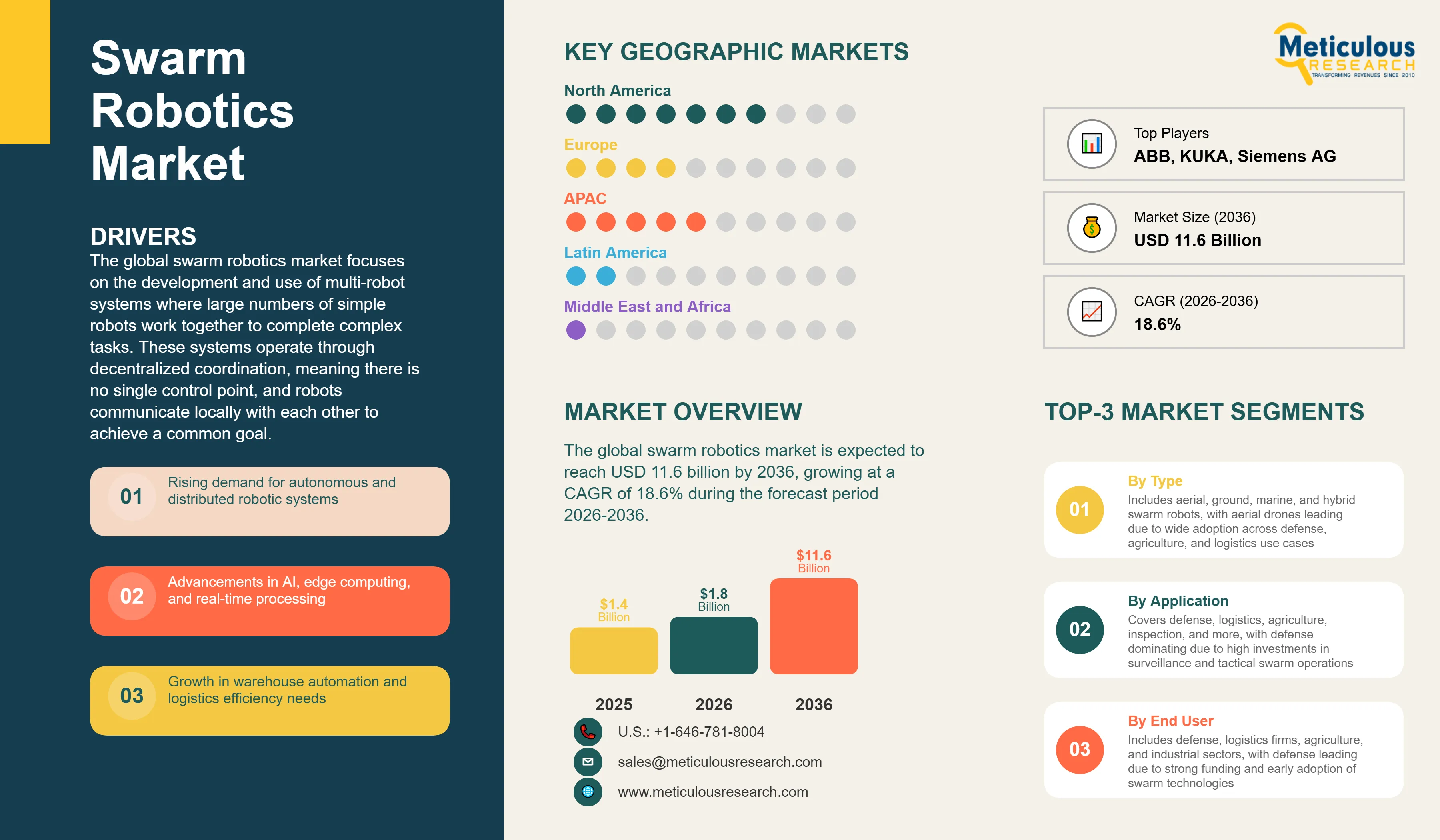
The global swarm robotics market was valued at USD 1.4 billion in 2025. This market is expected to reach USD 11.6 billion by 2036 from an estimated USD 1.8 billion in 2026, growing at a CAGR of 18.6% during the forecast period 2026-2036.
- Published
- Apr 2026
- Pages
- 280
- Format
- PDF + Excel
- Report ID
- MR-1913
- Base year
- 2025
- 2025 · BASELINE
- $1.40B
- 2036
- $11.60B
- CAGR 2026–2036
- 18.6%
2025 baseline · 2026–2036 forecast at 18.6% CAGR · hover a bar for the value
Key highlights
The global swarm robotics market is projected to reach USD 11.6 billion by 2036.
The market is expected to grow at a CAGR of 18.6% during the forecast period 2026-2036.
The market was valued at USD 1.4 billion in 2025 and is estimated to reach USD 1.8 billion in 2026.
North America is expected to dominate the global swarm robotics market with the largest market share in 2026.
By robot type, the aerial swarm robots segment is expected to hold the largest share in 2026.
By control architecture, the hybrid control systems segment is expected to hold the largest share in 2026.
By communication technology, the RF communication segment is expected to hold the largest share in 2026.
By application, the defense and security segment is expected to hold the largest share in 2026.
By end user, the defense and military segment is expected to hold the largest share in 2026.
By deployment mode, the semi-autonomous swarms segment is expected to hold the largest share in 2026.
By swarm size, the medium swarms (10 to 100 robots) segment is expected to hold the largest share in 2026.
Report summary
| Particulars | Details |
|---|---|
| Market Size by 2036 | USD 11.6 Billion |
| Market Size in 2026 | USD 1.8 Billion |
| Market Size in 2025 | USD 1.4 Billion |
| Revenue Growth Rate (2026-2036) | CAGR of 18.6% |
| Format | PDF, Excel & Cloud Portal · 280 pages |
| Dominating Robot Type | Aerial Swarm Robots (Drones/UAVs) |
| Fastest Growing Robot Type | Hybrid and Multi-Domain Swarms |
| Dominating Control Architecture | Hybrid Control Systems |
| Fastest Growing Control Architecture | Fully Decentralized Swarm Systems |
| Dominating Communication Technology | RF Communication |
| Fastest Growing Communication | 5G/6G Communication |
| Dominating Application | Defense and Security |
| Fastest Growing Application | Emerging Applications (Smart Cities, Space) |
| Dominating End User | Defense and Military |
| Fastest Growing End User | Logistics and E-commerce Companies |
| Dominating Deployment Mode | Semi-Autonomous Swarms |
| Fastest Growing Deployment Mode | Fully Autonomous Swarms |
| Dominating Swarm Size | Medium Swarms (10 to 100 Robots) |
| Fastest Growing Swarm Size | Large Swarms (100 or More Robots) |
| Dominating Geography | North America |
| Fastest Growing Geography | Asia-Pacific |
| Base Year | 2025 |
| Forecast Period | 2026 to 2036 |
Report overview
Segments covered: robot type, control architecture, communication, technology, end user.
The global swarm robotics market focuses on the development and use of multi-robot systems where large numbers of simple robots work together to complete complex tasks. These systems operate through decentralized coordination, meaning there is no single control point, and robots communicate locally with each other to achieve a common goal.
The market includes different types of swarm systems such as aerial drones and UAV swarms, ground-based robots (wheeled, tracked, or legged), marine robots (surface and underwater), and hybrid systems that combine multiple environments. These solutions are used across a wide range of applications, including defense and surveillance, warehouse automation, agriculture, infrastructure inspection, environmental monitoring, and disaster response. Deployment can vary from fully autonomous systems to those that are partially or fully controlled by humans.
Market growth is being driven by advancements in key technologies. These include embedded AI chips that allow robots to process data and make decisions individually, low-latency communication networks that enable real-time coordination between robots, and ongoing miniaturization of sensors, batteries, and computing hardware. Together, these developments are making swarm robots more capable and cost-effective.
Defense remains the primary driver of demand in the near term. Government programs, especially in the U.S., China, Israel, and the U.K., are investing heavily in drone swarm technologies for tactical and surveillance applications. These investments are also helping accelerate the development of technologies that can later be used in commercial sectors.
However, the market still faces some challenges. Coordinating large numbers of robots without centralized control is complex, particularly in dynamic and unpredictable environments. Ensuring smooth communication, avoiding collisions, and maintaining system reliability at scale are still evolving areas. In addition, regulations for autonomous multi-robot systems—especially drone swarms operating in shared airspace—are still developing and vary across regions, which creates uncertainty for commercial deployment.
Despite these challenges, the market is steadily progressing. Advances in swarm algorithms, along with the use of simulation platforms like Gazebo, ROS2, and NVIDIA Isaac Sim, are helping improve system performance and speed up development. At the same time, regulatory bodies in regions such as the U.S., Europe, and the U.K. are working toward clearer frameworks for autonomous operations.
Early commercial use cases in warehouse automation, agriculture, and drone-based events are also demonstrating real-world viability. These developments are building confidence in the technology and supporting increased investment, positioning swarm robotics as a high-growth market with strong long-term potential.
Report infographic
Market dynamics
6 factors across 3 forcesIncreasing Adoption of Autonomous and Distributed Systems
A major driver of the swarm robotics market is the growing shift toward autonomous and distributed systems across defense, logistics, and industrial sectors. Organizations are increasingly looking to reduce human involvement in repetitive, risky, or large-scale operations, and swarm robotics offers a scalable solution.
In the defense sector, swarm systems are gaining traction as they can operate in high-risk environments where human involvement is limited. Instead of relying on a single unmanned system, multiple low-cost drones can work together, making operations more flexible and difficult for adversaries to counter.
In logistics, companies are adopting swarm-based automation to improve efficiency and handle large volumes. For example, warehouse systems using fleets of robots are already proving successful, encouraging wider adoption across e-commerce, retail, and third-party logistics providers. This is creating strong demand for swarm-inspired automation globally.
Advancements in AI, Edge Computing, and Communication Technologies
Technological advancements are another key driver supporting market growth. Improvements in AI processing, edge computing, and communication networks are making swarm robotics more practical and scalable. Modern robots are now equipped with onboard AI capabilities, allowing them to process data, avoid obstacles, and coordinate with other robots in real time without relying heavily on cloud connectivity. At the same time, advancements in communication technologies—especially 5G and mesh networks—enable fast and reliable communication between large numbers of robots.
Additionally, the miniaturization of sensors, processors, and batteries is reducing costs and improving performance. These developments are making it economically feasible to deploy large swarms consisting of hundreds or even thousands of robots, which was previously difficult due to hardware and cost limitations.
Table of contents
15 chapters · 182 sections · 280 pages · click to expandSegmental analysis
| Segment | Largest share (2026) | Fastest growth (2026–2036) |
|---|---|---|
| By Robot Type | Aerial Swarm Robots | Hybrid and multi-domain swarms |
| By Application | Defense and Security | Emerging |
| By End User | Defense and Military | Logistics and e-commerce companies |
| By Swarm Size | Medium Swarms (10 to 100 Robots) | Large swarms (100+ robots) |
By Robot Type
- Aerial Swarm Robots to Dominate
- Aerial swarm robots are expected to dominate the market.
- This is because drones are currently the most mature and widely used swarm technology.
- They benefit from large-scale manufacturing, relatively clearer regulations for commercial use, and strong adoption across multiple applications such as surveillance, infrastructure inspection, agriculture, and entertainment.
- In addition, both defense programs and commercial applications, such as drone light shows and advertising, are already deploying large numbers of coordinated drones.
- This has created the largest installed base of swarm systems, making aerial robots the leading segment in terms of market share.
- However, hybrid and multi-domain swarms are expected to grow at the fastest rate during the forecast period.
- These systems combine aerial, ground, and marine robots to deliver more advanced capabilities.
- By leveraging the strengths of each type of robot, they can handle complex tasks that single-domain systems cannot perform.
- This segment is attracting strong investment from both defense and commercial sectors, particularly for applications requiring coordination across multiple environments.
- As a result, hybrid swarm systems are expected to emerge as a high-growth, high-value segment in the coming years.
- Hybrid Control Systems to Hold the Largest Share
- This is an important classification, as the control approach directly impacts scalability, reliability, and operational complexity.
- Hybrid control systems are expected to hold the largest market share.
- This reflects the current commercial reality, where most deployments combine the strengths of both centralized and decentralized approaches.
- In these systems, a central platform handles overall planning and monitoring, while individual robots make real-time decisions such as navigation and collision avoidance.
- This balance ensures better control, efficiency, and safety.
- For example, in warehouse automation, companies are using centralized systems for task allocation while allowing robots to operate independently on the ground.
- This hybrid approach has become the standard for large-scale commercial deployments.
- However, fully decentralized systems are expected to grow at the fastest rate during the forecast period.
- These systems allow robots to operate entirely without central control, making them more scalable and resilient, especially in environments where communication is limited or unreliable.
- Advancements in swarm intelligence and AI are enabling more effective decentralized coordination, making these systems increasingly suitable for applications such as defense, disaster response, and exploration.
- RF Communication to Hold the Largest Share
- RF communication is expected to hold the largest market share.
- This is because most current swarm systems, especially drones and ground robots, rely on RF technologies operating in sub-GHz and 2.4 GHz bands.
- These solutions are widely used due to their long range, good signal penetration, low cost, and proven reliability.
- Standard RF protocols and proprietary mesh-based RF systems are already well established and support effective communication for most existing swarm deployments within controlled environments.
- However, 5G/6G communication is expected to grow at the fastest rate during the forecast period.
- The increasing deployment of private 5G networks in warehouses, defense sites, and agricultural operations is enabling faster, more reliable, and low-latency communication—critical for coordinating large-scale swarms with hundreds of robots in real time.Looking ahead, the expected rollout of 6G in the early 2030s will further enhance connectivity with ultra-low latency and higher data speeds, enabling more advanced and large-scale swarm operations.
By Application
- Defense and Security to Hold the Largest Share
- Defense and security is expected to hold the largest market share.
- This is mainly because defense projects involve very high contract values and significant government funding.
- Programs in countries like the U.S., China, and Israel are heavily investing in drone swarm technologies for surveillance, tactical operations, and autonomous missions.The defense sector also plays a key role in advancing swarm technology, as it is willing to invest in early-stage innovations and accept higher initial costs.
- This results in faster development and deployment compared to most commercial applications.
- However, emerging applications are expected to grow at the fastest rate during the forecast period.
- This segment includes new and innovative use cases such as smart city traffic management, drone-based entertainment shows, urban delivery systems, and space exploration.
- For example, synchronized drone shows are already being used for large-scale events, while companies are testing drone swarms for last-mile delivery in urban areas.
- In addition, space agencies are exploring the use of robot swarms for future missions to the Moon and Mars.
By End User
- Defense and Military to Hold the Largest Share
- The defense and military segment is expected to account for the largest share.
- This aligns with the overall dominance of defense spending in swarm robotics.
- Military organizations across countries such as the U.S., U.K., China, and Israel are major adopters, investing heavily in swarm technologies for surveillance, tactical operations, and autonomous missions.
- Defense contracts are typically large, long-term, and high-value, providing stable revenue streams for vendors.
- These investments also support ongoing research and development, making defense the most influential end-user segment in the market
- However, logistics and e-commerce companies are expected to grow at the fastest rate during the forecast period.
- The rapid expansion of e-commerce is putting pressure on fulfillment operations to become faster, more efficient, and cost-effective.
- Swarm-based warehouse automation has already demonstrated strong returns for leading companies, encouraging wider adoption across the industry.
- As more companies expand their fulfillment networks, the deployment of robot swarms for sorting, picking, and material movement is expected to increase significantly.
By Swarm Size
- Medium Swarms (10 to 100 Robots) to Hold the Largest Share
- The medium swarms segment is expected to account for the largest share of the market.
- These deployments offer the right balance between performance and cost.
- They are large enough to deliver meaningful operational benefits, while still being manageable in terms of coordination and infrastructure requirements.
- Most current commercial applications—such as warehouse automation, agriculture, and inspection—operate within this range, as existing technologies can efficiently support this level of scale.
- However, large swarms (100+ robots) are expected to grow at the fastest rate during the forecast period.
- This growth is being driven by increasing demand for high-scale operations, particularly in defense, logistics, and agriculture.
- In defense, there is a strong focus on deploying large numbers of low-cost drones for tactical missions.
- In logistics, large fulfillment centers are expanding automation with bigger robot fleets.
- Similarly, in agriculture, covering large land areas efficiently requires higher numbers of coordinated robots.
Geographic analysis
North America
Largest shareIn 2026, North America is expected to account for the largest share of the global swarm robotics market. This is mainly due to the strong presence of the United States as both the largest investor and innovator in swarm robotics. The U.S. government is heavily funding research and development through defense programs, while leading companies are actively developing and deploying advanced swarm solutions. In addition, large-scale commercial adoption, especially in warehouse automation and logistics, has strengthened the region’s leadership. The presence of a strong technology ecosystem and early adoption of advanced robotics continues to drive market growth in North America.
Asia-Pacific
Fastest growthHowever, Asia-Pacific is expected to register the highest growth rate during the forecast period. This growth is driven by a combination of large-scale manufacturing capabilities, rising demand for automation, and increasing investments in robotics and drone technologies. China plays a key role as a major producer of drones and a growing technology innovator. At the same time, countries like Japan, South Korea, Australia, and India are expanding their investments in robotics, agriculture automation, and defense technologies. The rapid growth of e-commerce, smart agriculture, and industrial automation across the region is further accelerating the adoption of swarm robotics.
Competitive landscape
- SwarmFarm Robotics · Australia
- DJI/SZ DJI Technology Co. Ltd. · China
- Lockheed Martin Corporation (U.S.)
- Elbit Systems Ltd. · Israel
- Northrop Grumman Corporation (U.S.)
- Parrot Drones SAS · France
- Boston Dynamics Inc. (U.S.)
- ABB Ltd. · Switzerland
- KUKA AG · Germany
- Siemens AG · Germany
- NVIDIA Corporation (U.S.)
- Clearpath Robotics Inc. · Canada
- Locus Robotics Corp. (U.S.)
- GreyOrange Pte Ltd. · Singapore
- AgEagle Aerial Systems Inc. (U.S.)
Frequently asked questions
The global swarm robotics market is expected to reach USD 11.6 billion by 2036 from an estimated USD 1.8 billion in 2026, at a CAGR of 18.6% during the forecast period 2026-2036.
Cite this report
Meticulous Research. (2026). Swarm Robotics Market - Global Opportunity Analysis and Industry Forecast (2026-2036) (Report No. MR-1913). Meticulous Market Research Pvt. Ltd. https://www.meticulousresearch.com/product/swarm-robotics-market-6596