Resources
About Us
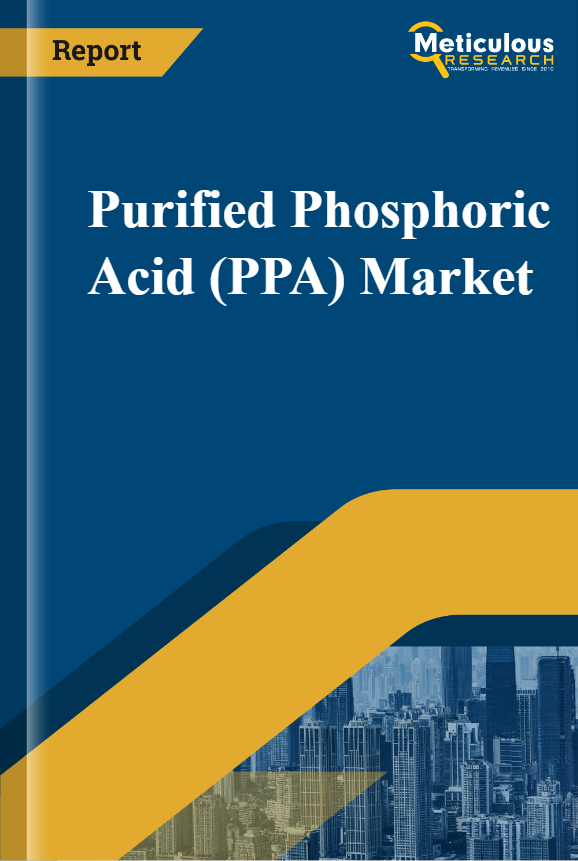
Purified Phosphoric Acid (PPA) Market by Grade, Application (Food & Beverages, Pharmaceuticals, Electronics & Semiconductors, LFP Batteries, Industrial Chemicals, Animal Feed), Production Method — Global Forecast to 2036
Report ID: MRAGR - 1041644 Pages: 238 Jan-2026 Formats*: PDF Category: Agriculture Delivery: 24 to 72 Hours Download Free Sample Report
The global purified phosphoric acid (PPA) market is expected to reach USD 12.23 billion by 2036 from USD 5.36 billion in 2026, at a CAGR of 8.6% from 2026 to 2036.
Purified phosphoric acid (PPA) is a premium grade of phosphoric acid that is produced through advanced, multi‑stage purification processes designed to remove impurities such as heavy metals, arsenic, fluoride, and other contaminants. These processes enable PPA to meet the stringent quality requirements of food, pharmaceutical, electronics, and advanced energy storage applications. In contrast to merchant‑grade phosphoric acid, typically produced via wet‑process routes for fertilizer use and containing relatively high impurity levels, PPA achieves purity levels exceeding 99% through technologies such as thermal processing, solvent extraction, ion exchange, crystallization, and advanced filtration.
The PPA market serves a range of high‑value end uses. In the food industry, food‑grade phosphoric acid (typically 75–85% H₃PO₄) is widely used as an acidulant and pH regulator in carbonated beverages and processed foods. Pharmaceutical‑grade PPA (>99% purity) functions as a buffering agent and excipient in drug formulations. Ultra‑pure electronics‑grade PPA is essential for precision etching and cleaning processes in semiconductor manufacturing. In the energy storage sector, battery‑grade PPA (generally >85% concentration with tightly controlled metal impurities) is a critical precursor for lithium iron phosphate (LFP) cathode materials used in rechargeable batteries.
Among these applications, battery‑grade PPA represents the fastest‑growing segment, driven by accelerating electric vehicle adoption and expanding energy storage deployments. Production of battery‑grade material typically requires high‑quality igneous phosphate rock and sophisticated purification technologies to meet the strict impurity specifications necessary for consistent LFP battery performance and longevity.
-market.webp)
Click here to: Get Free Sample Pages of this Report
The rapid emergence of battery‑grade purified phosphoric acid (PPA) for lithium iron phosphate (LFP) cathode production is one of the key trends reshaping market dynamics and investment priorities. LFP batteries require high‑purity phosphoric acid to produce iron phosphate precursors, with stringent specifications governing metallic impurities that can impair battery performance, safety, and cycle life. Battery‑grade PPA typically exceeds 85% H₃PO₄ concentration and is subject to parts‑per‑million limits on heavy metals, alkali metals, and halides. Meeting these requirements increasingly necessitates the use of igneous phosphate rock sources, which contain lower levels of deleterious trace elements and enable significantly higher conversion efficiencies compared with sedimentary rock. In response, producers and developers, including Innophos (VOLTIX), First Phosphate Corp., Fox River Resources, and several Chinese suppliers are investing in dedicated battery‑grade PPA capacity to serve expanding LFP supply chains in North America, Europe, and Asia.
Supply chain localization and ESG considerations are also reshaping sourcing strategies, particularly in battery and pharmaceutical end markets. Regulatory pressure in Europe has heightened restrictions on phosphoric acid derived from sedimentary phosphate rock due to radioactive gypsum byproducts, increasing preference for igneous‑based feedstocks that generate non‑radioactive, reusable co‑products. In North America, battery manufacturers and automotive OEMs are prioritizing regional PPA supply to meet domestic content requirements under the Inflation Reduction Act and to enhance supply security. This has accelerated investment in Canadian igneous phosphate development and U.S. purification capacity. Pharmaceutical manufacturers are similarly emphasizing traceability, GMP compliance, and documented sustainability performance, favoring suppliers with transparent, certified production pathways. These trends support regional producers while challenging import‑reliant markets to develop domestic capacity or secure long‑term strategic partnerships.
In the food and beverage sector, clean‑label and natural‑ingredient trends are influencing formulation choices in favor of phosphoric acid as a naturally derived acidulant. Its long history of food use and relatively recognizable nomenclature position it advantageously compared with synthetic alternatives. Beverage producers, including major soft drink manufacturers, are increasingly highlighting natural acidulants while maintaining established flavor profiles, benefiting food‑grade PPA suppliers with strong quality and safety credentials. This trend is extending into processed foods, where phosphoric acid supports pH adjustment, shelf‑life extension, mineral fortification, and emulsification. As brands pursue organic and natural product certifications, demand is rising for food‑grade PPA sourced from verified feedstocks and transparent processing routes.
Driver: Electric Vehicle Adoption and LFP Battery Market Expansion
Rapid growth in the global electric vehicle (EV) market, led by China’s dominance in lithium iron phosphate (LFP) battery adoption, is driving demand for battery‑grade purified phosphoric acid. LFP battery chemistry offers several advantages, including superior thermal stability and safety, cost competitiveness for mass‑market and commercial vehicles, cobalt‑free composition that mitigates supply chain and ESG risks, and longer cycle life suitable for both automotive and stationary energy storage systems. As a result, LFP batteries have become the preferred chemistry across multiple vehicle segments in China, which accounts for more than half of global EV sales. Major Chinese OEMs, including BYD, deploy LFP across passenger vehicles, buses, trucks, two‑wheelers, and light commercial vehicles.
Adoption of LFP technology is also accelerating in Western markets. Tesla utilizes LFP batteries in standard‑range Model 3 and Model Y vehicles, while U.S. and European manufacturers are increasingly evaluating LFP for cost‑sensitive passenger vehicles and commercial fleets where safety and durability outweigh energy density considerations. Each gigawatt‑hour of LFP battery production consumes an estimated 300–400 metric tons of battery‑grade PPA, translating announced global capacity expansions into significant, long‑term growth in high‑purity phosphoric acid demand.
Driver: Pharmaceutical Industry Growth and Demand for High‑Purity Excipients
Global expansion of pharmaceutical manufacturing is supporting steady growth in demand for pharmaceutical‑grade purified phosphoric acid. PPA plays a critical role as a buffering agent for pH control in liquid formulations, an excipient in solid dosage forms, a solubilizing agent to enhance bioavailability, and an intermediate in the synthesis of select active pharmaceutical ingredients.
Pharmaceutical applications impose stringent purity standards, typically exceeding 99% with trace metal limits measured in parts per billion, supporting premium pricing for compliant material. Regulatory frameworks such as the United States Pharmacopeia (USP), European Pharmacopoeia (EP), and equivalent standards globally require consistent quality, comprehensive testing, and full traceability. In addition, accelerating biosimilar development driven by patent expirations of major biologics is further increasing demand for high‑purity phosphate buffers used in protein stabilization and formulation.
Opportunity: Expansion of Semiconductor Industry and Demand for Ultra‑Pure Chemicals
The global expansion of semiconductor manufacturing, driven by accelerating digitalization, artificial intelligence workloads, automotive electronics growth, and government‑led supply chain diversification initiatives, is creating rising demand for electronics‑grade purified phosphoric acid. Semiconductor fabrication processes rely on ultra‑pure phosphoric acid, typically exceeding 99.999% purity with metal impurities controlled at parts‑per‑trillion levels, for critical applications such as silicon wafer etching, photoresist stripping, inter‑process cleaning, and surface preparation.
Stringent contamination control requirements make electronics‑grade chemical purity non‑negotiable, as even trace impurities can result in yield losses or device failures at advanced technology nodes. Ongoing investments in new fabrication capacity, including TSMC’s facilities in Arizona and Japan, Samsung’s expansions in Texas and South Korea, Intel’s manufacturing projects across the United States and Europe, and China’s domestic semiconductor build‑out, are increasing demand for localized supply of ultra‑high‑purity process chemicals, including phosphoric acid.
Opportunity: Energy Storage Systems and Grid‑Scale Battery Deployment
Rapid deployment of grid‑scale energy storage systems to support renewable energy integration and grid reliability represents a significant opportunity for battery‑grade purified phosphoric acid beyond automotive electrification. Utility‑scale energy storage increasingly favors lithium iron phosphate battery chemistry due to its long cycle life, typically 4,000–6,000 cycles compared with 1,000–2,000 cycles for nickel‑rich chemistries, along with superior safety performance, lower lifetime cost per kilowatt‑hour, and the absence of energy density constraints inherent to stationary applications.
With industry forecasts projecting annual grid‑scale energy storage installations exceeding 100 GWh by 2030, stationary storage is emerging as a long‑term driver of battery‑grade PPA demand that complements growth from electric vehicles.
By Grade:
In 2025, food‑grade purified phosphoric acid (PPA) held the largest share of the overall purified phosphoric acid market, driven by increasing consumption in the carbonated beverage industry, where it provides the characteristic acidic profile of cola drinks and functions as a stable acidulant. Beyond beverages, it is also widely used in processed cheese, meats, baked goods, and fruit preparations for pH control, preservation, and emulsification. This segment is characterized by market maturity, stable volumes, and modest growth aligned with global food consumption trends.
By contrast, battery‑grade purified phosphoric acid is expected to grow at the fastest CAGR through 2036, driven by rapid adoption of lithium iron phosphate (LFP) batteries across electric vehicles and stationary energy storage. Battery‑grade PPA typically exceeds 85% H₃PO₄ and requires extremely low impurity levels, as trace metals can impair LiFePO₄ synthesis and battery performance. Meeting these specifications economically has increased reliance on igneous phosphate rock sources, which offer lower inherent contaminant levels and align with ESG and supply‑chain transparency requirements.
By Application:
Food & beverage applications accounted for the largest share of the purified phosphoric acid market in 2025, led by carbonated soft drinks as the single largest end‑use. In beverage formulations, phosphoric acid delivers the characteristic tart profile of cola drinks while serving as an acidulant to control pH, enhance flavor balance, and extend shelf life through microbial inhibition. Its long history of use, formulation stability, and universal regulatory acceptance make it the preferred acidulant for cola beverages globally. Beyond drinks, purified phosphoric acid is widely used in processed foods, including cheese, meat products, baked goods, and jams, where it supports pH regulation, emulsification, preservation, and shelf‑life extension. Clean‑label trends generally favor phosphoric acid due to its recognizable labeling, with niche premium demand emerging for verified natural or traceable sources.
However, the LFP battery applications segment is expected to grow at the fastest CAGR from 2026 to 2036. Lithium iron phosphate cathode production requires high‑purity phosphoric acid for LiFePO₄ synthesis, with material purity directly influencing battery performance, cycle life, and safety. Chinese battery manufacturers, including CATL, BYD, Gotion High‑Tech, and Eve Energy, currently account for the largest consumption, while Western EV and energy‑storage supply chains are rapidly scaling demand.
Regional Insights:
In 2025, North America commanded the largest share of the global purified phosphoric acid market in value terms, driven primarily by the U.S. The region hosts major integrated phosphate producers such as The Mosaic Company and Nutrien, alongside specialized PPA suppliers including Innophos, which serves food, pharmaceutical, electronics, and emerging battery markets. Canada is emerging as an important contributor to battery‑grade PPA development, with companies such as First Phosphate Corp. and Fox River Resources advancing igneous phosphate projects aligned with ESG and supply‑security objectives.
Asia‑Pacific is the fastest‑growing market for purified phosphoric acid, led by China’s dominance in LFP battery production for electric vehicles and energy storage systems. Chinese integrated phosphate producers have rapidly expanded food‑grade and battery‑grade PPA capacity to support domestic battery manufacturers such as CATL and BYD. India is experiencing strong growth driven by food processing, pharmaceutical manufacturing, and emerging electronics production, while Southeast Asian markets show rising food‑grade demand as processed food industries expand. Japan and South Korea maintain concentrated high‑purity demand from electronics, semiconductor, and battery sectors, while Australia serves as a key regional phosphate rock supplier despite limited downstream PPA production.
The European purified phosphoric acid market is expected to witness moderate growth with the rising demand in pharmaceutical and electronics applications, shaped by stringent quality and environmental regulations. Pharmaceutical‑grade PPA consumption is driven by originator, generic, and biosimilar manufacturers, while electronics demand stems from semiconductor and PCB manufacturing hubs across Western Europe.
Key Players:
The purified phosphoric acid (PPA) market is characterized by the presence of both large integrated phosphate producers and specialty chemical manufacturers. Key players operating in this market include Innophos Holdings Inc., Nutrien Ltd., The Mosaic Company, OCP Group S.A., ICL Group Ltd., PhosAgro Group of Companies, EuroChem Group AG, and Prayon Technologies SA, which benefit from strong upstream phosphate integration and established purification capabilities. In addition, specialty and regionally focused producers such as SMC Global, Prasol Chemicals Pvt. Ltd., Arkema Group, Solvay S.A., and Hubei Xingfa Chemicals Group Co., Ltd. play an important role in serving food-grade, pharmaceutical, and industrial end-use segments. Together, these companies shape the competitive landscape through capacity expansions, product quality differentiation, and long-term supply relationships, while other regional producers contribute to market depth and localized supply.
The purified phosphoric acid market is expected to grow from USD 5.36 billion in 2026 to USD 12.23 billion by 2036.
The purified phosphoric acid market is expected to grow at a CAGR of 8.6% from 2026 to 2036.
The major players operating in the purified phosphoric acid market include Innophos Holdings Inc., Nutrien Ltd., The Mosaic Company, OCP Group S.A., ICL Group Ltd., PhosAgro Group of Companies, EuroChem Group AG, Prayon Technologies SA, SMC Global, Prasol Chemicals Pvt. Ltd., Arkema Group, Solvay S.A., and Hubei Xingfa Chemicals Group Co., Ltd., among others.
Main drivers include exponential LFP battery adoption in electric vehicles and energy storage, food & beverage industry clean-label trends, pharmaceutical industry expansion, semiconductor manufacturing growth, supply chain localization initiatives, and ESG-driven preference for igneous phosphate sources producing non-radioactive byproducts.
North America leads in value terms with established producers and diversified demand, while Asia-Pacific shows highest growth rate driven by China's dominant LFP battery production, India's food processing expansion, and regional electronics manufacturing concentration.



















Published Date: Sep-2026
Published Date: Sep-2026
Published Date: Sep-2026
Published Date: Sep-2026
Published Date: Sep-2026
Please enter your corporate email id here to view sample report.
Subscribe to get the latest industry updates


