Ebb and Flow System Market (2026-2036)
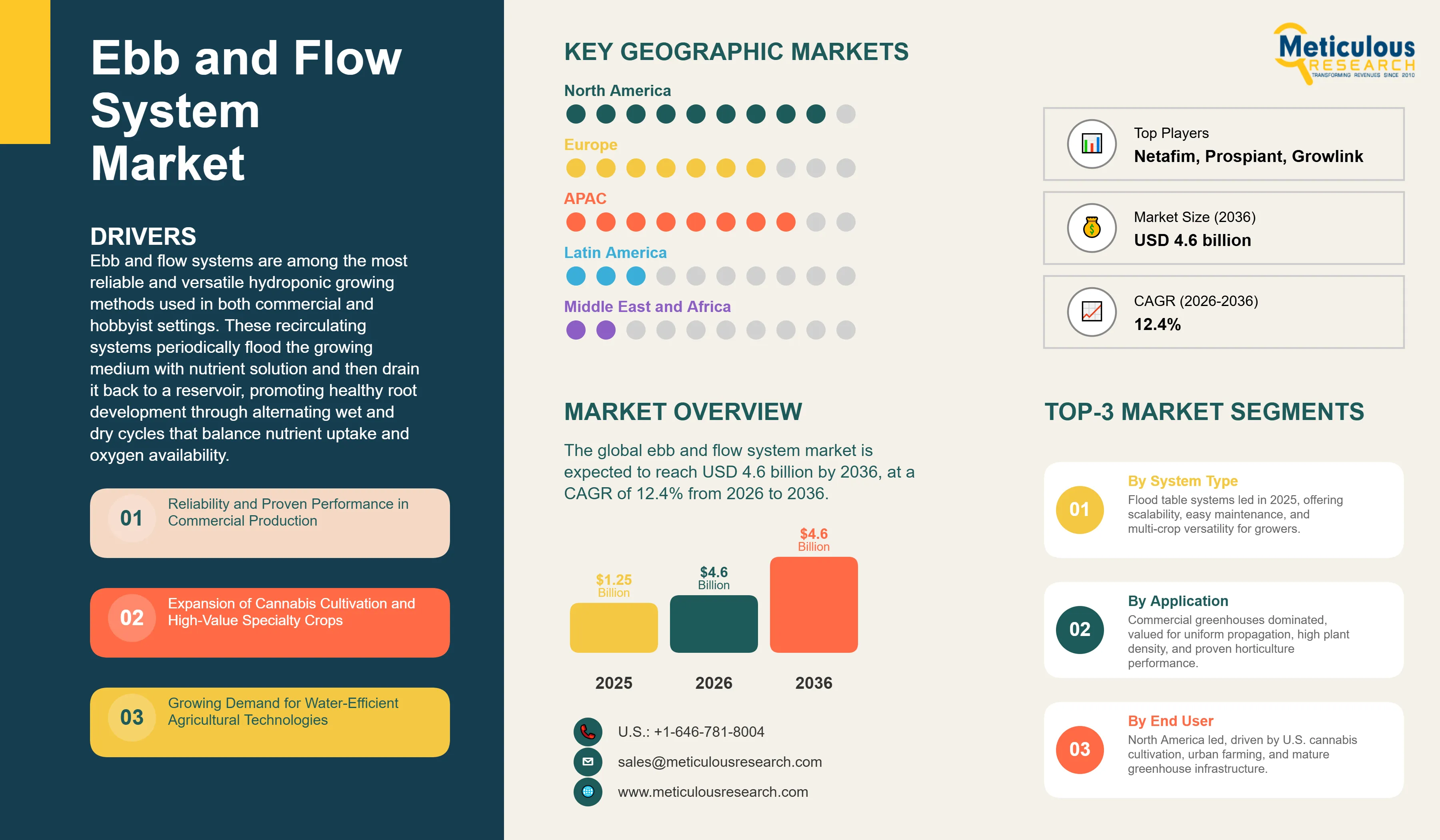
The global ebb and flow system market is expected to reach USD 4.6 billion by 2036 from USD 1.4 billion in 2026, at a CAGR of 12.4% from 2026 to 2036.
- Published
- Jan 2026
- Pages
- 240
- Format
- PDF + Excel
- Report ID
- MR-1646
- Base year
- 2025
- 2026 · ESTIMATED
- $1.40B
- 2036
- $4.60B
- CAGR 2026–2036
- 12.4%
2025 baseline · 2026–2036 forecast at 12.4% CAGR · hover a bar for the value
Key highlights
In 2025, North America accounted for the largest share of the global ebb and flow system market, driven by extensive commercial greenhouse operations, rapid expansion of controlled environment agriculture, and strong adoption in cannabis cultivation facilities.
Asia-Pacific is projected to register the highest CAGR during the forecast period, fueled by government support for modern agriculture, land scarcity driving vertical farming adoption, and increasing demand for pesticide-free vegetables in urban markets.
Based on system type, flood table systems held the largest share of the market in 2025, driven by their scalability for commercial operations, ease of maintenance, and versatility for growing multiple crop types simultaneously.
Based on application, commercial greenhouses dominated the market in 2025, owing to the system's reliability for large-scale propagation, excellent uniformity across hundreds of plant sites, and proven track record in professional horticulture.
Based on application, vertical farms are expected to witness significant growth during the forecast period, driven by space efficiency advantages, compatibility with automated nutrient delivery, and increasing urban agriculture deployment.
Based on crop type, leafy greens accounted for the largest share of the market in 2025, fueled by short growing cycles in flood and drain systems, high demand from food service sector, and excellent crop uniformity for commercial packaging.
Based on growing medium, expanded clay pebbles held the largest share in 2025, driven by reusability, excellent drainage characteristics, pH neutrality, and proven performance across diverse crop types.
The U.S. ebb and flow system market is mainly driven by the strong growth in cannabis cultivation applications where ebb and flow systems provide precise control over root zone conditions critical for premium flower production.
Europe ebb and flow system market is driven by the growing adoption in propagation and nursery operations where bottom-flooding techniques ensure uniform seedling development while minimizing disease transmission compared to overhead watering methods.
Report summary
| Particulars | Details |
|---|---|
| Base Year | 2025 |
| Estimated Year | 2026 |
| Forecast Period | 2026–2036 |
| Market Size (2026) | USD 1.40 billion |
| Market Size (2036) | USD 4.60 billion |
| CAGR (2026–2036) | 12.4% |
| Format | PDF, Excel & Cloud Portal · 240 pages |
| Segments Covered | By System Type: In 2025, individual pots, often 200–400+ sites per table depending on crop size, UV‑stabilized materials, scalable reservoir options., Bucket systems are expected to grow at the fastest CAGR through 2036, simplified harvesting, isolation of individual plants when needed, advantages not easily achieved with fixed flood tables. · By Application: Based on application, reduces disease transmission compared with overhead watering, including rolling benches, lighting, climate control, making them well suited to professional production environments., emphasizing shallow trays that reduce solution volume, system weight, pumping energy requirements. The closed‑loop, demand for specialized ebb and flow systems continues to accelerate. · By Crop Type: Leafy greens, including lettuce, spinach, kale, while some producers utilize flood and drain through harvest., Fruiting vegetables and high‑value crops, including tomatoes, peppers, cucumbers, strawberries, cannabis, individual plant management is critical for training, spacing, harvest optimization · By Growing Medium |
| Key Companies | Growing Innovations, Inc., Netafim Ltd., Hydro Systems Co., Rivulis Irrigation Ltd., Priva Holding B.V., Autogrow Systems Ltd., Argus Control Systems Ltd., Certhon Group, GGS Greenhouse + Grower Supplies, Prospiant Inc., Vanden Bussche Irrigation, Growlink Inc., T-Systems Hydroponics |
Report overview
Segments covered: system type, application, crop type, growing medium.
Ebb and flow systems are among the most reliable and versatile hydroponic growing methods used in both commercial and hobbyist settings. These recirculating systems periodically flood the growing medium with nutrient solution and then drain it back to a reservoir, promoting healthy root development through alternating wet and dry cycles that balance nutrient uptake and oxygen availability. During flooding, stale air is displaced from the medium, while drainage draws fresh oxygen back into the root zone. Modern systems incorporate automation, overflow protection, and precise timing controls to ensure consistent operation. Ebb and flow technology supports a wide range of growing media, including expanded clay, rockwool, coco coir, and perlite, and is suitable for propagating seedlings, leafy greens, herbs, and larger fruiting crops such as tomatoes, peppers, cucumbers, and cannabis.
Ebb and flow systems have become a foundational technology in modern hydroponic agriculture, valued for their reliability, operational simplicity, and adaptability across a wide range of crops. Compared with more complex hydroponic methods such as aeroponics or nutrient film technique, ebb and flow systems offer a balanced combination of performance and ease of use. Their core mechanism, periodic flooding followed by complete drainage, effectively addresses the dual requirement of delivering nutrients and oxygen to plant roots. During flooding, roots absorb nutrient solution while accumulated carbon dioxide and stale air are displaced from the growing medium; subsequent drainage draws oxygen‑rich air back into the root zone, supporting vigorous root development, improved nutrient uptake, and greater plant resilience.
The market spans a broad range of system scales, from small hobbyist setups with single flood tables supporting a limited number of plants to large commercial installations featuring interconnected tables covering extensive growing areas. Modern commercial systems typically incorporate advanced automation, including programmable irrigation controls, overflow protection, pH and electrical conductivity monitoring, and integration with temperature and humidity management systems. The long‑standing use of ebb and flow technology in commercial greenhouse propagation, where uniformity and repeatability are critical, has established proven design standards and best practices that support adoption across both industrial and home‑growing applications.
Report infographic
Market dynamics
7 factors across 3 forcesReliability and Proven Performance in Commercial Production
Ebb and flow systems have a long track record of reliable performance in commercial greenhouse operations, particularly in large‑scale seedling propagation where uniform germination and early plant development are critical. Bottom‑flood irrigation delivers consistent moisture across all plant sites, avoiding the dry spots common with overhead irrigation and the variability sometimes associated with drip systems. This uniformity minimizes uneven growth, reduces labor requirements for sorting, and improves overall marketable yield.
The mechanical simplicity, typically involving a submersible pump, timer, and overflow safeguard, supports high system uptime and straightforward maintenance. Unlike more complex hydroponic methods that rely on precise pressure or flow control, ebb and flow systems are tolerant of minor equipment variations without jeopardizing crop performance. This proven reliability makes them a low‑risk and cost‑effective choice for commercial growers investing in long‑term production infrastructure.
Expansion of Cannabis Cultivation and High‑Value Specialty Crops
The rapid expansion of legal cannabis cultivation is a significant driver of ebb and flow system adoption. Commercial cannabis producers favor flood and drain methods for their ability to precisely regulate root‑zone moisture and oxygen availability, key factors in achieving consistent yields and premium flower quality. Bucket‑based ebb and flow systems are particularly popular, allowing uniform irrigation across individual plant modules while enabling flexible plant spacing, training, and harvest scheduling.
Periodic drying between flood cycles encourages robust root development and supports optimal nutrient uptake, contributing to improved resin production and cannabinoid profiles. As cannabis legalization expands globally and licensed cultivation capacity increases, many producers are standardizing on proven hydroponic technologies, with ebb and flow systems widely adopted across both vegetative and flowering stages.
Table of contents
13 chapters · 142 sections · 240 pages · click to expandGeographic analysis
North America
Largest shareIn 2025, North America held the largest share of the global ebb and flow system market, led by the U.S. This is mainly attributed to its mature commercial greenhouse sector, rapid expansion of licensed cannabis cultivation, and growing urban agriculture adoption. The U.S. greenhouse operators producing vegetables, ornamentals, and transplants have largely standardized on flood table systems for propagation, while cannabis producers favor bucket‑based configurations for flowering and individual plant management. The well-established distribution networks and extensive technical support from major suppliers make ebb and flow systems widely accessible across North America, from home growers to large‑scale commercial operations. The Asia‑Pacific ebb and flow system market is expected to grow at the fastest CAGR from 2026 to 2036, driven by government support for modernized agriculture, land constraints in dense urban centers, and rising consumer demand for pesticide‑free produce.
Asia-Pacific
Japan and Singapore lead vertical farming deployment, where ebb and flow systems are commonly used due to their reliability in stacked growing environments. China’s greenhouse sector is rapidly modernizing with increasing adoption of automated irrigation, while South Korea and Taiwan show growing interest in hydroponic production for high‑value crops. The growing food safety concerns across the region are further supporting investment in controlled‑environment agriculture despite higher initial capital costs relative to conventional farming. The European ebb and flow system market also shows strong adoption of ebb and flow systems in greenhouse propagation and nursery operations, particularly in the Netherlands, Spain, Germany, and the U.K. The European growers focus on sustainability and resource efficiency, driving preference for recirculating hydroponic systems that reduce water use and nutrient runoff. Regulatory constraints on fertilizer discharge in sensitive watersheds are further encouraging closed‑loop systems such as flood and drain. This market is also further driven by a well‑developed supplier base serving both professional horticulture and advanced hobbyist markets.
Competitive landscape
- Growing Innovations, Inc.
- Netafim Ltd.
- Hydro Systems Co.
- Rivulis Irrigation Ltd.
- Priva Holding B.V.
- Autogrow Systems Ltd.
- Argus Control Systems Ltd.
- Certhon Group
- GGS Greenhouse + Grower Supplies
- Prospiant Inc.
- Vanden Bussche Irrigation
- Growlink Inc.
- T-Systems Hydroponics
Frequently asked questions
The ebb and flow system market is expected to grow from USD 1.4 billion in 2026 to USD 4.6 billion by 2036.
Cite this report
Meticulous Research. (2026). Ebb and Flow System Market - Global Opportunity Analysis and Industry Forecast (2026-2036) (Report No. MR-1646). Meticulous Market Research Pvt. Ltd. https://www.meticulousresearch.com/product/ebb-and-flow-system-market-6329