Resources
About Us
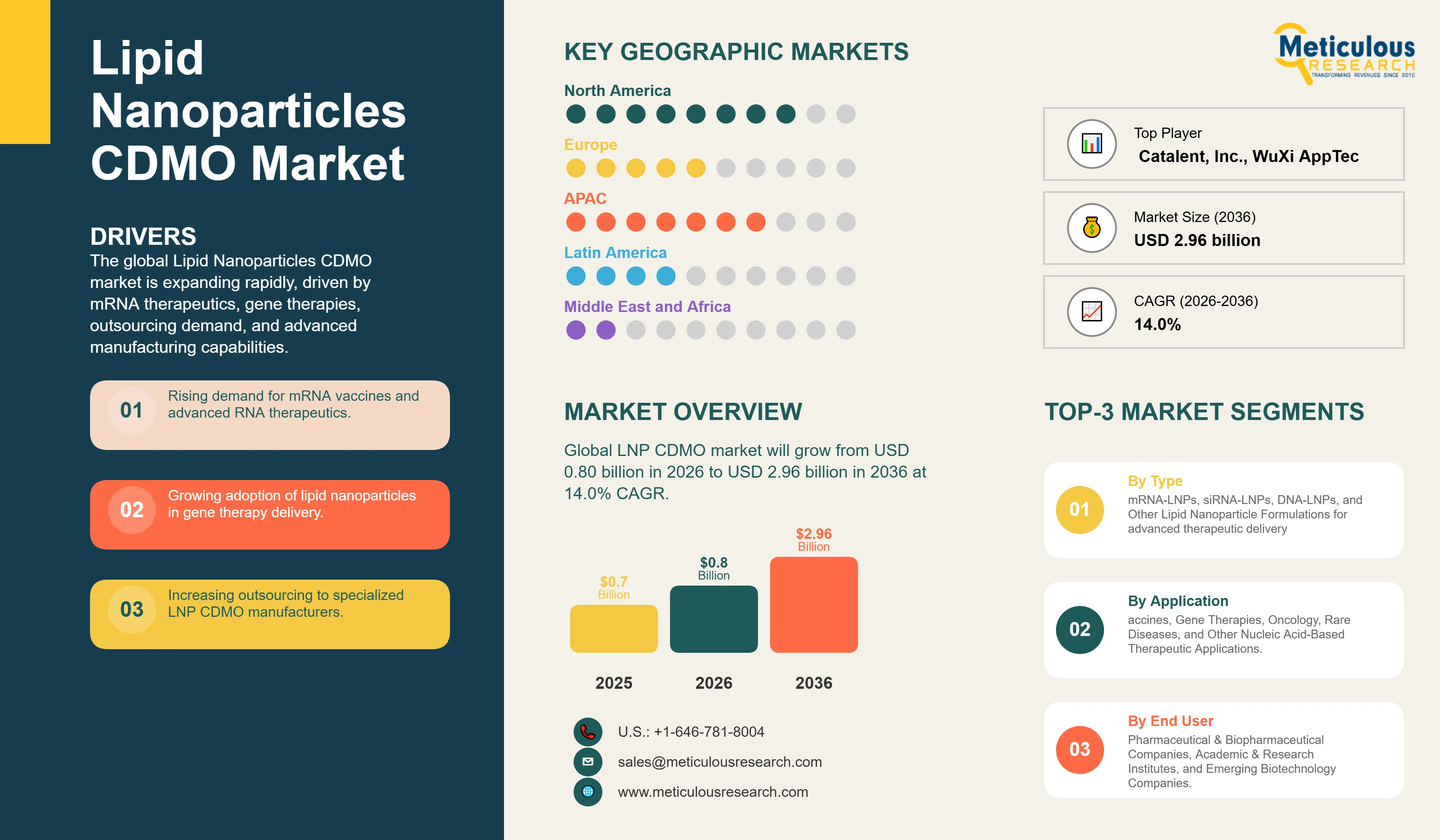
The global Lipid Nanoparticles (LNP) CDMO (Contract Development and Manufacturing Organization) market is projected to reach an estimated USD 0.80 billion in 2026 and is expected to grow significantly to USD 2.96 billion by 2036, exhibiting a robust Compound Annual Growth Rate (CAGR) of 14.0% during the forecast period. This substantial growth is primarily driven by the increasing adoption of LNP-based drug delivery systems in gene therapies, mRNA vaccines, and other advanced therapeutics, coupled with the growing demand for specialized manufacturing expertise and infrastructure provided by CDMOs.
 Click here to: Get Free Sample Pages of this Report
Lipid Nanoparticles (LNPs) are a critical component in the formulation of various advanced therapeutic modalities, particularly for the efficient and safe delivery of nucleic acids (mRNA, siRNA, DNA) and other sensitive payloads. LNP CDMOs are specialized organizations that offer comprehensive services for the development, formulation, analytical characterization, and GMP-compliant manufacturing of LNPs. These services are essential for pharmaceutical and biotechnology companies seeking to leverage the potential of LNP technology for novel vaccines, gene therapies, and oncology treatments.
The market for LNP CDMOs is expanding rapidly due to the proven success of LNP-encapsulated mRNA vaccines during recent global health crises, which has significantly accelerated research and development in this field. CDMOs provide crucial expertise in lipid chemistry, formulation science, process development, and scale-up, enabling clients to overcome complex manufacturing challenges, ensure product quality, and expedite time-to-market for their LNP-based therapeutics. The intricate nature of LNP manufacturing, requiring specialized equipment and stringent quality control, makes outsourcing to experienced CDMOs a strategic imperative for many drug developers.
Drivers
Restraints
Opportunities
Challenges
The global Lipid Nanoparticles CDMO market is characterized by several pivotal trends. A significant trend is the increasing demand for integrated end-to-end services, where CDMOs provide comprehensive support from early-stage development to commercial manufacturing, streamlining the entire process for clients. Another key trend is the growing focus on process intensification and continuous manufacturing to enhance efficiency, reduce costs, and improve the scalability of LNP production. The market is also witnessing a rise in the adoption of advanced analytical techniques for robust characterization and quality control of complex LNP formulations. Furthermore, there is an increasing emphasis on novel lipid development to create LNPs with improved targeting, stability, and reduced immunogenicity. Finally, the strategic consolidation of the CDMO landscape through mergers and acquisitions is a notable trend, as companies seek to expand their capabilities, capacity, and geographic footprint to meet the escalating demand for LNP-based therapeutics.
Analysis by Service Type: Contract Manufacturing Dominating the Landscape
Based on service type, the contract manufacturing segment is expected to hold the largest share of the global LNP CDMO market. This dominance is attributed to the high capital investment required for specialized LNP manufacturing facilities, the need for GMP compliance, and the technical expertise demanded for large-scale LNP production, making outsourcing a strategic choice for many companies. The contract development segment is anticipated to witness the fastest CAGR, driven by the increasing complexity of novel LNP formulations and the growing need for specialized process development and analytical method development support.
Analysis by LNP Type: mRNA-LNPs Leading the Way
Based on LNP type, mRNA-LNPs are expected to command the largest share of the global LNP CDMO market. This dominance is due to the widespread success and ongoing development of mRNA vaccines and therapeutics, which heavily rely on LNP technology for effective delivery. The siRNA-LNPs segment is anticipated to exhibit the fastest CAGR, propelled by the significant advancements in RNA interference technology and the increasing number of siRNA-based therapeutics entering clinical trials.
Analysis by Application: Vaccines and Gene Therapies at the Forefront
Based on application, the vaccines segment is projected to account for the largest share of the LNP CDMO market, primarily driven by the continued demand for mRNA vaccines and the development of new LNP-based vaccine platforms. The gene therapies segment is expected to grow at the fastest CAGR, fueled by the increasing number of LNP-mediated gene therapy candidates advancing through clinical development for various genetic disorders.
Analysis by End User: Pharmaceutical & Biopharmaceutical Companies as Key Clients
Based on end user, pharmaceutical & biopharmaceutical companies are expected to command the largest share of the global LNP CDMO market. These companies are the primary developers and commercializers of LNP-based therapeutics, driving the bulk of outsourcing demand for specialized CDMO services. The academic & research institutes segment is anticipated to exhibit the fastest CAGR, driven by the increasing funding for basic research in LNP technology and the growing need for custom LNP synthesis and formulation for discovery and preclinical studies.
North America: A Global Leader in Biopharmaceutical Innovation and LNP Technology
North America is expected to hold the largest share of the global LNP CDMO market. This dominance is attributed to a highly developed biopharmaceutical industry, significant R&D investments in LNP technology, the presence of numerous key market players and specialized CDMOs, and a robust regulatory framework that supports advanced drug development. The United States, in particular, is a major contributor due to its large patient population, strong funding for biotechnology research, and leading position in mRNA vaccine development.
Europe: Advancing LNP Drug Delivery with Strong Research Ecosystems
Europe is expected to hold a significant share of the global LNP CDMO market, driven by a well-established pharmaceutical sector, strong academic research ecosystems, and increasing government support for biotechnology and life sciences. Countries like Germany, the U.K., and Switzerland are key contributors due to their advanced research capabilities and the presence of leading CDMOs specializing in LNP manufacturing. The key companies operating in the European market are Lonza Group AG, Evonik Industries AG, and CordenPharma International.
Asia-Pacific: Rapid Growth Fueled by Expanding Biopharmaceutical Manufacturing
Asia-Pacific is projected to witness the fastest CAGR during the forecast period. This rapid growth is driven by improving healthcare infrastructure, increasing investments in biopharmaceutical manufacturing capabilities, a growing pool of skilled scientific talent, and the rising demand for cost-effective CDMO services in countries like China, India, and South Korea. Government initiatives to promote biotechnology and attract foreign investment also contribute to the region's market expansion. The key companies operating in the Asia-Pacific market are WuXi AppTec, Samsung Biologics, and GenScript Biotech Corporation.
Latin America: Emerging Opportunities in Advanced Drug Delivery Outsourcing
Latin America is anticipated to witness steady growth in the LNP CDMO market, primarily due to increasing investments in biopharmaceutical R&D, a rising focus on local drug manufacturing, and growing awareness about advanced therapeutic modalities in countries like Brazil and Mexico. The modernization of healthcare facilities and the adoption of international quality standards also contribute to the demand for CDMO services. The key companies operating in the Latin American market are Thermo Fisher Scientific Inc. (with regional presence) and Merck KGaA (with regional presence).
Middle East & Africa: Gradual Expansion with Developing Biopharma Sector
The Middle East & Africa region is expected to experience gradual growth in the LNP CDMO market, driven by increasing healthcare investments, government initiatives to develop local biopharmaceutical industries, and a growing focus on adopting advanced medical technologies. Countries like UAE and Saudi Arabia are investing in biotechnology research and drug development, leading to a gradual increase in demand for LNP CDMO services. The key companies operating in the Middle East & Africa market are Thermo Fisher Scientific Inc. (with regional presence) and Merck KGaA (with regional presence).
The global Lipid Nanoparticles CDMO market is characterized by a dynamic and highly competitive landscape. It features a mix of large, integrated CDMOs, specialized LNP manufacturers, and biotechnology firms offering formulation and manufacturing services. Key players are focusing on expanding their manufacturing capacity, investing in advanced LNP formulation and process technologies, offering integrated end-to-end solutions, and forming strategic partnerships or acquisitions to strengthen their market positions. The competitive strategy often revolves around demonstrating technical expertise, ensuring regulatory compliance, providing high-quality GMP-grade materials, and offering flexible and cost-effective solutions to clients. Companies are also investing heavily in R&D to develop novel LNP compositions and processes for next-generation drug delivery systems.
The global LNP CDMO market is estimated at USD 0.80 billion in 2026 and is projected to reach USD 2.96 billion by 2036, growing at a CAGR of 14.0%.
The market is driven by the surging demand for mRNA-based vaccines and therapeutics, increasing adoption of gene therapies, technological advancements in LNP formulation and manufacturing, and growing outsourcing by pharmaceutical and biotechnology companies.
Key restraints include the high cost of LNP development and manufacturing, stringent regulatory requirements and quality control, limited availability of specialized expertise, and scalability challenges for large-scale production.
Opportunities include expansion into new therapeutic areas, development of novel LNP formulations, geographic expansion into emerging biopharmaceutical hubs, and strategic partnerships and consolidations.
Challenges include analytical characterization complexity, supply chain volatility for critical raw materials, intellectual property (IP) landscape, and competition from alternative drug delivery systems.
Contract manufacturing holds the largest share, while contract development is anticipated to witness the fastest CAGR.
mRNA-LNPs command the largest share, and siRNA-LNPs are anticipated to exhibit the fastest CAGR
Vaccines account for the largest share, and gene therapies are expected to grow at the fastest CAGR.
Which end-user segment accounts for the largest share, and which is anticipated to grow the fastest?
Pharmaceutical & biopharmaceutical companies hold the largest share, and academic & research institutes are anticipated to exhibit the fastest CAGR.
North America leads the market, and Asia-Pacific is projected to witness the fastest CAGR.
Key players include Lonza Group AG, Evonik Industries AG, CordenPharma International, WuXi AppTec, Samsung Biologics, GenScript Biotech Corporation, Thermo Fisher Scientific Inc., Merck KGaA, Danaher Corporation, and Catalent, Inc.
1. Introduction
1.1. Market Definition & Scope
1.2. Market Ecosystem
1.3. Currency Considered
1.4. Key Stakeholders
2. Research Methodology
2.1. Research Approach
2.2. Data Collection and Validation
2.2.1. Secondary Research
2.2.2. Primary Research/KOL Interviews
2.3. Market Sizing and Forecast
2.3.1. Market Size Estimation Approach
2.3.1.1. Bottom-Up Approach
2.3.1.2. Top-Down Approach
2.3.2. Growth Forecast Approach
2.3.3. Assumptions for the Study
3. Executive Summary
3.1. Overview
3.2. Segmental Analysis
3.2.1. Market Analysis, by Service Type
3.2.2. Market Analysis, by LNP Type
3.2.3. Market Analysis, by Application
3.2.4. Market Analysis, by End User
3.2.5. Market Analysis, by Geography
3.3. Competitive Analysis
4. Market Insights
4.1. Overview
4.2. Factors Affecting Market Growth
4.2.1. Drivers
4.2.1.1. Surging Demand for mRNA-Based Vaccines and Therapeutics
4.2.1.2. Increasing Adoption of Gene Therapies
4.2.1.3. Technological Advancements in LNP Formulation and Manufacturing
4.2.1.4. Growing Outsourcing by Pharmaceutical and Biotechnology Companies
4.2.2. Restraints
4.2.2.1. High Cost of LNP Development and Manufacturing
4.2.2.2. Stringent Regulatory Requirements and Quality Control
4.2.2.3. Limited Availability of Specialized Expertise
4.2.2.4. Scalability Challenges for Large-Scale Production
4.2.3. Opportunities
4.2.3.1. Expansion into New Therapeutic Areas
4.2.3.2. Development of Novel LNP Formulations
4.2.3.3. Geographic Expansion into Emerging Biopharmaceutical Hubs
4.2.3.4. Strategic Partnerships and Consolidations
4.2.4. Challenges
4.2.4.1. Analytical Characterization Complexity
4.2.4.2. Supply Chain Volatility for Critical Raw Materials
4.2.4.3. Intellectual Property (IP) Landscape
4.2.4.4. Competition from Alternative Drug Delivery Systems
4.2.5. Key Trends
4.3. Porter’s Five Forces Analysis
4.4. Regulatory Landscape
4.5. Value Chain Analysis
5. Global Lipid Nanoparticles CDMO Market, by Service Type
5.1. Overview
5.2. Contract Manufacturing
5.3. Contract Development
5.3.1. Process Development
5.3.2. Analytical Development
5.3.3. Formulation Development
6. Global Lipid Nanoparticles CDMO Market, by LNP Type
6.1. Overview
6.2. mRNA-LNPs
6.3. siRNA-LNPs
6.4. DNA-LNPs
6.5. Other LNPs
7. Global Lipid Nanoparticles CDMO Market, by Application
7.1. Overview
7.2. Vaccines
7.3. Gene Therapies
7.4. Oncology
7.5. Rare Diseases
7.6. Other Applications
8. Global Lipid Nanoparticles CDMO Market, by End User
8.1. Overview
8.2. Pharmaceutical & Biopharmaceutical Companies
8.3. Academic & Research Institutes
8.4. Biotechnology Companies
8.5. Other End Users
9. Global Lipid Nanoparticles CDMO Market, by Geography
9.1. Overview
9.2. North America
9.2.1. U.S.
9.2.2. Canada
9.3. Europe
9.3.1. Germany
9.3.2. U.K.
9.3.3. France
9.3.4. Italy
9.3.5. Spain
9.3.6. Rest of Europe
9.4. Asia-Pacific
9.4.1. China
9.4.2. Japan
9.4.3. India
9.4.4. South Korea
9.4.5. Rest of Asia-Pacific
9.5. Latin America
9.5.1. Brazil
9.5.2. Mexico
9.5.3. Rest of Latin America
9.6. Middle East & Africa
9.6.1. UAE
9.6.2. Saudi Arabia
9.6.3. Rest of Middle East & Africa
10. Competitive Landscape
10.1. Overview
10.2. Key Growth Strategies
10.3. Competitive Benchmarking
10.4. Competitive Dashboard
10.4.1. Industry Leaders
10.4.2. Market Differentiators
10.4.3. Vanguards
10.4.4. Emerging Companies
10.5. Market Share/Ranking Analysis, by Key Player (2025)
11. Company Profiles (Business Overview, Financial Overview, Product Portfolio, Strategic Developments, SWOT Analysis)
11.1. Lonza Group AG
11.2. Evonik Industries AG
11.3. CordenPharma International
11.4. WuXi AppTec
11.5. Samsung Biologics
11.6. GenScript Biotech Corporation
11.7. Thermo Fisher Scientific Inc.
11.8. Merck KGaA
11.9. Danaher Corporation
11.10. Catalent, Inc.
12. Appendix
12.1. Abbreviations
12.2. Bibliography
12.3. Disclaimer




















Published Date: Jun-2026
Published Date: Apr-2026
Subscribe to get the latest industry updates