
Microbubbles/Ultrasound Contrast Agents Market (2026-2036)
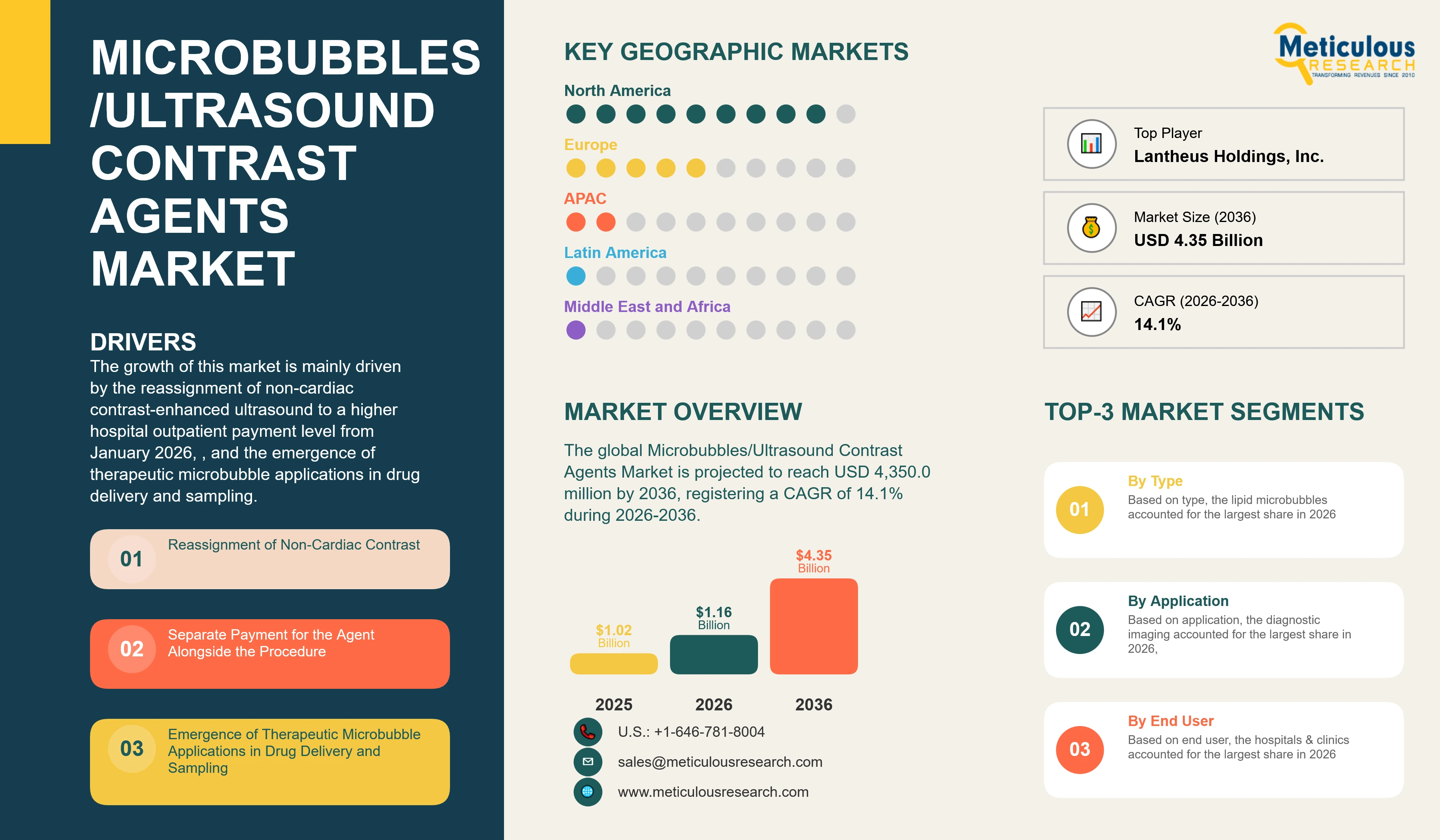
The global Microbubbles/Ultrasound Contrast Agents Market was valued at USD 1,020.0 million in 2025. This market is expected to reach USD 4,350.0 million by 2036 from an estimated USD 1,160.0 million in 2026, registering a CAGR of 14.1% during the forecast period (2026-2036).
- Published
- Oct 2026
- Pages
- 190
- Format
- PDF + Excel
- Report ID
- MRHC - 10451
- Base year
- 2025
- 2025 · BASELINE
- $1.02B
- 2036
- $4.35B
- CAGR 2026–2036
- 14.1%
2025 baseline · 2026–2036 forecast at 14.1% CAGR · hover a bar for the value
Key highlights
The global Microbubbles/Ultrasound Contrast Agents Market is valued at USD 1, 160.0 million in 2026 and is projected to reach USD 4,350.0 million by 2036, at a CAGR of 14.1%.
Based on type, the lipid microbubbles segment is expected to account for the largest share of the market in 2026, while the polymer microbubbles segment is projected to register the highest CAGR during the forecast period.
Based on application, the diagnostic imaging segment is expected to account for the largest share of the market in 2026, while the therapeutic applications segment is projected to register the highest CAGR during the forecast period.
Based on end user, the hospitals and clinics segment is expected to account for the largest share of the market in 2026, while the diagnostic laboratories segment is projected to register the highest CAGR during the forecast period.
Within diagnostic imaging, the cardiovascular imaging segment is expected to account for the largest share of the market in 2026, while the abdominal imaging segment is projected to register the highest CAGR during the forecast period.
Based on geography, North America is expected to account for the largest share of the market in 2026, while Asia-Pacific is projected to register the highest CAGR during the forecast period.
Report summary
| Particulars | Details |
|---|---|
| Base Year | 2025 |
| Estimated Year | 2026 |
| Forecast Period | 2026-2036 |
| Market Size in 2025 | USD 1,020.0 million |
| Market Size in 2026 | USD 1,160.0 million |
| Market Size by 2036 | USD 4,350.0 million |
| CAGR (2026-2036) | 14.1% |
| Format | PDF, Excel & Cloud Portal · 190 pages |
| Largest Segment by Type (2026) | Lipid Microbubbles |
| Fastest-growing Segment by Type | Polymer Microbubbles |
| Largest Segment by Application (2026) | Diagnostic Imaging |
| Fastest-growing Segment by Application | Therapeutic Applications |
| Largest Region (2026) | North America |
| Fastest-growing Region | Asia-Pacific |
| Segments Covered | Type, Application, End User, Geography |
| Number of Companies Profiled | 12 |
Report overview
Segments covered: type, application, end user.
This report covers gas-filled microbubble contrast agents administered intravenously to enhance ultrasound imaging, together with their therapeutic applications, across lipid, protein and polymer shell chemistries, diagnostic imaging and therapeutic use, and the hospital, laboratory and other care settings in which they are administered. The growth of this market is driven by the reassignment of non-cardiac contrast-enhanced ultrasound to a higher hospital outpatient payment level from January 2026, by the suitability of these agents for patients in whom iodinated and gadolinium-based contrast cannot be used, by the absence of ionising radiation, and by the emergence of therapeutic microbubble applications in which the agent carries or enables a treatment rather than only an image.
The decisive constraint on this market has never been clinical evidence or product availability, and understanding that is the key to reading the forecast correctly. Approved agents have existed for decades, guideline support is settled across the major indications, and the clinical case in renal impairment and pregnancy is strong. What held adoption back in the largest national market was payment, because the hospital outpatient rate for a contrast-enhanced ultrasound study did not sit at the level paid for contrast-enhanced computed tomography or magnetic resonance imaging. That specific gap closed at the start of the forecast period, which is why the growth profile in this edition is weighted towards the non-cardiac diagnostic segment rather than spread evenly across the market.
A second structural feature belongs at the front of any assessment. The agent is inexpensive relative to the procedure it enables. At the published first quarter 2026 average sales prices, a Definity vial is USD 80.41 and a Lumason vial USD 90.83 against a hospital outpatient payment of USD 356.43 for the initial lesion study, so the consumable represents roughly a quarter of the facility payment. Growth in this market therefore follows procedure volume rather than agent pricing, and manufacturers compete on indication breadth, clinical support and supply reliability rather than on price per dose.
A microbubble contrast agent is a suspension of gas-filled spheres small enough to pass through the pulmonary circulation and remain within the vascular space. Because the bubbles resonate under an ultrasound field, they return a signal far stronger than tissue, which makes blood visible where it was previously inferred from motion alone. That physical behaviour explains both the clinical value of these agents and the shape of the market around them, because the agent is a consumable within a procedure performed on equipment that the provider already owns, and the economics of the market are therefore set by the economics of the procedure.
Shell chemistry divides the product. Lipid-shelled agents dominate clinical use because the shell is flexible enough to oscillate strongly at diagnostic pressures while remaining stable in circulation, which gives the combination of signal and persistence that imaging requires. Protein-shelled agents, built on human albumin, remain in use and hold established cardiac indications. Polymer-shelled agents are stiffer and less efficient as pure reflectors, which has limited their diagnostic role, but the same stiffness allows them to be loaded and to be ruptured in a controlled way, which is why they matter disproportionately in the therapeutic segment relative to their diagnostic share.
The commercial story of the last decade has been payment rather than science, and the position changed at the start of this forecast period. In August 2025 the Board of Directors of the International Contrast Ultrasound Society wrote to the Centers for Medicare and Medicaid Services asking that CPT 76978 and CPT 76979 be reassigned to ambulatory payment classification 5572, on the grounds that contrast-enhanced computed tomography and magnetic resonance imaging already sit there and that the reassignment would create a clinical coherency absent from the previous assignment. The society stated that it sought no change for cardiac contrast-enhanced ultrasound.
The 2026 position shows that request reflected in the payment chart. The 2026 coding and payment chart published by the International Contrast Ultrasound Society, effective 1 January 2026 and updated 1 February 2026, assigns CPT 76978, non-cardiac contrast-enhanced ultrasound for the initial lesion, to ambulatory payment classification 5572, Level 2 Imaging with Contrast, at USD 356.43 in the hospital outpatient setting. The practical effect is that a hospital performing a contrast-enhanced ultrasound study for an initial lesion is now paid within the same imaging-with-contrast classification family as the cross-sectional alternatives, which removes the structural disincentive that previously made the study financially unattractive relative to a contrast computed tomography scan. This is the single most consequential development for the non-cardiac segment in the forecast period, and the forecast in this report is weighted accordingly.
The agents remain separately payable, which matters because it means the provider is not absorbing the consumable within the procedure payment. The same chart shows the agents themselves remaining separately payable at average sales price in the first quarter of 2026, with Lumason under HCPCS Q9950 at USD 18.17 per millilitre and USD 90.83 for a 5 millilitre vial, Optison under Q9956 at USD 40.21 per millilitre and USD 120.61 for a 3 millilitre vial, and Definity under Q9957 at USD 40.21 per millilitre and USD 80.41 for a 2 millilitre vial.
Those figures also establish the proportionality that should govern any commercial assessment of this market. A Definity vial at USD 80.41 and a Lumason vial at USD 90.83 sit against a facility payment of USD 356.43 for the study, so the agent is approximately a quarter of the payment for the procedure it makes possible. The consequence is that agent price is not the lever on adoption, and a manufacturer pursuing volume through discounting is addressing the smaller part of the provider calculation. What moves volume is whether the study is paid properly, whether the indication is on label, and whether the radiologist or sonographer is trained and confident in the technique.
One residual payment constraint deserves stating because it shapes where studies are performed and how they are scoped. CPT 76979, covering each additional lesion, is packaged in the hospital outpatient setting and carries no separate payment, while in the non-facility setting it is payable as an add-on. A patient with several lesions therefore generates no additional facility payment for the additional characterisation work, which caps the economics of multi-lesion studies in the hospital outpatient setting and gives the office and independent diagnostic testing facility setting a relative advantage for those cases. Suppliers reading only the headline reassignment will miss this, and it is a live constraint on the segment that the reassignment was meant to open.
Evidence of underlying momentum is available from the one agent whose revenue is publicly reported. Lantheus Holdings reported first quarter 2026 results on 7 May 2026, recording sales of DEFINITY of USD 84.6 million, an increase of 6.8% against USD 79.2 million in the first quarter of 2025, within worldwide revenue of USD 377.3 million that grew 1.2% over the same period. Two observations follow. The agent franchise grew at several times the rate of the diversified imaging business that contains it, which indicates that growth is specific to contrast ultrasound rather than a general imaging trend. And the annualised figure implied by that quarter, approximately USD 338 million, represents close to thirty per cent of the global market estimated for 2026 in this report, which is a useful external check on the sizing and a reminder that this is a concentrated market in which three agents account for most of global consumption.
The clinical argument that sustains demand is narrower and more durable than general enthusiasm for ultrasound. Microbubble agents contain neither iodine nor gadolinium and are not nephrotoxic, which makes contrast-enhanced ultrasound the appropriate advanced imaging option for patients in whom contrast computed tomography and magnetic resonance imaging are contraindicated by renal impairment. They do not cross the placenta and the examination involves no ionising radiation, which extends the same logic to pregnancy. These are not marginal populations in a hospital practice, and because the alternative in these patients is frequently no advanced contrast imaging at all rather than a different modality, demand in this part of the market is substitution-resistant.
The therapeutic segment is where the long-term option value sits, and it should be assessed as a device-led opportunity rather than an agent-led one. Insightec announced on 9 March 2022 that the United States Food and Drug Administration had approved two pivotal investigational device exemptions for the Exablate Neuro system and had granted Breakthrough Device designation for the treatment of primary non-small cell lung cancer metastatic to the brain in conjunction with standard-of-care pembrolizumab, under the LIMITLESS study. The second exemption covers enhanced efficacy of liquid biopsy for recurrence monitoring in primary brain cancer. The principal investigator described low-intensity focused ultrasound with microbubbles opening the blood brain barrier, and the release stated that low-intensity focused ultrasound can transiently increase the permeability of the blood brain barrier and allow passage of region-specific biomarkers.
The mechanism matters more than any single programme. Microbubbles under a focused ultrasound field transiently open the blood brain barrier, which allows a systemically administered drug to reach the brain and allows biomarkers to leave it. Both directions have been taken into pivotal study, the first for drug delivery alongside immunotherapy and the second as a non-invasive alternative to neurosurgical biopsy. The commercial caution is that in these applications the microbubble is a low-cost consumable within a high-cost procedure delivered on capital equipment, so success transforms procedure volumes and device revenue far more than it transforms agent revenue. The therapeutic segment therefore grows fastest in percentage terms from a small base, and a forecast that treats therapeutic promise as agent revenue will overstate this market substantially.
Supply concentration is the risk that does not appear in the clinical literature. Three agents account for most global consumption, each manufactured by a single company, and at least one manufacturer identifies its ability to produce the agent in its own facility in the amounts and at the times needed as a recognised risk. For a provider, a contrast-enhanced ultrasound service built around a single agent is a service exposed to that agent supply. For a manufacturer, reliability of supply is accordingly a competitive attribute rather than an operational detail, and it is one of the few grounds on which a second agent can displace an incumbent in an established department.
Report infographic
Market dynamics
19 factors across 5 forcesReassignment of Non-Cardiac Contrast-Enhanced Ultrasound to a Higher Payment Level
Payment reassignment is the major factor driving the Microbubbles/Ultrasound Contrast Agents Market in this forecast period. The 2026 coding and payment chart published by the International Contrast Ultrasound Society, effective 1 January 2026 and updated 1 February 2026, assigns CPT 76978, non-cardiac contrast-enhanced ultrasound for the initial lesion, to ambulatory payment classification 5572, Level 2 Imaging with Contrast, at USD 356.43 in the hospital outpatient setting. In August 2025 the Board of Directors of the International Contrast Ultrasound Society wrote to the Centers for Medicare and Medicaid Services asking that CPT 76978 and CPT 76979 be reassigned to ambulatory payment classification 5572, on the grounds that contrast-enhanced computed tomography and magnetic resonance imaging already sit there and that the reassignment would create a clinical coherency absent from the previous assignment. The society stated that it sought no change for cardiac contrast-enhanced ultrasound. The driver operates by removing a structural disincentive rather than by creating new clinical demand, because the studies were already indicated and the agents already approved, and the effect is therefore expected to appear as a step change in non-cardiac utilisation early in the period rather than as gradual growth across it.
Suitability for Patients in Whom Iodinated and Gadolinium Contrast Cannot Be Used
Contraindication to other contrast media is driving durable demand that does not compete with cross-sectional imaging. Ultrasound contrast agents contain neither iodine nor gadolinium and are not nephrotoxic, which makes contrast-enhanced ultrasound the appropriate advanced imaging option in renal impairment, and they do not cross the placenta while the examination involves no ionising radiation, which extends the same reasoning to pregnancy. The driver is substitution-resistant because the realistic alternative in these patients is frequently no contrast-enhanced advanced imaging rather than a different modality, so demand here is set by patient numbers rather than by modality preference.
Separate Payment for the Agent Alongside the Procedure
The separate payability of the agent is driving adoption by removing the consumable from the provider margin calculation. The same chart shows the agents themselves remaining separately payable at average sales price in the first quarter of 2026, with Lumason under HCPCS Q9950 at USD 18.17 per millilitre and USD 90.83 for a 5 millilitre vial, Optison under Q9956 at USD 40.21 per millilitre and USD 120.61 for a 3 millilitre vial, and Definity under Q9957 at USD 40.21 per millilitre and USD 80.41 for a 2 millilitre vial. Because the agent is reimbursed at average sales price in addition to the procedure, a department adding contrast-enhanced ultrasound is not absorbing the cost of the dose within the study payment, which is the arrangement that makes the service viable at modest volumes. The driver also means that competition among agents proceeds on indication breadth, clinical support and supply reliability rather than on price, since the provider is largely indifferent to a dose price it does not bear.
Emergence of Therapeutic Microbubble Applications in Drug Delivery and Sampling
Therapeutic application is driving interest and investment well ahead of revenue. Insightec announced on 9 March 2022 that the United States Food and Drug Administration had approved two pivotal investigational device exemptions for the Exablate Neuro system and had granted Breakthrough Device designation for the treatment of primary non-small cell lung cancer metastatic to the brain in conjunction with standard-of-care pembrolizumab, under the LIMITLESS study. The second exemption covers enhanced efficacy of liquid biopsy for recurrence monitoring in primary brain cancer. The principal investigator described low-intensity focused ultrasound with microbubbles opening the blood brain barrier, and the release stated that low-intensity focused ultrasound can transiently increase the permeability of the blood brain barrier and allow passage of region-specific biomarkers. Because microbubbles under a focused ultrasound field transiently open the blood brain barrier in both directions, the same mechanism supports drug delivery into the brain and the release of biomarkers out of it, and both have entered pivotal study. The driver expands the definition of the product from an imaging agent to a therapeutic enabler, which raises the strategic value of microbubble formulation capability even where near-term agent revenue remains modest.
Table of contents
11 chapters · 119 sections · 190 pages · click to expandGeographic analysis
North America
Largest shareIn 2026, North America is expected to account for the largest share of the market. The large share of this region is mainly due to the payment structure that now places non-cardiac contrast-enhanced ultrasound for the initial lesion in ambulatory payment classification 5572 at USD 356.43 with the agent separately payable at average sales price, the concentration of the leading agent franchise in the region, and an echocardiography base large enough to sustain the highest agent consumption of any market here.
Asia-Pacific
Fastest growthHowever, Asia-Pacific is projected to register the highest CAGR during the forecast period. The rapid growth of this region is attributed to the established clinical acceptance of contrast-enhanced ultrasound for focal liver lesion characterisation in a region carrying a high burden of chronic liver disease, to agent availability including a perflubutane agent approved in several national markets in the region rather than in the United States, and to ultrasound being the dominant cross-sectional alternative where computed tomography and magnetic resonance capacity per head is lower. Growth is supported by hepatology pathways in which contrast-enhanced ultrasound substitutes for a modality that is scarce rather than merely more expensive.
Europe
Europe holds a position defined by clinical practice and guideline leadership rather than by payment reform. The region originated much of the evidence base and the enhancement criteria on which focal lesion characterisation depends, and contrast-enhanced ultrasound is embedded in hepatology and radiology practice across several national systems more deeply than in the United States. Growth in the region is therefore driven by procedure volume and by national reimbursement decisions taken separately in each health system rather than by a single structural change, which produces a steadier trajectory and wide variation between countries holding similar equipment.
Latin America
Latin America and the Middle East & Africa remain smaller positions where the clinical argument is strong and the constraint is agent access rather than clinical interest. Contrast-enhanced ultrasound is attractive in both regions precisely because it requires no additional capital equipment beyond an existing scanner and because the agents are not nephrotoxic, yet registration status and distribution depth vary considerably by country and determine whether a clinically willing department can obtain product. Suppliers should treat both as registration and distribution questions rather than as demand generation questions within the forecast period.
Competitive landscape
The competitive landscape of the Microbubbles/Ultrasound Contrast Agents Market is concentrated to an unusual degree. Three agents account for most global consumption, each manufactured by a single company, and the diagnostic contest is therefore not a price contest among many suppliers but a contest over indication breadth, clinical support and supply reliability among a small group. Alongside these sit the diversified contrast media and imaging groups whose portfolios span modalities, and a separate population of therapeutic developers and focused ultrasound device companies whose interest in microbubbles is as a treatment enabler rather than as an imaging product.
Competitive advantage rests on three things in this market. The first is the breadth of approved indications held by each agent, because a department establishing a service prefers an agent labelled for the cases it intends to perform and because off-label use imposes governance friction that affects volume. The second is clinical support capability, because the technique is operator dependent and a supplier able to train sonographers and reporting radiologists in timing and enhancement criteria converts equipment that is already installed into utilisation that would not otherwise occur. The third is supply reliability, since a department committed to a single agent carries a continuity risk and at least one manufacturer identifies in-house production capacity as a recognised risk factor.
Key players operating in the global Microbubbles/Ultrasound Contrast Agents Market are Lantheus Holdings, Inc. (U.S.), Bracco Imaging S.p.A. (Italy), GE HealthCare Technologies Inc. (U.S.), Daiichi Sankyo Company, Limited (Japan), Bayer AG (Germany), Insightec Ltd. (Israel), OxSonics Therapeutics Ltd (U.K.), Nuvox Pharma, LLC (U.S.), Trust Bio-sonics, Inc. (Taiwan), Cordance Medical, Inc. (U.S.), Advanced Microbubbles, Inc. (U.S.), and SonoThera, Inc. (U.S.).
The companies profiled in this report were selected on the basis of verified activity as of October 2026 in the manufacture or clinical development of microbubble ultrasound contrast agents, or in the development of therapeutic microbubble applications within the scope of this report. The profile count is deliberately smaller than in comparable imaging markets because agent manufacture is genuinely concentrated and extending the list would misrepresent the structure of supply. Manufacturers of ultrasound imaging systems and transducers without a contrast agent product, suppliers of iodinated and gadolinium-based contrast media without an ultrasound agent, nanoparticle and drug delivery developers working outside acoustically active microbubbles, contract manufacturers without a proprietary agent, and distributors without product development were excluded, as were companies whose relevant operations could not be verified as active at the time of writing.
- Lantheus Holdings, Inc. (U.S.)
- Bracco Imaging S.p.A · Italy
- GE HealthCare Technologies Inc. (U.S.)
- Daiichi Sankyo Company, Limited · Japan
- Bayer AG · Germany
- Insightec Ltd. · Israel
- OxSonics Therapeutics Ltd (U.K.)
- Nuvox Pharma, LLC (U.S.)
- Trust Bio-sonics, Inc. · Taiwan
- Cordance Medical, Inc. (U.S.)
- Advanced Microbubbles, Inc. (U.S.)
- SonoThera, Inc. (U.S.)
Expert perspectives
The usual account of this market treats slow adoption as a problem of clinical awareness, and that reading has been wrong for some time. The evidence base, the enhancement criteria and the approved indications have been settled for years, and the agents are not nephrotoxic, contain neither iodine nor gadolinium, do not cross the placenta and involve no ionising radiation, which makes the clinical case in renal impairment and pregnancy unusually clean. What restrained the largest national market was the payment level attached to the study. In August 2025 the International Contrast Ultrasound Society asked the Centers for Medicare and Medicaid Services to reassign the non-cardiac codes to ambulatory payment classification 5572 on the grounds that contrast computed tomography and magnetic resonance imaging already sat there, and the 2026 payment chart effective 1 January 2026 shows CPT 76978 in that classification at USD 356.43. The binding constraint is therefore shifting from payment to the operational work of establishing services.
Three structural features are expected to shape competitive positions through 2036. First, growth will continue following procedure volume rather than agent pricing, because at published first quarter 2026 average sales prices a Definity vial at USD 80.41 and a Lumason vial at USD 90.83 represent roughly a quarter of the facility payment for the study, so the dose price is not the provider lever. Second, the product will continue widening from an imaging agent to a therapeutic enabler as focused ultrasound applications that open the blood brain barrier progress, which raises the value of formulation and shell engineering capability independently of imaging revenue. Third, supply reliability will continue rising as a competitive attribute in a market where three agents cover most consumption and each comes from a single manufacturer.
For companies planning entry or expansion, the shortest route available is the population of departments that evaluated contrast-enhanced ultrasound before 2026 and declined it on economics rather than on evidence. Those institutions hold the equipment and frequently hold the clinical interest, and the fact that decided against them has changed and is externally verifiable. Converting them is a service establishment task rather than a product promotion task, requiring a clinical sponsor, trained sonographers and reporting radiologists, protocols and referral flow from nephrology, hepatology, obstetrics and emergency medicine. The second route, for developers rather than manufacturers, is polymer and loadable formulation for therapeutic use, which avoids a price contest against established lipid agents entirely and sells to device developers running pivotal studies.
Two cautions belong in any assessment of this market. The first concerns the residual payment design. CPT 76979, covering each additional lesion, is packaged in the hospital outpatient setting and carries no separate payment, so a multi-lesion patient generates no additional facility payment for the additional characterisation work, which caps the return on precisely the complex cases where the modality adds most and gives the non-facility setting a relative advantage. A supplier reading only the headline reassignment will plan against an opportunity that is narrower than it appears. The second concerns the therapeutic segment. In focused ultrasound drug delivery and sampling the microbubble is a low-cost consumable within a high-cost procedure on capital equipment, so clinical success there transforms device revenue and procedure volume rather than agent revenue, and treating therapeutic promise as agent revenue will overstate this market substantially.
Overall, the core of demand through the forecast period will continue to sit in lipid microbubbles used for cardiovascular diagnostic imaging in hospitals and clinics across North America, while the fastest growth will come from polymer microbubbles, therapeutic applications, abdominal characterisation within the diagnostic segment, diagnostic laboratories and Asia-Pacific adoption, as a market long explained by clinical awareness turns out to have been governed by what the study was paid.
Customer perspectives
Director of Abdominal Imaging, Academic Medical Centre
This perspective confirms that the payment level rather than the clinical evidence governed adoption decisions, and that the reassignment has moved the constraint to operator competence. It supports the conclusion that the near-term opportunity lies with departments that previously declined on economics and that converting them is a service establishment task rather than a product promotion task.
Consultant Nephrologist, Tertiary Referral Hospital
This perspective identifies the substitution-resistant character of demand in renal impairment and confirms that the relevant comparison is frequently with no advanced contrast imaging rather than with another modality. It supports the conclusion that referral patterns grounded in contraindication are more durable than those grounded in modality preference.
Head of Procurement, Cardiac Imaging Network
This perspective confirms that agent price is not the provider lever and that supply continuity functions as a primary evaluation criterion in a concentrated market. It supports the conclusion that demonstrable capacity and continuity is one of the few grounds on which a second agent enters a department already committed to an incumbent.
Frequently asked questions
This study covers the market size and forecasts for various microbubbles/ultrasound contrast agents offered by key companies, and it can be delivered to hospitals & clinics and diagnostics laboratories.
Cite this report
Meticulous Research. (2026). Microbubbles/Ultrasound Contrast Agents Market - Global Opportunity Analysis and Industry Forecast (2026-2036) (Report No. MRHC - 10451). Meticulous Market Research Pvt. Ltd. https://www.meticulousresearch.com/product/microbubbles-ultrasound-contrast-agents-market-3732