Resources
About Us
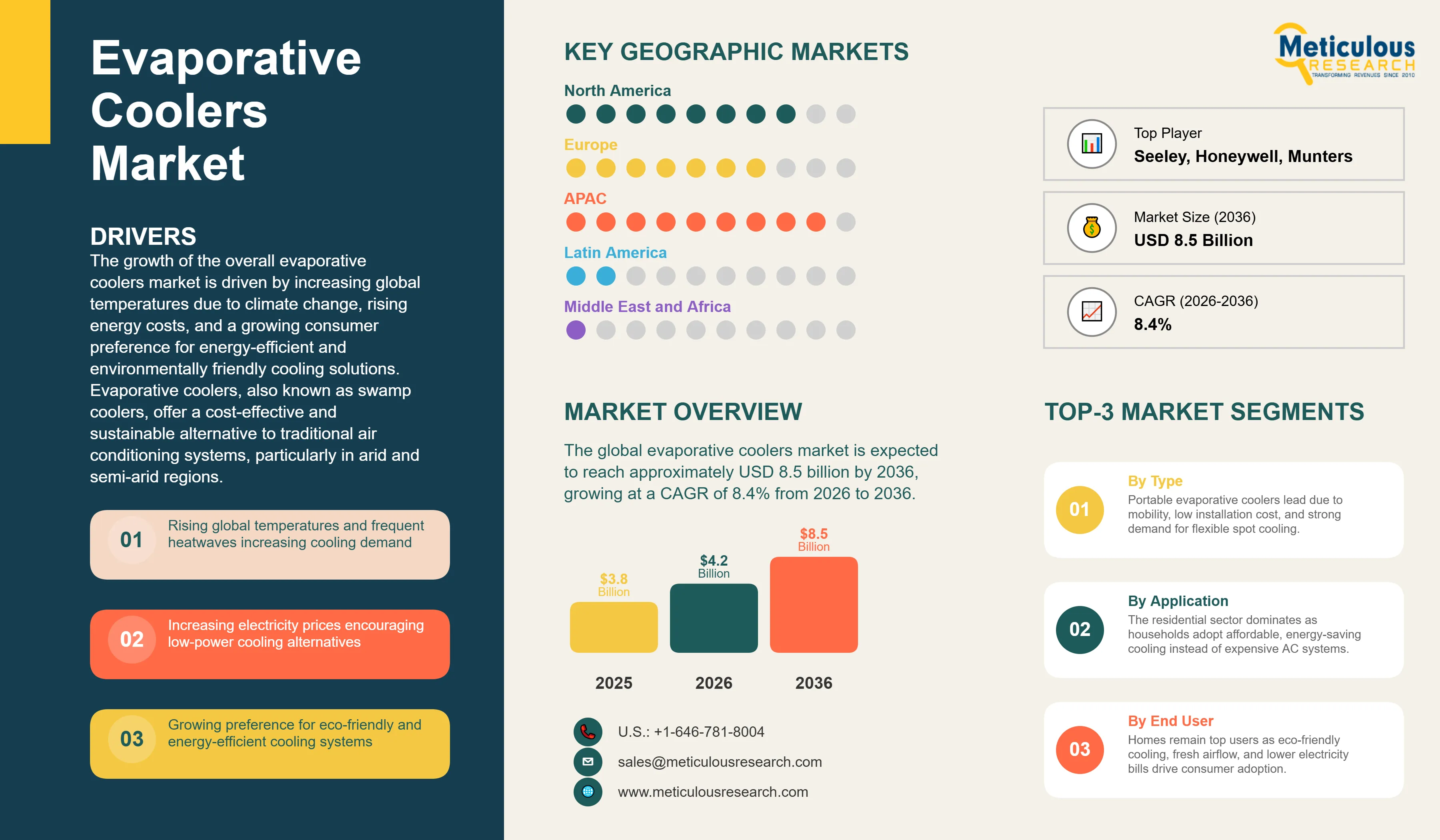
The global evaporative coolers market was valued at USD 3.8 billion in 2025. The market is expected to reach approximately USD 8.5 billion by 2036 from USD 4.2 billion in 2026, growing at a CAGR of 8.4% from 2026 to 2036. The growth of the overall evaporative coolers market is driven by increasing global temperatures due to climate change, rising energy costs, and a growing consumer preference for energy-efficient and environmentally friendly cooling solutions. Evaporative coolers, also known as swamp coolers, offer a cost-effective and sustainable alternative to traditional air conditioning systems, particularly in arid and semi-arid regions. Furthermore, technological advancements leading to improved cooling efficiency, enhanced design aesthetics, and the integration of smart features are expanding their adoption across residential, commercial, and industrial applications. The growing awareness about the health benefits of evaporative cooling, such as maintaining humidity levels and providing fresh air, also contributes to market expansion.
Click here to: Get Free Sample Pages of this Report
Evaporative coolers, often referred to as swamp coolers, are cooling devices that utilize the natural process of water evaporation to reduce air temperature. Unlike air conditioners that use refrigerants, evaporative coolers draw in hot, dry air, pass it over water-saturated pads, and release cooler, humidified air. This process is highly energy-efficient and environmentally friendly, as it consumes significantly less electricity and does not use harmful refrigerants. The market encompasses a variety of types, including portable units for flexible use, window-mounted coolers for residential applications, whole-house systems integrated into HVAC, and large industrial/commercial units designed for expansive spaces. These systems are particularly effective in arid and semi-arid climates where humidity levels are low.
The market is characterized by continuous innovation aimed at improving cooling efficiency, reducing water consumption, and enhancing user convenience. Modern evaporative coolers feature advanced cooling pads made from cellulose or synthetic materials that offer higher saturation efficiency and longer lifespan. Integration of smart controls, remote operation capabilities, and IoT connectivity allows for precise temperature management, energy optimization, and seamless user experience. Manufacturers are also focusing on aesthetic designs to blend with modern interiors and developing hybrid systems that combine evaporative cooling with other technologies for enhanced performance in diverse climatic conditions. The modular design and customization options cater to a broad spectrum of consumer and industrial needs.
The global climate crisis and the escalating cost of energy are significant factors driving the demand for sustainable and energy-efficient cooling solutions. Evaporative coolers offer a compelling alternative to conventional air conditioning, which is energy-intensive and contributes to greenhouse gas emissions. As governments and consumers increasingly prioritize environmental sustainability and cost savings, the adoption of evaporative cooling technology is accelerating. This shift is further supported by growing awareness of the health benefits, such as improved indoor air quality and reduced dry air-related ailments. Consequently, the evaporative coolers market is positioned as a vital component of future cooling strategies, contributing to both environmental protection and economic efficiency.
Increasing Adoption of Smart and IoT-Enabled Evaporative Coolers
The evaporative coolers market is witnessing a significant trend towards the integration of smart technologies and IoT (Internet of Things) for enhanced control, monitoring, and energy efficiency. Manufacturers are embedding sensors, Wi-Fi connectivity, and smart algorithms into their evaporative coolers, allowing users to control devices remotely via smartphones or smart home systems. These smart features enable users to schedule cooling cycles, monitor humidity levels, and receive maintenance alerts, optimizing comfort and reducing energy consumption. For instance, some advanced models can automatically adjust fan speeds and water flow based on real-time ambient temperature and humidity data, ensuring optimal cooling performance with minimal human intervention. This trend is driven by the growing demand for convenience, energy savings, and seamless integration with smart home ecosystems, making IoT-enabled evaporative coolers a key differentiator in the market.
Focus on Hybrid Cooling Solutions and Enhanced Cooling Media
Another prominent trend in the evaporative coolers market is the increasing focus on hybrid cooling solutions and the development of enhanced cooling media. Hybrid systems combine evaporative cooling with other cooling technologies, such as direct expansion (DX) coils or desiccant dehumidification, to overcome the limitations of traditional evaporative coolers in high-humidity environments. These systems offer improved performance and comfort across a wider range of climatic conditions, expanding the market reach of evaporative cooling technology. Simultaneously, there is continuous innovation in cooling media, with manufacturers developing more efficient, durable, and antimicrobial pads. New materials and designs for cooling pads aim to increase water absorption, improve evaporation rates, and prevent the growth of mold and bacteria, thereby enhancing cooling efficiency, air quality, and product lifespan. This dual focus on hybrid solutions and advanced cooling media is driven by the need to provide more versatile, effective, and hygienic cooling options to consumers and industries.
|
Parameter |
Details |
|
Market Size by 2036 |
USD 8.5 Billion |
|
Market Size in 2026 |
USD 4.2 Billion |
|
Market Size in 2025 |
USD 3.8 Billion |
|
Market Growth Rate (2026–2036) |
CAGR of 8.4% |
|
Dominating Region |
Asia-Pacific |
|
Fastest Growing Region |
North America |
|
Base Year |
2025 |
|
Forecast Period |
2026 to 2036 |
|
Segments Covered |
Type, Cooling Media, Application, and Region |
|
Regions Covered |
North America, Europe, Asia-Pacific, Latin America, and Middle East & Africa |
Drivers: Rising Global Temperatures and Energy Costs
A primary driver for the evaporative coolers market is the escalating global temperatures due to climate change, coupled with continuously rising energy costs. As heatwaves become more frequent and intense, the demand for effective and affordable cooling solutions surges. Traditional air conditioning systems are energy-intensive, leading to high electricity bills and increased carbon emissions. Evaporative coolers offer a significantly more energy-efficient alternative, consuming up to 75% less electricity than conventional AC units. This cost-saving advantage, combined with their lower environmental impact, makes them an increasingly attractive option for both residential and commercial consumers seeking to mitigate the financial burden of cooling and reduce their carbon footprint. The growing awareness of these benefits is accelerating market adoption, particularly in regions experiencing hot and dry climates.
Opportunity: Growing Demand for Sustainable and Eco-Friendly Cooling Solutions
The increasing global emphasis on environmental sustainability and the demand for eco-friendly products present a significant growth opportunity for the evaporative coolers market. Consumers and businesses are becoming more conscious of their environmental impact and are actively seeking alternatives to traditional air conditioning systems that use refrigerants with high global warming potential (GWP). Evaporative coolers use only water and electricity, making them a natural and environmentally benign cooling method. This aligns perfectly with green building initiatives, corporate sustainability goals, and individual efforts to reduce carbon footprints. The market is poised to capitalize on this growing eco-consciousness, with manufacturers innovating to enhance the sustainability features of their products, such as using recycled materials and designing for easier end-of-life recycling. This trend is particularly strong in regions with supportive environmental policies and a high degree of public awareness regarding climate change.
Why Do Portable Evaporative Coolers Lead the Market?
The Portable Evaporative Coolers segment accounts for the largest share of the overall evaporative coolers market in 2026. This dominance is primarily driven by their unparalleled flexibility, ease of installation, and affordability, making them a highly popular choice for spot cooling in various settings. Consumers and businesses appreciate the ability to move these units between rooms or locations as needed, providing targeted cooling without the need for complex installation or ductwork. Their compact design and plug-and-play functionality make them ideal for renters, small offices, workshops, and outdoor events. The lower initial cost compared to other cooling systems further contributes to their widespread adoption, especially in price-sensitive markets. Manufacturers are continuously enhancing their designs with improved aesthetics, quieter operation, and smart features, solidifying their leading position.
The Industrial/Commercial Evaporative Coolers segment is expected to witness the fastest growth during the forecast period. This growth is fueled by the increasing demand for cost-effective and energy-efficient cooling solutions in large-scale industrial facilities, warehouses, workshops, and commercial spaces. These robust units are designed to handle significant air volumes and provide effective cooling in challenging environments where traditional air conditioning would be prohibitively expensive to install and operate. The rising focus on worker comfort and productivity in industrial settings, coupled with the need to comply with environmental regulations, is driving the adoption of large-scale evaporative cooling systems. Innovations in direct and indirect evaporative cooling technologies are further enhancing their appeal for these demanding applications.
How Does the Cellulose Pads Segment Maintain Its Lead?
The Cellulose Pads segment holds the largest market share in 2026. This dominance is attributed to their superior water absorption capacity, high cooling efficiency, and durability, making them the preferred cooling media in a vast majority of evaporative coolers. Cellulose pads, often referred to as honeycomb pads, are engineered with a unique fluted design that maximizes the surface area for water evaporation, leading to more effective heat exchange and greater temperature drops. They are also resistant to sagging and deterioration, offering a longer lifespan compared to traditional aspen pads. The continuous advancements in manufacturing processes have made cellulose pads more cost-effective and widely available, further reinforcing their leading position across residential, commercial, and industrial evaporative cooling applications.
The Aspen Pads segment is expected to maintain a steady market presence, particularly in more traditional or budget-friendly evaporative cooler models. Aspen pads, made from wood fibers, are known for their natural filtration properties and are a cost-effective option. While they may require more frequent replacement than cellulose pads, their affordability and effectiveness in certain applications ensure their continued demand, especially in regions where cost is a primary purchasing factor.
Why Does the Residential Segment Lead the Market?
The Residential segment commands the largest share of the global evaporative coolers market in 2026. This leadership is primarily due to the widespread adoption of evaporative coolers in homes as an economical, energy-efficient, and environmentally friendly cooling option. Homeowners, particularly in hot and dry climates, are increasingly opting for evaporative coolers to reduce their electricity bills and minimize their carbon footprint compared to conventional air conditioners. The ease of installation of portable and window units, coupled with their ability to provide fresh, humidified air, makes them a popular choice for improving indoor comfort. The growing awareness of the health benefits, such as alleviating dry air symptoms, further drives their demand in the residential sector. Manufacturers are also focusing on developing aesthetically pleasing and quieter residential models, enhancing their appeal to a broader consumer base.
The Commercial segment is poised for significant growth, driven by the increasing demand for cost-effective and sustainable cooling solutions in offices, retail stores, restaurants, and other commercial establishments. Businesses are recognizing the energy savings and environmental benefits of evaporative cooling, especially in large, open spaces where traditional AC can be prohibitively expensive. The Industrial segment also represents a crucial application, where large-scale evaporative coolers are used to cool factories, warehouses, and production facilities, improving worker comfort and productivity in challenging environments. The need for efficient cooling in these sectors, coupled with stringent energy efficiency regulations, is accelerating the adoption of evaporative cooling solutions.
How is Asia-Pacific Maintaining Dominance in the Global Evaporative Coolers Market?
Asia-Pacific holds the largest share of the global evaporative coolers market in 2026. This dominance is primarily attributable to the region’s vast population, hot and dry climatic conditions in many sub-regions, and rapidly growing economies with increasing disposable incomes. Countries like India, China, and Australia are major markets, driven by the high demand for affordable and energy-efficient cooling solutions in both residential and commercial sectors. Rapid urbanization, coupled with significant investments in infrastructure development and manufacturing, further fuels market growth. The presence of numerous local and international manufacturers, offering a wide range of products tailored to regional needs, also contributes to Asia-Pacific’s leading position. Government initiatives promoting energy conservation and sustainable technologies are additionally boosting market expansion.
Which Factors Support North America and Europe Market Growth?
North America represents a substantial and steadily growing share of the global evaporative coolers market, driven by rising energy costs, increasing environmental awareness, and a growing preference for sustainable cooling solutions. The United States, particularly in its arid southwestern states, is a key market where evaporative coolers are highly effective. The region benefits from a strong focus on energy efficiency in building codes and consumer demand for eco-friendly appliances. Technological advancements, including smart features and hybrid cooling systems, are also enhancing the appeal of evaporative coolers in North America, expanding their adoption beyond traditional residential uses to commercial and industrial applications.
Europe is experiencing significant growth in the evaporative coolers market, primarily driven by increasing summer temperatures, a strong emphasis on energy efficiency, and stringent environmental regulations. Countries in Southern and Eastern Europe, which experience hot and dry summers, are key markets. The region’s commitment to reducing carbon emissions and promoting sustainable technologies aligns well with the benefits offered by evaporative cooling. Furthermore, the rising cost of electricity and the desire for healthier indoor air quality are prompting consumers and businesses to consider evaporative coolers as a viable alternative to conventional air conditioning. Innovations in design and performance, tailored to European market demands, are further accelerating adoption.
Latin America is an emerging market for evaporative coolers, with countries like Brazil, Mexico, and Argentina showing increasing interest in energy-efficient cooling solutions. The region’s warm climate and growing middle class are driving demand for affordable and sustainable cooling options. While market penetration is currently lower compared to developed regions, the potential for growth is significant as economic conditions improve and awareness of the benefits of evaporative cooling increases. Government support for energy-efficient appliances and rising environmental consciousness are expected to fuel further adoption.
The Middle East & Africa region is also experiencing nascent growth in the evaporative coolers market, particularly in countries with hot and arid climates such as Saudi Arabia, UAE, and parts of North Africa. The high temperatures and abundant sunshine make evaporative cooling a highly effective and economical solution. Investments in residential and commercial infrastructure, coupled with a growing awareness of energy conservation, are driving the adoption of evaporative coolers. The market is expected to expand further as economic diversification efforts and a focus on sustainable development continue across the region.
Companies such as Symphony Limited, Munters Group AB, Honeywell International Inc., Seeley International Pty Ltd., and Phoenix Manufacturing, Inc. lead the global evaporative coolers market with comprehensive product portfolios that cater to diverse residential, commercial, and industrial needs. Meanwhile, players including Portacool, LLC, Aolan Group, Hessaire Products, Inc., and Kenstar (Videocon Industries Ltd.) focus on specific market segments—such as portable solutions, industrial-grade coolers, and specialized cooling media—targeting enterprises with particular performance preferences or existing facility requirements. Emerging and expanding providers such as Climate Technologies (Coolair), Ram Coolers, and Bajaj Electricals Ltd. are strengthening their market positions through innovations in energy efficiency, smart features, and purpose-built offerings for various climatic conditions.
The global evaporative coolers market is expected to grow from USD 4.2 billion in 2026 to USD 8.5 billion by 2036.
The global evaporative coolers market is projected to grow at a CAGR of 8.4% from 2026 to 2036.
The portable evaporative coolers segment is expected to dominate the market in 2026 due to their flexibility and affordability. The industrial/commercial evaporative coolers segment is projected to accelerate its growth as businesses seek cost-effective and energy-efficient cooling solutions for large spaces.
Smart technologies and IoT are transforming the evaporative coolers market by enabling remote control, scheduling, and automated adjustments based on real-time data, leading to optimized comfort, reduced energy consumption, and enhanced user convenience.
Asia-Pacific holds the largest share of the global evaporative coolers market in 2026. This dominance is primarily driven by the region’s hot and dry climatic conditions, large population base, and increasing disposable incomes.
The leading companies include Symphony Limited, Munters Group AB, Honeywell International Inc., Seeley International Pty Ltd., and Phoenix Manufacturing, Inc.
1. Introduction
1.1 Market Definition
1.2 Market Scope
1.3 Research Methodology
1.4 Assumptions & Limitations
2. Executive Summary
3. Market Overview
3.1 Introduction
3.2 Market Dynamics
3.2.1 Drivers
3.2.2 Restraints
3.2.3 Opportunities
3.2.4 Challenges
3.3 Impact of Climate Change and Energy Efficiency Trends
3.4 Technological Advancements in Cooling Media and Smart Features
3.5 Porter’s Five Forces Analysis
4. Global Evaporative Coolers Market, by Type
4.1 Introduction
4.2 Portable Evaporative Coolers
4.3 Window Evaporative Coolers
4.4 Whole-House Evaporative Coolers
4.5 Industrial/Commercial Evaporative Coolers
5. Global Evaporative Coolers Market, by Cooling Media
5.1 Introduction
5.2 Cellulose Pads
5.3 Aspen Pads
5.4 Other Cooling Media (e.g., Synthetic Pads)
6. Global Evaporative Coolers Market, by Application
6.1 Introduction
6.2 Residential
6.3 Commercial
6.4 Industrial
7. Global Evaporative Coolers Market, by Region
7.1 Introduction
7.2 North America
7.2.1 U.S.
7.2.2 Canada
7.2.3 Mexico
7.3 Europe
7.3.1 Germany
7.3.2 France
7.3.3 U.K.
7.3.4 Italy
7.3.5 Spain
7.3.6 Nordic Countries
7.3.7 Rest of Europe
7.4 Asia-Pacific
7.4.1 China
7.4.2 India
7.4.3 Japan
7.4.4 South Korea
7.4.5 Southeast Asia
7.4.6 Australia
7.4.7 Rest of Asia-Pacific
7.5 Latin America
7.5.1 Brazil
7.5.2 Mexico
7.5.3 Argentina
7.5.4 Rest of Latin America
7.6 Middle East & Africa
7.6.1 Saudi Arabia
7.6.2 UAE
7.6.3 South Africa
7.6.4 Rest of Middle East & Africa
8. Competitive Landscape
8.1 Overview
8.2 Key Growth Strategies
8.3 Competitive Benchmarking
8.4 Competitive Dashboard
8.4.1 Industry Leaders
8.4.2 Market Differentiators
8.4.3 Vanguards
8.4.4 Emerging Companies
8.5 Market Ranking / Positioning Analysis of Key Players, 2025
9. Company Profiles
(Business Overview, Financial Overview, Product Portfolio, Strategic Developments, SWOT Analysis)
9.1 Symphony Limited
9.2 Munters Group AB
9.3 Honeywell International Inc.
9.4 Seeley International Pty Ltd.
9.5 Phoenix Manufacturing, Inc.
9.6 Portacool, LLC
9.7 Aolan Group
9.8 Hessaire Products, Inc.
9.9 Kenstar (Videocon Industries Ltd.)
9.10 Climate Technologies (Coolair)
9.11 Ram Coolers
9.12 Bajaj Electricals Ltd.
10. Appendix
10.1 Questionnaire
10.2 Related Reports
























Published Date: Mar-2026
Published Date: Apr-2023
Published Date: Jan-2026
Published Date: Mar-2026
Subscribe to get the latest industry updates