
Hot Water Boilers Market (2026-2036)
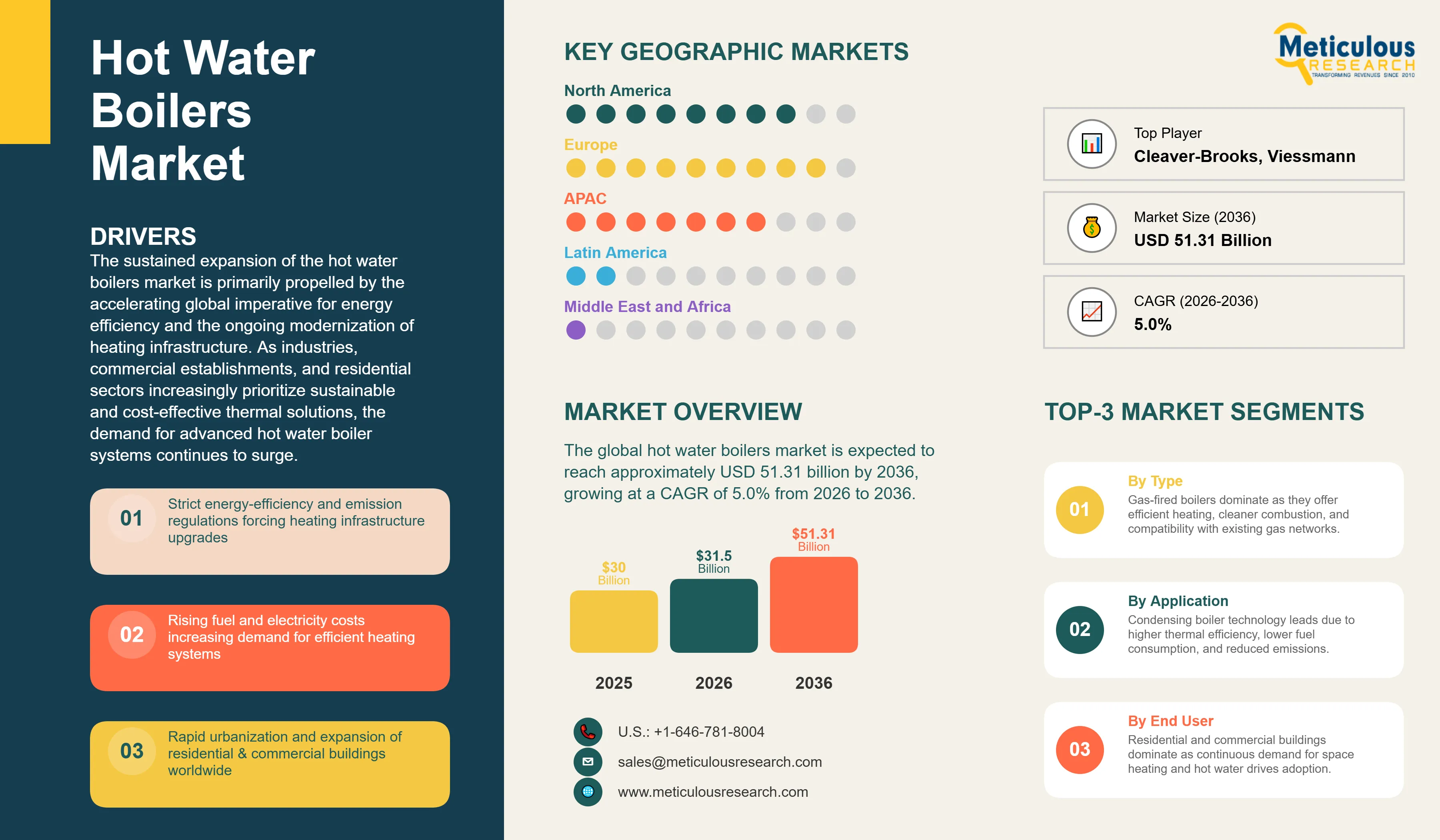
The global hot water boilers market was valued at USD 30.0 billion in 2025. The market is expected to reach approximately USD 51.31 billion by 2036 from USD 31.5 billion in 2026, growing at a CAGR of 5.0% from 2026 to 2036.
- Published
- Mar 2026
- Pages
- 277
- Format
- PDF + Excel
- Report ID
- MR-1820
- Base year
- 2025
- 2025 · BASELINE
- $30.00B
- 2036
- $51.31B
- CAGR 2026–2036
- 5.0%
2025 baseline · 2026–2036 forecast at 5.0% CAGR · hover a bar for the value
Key highlights
In terms of revenue, the global hot water boilers market is projected to reach USD 51.31 billion by 2036.
The market is expected to grow at a CAGR of 5.0% from 2026 to 2036.
Europe maintains its dominance in the global hot water boilers market, driven by a well-established district heating infrastructure, early adoption of stringent energy efficiency standards, and robust regulatory frameworks promoting decarbonization in the heating sector.
Asia-Pacific is poised for the fastest growth during the forecast period, fueled by rapid urbanization, significant industrial expansion, and increasing environmental awareness across key economies like China, India, and Japan.
By fuel type, gas-fired hot water boilers are anticipated to retain the largest market share, reflecting strong commercial and industrial demand for efficient and relatively clean heating solutions, supported by extensive natural gas distribution networks.
By technology, condensing boilers are expected to continue their market leadership, driven by their superior thermal efficiency, lower operational costs, and reduced environmental footprint, aligning with global sustainability goals.
By end-use vertical, the residential and commercial sectors collectively represent a substantial share of the market, underpinned by the fundamental need for space heating and domestic hot water in modern living and working environments.
Report summary
| Particulars | Details |
|---|---|
| Market Size by 2036 | USD 51.31 Billion |
| Market Size in 2026 | USD 31.5 Billion |
| Market Size in 2025 | USD 30.0 Billion |
| Market Growth Rate (2026–2036) | CAGR of 5.0% |
| Format | PDF, Excel & Cloud Portal · 277 pages |
| Dominating Region | Europe |
| Fastest Growing Region | Asia-Pacific |
| Base Year | 2025 |
| Forecast Period | 2026 to 2036 |
| Segments Covered | Fuel Type, Technology, Design, Capacity, End-use Vertical, and Region |
| Regions Covered | North America, Europe, Asia-Pacific, Latin America, and Middle East & Africa |
Report overview
Segments covered: fuel type, technology, design, capacity, end-use vertical.
The sustained expansion of the hot water boilers market is primarily propelled by the accelerating global imperative for energy efficiency and the ongoing modernization of heating infrastructure. As industries, commercial establishments, and residential sectors increasingly prioritize sustainable and cost-effective thermal solutions, the demand for advanced hot water boiler systems continues to surge. Key drivers include stringent environmental regulations, escalating energy costs, and the rapid growth of urban and industrial infrastructures worldwide. Furthermore, the integration of smart technologies and the expansion of district heating networks are creating new avenues for market growth, positioning modern hot water boilers as indispensable components for optimized thermal management.
Hot water boilers stand as a cornerstone of modern thermal management, seamlessly integrating efficient heat generation with reliable water circulation within a unified system. These sophisticated platforms are engineered with high-performance heat exchangers, advanced combustion mechanisms, and intelligent control systems that dynamically regulate heat delivery. Their operation is precisely calibrated to meet real-time demand, adapt to ambient conditions, and achieve optimal operational efficiency. The market is currently undergoing a profound transformation, moving away from outdated, hardware-centric systems towards integrated, high-efficiency platforms. These contemporary solutions are often cloud-enabled, ensuring consistent and optimized thermal energy distribution across diverse environments, from individual residences to expansive commercial complexes and demanding industrial facilities.
Modern hot water boiler architectures encompass a broad spectrum of designs, ranging from compact, wall-mounted units ideal for residential use to large-scale industrial boiler plants that can effectively replace entire legacy heating infrastructures. A notable trend is the increasing integration of artificial intelligence (AI) and machine learning (ML) capabilities. These advanced features enable autonomous combustion optimization, dynamic adjustment of thermal output based on occupancy or process requirements, and proactive maintenance management across distributed systems. The ability to deliver precise temperature control, granular energy consumption tracking, and continuous performance monitoring through a single digital interface has cemented the position of modern hot water boiler technology as the preferred choice for organizations seeking both operational agility and thermal resilience.
The global thermal energy landscape is in the midst of a significant paradigm shift, driven by a confluence of factors including sustainability mandates, persistent energy efficiency regulations, and volatile fuel prices. This shift has accelerated the decommissioning of traditional non-condensing infrastructure and older, less efficient units. Consequently, organizations are increasingly prioritizing unified boiler platforms that can ensure compliance with emission standards, automate incident response, and maintain regulatory adherence across geographically dispersed operations. The burgeoning growth in sustainable building initiatives, the expansion of district energy systems, and the development of hydrogen-ready boiler designs are further solidifying the role of hot water boilers as a fundamental thermal architecture for the evolving industrial and commercial ecosystem.
Report infographic
Market dynamics
4 factors across 3 forcesAccelerating Shift to Energy-Efficient and Sustainable Building Architectures
The global hot water boilers market is primarily driven by the intensifying mandate for energy efficiency and sustainable building operations. As governments worldwide implement rigorous carbon reduction targets and building codes, organizations are compelled to modernize their heating infrastructure. The transition from legacy, high-emission boilers to advanced condensing and electric systems is no longer a discretionary upgrade but a strategic necessity for regulatory compliance and operational cost management. This driver is particularly potent in developed markets where the “Renovation Wave” is transforming the existing building stock into low-carbon environments.
Table of contents
12 chapters · 96 sections · 277 pages · click to expandGeographic analysis
Europe
Largest shareEurope holds the largest share of the global hot water boilers market in 2026. This dominance is primarily attributable to the region’s high concentration of leading boiler manufacturers, mature energy efficiency awareness, and strong regulatory impetus driving the adoption of condensing technology across both public and private sectors. The European Union alone accounts for the majority of regional revenue, with mandates like the EcoDesign Directive and the Energy Performance of Buildings Directive (EPBD) accelerating procurement timelines across residential and commercial sectors. The presence of established vendors including Bosch, Viessmann, and Vaillant, alongside a well-developed channel of specialized installers and system integrators, provides European enterprises with robust access to mature, fully supported boiler deployments.
Asia-Pacific
Fastest growthAsia-Pacific is the fastest-growing regional market for hot water boilers during the forecast period, driven by rapid urbanization across China, India, Southeast Asia, and Japan. The region’s massive and rapidly digitizing industrial base, combined with growing awareness of sustainable heating and evolving environmental regulations, is creating strong demand for high-efficiency boiler platforms that can scale with the pace of economic development. Governments across the region are also actively promoting cleaner heating frameworks aligned with global climate goals, further accelerating enterprise adoption.
North America
North America represents a substantial and steadily growing share of the global market, shaped by the continent’s stringent emission standards and the increasing focus on smart building technologies. The regulatory requirement for high-efficiency systems in new constructions and the ability to enforce strict energy codes at the state and federal levels are driving North American enterprises to prioritize advanced boiler vendors with locally distributed support networks. The United States and Canada are among the most active adoption markets, supported by a mature commercial HVAC landscape and a well-developed ecosystem of regional thermal energy service providers.
Competitive landscape
- Bosch Thermotechnik GmbH
- Viessmann Group
- Cleaver-Brooks, Inc.
- A.O. Smith Corporation
- Vaillant Group
- Ariston Group
- BDR Thermea Group
- Ferroli S.p.A
- Weil-McLain
- Lochinvar, LLC
- Rheem Manufacturing Company
- Navien, Inc.
- Hurst Boiler & Welding Co., Inc.
- Fulton Thermal Corporation
Frequently asked questions
The global hot water boilers market is expected to grow from USD 31.5 billion in 2026 to USD 51.31 billion by 2036.
Cite this report
Meticulous Research. (2026). Hot Water Boilers Market - Global Opportunity Analysis and Industry Forecast (2026-2036) (Report No. MR-1820). Meticulous Market Research Pvt. Ltd. https://www.meticulousresearch.com/product/hot-water-boilers-market-6503