
Industrial Heat Pump Systems Market (2026-2036)
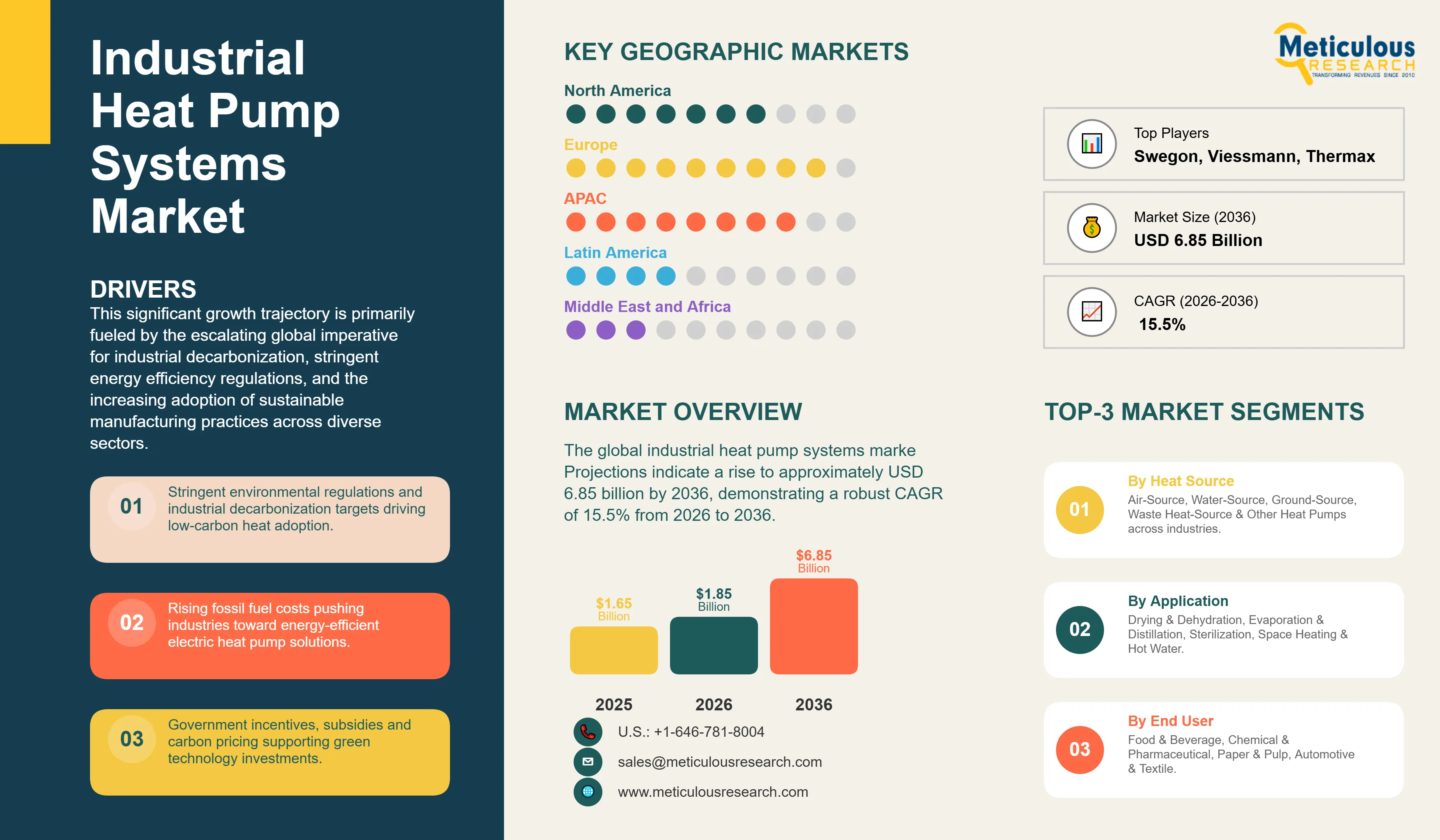
The global industrial heat pump systems market, valued at an estimated USD 1.65 billion in 2025, is poised for substantial expansion. Projections indicate a rise to approximately USD 6.85 billion by 2036 from USD 1.85 billion in 2026, demonstrating a robust Compound Annual Growth Rate (CAGR) of 15.5% from 2026 to 2036.
- Published
- Mar 2026
- Pages
- 278
- Format
- PDF + Excel
- Report ID
- MR-1824
- Base year
- 2025
- 2025 · BASELINE
- $1.65B
- 2036
- $6.85B
- CAGR 2026–2036
- 15.5%
2025 baseline · 2026–2036 forecast at 15.5% CAGR · hover a bar for the value
Key highlights
Revenue Growth: The global industrial heat pump systems market is projected to achieve a valuation of USD 6.85 billion by 2036.
Growth Rate: The market is anticipated to expand at a CAGR of 15.5% between 2026 and 2036.
Regional Dominance: Europe is set to maintain its leading position in the global industrial heat pump systems market in 2026, driven by ambitious decarbonization targets, robust regulatory frameworks promoting energy efficiency, and significant investments in industrial electrification across key economies like Germany, France, and the Nordics.
Fastest Growing Region: Asia-Pacific is expected to exhibit the most rapid growth throughout the forecast period, propelled by accelerated industrialization, burgeoning manufacturing sectors, and increasing adoption of energy-efficient solutions in countries like China, India, and Japan.
Heat Source Leadership: Waste Heat-Source Heat Pumps are forecast to command the largest market share in 2026, primarily due to their critical role in industrial energy recovery, enabling significant operational cost savings and reduced carbon footprints by utilizing otherwise discarded thermal energy.
Temperature Range Leadership: The Medium Temperature (100-160°C) Heat Pumps segment is projected to hold the largest market share in 2026, owing to its versatility and broad applicability in a wide array of industrial processes such as drying, sterilization, and hot water generation, which typically fall within this temperature bracket.
Application Significance: The Drying & Dehydration segment is expected to account for a substantial share of the overall market in 2026, underscoring the critical necessity for energy-efficient moisture removal processes in industries like food & beverage, paper & pulp, and chemicals.
Report summary
| Particulars | Details |
|---|---|
| Market Size by 2036 | USD 6.85 Billion |
| Market Size in 2026 | USD 1.85 Billion |
| Market Size in 2025 | USD 1.65 Billion |
| Market Growth Rate (2026–2036) | CAGR of 15.5% |
| Format | PDF, Excel & Cloud Portal · 278 pages |
| Dominating Region | Europe |
| Fastest Growing Region | Asia-Pacific |
| Base Year | 2025 |
| Forecast Period | 2026 to 2036 |
| Segments Covered | Heat Source, Temperature Range, Technology, Application, End-use Vertical, and Region |
| Regions Covered | North America, Europe, Asia-Pacific, Latin America, and Middle East & Africa |
Report overview
Segments covered: heat source, temperature range, technology, application, end-use vertical.
This significant growth trajectory is primarily fueled by the escalating global imperative for industrial decarbonization, stringent energy efficiency regulations, and the increasing adoption of sustainable manufacturing practices across diverse sectors. Key drivers include the rising cost of fossil fuels, governmental incentives and subsidies for green technologies, and the growing recognition of heat pumps as a viable solution for recovering and upgrading waste heat in industrial processes. Furthermore, continuous advancements in high-temperature heat pump technologies, the integration of smart control systems, and the expanding application scope in energy-intensive industries are collectively enhancing the efficacy and market appeal of industrial heat pump systems worldwide.
Industrial heat pump systems represent a sophisticated class of thermal energy management solutions engineered to meticulously transfer heat from a lower temperature source to a higher temperature sink, thereby upgrading waste heat for productive use in various industrial processes. This mechanism leverages thermodynamic principles, typically involving a refrigerant cycle, to achieve precise and controlled temperature profiles. Distinct from conventional boilers or furnaces, which generate heat through combustion, industrial heat pumps excel in environments characterized by the need for high energy efficiency, reduced greenhouse gas emissions, and optimal resource utilization. These systems are indispensable for meticulously recovering and reusing thermal energy within sensitive industrial operations, thereby mitigating energy consumption, ensuring process stability, and preserving the intrinsic integrity of advanced manufacturing. The market landscape for these devices is diverse, encompassing robust air-source and water-source heat pumps tailored for various ambient conditions, and advanced waste heat-source systems designed for maximizing energy recovery in energy-intensive industries.
The market is currently experiencing a dynamic phase of continuous innovation, primarily propelled by an industry-wide pursuit of superior energy efficiency, enhanced precision in temperature control, and unwavering operational reliability. Contemporary industrial heat pumps frequently incorporate advanced compressor technologies boasting augmented performance coefficients, sophisticated heat exchanger designs engineered to maximize heat transfer, and highly intelligent control mechanisms. These cutting-edge systems are equipped with real-time performance monitoring, advanced diagnostic capabilities, and seamless integration with broader industrial control systems (ICS) and energy management platforms. Manufacturers are strategically channeling their research and development efforts towards crafting solutions that not only minimize energy consumption and reduce operational overheads but also feature modular designs for effortless integration into existing industrial infrastructure or as standalone energy recovery units. This emphasis on customization ensures that a broad spectrum of industrial demands can be met, ranging from the exacting standards of food processing to the protective requirements of chemical manufacturing.
The global industrial ecosystem is increasingly characterized by an imperative for stringent environmental control and cost optimization, driven by the need to adhere to rigorous sustainability benchmarks, optimize production workflows, and reduce operational expenditures. Industries spanning food & beverage, chemical & pharmaceutical, paper & pulp, and automotive necessitate exceptionally efficient and reliable thermal management solutions to avert product spoilage, mitigate energy waste, and comply with evolving environmental regulations. The escalating awareness regarding the detrimental ramifications of inefficient heat generation—encompassing high energy costs, increased carbon emissions, and potential process inefficiencies—is significantly accelerating the adoption of advanced industrial heat pump systems. This burgeoning recognition of industrial heat pumps as a foundational component of modern sustainable manufacturing infrastructure is firmly establishing their indispensable role in contemporary industrial operations.
Report infographic
Market dynamics
4 factors across 3 forcesStringent Environmental Regulations and Decarbonization Targets
A primary driver for the industrial heat pump systems market is the escalating global pressure from stringent environmental regulations and ambitious decarbonization targets set by governments and international bodies. Industries are increasingly mandated to reduce their greenhouse gas emissions and improve energy efficiency to combat climate change. Industrial heat pumps offer a compelling solution by significantly lowering energy consumption and replacing fossil fuel-fired systems, thereby reducing direct and indirect carbon emissions. For instance, the European Union’s Green Deal and various national policies in North America and Asia-Pacific are actively promoting the electrification of industrial heat and the adoption of renewable energy technologies. These regulatory frameworks, coupled with financial incentives and carbon pricing mechanisms, create a strong economic and environmental impetus for industries to invest in advanced heat pump systems, driving market growth across all major regions.
Table of contents
12 chapters · 96 sections · 278 pages · click to expandSegmental analysis
| Segment | Largest share (2026) | Fastest growth (2026–2036) |
|---|---|---|
| By Heat Source | Waste Heat-Source Heat Pumps | — |
| By Temperature Range | Medium Temperature (100-160°C) Heat Pumps | — |
| By Technology | Closed Cycle Technology | — |
| By Application | Drying & Dehydration | — |
| By End-use Vertical | — | — |
By Heat Source
- The Waste Heat-Source Heat Pumps segment accounts for the largest share of the overall industrial heat pump systems market in 2026.
- This dominance is primarily driven by the immense potential for energy recovery and cost savings in energy-intensive industries.
- Industrial processes often generate significant amounts of waste heat at various temperature levels, which can be efficiently captured and upgraded by heat pumps for reuse within the same process or for other heating demands.
- This not only reduces the reliance on primary energy sources but also lowers operational expenses and greenhouse gas emissions.
- Industries such as chemical, food & beverage, and paper & pulp, which have abundant sources of low-grade waste heat, are increasingly adopting these systems to enhance their energy efficiency and sustainability profiles.
- The economic and environmental benefits associated with waste heat recovery make this segment a critical driver of market growth.
- The Water-Source Heat Pumps segment is expected to witness steady growth during the forecast period.
- This growth is fueled by their high efficiency and stable performance, particularly when utilizing large bodies of water (rivers, lakes, groundwater) or industrial wastewater as a heat source.
- Their consistent operating conditions and ability to provide both heating and cooling make them attractive for various industrial applications.
By Temperature Range
- The Medium Temperature (100-160°C) Heat Pumps segment holds the largest market share in 2026.
- This dominance is attributed to its versatility and broad applicability across a wide array of industrial processes that typically require heat in this temperature range.
- Many common industrial operations, such as drying, evaporation, sterilization, and hot water generation for cleaning or process heating, fall within the 100-160°C bracket.
- The continuous advancements in high-temperature heat pump technology have made it increasingly feasible and efficient to achieve these temperatures, enabling industries to replace traditional fossil fuel-fired systems with more sustainable and cost-effective alternatives.
- The growing demand for energy efficiency and decarbonization in sectors like food & beverage, chemical, and textile further reinforces the leading position of medium-temperature heat pumps.
- The Low Temperature (<100°C) Heat Pumps segment is expected to witness significant growth, particularly for applications like space heating, pre-heating, and low-temperature drying.
- The High Temperature (>160°C) Heat Pumps segment is also projected for growth, driven by specialized applications in heavy industries requiring very high process temperatures.
By Technology
- The Closed Cycle heat pump technology segment commands the largest share of the global industrial heat pump systems market in 2026.
- This leadership stems from its inherent advantages in terms of efficiency, reliability, and the ability to handle a wide range of refrigerants, including those with lower global warming potential (GWP).
- In closed-cycle systems, the refrigerant circulates within a sealed loop, transferring heat between the source and the sink without direct contact with the process fluid.
- This design minimizes refrigerant loss, prevents contamination, and allows for precise control over the thermodynamic cycle, leading to higher coefficients of performance (COPs).
- These systems are widely adopted in various industrial applications where consistent performance, long operational lifespan, and environmental compliance are critical.
- The continuous development of advanced refrigerants and more efficient compressors further solidifies the dominance of closed-cycle technology.
- The Open Cycle heat pump technology segment is expected to witness steady growth, particularly in applications where the process fluid itself can act as the refrigerant (e.g., mechanical vapor recompression).
- The Hybrid technology segment is also projected for growth, driven by the need for flexible solutions that combine the benefits of different heat pump cycles or integrate with other heating systems to optimize performance under varying load conditions.
By Application
- The Drying & Dehydration segment accounts for the largest share of the overall industrial heat pump systems market in 2026.
- This dominance is primarily driven by the significant energy consumption associated with traditional drying processes and the high potential for energy savings offered by heat pump technology.
- Heat pump dryers efficiently remove moisture from products by recirculating heated air, recovering latent heat from the evaporated moisture, and significantly reducing the energy input compared to conventional methods.
- This makes them particularly attractive for industries such as food & beverage, wood processing, pharmaceuticals, and textiles, where drying is a critical and energy-intensive step.
- The ability of heat pump systems to provide precise temperature and humidity control also helps in preserving product quality and reducing spoilage, further driving their adoption in these applications.
- The Evaporation & Distillation segment is expected to witness significant growth during the forecast period.
- This growth is fueled by the increasing demand for energy-efficient separation processes in the chemical, pharmaceutical, and wastewater treatment industries.
- Heat pumps can substantially reduce the energy required for evaporation and distillation by recovering and reusing the latent heat of vaporization.
By End-use Vertical
- The Food & Beverage sector is expected to account for a substantial share of the overall industrial heat pump systems market in 2026.
- This is primarily due to the critical role of heat pumps in various processes such as pasteurization, sterilization, drying, evaporation, and hot water generation for cleaning and sanitation.
- The food and beverage industry has stringent hygiene requirements and high energy demands for thermal processing, making energy-efficient and environmentally friendly solutions highly desirable.
- Industrial heat pumps offer precise temperature control, reduce reliance on fossil fuels, and help in complying with sustainability goals.
- The continuous need for process optimization, cost reduction, and adherence to environmental regulations further amplifies the demand for advanced heat pump systems in this sector.
- The Chemical & Pharmaceutical sector is expected to witness robust growth during the forecast period.
- The demand for heat pumps in processes like distillation, evaporation, drying, and reaction heating is driven by the need for energy efficiency, precise temperature control, and the handling of sensitive materials.
- The stringent regulatory environment and the focus on sustainable production methods in these industries further amplify the adoption of industrial heat pump systems.
Geographic analysis
Europe
Regional Dominance: Europe is set to maintain its leading position in the global industrial heat pump systems market in 2026, driven by ambitious decarbonization targets, robust regulatory frameworks promoting energy efficiency, and significant investments in industrial electrification across key economies like Germany, France, and the Nordics.
Asia-Pacific
Fastest growthFastest Growing Region: Asia-Pacific is expected to exhibit the most rapid growth throughout the forecast period, propelled by accelerated industrialization, burgeoning manufacturing sectors, and increasing adoption of energy-efficient solutions in countries like China, India, and Japan.
Frequently asked questions
The global industrial heat pump systems market is expected to grow from USD 1.85 billion in 2026 to USD 6.85 billion by 2036.
Cite this report
Meticulous Research. (2026). Industrial Heat Pump Systems Market - Global Opportunity Analysis and Industry Forecast (2026-2036) (Report No. MR-1824). Meticulous Market Research Pvt. Ltd. https://www.meticulousresearch.com/product/industrial-heat-pump-systems-market-6507