Resources
About Us
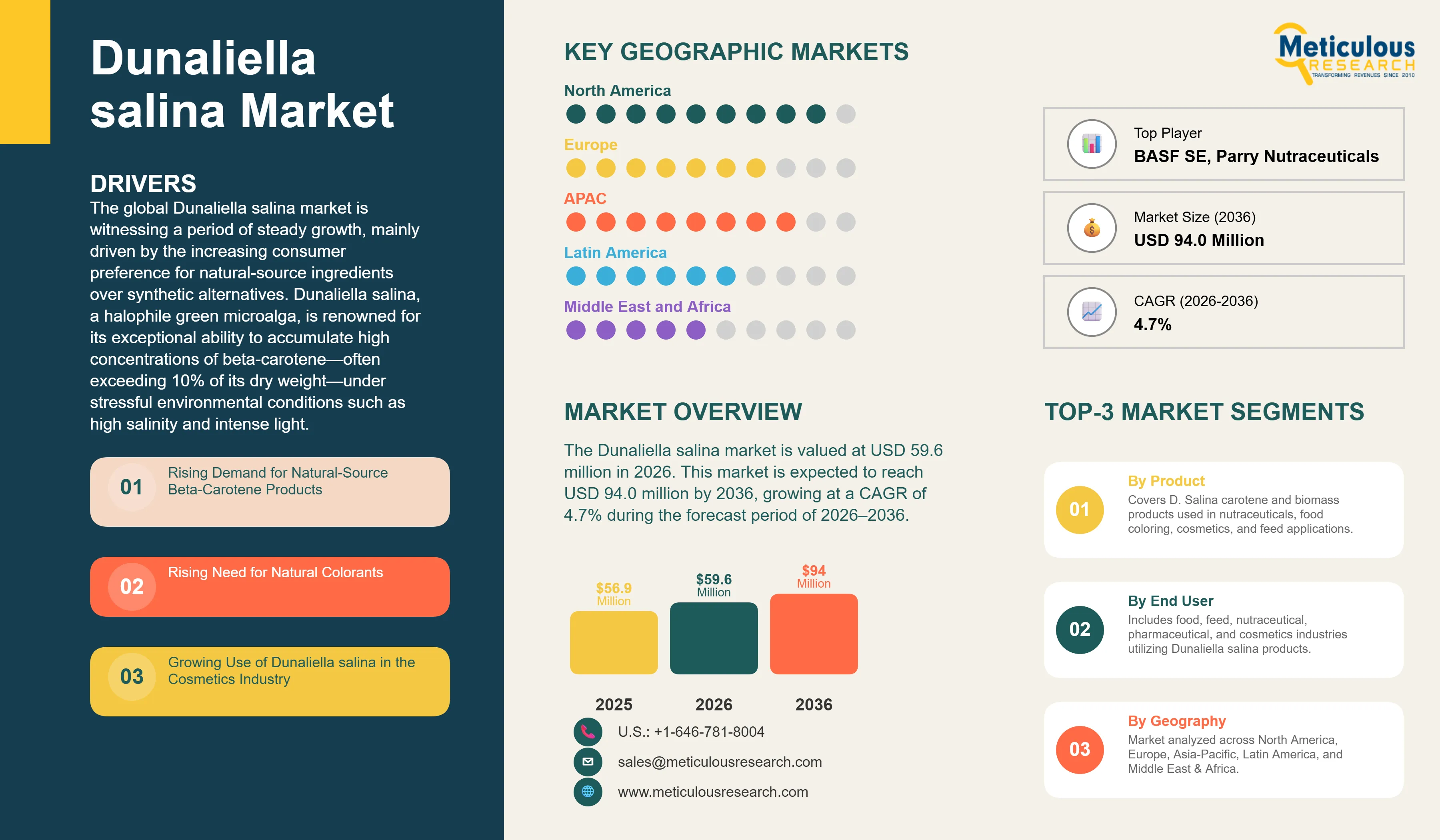
The global Dunaliella salina market is valued at USD 59.6 million in 2026. This market is expected to reach USD 94.0 million by 2036, growing at a CAGR of 4.7% during the forecast period of 2026–2036.
 Click here to: Get Free Sample Pages of this Report
The global Dunaliella salina market is witnessing a period of steady growth, mainly driven by the increasing consumer preference for natural-source ingredients over synthetic alternatives. Dunaliella salina, a halophile green microalga, is renowned for its exceptional ability to accumulate high concentrations of beta-carotene—often exceeding 10% of its dry weight—under stressful environmental conditions such as high salinity and intense light. This unique characteristic makes it the premier biological source for natural beta-carotene, which is widely utilized as a provitamin A supplement, a natural food colorant, and a potent antioxidant in the nutraceutical and cosmetics industries. The growth of this market is further driven by the global clean-label movement, where food and beverage manufacturers are actively replacing synthetic dyes like E160a with algae-derived pigments to meet the demands of health-conscious consumers.
The nutraceutical and dietary supplement sector is the primary consumer of Dunaliella salina products, leveraging its high antioxidant profile to address the growing demand for supplements that support immune health, vision, and skin protection. Beyond its carotene content, the biomass of Dunaliella salina is rich in essential fatty acids, proteins, and glycerol, which are increasingly being explored for applications in specialized animal feed and aquaculture. In the aquaculture industry, the addition of Dunaliella salina to feed is prized for its ability to enhance the pigmentation and nutritional value of fish and crustaceans. Furthermore, the cosmetics industry is emerging as a significant growth avenue, with Dunaliella salina extract being integrated into high-end skincare formulations for its proven ability to protect skin cells from oxidative stress and UV-induced damage.
Cultivation of Dunaliella salina primarily occurs in large-scale open-pond systems, which are strategically located in regions with high solar radiation and available hypersaline water sources. While open-pond systems are cost-effective, they are subject to environmental variability and contamination risks, leading to an increasing interest in closed photobioreactor technologies for producing high-purity extracts for pharmaceutical applications. The market is also characterized by a high degree of geographic concentration, with major production hubs in Australia, Israel, and China. These regions benefit from ideal climatic conditions and established algae biotechnology ecosystems, allowing them to supply the global demand for high-quality Dunaliella-derived products.
Despite the positive outlook, the market faces challenges related to high production costs and competition from other natural beta-carotene sources such as palm oil and carrots. The energy-intensive nature of harvesting and drying microalgae biomass remains a significant factor in the final product pricing. However, continuous advancements in harvesting technologies and the development of multi-product biorefinery models, where glycerol and other valuable co-products are recovered alongside carotene, are expected to improve the economic viability of Dunaliella salina production. As the market moves toward 2036, the integration of sustainable cultivation practices and the expansion into emerging economies in the Asia-Pacific and Latin American regions are expected to be key strategic priorities for leading market players.
The global Dunaliella salina market is valued at USD 59.6 million in 2026. This market is expected to reach USD 94.0 million by 2036, growing at a CAGR of 4.7% during the forecast period of 2026–2036.
The rising demand for natural-source beta-carotene products is the primary driver for the Dunaliella salina market. As health awareness grows, consumers are increasingly avoiding synthetic food additives and seeking natural alternatives with proven health benefits. Dunaliella-derived beta-carotene is highly valued for its purity and high bioavailability compared to synthetic versions. Additionally, the growing need for natural colorants in the food and beverage industry, fueled by regulatory restrictions on synthetic dyes in several European and North American countries, is significantly boosting market demand.
Another key driver is the increasing use of Dunaliella salina in the cosmetics and personal care industry. The alga's high concentration of antioxidants and its ability to protect against UV radiation make it an ideal ingredient for anti-aging and sun-protection products. The shift toward 'blue beauty' and sustainable, marine-derived ingredients is further propelling the adoption of Dunaliella salina extracts by major global cosmetics brands.
The complexities and high costs associated with Dunaliella salina production processes act as a major restraint. Cultivating the alga requires specific environmental conditions, including high salinity and intense solar radiation, which limits production to certain geographic areas. Furthermore, the processes for harvesting, drying, and extracting carotene from microalgae are energy-intensive and require specialized equipment, leading to higher product prices compared to synthetic beta-carotene and other natural sources like carrots.
There is a significant opportunity in the expansion of Dunaliella salina applications into the pharmaceutical and animal feed sectors. Research into the alga's potential for producing biofuels and other high-value co-products like glycerol could also enhance the overall profitability of production. Furthermore, the growing middle-class population in emerging markets such as India and Brazil presents an opportunity for market players to expand their footprint in the nutraceutical and premium personal care segments.
The risk of contamination in open-pond cultivation systems remains a critical challenge. Maintaining the high-salinity environment necessary to favor Dunaliella salina growth over other competing microorganisms is difficult and requires constant monitoring. Additionally, navigating the diverse and evolving regulatory requirements for novel food ingredients and health claims across different international markets can be a complex and time-consuming process for manufacturers.
The dominant trend in the market is the shift toward clean-label and naturally sourced ingredients. According to recent consumer studies, 81% of shoppers consider clean-label products important, while 78% are willing to pay a premium for products marketed as natural or all-natural. Furthermore, nearly half of consumers globally have increased purchases of minimally processed foods, and approximately 30% of new food and beverage launches now feature clean-label claims. These trends strongly support demand for Dunaliella salina-derived beta-carotene, which is positioned as a natural, algae-based alternative to synthetic colorants and antioxidants.
Technological advancements in harvesting and extraction are further enhancing the commercial viability of Dunaliella salina. Manufacturers are increasingly adopting membrane filtration, advanced drying systems, and supercritical CO₂ extraction technologies to improve beta-carotene recovery rates, enhance extract purity, and eliminate solvent residues. The growing adoption of supercritical fluid extraction technologies across the bioactive ingredients industry reflects increasing demand for sustainable, high-efficiency extraction methods capable of producing premium-grade natural carotenoid ingredients for food, nutraceutical, and cosmetic applications.
Based on product, the D. Salina market is segmented into D. Salina Biomass & Powder and D. Salina Carotene. In 2026, the D. Salina Carotene segment is expected to hold the largest share of the market. This dominance is due to the strong demand for natural beta-carotene in the food, beverage, and supplement industries, where it is used as both a nutritional ingredient and a high-value colorant. The high concentration of carotene in Dunaliella salina makes this segment the primary revenue generator for the industry.
The D. Salina Biomass & Powder segment is projected to register the fastest CAGR during the forecast period. This growth is driven by the increasing use of whole-algae biomass in specialized animal feed, aquaculture, and as a natural ingredient in vegan food products that require the full nutritional profile of the alga beyond just its carotene content.
Based on end user, the D. Salina market is segmented into Food & Beverage Companies, Feed & Aquaculture Companies, Nutraceutical & Dietary Supplement Companies, Pharmaceutical Companies, and Cosmetics & Personal Care Companies. In 2026, the Nutraceutical & Dietary Supplement segment is expected to hold the largest share of the market. This is because Dunaliella salina is primarily consumed for its high provitamin A and antioxidant content, which are essential components of modern health supplements aimed at vision and immune support.
The Cosmetics & Personal Care segment is projected to witness the fastest growth during the forecast period. The rising demand for natural and effective anti-aging ingredients in skincare, combined with the alga's proven ability to protect against environmental stressors, is driving its rapid adoption by premium cosmetics manufacturers globally.
North America is expected to hold a significant share of the global Dunaliella salina market in 2026, driven by a mature nutraceutical industry and high consumer awareness regarding the benefits of natural antioxidants. The U.S. is a major market for dietary supplements, with a strong presence of health-conscious consumers and leading supplement brands.
Asia-Pacific is projected to witness the fastest growth during the forecast period. This is driven by the presence of major production hubs in China and Australia, increasing investments in algae biotechnology, and the growing demand for natural food colorants in the region's expanding food and beverage industry. China is both a major producer and consumer of Dunaliella salina biomass. The key companies operating in the Asia-Pacific market are BASF (Betatene), Parry Nutraceuticals, and Hangzhou OuQi Food.
The global Dunaliella salina market is characterized by a mix of large multinational chemical companies and specialized biotechnology firms. The competitive landscape is dominated by a few key players with large-scale production facilities in ideal climatic regions. BASF, through its Betatene operations in Australia, remains a dominant force in the high-purity natural beta-carotene market. Other major players like Parry Nutraceuticals and various Chinese manufacturers are also significant contributors, focusing on both biomass production and refined extracts.
Innovation in cultivation and extraction techniques is a key competitive factor, with companies investing in closed photobioreactors and more sustainable harvesting methods to differentiate their offerings. Strategic partnerships between algae producers and end-user companies in the food and cosmetics sectors are also common, ensuring a stable supply of high-quality ingredients. Key players in the global Dunaliella salina market include BASF SE (Betatene Ltd.), Parry Nutraceuticals, Hangzhou OuQi Food Co., Ltd., Seagrass Tech Private Limited, and Algatechnologies Ltd.
The market is projected to reach USD 94 million by 2036, growing at a CAGR of 4.7% from 2026 to 2036.
D. Salina Carotene is expected to hold the largest share in 2026 due to the high demand for natural beta-carotene.
The rising demand for natural-source beta-carotene and the global clean-label movement are the primary drivers.
The Cosmetics & Personal Care segment is expected to grow the fastest due to the demand for algae-based skincare.
Challenges include high production costs, energy-intensive harvesting, and the risk of contamination in open ponds.
Asia-Pacific is projected to witness the highest CAGR due to major production hubs and increasing regional demand.
It is the richest biological source of beta-carotene, often containing over 10% of its dry weight in carotene.
Yes, it is used in aquaculture feed to enhance the pigmentation and nutritional value of fish and crustaceans.
The cosmetics industry uses Dunaliella extract for its antioxidant and UV-protective properties in anti-aging products.
Leading players include BASF (Betatene), Parry Nutraceuticals, Hangzhou OuQi Food, and Algatechnologies.
1. Market Definition & Scope
1.1. Market Definition
1.2. Market Ecosystem
1.3. Currency Considered
1.4. Key Stakeholders
2. Research Methodology
2.1. Research Approach
2.2. Process of Data Collection and Validation
2.2.1. Secondary Research
2.2.2. Primary Research/Interviews with Key Opinion Leaders from the Industry
2.3. Market Sizing and Forecast
2.3.1. Market Size Estimation Approach
2.3.1.1. Bottom-Up Approach
2.3.1.2. Top-Down Approach
2.3.2. Growth Forecast Approach
2.3.3. Assumptions for the Study
3. Executive Summary
3.1. Overview
3.2. Segmental Analysis
3.2.1. Market Analysis, by Product
3.2.2. Market Analysis, by End User
3.2.3. Market Analysis, by Geography
3.2.4. Competitive Analysis
4. Market Insights
4.1. Overview
4.2. Factors Affecting Market Growth
4.2.1. Drivers
4.2.1.1. Rising Demand for Natural-Source Beta-Carotene Products
4.2.1.2. Rising Need for Natural Colorants
4.2.1.3. Growing Use of Dunaliella salina in the Cosmetics Industry
4.2.2. Restraints
4.2.2.1. Complexities in Dunaliella salina Production Processes
4.2.3. Challenges
4.2.3.1. Risk of Contamination
4.2.4. Trends
4.2.4.1. Increasing Demand for Clean-Label Products
4.3. Porter’s Five Forces Analysis
5. Competitive Landscape
5.1. Overview
5.2. Key Growth Strategies
5.3. Competitive Dashboard
5.3.1. Industry Leaders
5.3.2. Market Differentiators
5.3.3. Vanguards
5.3.4. Emerging Companies
5.4. Vendor Market Positioning
5.5. Market Share/Ranking Analysis of Key Players, 2025
6. Dunaliella salina Market, by Product
6.1. Overview
6.2. D. Salina Biomass & Powder
6.3. D. Salina Carotene
7. Dunaliella salina Market, by End User
7.1. Overview
7.2. Food & Beverage Companies
7.3. Feed & Aquaculture Companies
7.4. Nutraceutical & Dietary Supplement Companies
7.5. Pharmaceutical Companies
7.6. Cosmetics & Personal Care Companies
8. Dunaliella salina Market, by Geography
8.1. Overview
8.2. North America
8.2.1. U.S.
8.2.2. Canada
8.3. Europe
8.3.1. Germany
8.3.2. U.K.
8.3.3. France
8.3.4. Italy
8.3.5. Spain
8.3.6. Netherlands
8.3.7. Denmark
8.3.8. Sweden
8.3.9. Rest of Europe
8.4. Asia-Pacific
8.4.1. China
8.4.2. Japan
8.4.3. India
8.4.4. Australia
8.4.5. Rest of Asia-Pacific
8.5. Latin America
8.5.1. Brazil
8.5.2. Mexico
8.5.3. Argentina
8.5.4. Rest of Latin America
8.6. Middle East & Africa
8.6.1. UAE
8.6.2. Saudi Arabia
8.6.3. Israel
8.6.4. Egypt
8.6.5. South Africa
8.6.6. Rest of Middle East & Africa
9. Company Profiles
(Business Overview, Financial Overview, Product Portfolio, Strategic Developments, and SWOT Analysis)
9.1. BASF / Betatene Ltd. (Australia)
9.2. Parry Nutraceuticals
9.3. Hangzhou OuQi Food Co., Ltd.
9.4. Seagrass Tech Private Limited
9.5. Nutragreenlife Biotechnology Co., Ltd.
9.6. Xi’an Fengzu Biological Technology Co., Ltd.
9.7. Glaukos Algae Technologies Private Limited
9.8. Viride GmbH
9.9. Botanic Healthcare Pvt. Ltd.
9.10. Others
10. Appendix
10.1. Available Customization
10.2. Related Reports



















Published Date: Apr-2023
Published Date: Nov-2025
Published Date: Jan-2025
Published Date: Jan-2025
Published Date: Apr-2023
Subscribe to get the latest industry updates