
Europe Dunaliella Salina Market (2023-2030)
–2030 to reach $27.1 million by 2030.The popularity of Dunaliella salina is rising due to changing lifestyles and the growing natural food trend, which positively impacts the demand for Dunaliella salina.
- Published
- Apr 2023
- Pages
- 72
- Format
- PDF + Excel
- Report ID
- MRFB - 104813
- 2030 · FORECAST
- $27.1M
- 2030
- $27.1M
- CAGR 2023–2030
- —
2022 baseline · 2023–2030 forecast · hover a bar for the value
Report summary
| Particulars | Details |
|---|---|
| Estimated Year | 2023 |
| Forecast Period | 2023–2030 |
| Market Size (2030) | USD 27.1 million |
| Format | PDF, Excel & Cloud Portal · 72 pages |
| Segments Covered | By End User: Extraction Companies, Food & Beverage Companies, Feed Companies, Nutraceutical and Health Supplement Companies, Pharmaceutical Companies, Cosmetic Companies |
| Countries Covered | Europe (Germany, France, U.K, Italy, Spain, Netherlands, Denmark, Sweden, Rest of Europe) |
| Key Companies | Fuqing King Dnarmsa Spirulina Co., Ltd., ALGALIMENTO SL, Hangzhou OuQi Food co., Ltd., BlueBioTech Group, Xi’an Fengzu Biological Technology Co., Ltd. (FZBIOTECH), Monzón Biotech S.L |
Report overview
Segments covered: end user. Regions: Europe.
This report is executed in collaboration with the European Algae Biomass Association (EABA). Combining Meticulous Research®’ market intelligence services with EABA’s broad expertise in the development of research, technology and industrial capacities in the field of algae, the two organizations have leveraged their research capabilities to come up with the most reliable and accurate market assessments in this field.
The Europe Dunaliella salina market is driven by increasing demand for naturally-sourced beta carotene products, rising need for natural colorants, and increased use of Dunaliella salina in the cosmetics industry. However, the complex production process for Dunaliella salina is expected to restrain the growth of this market.
Beta-carotene is a part of the carotenoid family and an antioxidant derived from natural and synthetic sources. It is the main safe dietary source of vitamin A, which is essential for normal growth and development, immune system functioning, and healthy skin, epithelium, and vision.
Naturally-sourced beta-carotene has several advantages over synthetic beta-carotene. Disadvantages of synthetic bet-carotene include its low nutritional value, various side effects, and the incidence of lung cancer and associated mortalities. To overcome these disadvantages, key manufacturers are developing beta-carotene products from natural sources, including algae, fruits, and vegetables. Dunaliella salina is a one of the richest sources of natural β-carotene. It accumulates a high quantity of carotenoids (12.6% of the dry weight of Dunaliella salina), with β-carotene comprising more than 60.4% of total carotenoids. Therefore, the increasing focus on natural-source beta-carotene products is expected to boost the demand for Dunaliella salina, driving the growth of this market during the forecast period.
In Europe, the extensive use of artificial production sources to increase food production has resulted in various health hazards. As consumers become increasingly health-conscious and environmentally aware, there is a growing demand for naturally grown food products. Consequently, manufacturers are now widely using natural colors to enhance the visual appeal of products after processing and meet this demand for natural products.
Natural colors or dyes are primarily derived from sources such as algae, plants, animals, fruits, and insects, making them safe to use as a food additive and free of harmful side effects. The therapeutic applications of natural colors are also growing due to their non-toxic nature and minimal side effects. Many countries' governments support using natural food colors since they are biodegradable and do not cause pollution upon disposal. Moreover, in the EU, the European Commission has banned the use of titanium dioxide (E171) as a food additive since August 7, 2022. Several regulations have been passed to limit the use of synthetic food colors. Hence, European consumers are adopting natural colors and food products with natural ingredients. This trend has opened up opportunities for exporters of natural food colors, especially algae-based natural food colors.
Moreover, government initiatives promoting the use of natural food colors in food & beverage applications, increasing consumer preference for organic and clean-label products, and general health and wellness trends are expected to drive the demand for natural food colors globally. Beta-carotene, extracted from Dunaliella salina, is a popular natural colorant that provides a yellow-orange hue to food and cosmetic products. Its versatility allows it to be used in a wide range of products, including bakery goods, beverages, functional drinks, coatings, compound seasonings, confectionery, flour products, frozen drinks, cheese, dairy products, margarine, jams, cooked meat products, egg products, jelly, and puffed food products.
The European market for natural food colors is growing due to their health, safety, and sustainability benefits. Consumers’ increasing preference for natural ingredients has encouraged the F&B industry to adopt natural alternatives to synthetic ingredients. Major European importers of natural food colors include Germany, the Netherlands, Spain, Italy, France, the U.K. and Denmark. Thus, the rising need for natural colorants is boosting the demand for Dunaliella salina in Europe, driving the growth of this market.
Report infographic
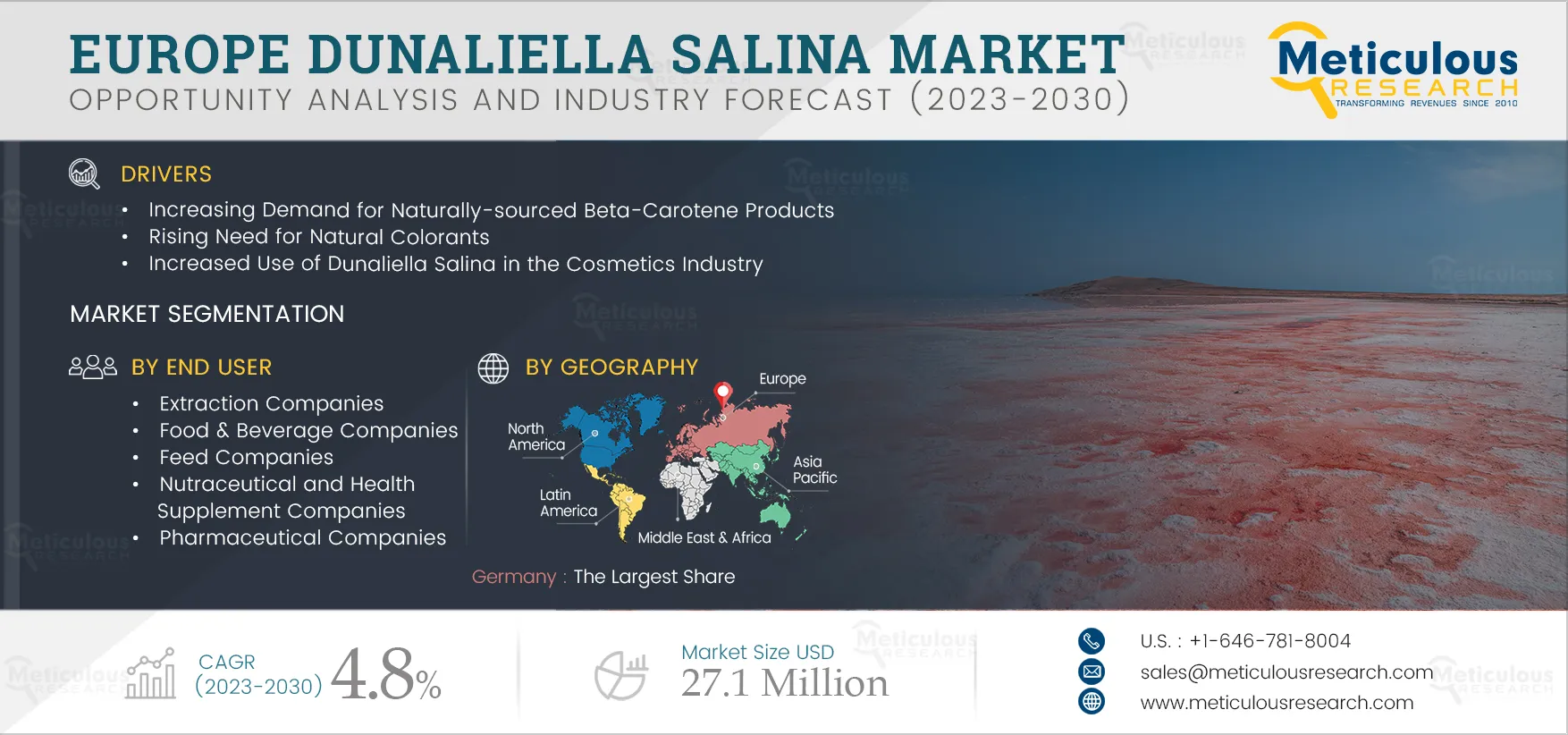
Table of contents
9 chapters · 66 sections · 72 pages · click to expandSegmental analysis
| Segment | Largest share (2023) | Fastest growth (2023–2030) |
|---|---|---|
| By End User | Extraction Companies | — |
By End User
- The extraction companies segment is expected to account for the largest share of the Europe Dunaliella salina market.
- The large market share of this segment is attributed to the growing use of Dunaliella salina by extraction companies due to the rising demand for natural algae-derived hydrocolloids like carotenoids, including beta-carotene, alpha-carotene, zeaxanthin, lutein, and cryptoxanthin from food & beverage, cosmetics, animal feed, dietary supplements, and other industries.
Geographic analysis
Europe
Largest shareThe Europe Dunaliella salina market is segmented into Germany, France, the U.K., Italy, Spain, the Netherlands, Denmark, Sweden, and the Rest of Europe. In 2023, Germany is expected to account for the largest share of the Europe Dunaliela salina market. Germany’s major market share is attributed to the growing food & beverage industry, rising health and wellness trends, growing demand for natural colorants from various end-use industries, and rising government focus on the algae industry in the country. However, the U.K. is slated to register the highest CAGR during the forecast period. The growth of this market is attributed to the growing nutraceutical market and the well-established food and beverage industry. Moreover, in the U.K., microalgae are traditional crops harvested, extracted, and used for food and feed in coastal communities, which boosts the demand for Dunaliella salina in the U.K. Germany: The Leading market in the Europe Dunaliella salina Market
Competitive landscape
- Fuqing King Dnarmsa Spirulina Co., Ltd. · China
- ALGALIMENTO SL · Spain
- Hangzhou OuQi Food co., Ltd. · China
- BlueBioTech Group · Germany
- Xi’an Fengzu Biological Technology Co., Ltd. (FZBIOTECH) · China
- Monzón Biotech S.L · Spain
Frequently asked questions
The Europe Dunaliella salina market is projected to reach $27.1 million by 2030, at a CAGR of 4.8% from 2023 to 2030.
Cite this report
Meticulous Research. (2023). Europe Dunaliella Salina Market - Regional Opportunity Analysis and Industry Forecast (2023-2030) (Report No. MRFB - 104813). Meticulous Market Research Pvt. Ltd. https://www.meticulousresearch.com/product/europe-dunaliella-salina-market-5497