Resources
About Us
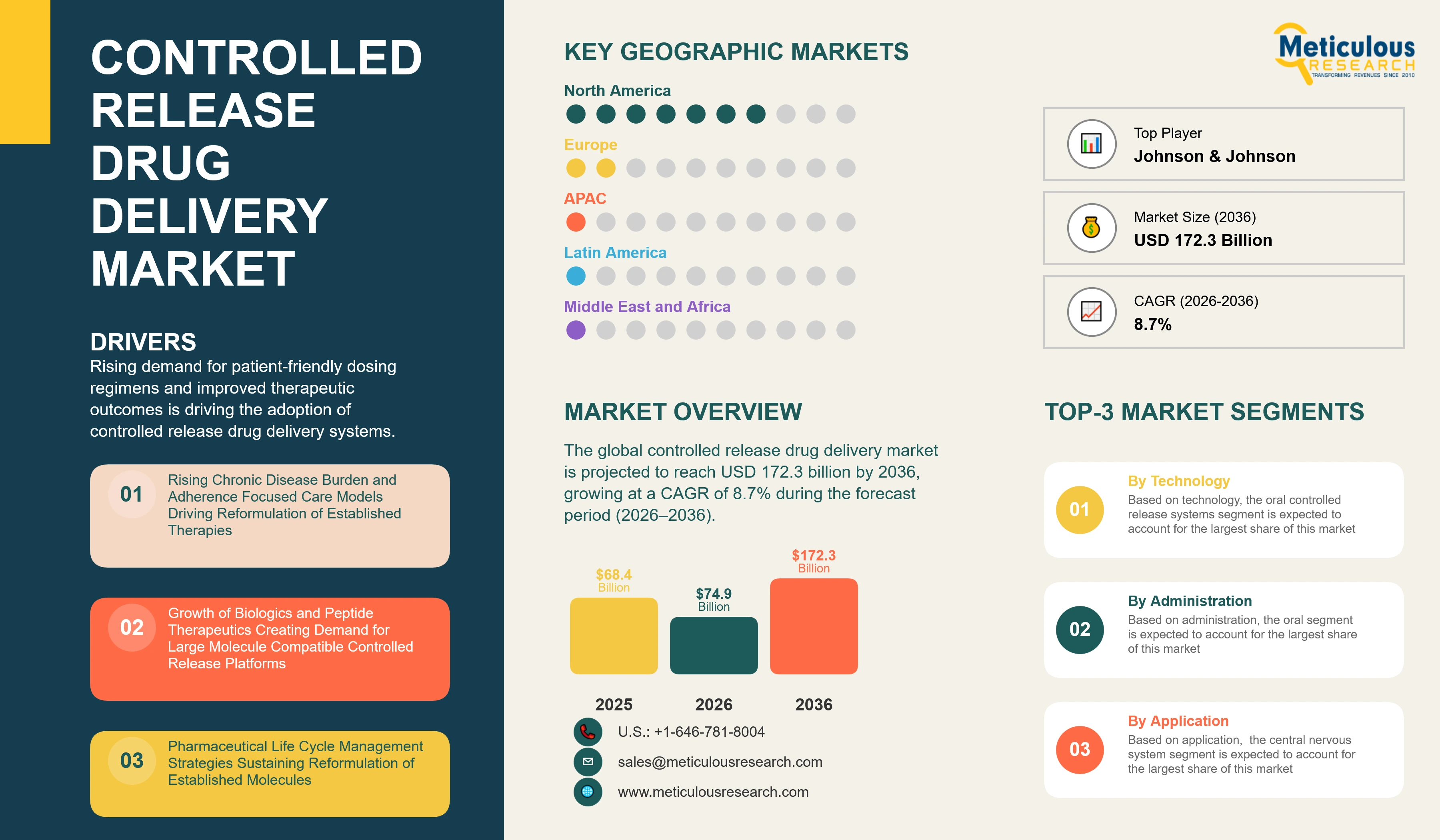
The global controlled release drug delivery market was valued at USD 68.4 billion in 2025. The market is projected to reach USD 172.3 billion by 2036, growing from USD 74.9 billion in 2026 at a CAGR of 8.7% during the forecast period (2026–2036).
Click here to: Get Free Sample Pages
The global controlled release drug delivery market encompasses formulation technologies and delivery platforms designed to regulate the rate, timing, and duration of active pharmaceutical ingredient release, enabling therapeutic drug concentrations to be maintained over extended periods while reducing dosing frequency. The market includes oral matrix and osmotic tablets, multiparticulate pellet and bead systems, transdermal patches, long-acting injectable and implantable depots, in situ forming gels, subcutaneous implants, and ophthalmic inserts across therapeutic areas such as central nervous system disorders, cardiovascular disease, oncology, diabetes and endocrine disorders, pain management, opioid use disorder, infectious disease, and ophthalmology.
Rising chronic disease prevalence is a key market driver because long-term therapies benefit from dosage forms that reduce pill burden and support treatment adherence. According to the Centers for Disease Control and Prevention, 76.4% of U.S. adults, representing more than 194 million people, reported at least one chronic condition in 2023, while prevalence reached 93.0% among adults aged 65 years and older.
Technological and regulatory advances are further expanding controlled release applications. Long-acting injectable and implantable platforms are increasingly used in psychiatry, substance use disorder treatment, and infectious disease prevention. For example, the FDA-approved twice-yearly injectable lenacapavir for HIV pre-exposure prophylaxis demonstrates the potential of extended-duration delivery in infectious disease management. Globally, 40.8 million people were living with HIV in 2024, reinforcing the public health relevance of longer-acting treatment and prevention options.
Despite these opportunities, controlled release products face higher development and manufacturing costs, specialized polymer and formulation requirements, complex regulatory pathways, and additional sterile manufacturing or administration requirements for injectable and implantable systems. Growth opportunities are particularly strong in long-acting depots and platforms capable of delivering biologics and peptides over extended intervals.
Rising Chronic Disease Burden and Adherence Focused Care Models Driving Reformulation of Established Therapies
The growing prevalence of chronic conditions requiring sustained, long term pharmacological management represents the most structurally significant demand driver in the global controlled release drug delivery market. As documented by the Centers for Disease Control and Prevention, more than three quarters of American adults now live with at least one chronic condition, and more than half live with two or more, a burden that increases sharply with age. This population level shift toward multiple concurrent chronic conditions has made medication adherence a central concern for prescribers, payers, and health systems alike, since regimens requiring frequent daily dosing are disproportionately associated with missed doses and treatment discontinuation.
Pharmaceutical companies are responding by systematically reformulating high volume oral therapies for hypertension, diabetes, depression, and attention disorders into once daily or extended interval controlled release presentations that reduce pill burden without compromising therapeutic exposure. In parallel, payers and health systems in the United States and Europe are increasingly evaluating total cost of care rather than unit drug price alone, a shift that favors dosage forms demonstrated to improve adherence and reduce downstream hospitalization associated with uncontrolled chronic disease. This adherence economics argument is reinforcing controlled release reformulation as a standard life cycle management strategy across cardiovascular, central nervous system, and metabolic disease portfolios.
Long Acting Injectable and Implantable Depot Technology Expanding Beyond Psychiatry Into Infectious Disease and Endocrinology
The extension of long acting injectable and implantable depot technology beyond its historical concentration in antipsychotic and hormone therapy into infectious disease, endocrinology, and pain management represents the most significant technology level shift currently reshaping the global controlled release drug delivery market. Depot platforms developed by companies including Alkermes plc, Indivior plc, Camurus AB, Tolmar Inc., and Braeburn Inc. use polymer microsphere, in situ forming gel, and lipid liquid crystal technologies to sustain therapeutic drug levels for periods ranging from one week to six months following a single administration, fundamentally changing the treatment paradigm for conditions where daily adherence has historically been difficult to sustain.
The approval and commercial expansion of long acting injectable antiretroviral and pre exposure prophylaxis regimens for HIV, including options requiring administration as infrequently as twice yearly, illustrates how depot technology originally proven in psychiatry is now addressing public health priorities in infectious disease where dosing convenience directly influences population level prevention outcomes. Similarly, long acting buprenorphine depot injections for opioid use disorder, commercialized under agreements between companies such as Camurus AB and Braeburn Inc., are gaining formulary adoption as clinicians and payers recognize the reduced diversion risk and improved treatment retention associated with monthly rather than daily dosing. This broadening of depot technology into new therapeutic categories is drawing sustained investment from both branded pharmaceutical companies seeking differentiated life cycle extensions and specialized formulation developers licensing platform technology to third party sponsors.
Growth of Biologics and Peptide Therapeutics Creating New Demand for Large Molecule Compatible Controlled Release Platforms
The rapid expansion of biologic and peptide based therapeutics across oncology, metabolic disease, and autoimmune conditions is creating a distinct and fast growing demand segment within the controlled release drug delivery market, since conventional oral matrix and osmotic technologies developed for small molecule actives are not suitable for proteins and peptides that are degraded by gastrointestinal enzymes and require parenteral administration. Formulation developers including DURECT Corporation and Evonik Industries AG, whose Resomer polymer portfolio is widely used in injectable microsphere depot systems, are extending polymer and lipid based encapsulation platforms to protect sensitive biologic and peptide actives while enabling less frequent subcutaneous dosing than the daily or weekly injections such molecules would otherwise require.
Contract development and manufacturing organizations with sterile injectable and microsphere manufacturing capability, including Lonza Group AG, are positioned to benefit from this shift as branded pharmaceutical companies increasingly outsource complex long acting biologic formulation work rather than build internal sterile depot manufacturing capacity. This trend is also encouraging closer collaboration between drug delivery technology licensors and biologics developers earlier in the development cycle, since selecting an appropriate controlled release platform for a large molecule asset has direct implications for clinical trial design, cold chain logistics, and eventual commercial manufacturing strategy.
By Technology: In 2026, the Oral Controlled Release Systems Segment to Dominate the Global Controlled Release Drug Delivery Market
Based on technology, the controlled release drug delivery market is segmented into oral controlled release systems, transdermal systems, long acting injectable and implantable depots, ophthalmic inserts, and other controlled release technologies. In 2026, the oral controlled release systems segment, comprising matrix tablets, osmotic pump systems, and multiparticulate pellet and bead formulations, is expected to account for the largest share of this market. The leading position of this segment is attributed to the established regulatory pathway for oral modified release products, the broad manufacturing infrastructure already in place across the generic and specialty pharmaceutical industry for tablet and capsule production, and the sheer breadth of chronic oral therapies across cardiovascular disease, central nervous system disorders, and pain management for which extended release reformulation offers a meaningful once daily or twice daily dosing advantage over immediate release alternatives. Formulation and coating technology providers including Colorcon Inc. and Adare Pharma Solutions, together with contract manufacturers such as Lonza Group AG, continue to support the segment's scale through established coating, pelletization, and matrix tableting platforms.
However, the long acting injectable and implantable depot segment is projected to register the highest growth during the forecast period. The high growth of this segment is driven by expanding clinical and commercial adoption of monthly and multi month depot formulations in psychiatry, opioid use disorder treatment, and hormone dependent oncology, the extension of depot platforms into infectious disease prevention and treatment, and the favorable adherence and treatment retention profile that injectable depots offer over daily oral regimens in patient populations where consistent dosing has historically been difficult to sustain.
By Route of Administration: In 2026, the Oral Segment to Hold the Largest Share
Based on route of administration, the controlled release drug delivery market is segmented into oral, parenteral, transdermal, ophthalmic, and other routes of administration. In 2026, the oral segment is expected to account for the largest share of this market. The growth of this segment is driven by the continued dominance of oral dosing as the preferred administration route across the majority of chronic disease categories, the lower cost and simpler self administration profile of oral controlled release products relative to injectable and transdermal alternatives, and the extensive existing base of oral molecules across cardiovascular, central nervous system, and metabolic disease therapy areas that remain candidates for extended release reformulation.
However, the parenteral segment is projected to register the highest growth during the forecast period. The high growth of this segment is driven by the expanding pipeline of long acting injectable products in psychiatry, endocrinology, and infectious disease, growing physician and payer acceptance of depot injections as a means of improving treatment adherence in populations with historically poor daily medication compliance, and the parallel growth of biologic and peptide therapeutics that require parenteral administration and are increasingly being formulated into extended release depot presentations to reduce injection frequency.
By Application: In 2026, the Central Nervous System Segment to Hold the Largest Share
Based on application, the controlled release drug delivery market is segmented into central nervous system disorders, cardiovascular disease, oncology, diabetes and endocrine disorders, pain management and opioid use disorder, infectious disease, ophthalmology, and other applications. In 2026, the central nervous system segment is expected to account for the largest share of this market, reflecting the long established use of extended release oral formulations and, increasingly, long acting injectable depots in the management of schizophrenia, bipolar disorder, depression, and attention deficit hyperactivity disorder, conditions in which medication non adherence is common and dosing convenience has a direct bearing on relapse prevention. The scale of central nervous system disease burden, combined with decades of commercial experience among manufacturers including Johnson & Johnson, Alkermes plc, and Indivior plc in developing and marketing long acting antipsychotic depot therapies, continues to anchor this segment's leading position.
However, the oncology segment is projected to register the highest growth during the forecast period. The high growth of this segment is driven by increasing use of long acting hormone therapy depots in prostate and breast cancer management, growing interest in localized and implantable drug delivery systems for tumor site specific treatment, and the broader expansion of oncology drug development pipelines, an area that the U.S. Food and Drug Administration's Center for Drug Evaluation and Research continues to identify as one of the largest categories of new drug approval activity.
Based on geography, the global controlled release drug delivery market is segmented into North America, Europe, Asia Pacific, Latin America, and the Middle East and Africa. In 2026, North America is expected to account for the largest share of the market, supported by its advanced pharmaceutical and drug delivery infrastructure, high adoption of long-acting and extended-release therapies, strong presence of specialty pharmaceutical companies, and substantial chronic disease burden. Grand View Research estimates that North America accounted for 42.4% of the global controlled release drug delivery market in 2025. The U.S. also has a substantial population requiring long-term medication, with the Centers for Disease Control and Prevention reporting that 76.4% of U.S. adults, representing more than 194 million people, had at least one chronic condition in 2023.
Asia Pacific is expected to register the fastest growth during 2026–2036, driven by expanding pharmaceutical manufacturing capacity, rising healthcare expenditure, increasing prevalence of chronic diseases, aging populations, and growing adoption of advanced drug delivery technologies across China, India, Japan, and South Korea. The region's expanding generic pharmaceutical industry is also supporting demand for oral extended-release and other controlled release formulations.
Europe represents a mature and well-established market, supported by advanced pharmaceutical research and manufacturing capabilities, established regulatory systems, and high adoption of innovative drug delivery technologies. Companies such as Camurus have strengthened the region's long-acting drug delivery landscape; its FluidCrystal-based Buvidal received European Commission approval and is commercially available across European markets.
Latin America is supported by increasing chronic disease management needs and expanding pharmaceutical manufacturing, particularly in Brazil and Mexico. The Middle East and Africa is expected to experience steady growth as healthcare infrastructure expands, pharmaceutical access improves, and demand for chronic disease therapies increases across major markets such as Saudi Arabia, the UAE, and South Africa.
The global controlled release drug delivery market is moderately fragmented, with competition driven by proprietary formulation technology, clinical differentiation from immediate release alternatives, regulatory approval track record, and the strength of manufacturing and distribution networks required to support both oral and sterile injectable dosage forms. Key differentiators among leading participants include the breadth of proprietary delivery platforms spanning oral, transdermal, and injectable depot technologies, depth of clinical development experience in securing modified release and long acting injectable approvals from the U.S. Food and Drug Administration and the European Medicines Agency, and the scale of contract development and manufacturing capability available to support third party sponsors seeking to reformulate existing molecules.
Large diversified pharmaceutical companies including Johnson & Johnson, Pfizer Inc., Novartis AG, and Teva Pharmaceutical Industries Ltd. compete through broad portfolios of branded and generic controlled release products spanning multiple therapy areas, supported by extensive global commercial and regulatory infrastructure. Specialized long acting injectable developers including Alkermes plc, Indivior plc, Camurus AB, Tolmar Inc., and Braeburn Inc. compete through proprietary depot technology platforms and deep clinical expertise in psychiatry, opioid use disorder treatment, and hormone therapy. Formulation and delivery technology specialists including DURECT Corporation, Evonik Industries AG, and Ocular Therapeutix Inc. compete by licensing proprietary controlled release platforms to pharmaceutical sponsors, while contract development and manufacturing organizations including Lonza Group AG, Colorcon Inc., Adare Pharma Solutions, and Corium LLC compete through formulation science expertise and manufacturing scale that allow pharmaceutical companies to outsource complex oral and transdermal controlled release production.
The report provides a comprehensive competitive analysis based on an assessment of key players' product portfolios, geographic presence, and strategic initiatives undertaken over the past few years.
Some of the key players operating in the global controlled release drug delivery market include Johnson & Johnson (U.S.), Pfizer Inc. (U.S.), Novartis AG (Switzerland), Teva Pharmaceutical Industries Ltd. (Israel), Alkermes plc (Ireland), Indivior plc (U.K.), Camurus AB (Sweden), Tolmar Inc. (U.S.), Braeburn Inc. (U.S.), DURECT Corporation (U.S.), Evonik Industries AG (Germany), Lonza Group AG (Switzerland), Colorcon Inc. (U.S.), Adare Pharma Solutions (U.S.), Corium LLC (U.S.), and Ocular Therapeutix Inc. (U.S.), among others.
|
Parameters |
Details |
|
Market Size by 2036 |
USD 172.3 Billion |
|
Market Size in 2026 |
USD 74.9 Billion |
|
Market Size in 2025 |
USD 68.4 Billion |
|
Revenue Growth Rate (2026–2036) |
CAGR of 8.7% |
|
Dominating Technology |
Oral Controlled Release Systems |
|
Fastest Growing Technology |
Long Acting Injectable and Implantable Depots |
|
Dominating Route of Administration |
Oral |
|
Fastest Growing Route of Administration |
Parenteral |
|
Dominating Application |
Central Nervous System Disorders |
|
Fastest Growing Application |
Oncology |
|
Dominating Geography |
North America |
|
Fastest Growing Geography |
Asia Pacific |
|
Base Year |
2025 |
|
Forecast Period |
2026 to 2036 |
The global controlled release drug delivery market is expected to reach USD 172.3 billion by 2036 from an estimated USD 74.9 billion in 2026, at a CAGR of 8.7% during the forecast period 2026–2036.
In 2026, the oral controlled release systems segment is expected to hold the largest share of this market, driven by the established regulatory pathway for oral modified release products and the broad base of chronic oral therapies suitable for extended release reformulation.
The long acting injectable and implantable depot segment is expected to register the highest CAGR during the forecast period 2026–2036, driven by expanding adoption in psychiatry, opioid use disorder treatment, and infectious disease, and by the favorable treatment adherence profile of extended interval dosing.
In 2026, the oral segment is expected to hold the largest share of this market, reflecting the continued dominance of oral dosing across the majority of chronic disease treatment categories.
In 2026, the central nervous system segment is expected to hold the largest share of this market, reflecting the long established and expanding use of extended release oral and long acting injectable formulations in psychiatric disease management.
North America is expected to account for the largest share of the global controlled release drug delivery market in 2026, driven by the concentration of long acting injectable and transdermal product approvals, a mature specialty pharmaceutical manufacturing base, and broad payer coverage for extended dosing regimens.
What are the major factors driving the growth of the global controlled release drug delivery market?
The growth of this market is primarily driven by the rising global burden of chronic disease and the resulting focus on medication adherence, the expansion of long acting injectable and implantable depot technology beyond psychiatry into infectious disease and endocrinology, the growth of biologic and peptide therapeutics requiring large molecule compatible controlled release platforms, and sustained pharmaceutical industry investment in life cycle management reformulation of established molecules.
Key players in the global controlled release drug delivery market include Johnson & Johnson (U.S.), Pfizer Inc. (U.S.), Novartis AG (Switzerland), Teva Pharmaceutical Industries Ltd. (Israel), Alkermes plc (Ireland), Indivior plc (U.K.), Camurus AB (Sweden), Tolmar Inc. (U.S.), Braeburn Inc. (U.S.), DURECT Corporation (U.S.), Evonik Industries AG (Germany), Lonza Group AG (Switzerland), Colorcon Inc. (U.S.), Adare Pharma Solutions (U.S.), Corium LLC (U.S.), and Ocular Therapeutix Inc. (U.S.).
Asia Pacific is expected to register the highest growth rate in the global controlled release drug delivery market during the forecast period 2026–2036, driven by expanding generic and specialty pharmaceutical manufacturing capacity, rising chronic disease incidence tied to aging populations, and growing contract development and manufacturing investment across India, China, South Korea, and Japan.
1. Introduction
1.1 Market Definition and Scope
1.2 Market Ecosystem
1.3 Currency and Limitations
1.3.1 Currency
1.3.2 Limitations
1.4 Key Stakeholders
2. Research Methodology
2.1 Research Approach
2.2 Data Collection & Validation Process
2.2.1 Secondary Research
2.2.2 Primary Research & Validation
2.2.2.1 Primary Interviews with Experts
2.2.2.2 Country-/Region-Level Analysis
2.3 Market Estimation
2.3.1 Bottom-Up Approach
2.3.2 Top-Down Approach
2.4 Data Triangulation
2.5 Assumptions for the Study
3. Executive Summary
3.1 Market Overview
3.2 Market Analysis by Technology
3.3 Market Analysis by Route of Administration
3.4 Market Analysis by Application
3.5 Market Analysis by Geography
4. Market Dynamics
4.1 Overview
4.2 Drivers
4.2.1 Rising Chronic Disease Burden and Adherence Focused Care Models Driving Reformulation of Established Therapies
4.2.2 Expansion of Long Acting Injectable and Implantable Depot Technology Beyond Psychiatry Into New Therapeutic Categories
4.2.3 Growth of Biologics and Peptide Therapeutics Creating Demand for Large Molecule Compatible Controlled Release Platforms
4.2.4 Pharmaceutical Life Cycle Management Strategies Sustaining Reformulation of Established Molecules
4.3 Restraints
4.3.1 High Development and Manufacturing Costs Associated With Long Acting Injectable and Implantable Depot Platforms
4.3.2 Regulatory and Bioequivalence Complexity Extending Development Timelines for Modified Release Products
4.4 Opportunities
4.4.1 Growing Licensing and Contract Manufacturing Demand for Long Acting Injectable Platform Technology
4.4.2 Expansion of Controlled Release Applications Into Infectious Disease Prevention and Treatment
4.4.3 Large Molecule Compatible Depot Systems Opening New Demand From Biologic and Peptide Developers
4.5 Challenges
4.5.1 Cold Chain and Site of Care Administration Requirements Complicating Depot Injectable Distribution
4.5.2 Abuse Deterrent Formulation Requirements Adding Complexity to Pain Management Product Development
4.6 Porter's Five Forces Analysis
5. Controlled Release Drug Delivery Market, by Technology
5.1 Overview
5.2 Oral Controlled Release Systems
5.2.1 Matrix Tablets
5.2.2 Osmotic Pump Systems
5.2.3 Multiparticulate Pellet and Bead Systems
5.3 Transdermal Systems
5.3.1 Reservoir Patches
5.3.2 Matrix Patches
5.4 Long Acting Injectable and Implantable Depots
5.4.1 Polymer Microsphere Depots
5.4.2 In Situ Forming Gel Depots
5.4.3 Subcutaneous Implants
5.5 Ophthalmic Inserts
5.6 Other Controlled Release Technologies
6. Controlled Release Drug Delivery Market, by Route of Administration
6.1 Overview
6.2 Oral
6.3 Parenteral
6.4 Transdermal
6.5 Ophthalmic
6.6 Other Routes of Administration
7. Controlled Release Drug Delivery Market, by Application
7.1 Overview
7.2 Central Nervous System Disorders
7.3 Cardiovascular Disease
7.4 Oncology
7.5 Diabetes and Endocrine Disorders
7.6 Pain Management and Opioid Use Disorder
7.7 Infectious Disease
7.8 Ophthalmology
7.9 Other Applications
8. Controlled Release Drug Delivery Market, by Geography
8.1 Overview
8.2 North America
8.2.1 U.S.
8.2.2 Canada
8.3 Europe
8.3.1 Germany
8.3.2 U.K.
8.3.3 France
8.3.4 Italy
8.3.5 Sweden
8.3.6 Spain
8.3.7 Rest of Europe
8.4 Asia Pacific
8.4.1 China
8.4.2 Japan
8.4.3 India
8.4.4 South Korea
8.4.5 Australia
8.4.6 Rest of Asia Pacific
8.5 Latin America
8.5.1 Brazil
8.5.2 Mexico
8.5.3 Rest of Latin America
8.6 Middle East and Africa
8.6.1 Saudi Arabia
8.6.2 UAE
8.6.3 South Africa
8.6.4 Rest of Middle East and Africa
9. Competitive Landscape
9.1 Overview
9.2 Key Growth Strategies
9.3 Competitive Benchmarking
9.4 Competitive Dashboard
9.4.1 Industry Leaders
9.4.2 Market Differentiators
9.4.3 Vanguards
9.4.4 Emerging Companies
9.5 Market Share/Ranking Analysis (2025)
10. Company Profiles
10.1 Johnson & Johnson
10.2 Pfizer Inc.
10.3 Merck & Co., Inc.
10.4 AbbVie Inc.
10.5 Novartis AG
10.6 Bayer AG
10.7 AstraZeneca plc
10.8 Teva Pharmaceutical Industries Ltd.
10.9 Alkermes plc
10.10 Amneal Pharmaceuticals, Inc.
10.11 Camurus AB
10.12 Indivior plc
10.13 Evonik Industries AG
10.14 Colorcon Inc.
10.15 Adare Pharma Solutions
10.16 Ocular Therapeutix, Inc.
11. Appendix
11.1 Questionnaire
11.2 Related Reports






















Published Date: Jun-2026
Published Date: Jun-2026
Published Date: Feb-2026
Published Date: Jan-2025
Subscribe to get the latest industry updates