Resources
About Us
AI-Generated Fashion Market Size, Share, Growth 2025-2035 | Generative AI in Fashion Design, Virtual Clothing, Digital Fashion Technology - Market Analysis & Forecast
Report ID: MRICT - 1041571 Pages: 220 Aug-2025 Formats*: PDF Category: Information and Communications Technology Delivery: 24 to 72 Hours Download Free Sample Report
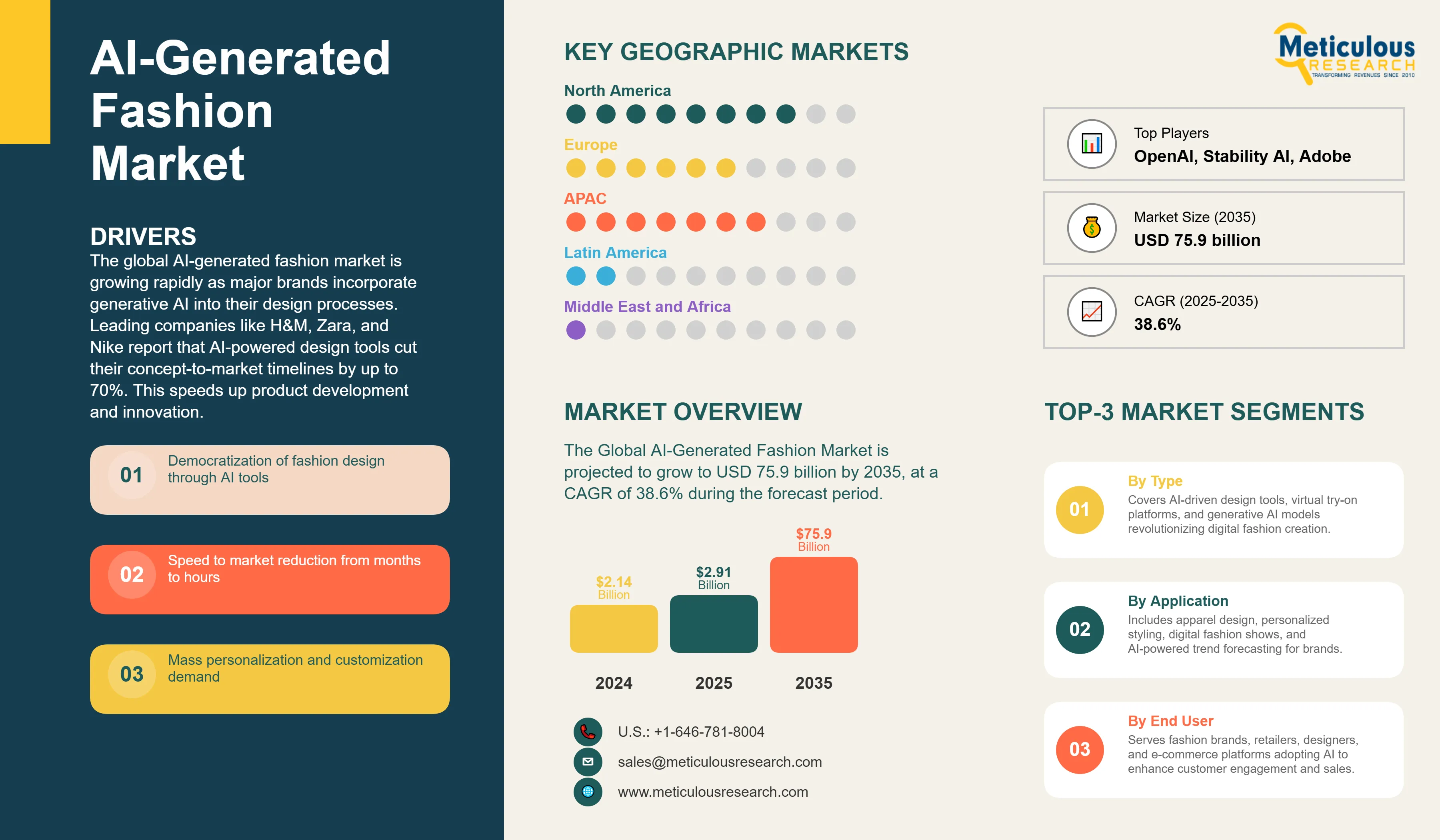
The Global AI-Generated Fashion Market was valued at USD 2.14 billion in 2024. The market is estimated to reach USD 2.91 billion in 2025 and is projected to grow to USD 75.9 billion by 2035, at a CAGR of 38.6% during the forecast period.
Global AI-Generated Fashion Market 2025 - Key Industry Statistics
|
Metric |
Value |
|
Market Value (2025) |
USD 2.91 billion |
|
Market Value (2035) |
USD 75.9 billion |
|
CAGR (2025-2035) |
38.6% |
|
AI Design Tools Users (2025) |
2.5 million+ |
|
Projected Users (2035) |
25 million+ |
|
Largest Technology Segment |
Generative AI Models (45-50% share) |
|
Fastest Growing Application |
Virtual Fashion/Metaverse (25-30% CAGR) |
|
Leading End-User |
Fashion Brands & Designers (55-60% share) |
|
Top Region by Market Size |
North America (35-40% share) |
|
Fastest Growth Region |
Asia-Pacific (25-30% CAGR) |
|
Design Time Reduction |
70-90% (weeks to hours) |
|
Cost Savings |
40-60% in prototyping |
|
Personalization Accuracy |
85-95% match rate |
AI-Generated Fashion Market Overview
Click here to: Get Free Sample Pages of this Report
Why is the Global AI-Generated Fashion Market Experiencing Explosive Growth?
Global AI-Generated Fashion Market Size, Growth Projections and Technology Adoption 2025-2035
|
Metric |
Value |
|
Global AI Fashion Design Market Value (2025) |
USD 2.91 billion |
|
Generative AI Fashion Market Forecast (2035) |
USD 75.9 billion |
|
Digital Fashion Technology CAGR (2025-2035) |
38.6% |
Market Segmentation - Global AI-Powered Fashion Design and Generation
The global AI-generated fashion market is mainly segmented by technology type, application area, deployment model, end-user category, fashion segment, and geographic region. Technologies include Generative AI Models (Diffusion, GANs, Transformers), Computer Vision, NLP, and 3D Simulation. Applications span design generation, product development, marketing, retail, and trend forecasting. Deployment options include Cloud SaaS, On-Premise, and API Services. End-users range from luxury brands to individual creators.
Generative AI Models Dominate Market with 45-50% Share in 2025
Generative AI models hold around 45-50% of the overall AI-generated fashion market in 2025. They support important creative tasks by quickly turning ideas into detailed designs. For instance, fashion-specific Stable Diffusion models create over 1 million designs every day, covering everything from haute couture to streetwear. Specialized models like Fashion Diffusion reach around 95% manufacturing feasibility, while general-purpose models achieve about 60%.
Fashion Brands and Designers Drive 50-60% of Market Demand
Fashion brands and designers make up about 50-60% of the overall AI-generated fashion market demand in 2025. They are increasingly using AI in both creative and operational processes.
Fast fashion leaders like Shein and Zara use AI to spot micro-trends and quickly create new designs. They introduce more than 6,000 new SKUs every week. Their sell-through rates can reach as high as 85%, much above the usual 60% industry average. AI-driven A/B testing on social media can predict the best styles with up to 90% accuracy. This helps brands cut inventory risks by over $500 million each year and reduces trend response times from 3-6 months to just 3-5 days.
Independent designers use advanced AI tools through platforms like CALA, which connects over 15,000 designers to global supply chains. These designers create more than $150 million in annual gross merchandise value (GMV), with AI handling technical specifications, grading, and matching manufacturers. These tasks typically required dedicated teams. Success stories include Pronounced Design, a startup that reached $10 million in revenue by solely using AI-generated fashion collections.
North America Leads Global Adoption of AI Generated Fashion with 35-40% Share of the Global Market in 2025.
This dominance is driven by technological skills, venture capital investments, and a culture focused on innovation. Silicon Valley is a hub for fashion technology, home to over 500 startups, including unicorns like Stitch Fix, valued at about $3 billion, and The RealReal, both leveraging AI for personalization and authentication.
Top tech companies in the U.S. are actively working on AI fashion infrastructure. Google is advancing Fashion AI, Meta is developing Fashion++, and Apple is integrating style transfer algorithms into billions of devices. Microsoft is teaming up with H&M Group to explore AI-driven factory-to-consumer connections, while NVIDIA’s GPU updates improve complex garment simulations.
North America’s regulatory landscape supports quick experimentation with digital fashion, NFTs, and AI content, which contrasts with Europe’s strict GDPR rules. Each year, about $1.5 billion in venture capital funds fashion AI startups primarily located in New York and San Francisco. Successful exits like Apple’s purchase of Fashwell and Sotheby’s acquisition of Thread Genius show strong investor confidence in the potential of this sector.
Key Market Drivers, Challenges, and Technological Innovations in AI-generated Fashion Market
The global AI-generated fashion market is primarily driven by the democratization of design, personalization demands, sustainability requirements, and digital transformation.
Impact of Key Growth Drivers and Restraints on AI-Generated Fashion Market
Base CAGR: 38.6%
AI Fashion Market Drivers
|
Driver |
CAGR Impact |
Key Factors |
|
Design Democratization |
+5.8% |
|
|
Mass Personalization |
+5.2% |
|
|
Speed to Market |
+4.5% |
|
|
Sustainability Goals |
+3.9% |
|
AI Fashion Technology Market Restraints
|
Restraint |
CAGR Impact |
Mitigation Strategies |
|
IP/Copyright Issues |
-2.3% |
|
|
Quality Concerns |
-1.8% |
|
|
Industry Resistance |
-1.4% |
|
Technological Breakthroughs and Platform Evolution Transform Fashion Creation
Competitive Landscape – AI Fashion Technology Providers and Platforms
Recent Developments in Global AI-Generated Fashion Market 2024-2025
|
Report Element |
Details |
|
Market Size (2025) |
USD 2.91 Billion |
|
Technology Types |
Generative AI, Computer Vision, NLP, 3D Simulation |
|
Key Applications |
Design Generation, Virtual Fashion, Personalization, Marketing |
|
Deployment Models |
Cloud SaaS, On-Premise, API Services |
|
End-Users |
Brands, Designers, E-commerce, Creators, Consumers |
|
Fashion Categories |
Apparel, Footwear, Accessories, Digital/Virtual, NFTs |
|
Geographic Coverage |
North America, Europe, Asia-Pacific, LATAM, MEA |
|
Leading Companies |
OpenAI, Stability AI, Adobe, Midjourney, The Fabricant |
|
Analysis Components |
Technology evolution, IP considerations, sustainability impact, Porter’s Five Forces Analysis, competitive landscape and benchmarking, company profiles, market drivers and trends, key strategic developments |
The global AI-generated fashion market is valued at USD 2.91 billion in 2025, with 2.5+ million active users across design, retail, and creative applications.
The AI-generated fashion market is projected to reach USD 75.9 billion by 2035, supporting 25+ million users from professional designers to individual creators.
The global AI-generated fashion market is expected to grow at 38.6% CAGR between 2025 and 2035, driven by democratization of design and mass personalization.
Generative AI models command 45-50% market share, providing core creative capabilities for design generation, pattern creation, and style transfer.
Fashion brands and designers represent 55-60% of demand, using AI for design acceleration, trend prediction, and personalization at scale while maintaining creative control.
























Published Date: Apr-2026
Published Date: Sep-2025
Published Date: Aug-2025
Published Date: Oct-2024
Published Date: Jul-2024
Please enter your corporate email id here to view sample report.
Subscribe to get the latest industry updates


